






Automi AI
Automi AI: an intelligent tool focused on AI programming.
Tags:AI programming toolsWhat is Automi AI?
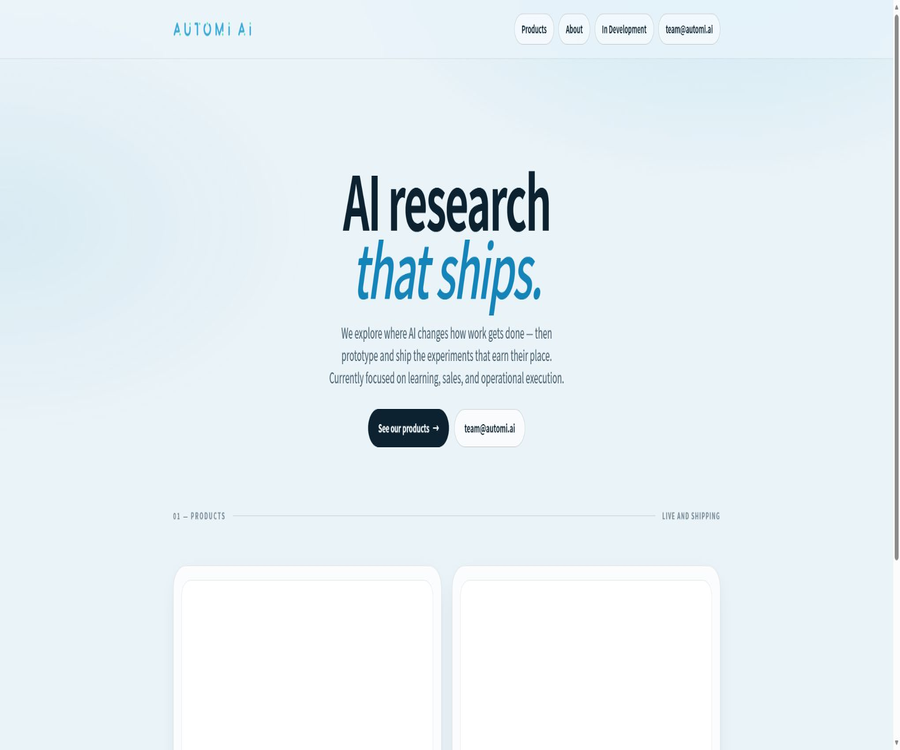
Automi AI is currently a product research laboratory focused on AI applications, rather than being a single low-code AI generation tool. The team explores how AI can transform tasks in learning, sales, and operations, and then develops the proven experimental solutions into standalone products.
The official website lists four products that have been released to date: TutorLM, Holostaff AI, playboox, and machinevision.cloud. Each of these products has its own website, user base, billing system, and rules for data processing, so it is necessary to evaluate them separately.
Automi AI’s current product portfolio
| Products | Positioning | Primary users | Current business entry point |
|---|---|---|---|
| TutorLM | Real-time voice AI tutor and structured AI courses | AI learners, students, and professionals | Free sessions and paid subscriptions |
| Holostaff AI | AI-driven customer success employees integrated into SaaS products | Products, Growth, and Customer Success Teams | Start for free, pay after going live |
| playboox | The recruitment processes carried out in Claude and ChatGPT | Recruitment team, candidates, and hiring managers | Charged based on complete applications and successful hires |
| machinevision.cloud | Machine vision reasoning API for defining tasks in natural language | Developers, on-site operations teams, and visual monitoring teams | The official website does not disclose a fixed price. |
Why is it necessary to distinguish between older versions of the information?
In the past, Automi AI was presented as a low-code generative AI tool, as well as a platform for dialogue avatars and model applications; there are still many old descriptions of it available online. The current official website has been transformed into a product research laboratory, and the content of its catalog should no longer describe those historical functions as part of a unified platform that can be purchased today.
| Old description | Current status | Directory formatting |
|---|---|---|
| Low-code generative AI platform | The current homepage does not provide an entry point to the unified builder. | As a historical direction, it is not included among the current core functions. |
| Conversational AI avatar | The current homepage is no longer presented as a standalone product. | Do not equate it simply with Holostaff AI. |
| Open model market | The current homepage does not display the unified model marketplace. | It is still possible to directly select a model for deployment without making any declarations. |
| Single Automi subscription | The four products are operated and billed separately. | Specify the prices and terms for each product separately. |
Product research and incubation methods
- Choose markets with clear existing needs in areas such as learning, recruitment, customer success, and on-site visualization.
- Research which processes can be redesigned with the involvement of AI, rather than merely adding a chat interface.
- Create prototypes quickly and verify their practical value in real-world applications.
- Develop the experiments that show stable performance and for which users are willing to pay into standalone products.
- Create dedicated interfaces, infrastructure, pricing, and operational processes for the product.
- Continue to study fundamental capabilities such as the agent market and long-term reasoning loops.
TutorLM: Real-time voice AI tutor
TutorLM imparts knowledge of artificial intelligence through real-time voice conversations. The tutor draws formulas, tables, animations, and diagrams while explaining, pauses to ask questions, schedules quizzes, and adjusts the pace according to the learner’s performance.
- Voice priority: Learners can ask questions at any time during the explanation.
- Synchronized canvas: Create formulas, charts, and animations as the narrative progresses.
- Browser exercises: Provide interactive Python exercises that can be run directly.
- Comprehension check: Assess the level of understanding through quizzes, reverse explanation, and follow-up questions.
- Structured pathway: Covers AI topics step by step, through courses and learning tracks.
- Final assessment: The learning track concludes with a comprehensive oral project.
TutorLM course directions
| Study tracks or courses | Status or content | Suitable for beginners |
|---|---|---|
| AI Foundations | It is now available, covering neural networks, evaluation, embedding, and retrieval. | Learners who wish to establish a systematic foundation |
| AI Engineering | The official website lists it as a structured orbit. | Those who are preparing to develop AI systems |
| AI Applications | The official website lists it as a structured orbit. | Those who are interested in actual products and applications |
| AI Safety & Society | The official website lists it as a structured orbit. | Those who are concerned about safety, governance, and social impact |
| Transformer and LLM courses | Covers attention, architecture, generation, fine-tuning, and evaluation | Those who already have a foundation and wish to delve deeper |
How to use TutorLM for learning
- Choose courses that match your existing foundation in mathematics, programming, and machine learning.
- Prepare your headphones and a stable internet connection, and start the voice course in a quiet environment.
- If you don’t understand, interrupt immediately and ask for a different example or a different way of derivation.
- View formulas, diagrams, and code on the synchronized canvas, and carry out practical exercises.
- Rephrase the concepts in your own words so that the instructor can identify any gaps in understanding.
- Complete the phase test and note down the mistakes, then arrange targeted review.
- Complete the knowledge structure and practical tasks independently before taking the final oral exam.
Holostaff AI: Customer Success employees within the product
Holostaff AI integrates AI-powered customer success specialists into SaaS products; it monitors the user’s actions on the interface and offers assistance when the user gets stuck. It is different from ordinary chatbots that wait for users to ask questions, as well as from product guides that follow a fixed set of steps.
- Scan the code repository to understand routing, pages, components, and product workflows.
- Map the user journey and identify the points that may cause delays or customer churn.
- Assign different employees for onboarding, training, technical support, adoption, and expansion.
- Rehearse and evaluate each service action in a simulated user environment.
- Add the execution script and SDK to the product through a code review request.
- Each action is recorded, and playback, undoing, as well as emergency stop for individual employees are available.
- Use a control group to measure changes in activation, retention, expansion, and support.
Holostaff AI deployment process
- Install and run the Holostaff command-line tool in the web application code repository.
- Let the scanning agent read the routes, components, and key user processes.
- Check the generated user journeys and churn risks, rather than allowing the system to determine these aspects on its own.
- Define responsibilities, data permissions, and prohibited actions for each AI employee.
- Use simulated users to repeatedly test normal, abnormal, and sensitive operations.
- Review the automatically generated code changes; once approved, the team merges them and releases them.
- After going live, monitor action logs, user feedback, and control group metrics.
Holostaff AI governance capabilities
- Each AI employee and their responsibilities are explicitly approved by the company.
- Testing and evaluation are carried out through simulated scenarios prior to the official launch.
- Deployment changes must undergo the company’s own code review and merging process.
- All actions can be recorded and replayed, which facilitates the investigation of errors.
- Each AI employee can be disabled individually, thereby reducing the scope of the impact.
- The session context is intended for serving the current user; it should not be used to train employees of other customers.
Playboox: The recruitment process within AI assistants
Playboox has integrated the processes of job application, screening, scheduling interviews, and making hiring decisions into Claude and ChatGPT. Candidates answer the questions posed by employers through their AI assistants, while hiring teams can also use these AI assistants to view summaries and move forward with the hiring process.
- Candidates do not need to create additional accounts or fill out lengthy forms.
- The questions are posed one by one, and the candidates answer them in their own words.
- All applications contain the same structure and evidence, facilitating comparison.
- The system generates a brief summary, strengths, and interview follow-up questions for each candidate.
- Candidates can check their status and select an interview time through the conversation.
- Team members check their tasks in their AI assistants and make decisions.
- Every decision to proceed requires confirmation by a named individual, along with an explanation of the reasons.
How to recruit using PlayBoox
- Combine the steps of application, screening, interview, and hiring in the process designer.
- Define uniform criteria for job assignments, evidence for making judgments, and designated persons responsible for approval.
- Publish a job listing page and provide candidates with an entry point to apply using an AI assistant.
- Candidates complete the application step by step using Claude or ChatGPT.
- Recruiters read the structured summaries and the original responses, relying not only on the AI’s conclusions.
- Named individuals confirm whether to proceed, reject, or ask additional questions.
- Schedule the interview within the conversation and sync the invitation to both parties’ calendars.
The boundaries of responsibility between humans and the PlayBoox system
Playboox uses AI specifically for organizing information, providing suggestions, and managing processes; it does not allow AI to make hiring decisions on its own. Each step must be approved by a designated person, and this approach helps with tracking responsibilities, but it cannot automatically eliminate biases or unfair screening practices.
- AI can generate candidate summaries, but recruiters must read the original documents.
- AI can generate interview questions, but humans need to check their legality and relevance.
- AI can recommend the next step, but it cannot reject candidates without authorization.
- For each decision, the name of the person, the time, and the business reason should be recorded.
- Selection shall not be based on protected characteristics, proxy variables, or inferred personality traits.
- Candidates should be able to understand the status and have access to the necessary channels for human contact.
machinevision.cloud: Machine vision inference API
MachineVision.cloud enables developers to describe visual tasks in natural language; after uploading images, structured JSON results are generated. The Automi website also describes it as a visual monitoring solution capable of processing satellite imagery, images from fixed cameras, and photos taken by people on site.
- Define the visual tasks that need to be recognized, inspected, or extracted in natural language.
- Submit a single image and receive results with structured fields.
- Check for changes in the land, construction site, facilities, or production environment.
- Extract the status of the site from photos taken on the staff members’ phones.
- Write the visual results to alerts, tickets, or operational systems.
- Add manual review and evidence images for key results.
Process for using machine vision APIs
- Identify clearly the objects to be recognized, the states, the exceptions, and the structured output fields.
- Prepare test images that include normal, abnormal, ambiguous, and edge cases.
- Describe the task in simple, natural language and define how to return results when there is uncertainty.
- Call the inference interface to submit an image, and save the request, the results, as well as the model version.
- Domain experts examine the accuracy, false negatives, false positives, and the impact of sensitive attributes.
- Manual review and minimum confidence requirements are established for high-risk assessments.
- Alerts, tickets, and automated processes can be integrated once the business threshold is reached.
Product pricing
Automi AI does not offer a single laboratory subscription plan; each product is billed separately. The public prices for TutorLM and playboox are known at present, while Holostaff AI indicates that it can be used free of charge initially, with payment required once employees start using it on a regular basis. Machinevision.cloud does not disclose any fixed subscription packages.
| Products | Free entry | Public payment methods | Notes |
|---|---|---|---|
| TutorLM | 3 free sessions per month | Paid plan: $15 per month | Different learning paths and session privileges are subject to the product page. |
| Holostaff AI | Start for free, no credit card required | Payment starts once the AI employee goes online; the fixed price is not disclosed. | Companies can schedule demonstrations and verify the units of measurement. |
| playboox | No restrictions on positions or members; the first 10 complete applications are free. | $ | No seat fee or monthly subscription required |
| machinevision.cloud | Not specified | Fixed price not disclosed | It is necessary to request a quote based on the number of images, tasks, and API usage, or to check the console. |
PlayBoox billing method
Playboox uses a billing model based on the outcomes and usage volume, rather than subscription fees for user accounts. Companies can publish unlimited job positions free of charge and invite as many team members as they wish; a fee of 19 dollars is charged only when a candidate completes the entire application process, with an additional fixed fee of 190 dollars applied once the recruitment is completed.
| Billing items | Price | Explanation |
|---|---|---|
| Job posting | $ | No limit on the number of positions |
| Team members | $ | No limit on the number of members |
| Top 10 complete applications | $ | Used to initiate the testing process |
| Complete application | 19 dollars per portion | Applications that are incomplete or not worth reading are provided without charge, as stated in the public guidelines. |
| Successful recruitment | $ | Fixed fees, with no commission based on salary percentage |
Which users are it suitable for
- Those who wish to learn about AI through real-time voice and interactive practice systems.
- The product team hopes to proactively assist every user within the SaaS product.
- Recruitment teams that need to reduce the workload associated with recruitment forms and the initial screening of resumes.
- Small businesses that wish to have both candidates and their teams work using AI assistants.
- Developers who need to understand how images can be integrated into on-site monitoring and operational processes.
- Teams focused on the design of AI-native products and the infrastructure for managing agents.
Common use cases
- AI learning: Learn neural networks, embeddings, retrieval, and Transformers with voice tutors.
- Getting started with SaaS: Proactively guide users through the configuration process and help them complete their first valuable action when they encounter difficulties.
- Product education: AI employees explain features, documentation, and technical issues.
- Application for recruitment: Candidates complete a structured dialogue through the AI assistant to submit their application.
- Recruitment collaboration: The hiring manager reviews the summary, notes the reasons, and schedules interviews.
- On-site inspection: Analyze changes and abnormalities in images from satellites, cameras, or mobile phones.
- Operational automation: Transmitting structured visual results to ticketing and alert systems.
Product advantages
- Focus on markets with genuine needs, rather than merely showcasing general chat capabilities.
- The workflows for all four products have been redesigned, giving them a clearer definition.
- TutorLM combines speech, visualization, exercises, and assessments to create a learning loop.
- Holostaff AI emphasizes simulated rehearsals, code reviews, logging, and emergency shutdown.
- Playboox retains human decision-making with named individuals, to avoid AI making automatic decisions regarding hiring outcomes.
- The machine vision API lowers the barrier to entry by handling tasks in natural language and providing structured results.
Usage restrictions
- Automi AI is not a unified platform that can be purchased as a whole; the four individual products require separate registration and evaluation.
- The older low-code platforms and digital avatar data may no longer be suitable for the current products.
- Holostaff AI and its machine vision API do not have publicly available fixed prices.
- Some products are still in the early stages of the market, and their functions and business models may change rapidly.
- TutorLM cannot replace formal educational certification or a teacher’s support for complex learning difficulties.
- Holostaff AI needs to read the product code and session context, and companies must review the permissions.
- PlayBoox cannot automatically eliminate recruitment biases; human decisions must still be legal and explainable.
- Machine vision results may contain false positives or false negatives, and should not be used directly for high-risk automated decisions.
Data and Privacy Considerations
- Read the privacy policy and terms of service for each product separately, rather than just looking at the Automi homepage.
- TutorLM may handle voice, progress in learning, quizzes, and identity information.
- Holostaff AI may read code, product processes, session context, and user behavior.
- Playboox handles personal data such as resumes, responses, recruitment decisions, and interview arrangements.
- Machine vision images may contain faces, locations, property, and other sensitive information.
- Enterprises should determine the location of the data, its retention period, as well as the methods for training and deleting models.
- Only the minimum data necessary to complete the task is provided, and manual access auditing is implemented.
Methods for evaluating Automi products
- First, select a specific requirement from TutorLM, Holostaff, playboox, or machine vision.
- Visit the product’s website to view the current pricing, terms, and documentation.
- Define quantifiable goals, such as course completion rate or user activation rate.
- Conduct a small-scale pilot using test accounts, anonymous data, or non-production images.
- Check accuracy, manual workload, privacy risks, and overall cost.
- Re-verify the product promotion metrics using one’s own data.
- Deployment is expanded only after the effectiveness and governance meet the required thresholds.
GitHub, APIs, and open-source status
As of this verification, no unified official GitHub organization belonging to the Automi AI laboratory or any open-source core repositories that can be linked to it have been found. machinevision.cloud offers inference APIs, while Holostaff AI provides command-line tools and SDK-based deployment methods; however, the existence of public interfaces does not mean that the core platform is open source.
| Product or project | Development capability | Open-source status |
|---|---|---|
| Automi AI Laboratory | Product research and incubation | No unified official open-source repository was found. |
| TutorLM | Voice and interactive learning on web pages | The core product is not open source. |
| Holostaff AI | Command-line scanning, script, and SDK deployment | The core services are not open source. |
| playboox | The recruitment links in Claude and ChatGPT | The core services are not open source. |
| machinevision.cloud | Natural Language Machine Vision Reasoning API | The API is available, but the core services are not open source. |
Basic information
| Project | Content |
|---|---|
| Name | Automi AI |
| Current type | AI Application Products Research Laboratory |
| Construction begins | The official website states that as of 2022 |
| Current products | TutorLM, Holostaff AI, playboox, machinevision.cloud |
| Key areas of focus | Learning, sales, customer success, recruitment, and operational execution |
| Future research | AI-native two-sided markets and agent-based circular infrastructure |
| Unified price | No, each product is billed separately. |
| Whether API is provided | MachineVision.cloud provides APIs, while other products are integrated in their own way. |
| Is it open source? | The core products have not been confirmed to be open source. |
Recommendation score
The comprehensive recommendation score is 4.0 out of 5 points. Automi AI’s four products are designed with a clear focus on specific workflows; however, these products are not unified tools, and users must access each individual product in order to check its functions, prices, and data-related terms.
Frequently Asked Questions
Is Automi AI a low-code platform now?
The current official website positions itself as a research laboratory for AI application products, and it does not feature a unified low-code builder as its main product.
What are Automi AI’s current products?
Currently, four products are listed: TutorLM, Holostaff AI, playboox, and machinevision.cloud.
Is TutorLM free?
Three sessions can be used for free each month; the paid plans start at $15 per month.
What does Holostaff AI do?
It integrates AI-powered customer success professionals into SaaS products to offer assistance proactively when users encounter difficulties.
Will Playboox decide on hiring automatically?
No, AI is responsible for organizing and providing suggestions; each step in the process requires confirmation by a designated person.
How does PlayBoox charge fees?
Positions and team members are available free of charge; a full application costs $19, and a successful recruitment incurs a fixed fee of $190.
What does machinevision.cloud do?
It accepts natural language visual tasks and images, and returns structured results derived from machine vision reasoning.
Does Automi AI offer a unified subscription?
No unified subscription was found; the four products each have their own accounts, prices, and business models.
Is an API provided?
machinevision.cloud provides APIs explicitly; for the integration of other products, it is necessary to refer to their respective documentation.
Is Automi AI an open-source project?
No, no official and complete open-source repositories for the laboratory or the four core products have been found.
Tools similar to Automi AI



 Guigong Network Security Registration No. 45132202000164