






AI Test Automation Platform for Enterprise
An AI Test Automation Platform for enterprises, an intelligent tool focused on AI programming.
Tags:AI programming toolsWhat is Virtuoso QA?
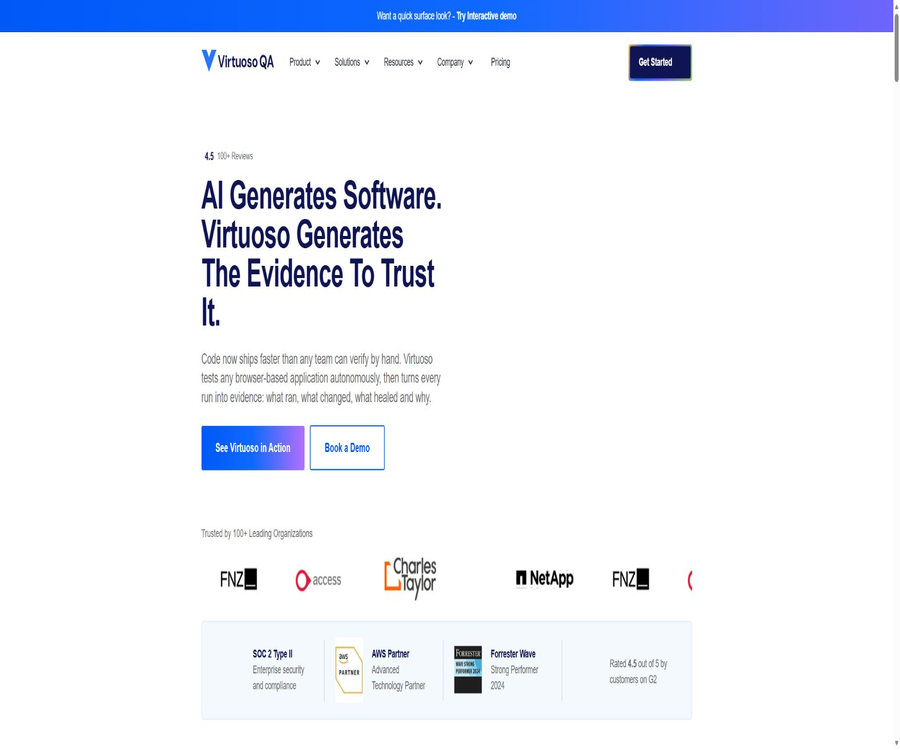
Virtuoso QA is an enterprise-grade, AI-driven test automation platform launched by SpotQA. It enables testers to create executable tests using natural language, and it reduces maintenance costs through intelligent object recognition, self-repair capabilities, parallel execution in the cloud, and comprehensive analysis reports.
A one-sentence summary
Virtuoso QA is suitable for enterprise teams that require large-scale web, API, and end-to-end regression testing; it is particularly appropriate for projects with high maintenance costs, frequent releases, or a need for audit evidence.
Core functions
- Write automated testing steps in natural language.
- Execution and verification are carried out in real time during the writing process.
- AI is used to identify page elements and automatically correct the positioning.
- Include the checks of the UI, APIs, and database within the same process.
- Runs on Chrome, Edge, Firefox, and Safari.
- Accelerate regression testing through parallel execution in the cloud.
- Generate screenshots, videos, logs, and root cause analysis.
- Connects CI/CD, defect management, and test management tools.
Natural language test creation
- Describe user actions using steps that are close to business terminology.
- It reduces the need to write Selenium scripts directly.
- Involve manual testers and business analysts in the automation process.
- It supports actions such as selection, input, clicking, verification, and navigation.
- Complex objects can still make use of selector hints and extensions.
- The clarity of natural language affects the outcome of execution.
Live Authoring – real-time writing
- Steps are executed in the target application immediately upon addition.
- Quickly detect mismatches in object names or data.
- It reduces the need to write the entire script first and then go through repeated debugging processes.
- View the feedback on the progress of each step in real time.
- Slow application responses increase the waiting time for writing.
- Side effects in real-world environments need to be carefully isolated.
Intelligent object recognition
- Locate elements using DOM, selectors, identifiers, and attributes.
- Find the target control based on natural language prompts.
- Reduce reliance on fragile XPath.
- It supports object recognition in dynamic pages.
- Similar buttons and duplicate labels may lead to accidental selections.
- Critical operations should use clear prompts and assertions.
Self-healing test
- After the UI changes, it automatically looks for alternative objects.
- Reduce the maintenance work resulting from changes in the positioners.
- Enable modular components to adapt to regular application upgrades.
- Officials claim that the accuracy of object recognition and self-repair can reach around 95%.
- Self-repair may conceal product changes that should have been reported.
- High-risk processes should have each automatic repair record reviewed.
Generated by AI testing
- Generate scenarios from requirements, user stories, or recording processes.
- Automatically creates test steps and assertions.
- Convert manual testing cases into regression suites.
- Assist in migrating Selenium, Tosca, and TestComplete assets.
- The generated results must still cover the business boundaries and abnormal paths.
- Agentic Test Generation is a paid extension.
Web functional testing
- Covers forms, navigation, search, and transaction processes.
- Supports switching between multiple tabs and frames.
- Handles modern Web structures such as Shadow DOM.
- Use intelligent waiting for dynamic loading.
- Suitable for SaaS, finance, retail, and enterprise applications.
- The authorities are currently focusing on browser-based applications rather than native mobile applications.
API testing
- Call the API throughout the end-to-end journey.
- Verify the response status, fields, and business data.
- Pass the API results to the subsequent UI steps.
- Reduce testing delays when the front end is unavailable.
- The combined UI and service layer are used to identify and locate faults.
- Keys and tokens should be managed using secure variables.
Database validation
- Include database checks in the same journey.
- Verify that the front-end operations are correctly written to the back-end.
- Perform end-to-end verification of key fields and statuses.
- Database accounts should only be granted query permissions.
- Avoid running high-load or unconditional queries.
- Production data testing requires masking and approval.
Visual and cross-browser testing
- Execute the same journey in different modern browsers.
- Differences in layout, style, and rendering were observed.
- Check the user experience by combining functional assertions.
- It supports Chrome, Edge, Firefox, and Safari.
- Fonts, animations, and dynamic content can cause visual noise.
- The browser coverage matrix should be selected based on actual user data.
Cloud and parallel execution
- Consumption automatically scales cloud execution based on demand.
- Capacity offers 5 to 100 parallel execution channels.
- The peak time of publishing can increase temporary parallel capacity.
- Large regression suites can run concurrently.
- Parallel testing requires isolating accounts, data, and the environment.
- Throughput is still affected by the duration of a single journey and the performance of the target system.
Reports and root cause analysis
- Provides real-time dashboards and performance trends.
- Save step-by-step screenshots and evidence of execution.
- Integration of the network, APIs, UI, and log analysis fails.
- Use natural language to help identify the cause of the fault.
- Retain audit and release approval tracking information.
- The root cause suggestions require engineers to confirm them in light of the actual system.
Combinable testing
Composable Test Automation transforms common business processes into reusable modules, allowing teams to build end-to-end workflows in a manner similar to assembling building blocks. The official website lists pre-built assets for Dynamics 365, Salesforce, SAP, Oracle Cloud, and Workday, among others.
- Reuse stable processes such as logging in, customer creation, and order placement.
- Combine the same modules across multiple projects and environments.
- Reduce the repetitive creation of tests for standard enterprise applications.
- Supports multiple instances for Dev, Test, UAT, and Prod.
- Custom applications can create their own asset libraries.
- Module changes require version control and impact analysis.
CI/CD and Integration
- Connect GitHub and GitHub Actions.
- It supports Azure DevOps, Jenkins, and GitLab.
- It can be integrated with defect management systems such as Jira.
- Tests are triggered after submitting, pulling requests, or deploying.
- Access the platform’s capabilities via APIs and Webhooks.
- When access control fails, it is necessary to distinguish between product defects and unstable testing.
Virtuoso QA Usage Guide
Create the first natural language test
- Create a project and configure the target application address.
- Establish Goals and Journeys that represent the business processes.
- Add the operation steps in clear and natural language.
- Execute each step instantly through Live Authoring.
- Add result, text, and status assertions.
- Repeat the execution using independent test data.
- Add to the regression suite after reviewing the evidence.
Create a journey for combining UI and API.
- Determine end-to-end business outcomes and testing boundaries.
- First, create the preliminary data using the API.
- User operations are carried out within the UI.
- Call the API or database to verify the backend status.
- Clean up the test data and restore the environment.
- Save responses and screenshots for failed steps.
- Run in parallel across multiple browsers.
Integrate with CI/CD
- Select key and stable smoke tests.
- Create platform access credentials with the minimum required permissions.
- Configure security variables in the CI tool.
- Set the trigger conditions after submission or deployment.
- Define timeout, retry, and failure thresholds.
- Send the report link back to the build results.
- Regularly analyze unstable tests and address the root causes.
Which users are it suitable for
- Teams of enterprise web applications that release frequently.
- A QA team that handles a large number of regression tests.
- Those who wish to participate in automated manual testing.
- Financial, insurance, and healthcare teams that require audit evidence.
- Organizations that migrate from Selenium or traditional enterprise testing suites.
- Teams that test Dynamics 365, SAP, or Salesforce.
- Engineering teams that need a unified approach for UI, APIs, and databases.
Typical use cases
- Key regression tests are run automatically every time something is released.
- Verify cross-system orders and customer processes.
- Test the upgrade of enterprise cloud application versions.
- Convert manual cases into executable journeys quickly.
- Migrate old Selenium tests to an AI-native platform.
- Validate key user experiences across browsers.
- Save traceable test evidence for compliant release.
It’s not very suitable for which situations
- It primarily tests native iOS or Android apps.
- A personal project that requires only a few simple unit tests.
- Organizations that cannot use cloud-based testing platforms are not accepted.
- The budget is not sufficient to hire a team for custom solutions.
- I hope that manual testing, design, and review can be completely eliminated.
- It is required to host the complete source code of the platform on one’s own.
Billing model
The Virtuoso QA official website offers two subscription models: Consumption and Capacity; in both cases, a request must be submitted to obtain a customized quote. The pricing is based on the number of tests written and executed, rather than on the number of test cases created.
| Model | Suitable for | Users and capacity | Price |
|---|---|---|---|
| Consumption | Teams that have just started using AI for testing or for estimating the amount of work required | From 3 to 100 users can be configured; the level of execution is adjusted according to requirements and automatic scaling is provided. | Custom quote |
| Capacity | Multiple applications, large-scale regressions, and teams with frequent releases | From 5 to an unlimited number of users; 5 to 100 parallel channels | Custom quote |
| Enterprise Upgrade | Organizations that require dedicated architecture, governance, and SLAs | Dedicated CSMs, technical architects, and migration support | Additional customized quote |
How to choose between the two models
| Comparison items | Consumption | Capacity |
|---|---|---|
| Main metrics | Volume of execution or frequency | Fixed parallel execution capacity |
| Expansion method | Automatically scale as needed | Add dedicated parallel channels |
| Applicable scale | Initial and predictable usage levels | Large suites and continuous execution |
| Create users | 3 to 100 | 5 to unlimited |
| Initial support | Templates, manuals, and sample test packages | Dedicated onboarding manager, migration guidance, and workshops |
| Price transparency | Quotation required | Quotation required |
Optional paid extensions
- Agentic Test Generation is priced based on the application and the amount of testing.
- Composable Test Automation is priced based on the scope of applications and the asset library.
- Quick setup and test case creation can serve as enhancements to the service.
- Support for getting started with multiple applications and for migration may incur additional fees.
- Corporate governance, technical architects, and advanced SLAs are part of the upgrade content.
- The purchase quote should clearly define the boundaries between the core platform and the additional extensions.
Free trial and verification
- The official website offers a two-week free trial period.
- Interactive demonstrations that do not require the use of a full environment are also available.
- Companies can apply for Proof of Value verification.
- The trial should cover real applications and key business workflows.
- At the same time, record the writing speed, maintenance time, and execution stability.
- Confirm how the data and testing assets will be handled before the trial period ends.
Contracts and withdrawal
- The standard contract duration is 12 months.
- Multi-year contracts may offer discounts on duration or capacity.
- User count and capacity can be expanded in a pre-structured manner.
- Upon departure, the authorities stated that they could assist with exporting the test assets.
- The export format and the feasibility of migration should be tested prior to procurement.
- The conditions for refunds, early termination, and downgrading are governed by the contract.
How to evaluate total cost
- Count the number of users who are responsible for compiling statistics and those who perform read-only review tasks.
- Estimate the number of executions per day and the peak parallelism.
- Distinguish between smoking, regression, and cross-browser matrices.
- There are additional costs associated with adding Agentic or Composable extensions.
- Calculate the costs associated with data migration, training, and testing for data governance.
- The return is measured by reducing maintenance time and release cycles.
- Avoid comparing different platforms based solely on the number of tests.
Security and Deployment
Virtuoso QA offers SaaS services hosted on AWS, and it provides Secure Bridge for conducting tests within private networks. The company claims to comply with SOC 2 Type II standards, offering support for role-based access, encrypted data processing, audit logs, and secure network configurations.
- Apply for the latest SOC report and its scope of application prior to making a purchase.
- Use SAML SSO to access the enterprise identity system.
- Set minimum permissions for projects, the environment, and users.
- Sensitive internal network applications have their connections evaluated using Secure Bridge.
- Keys and test data use secure variables.
- Regularly review logs, members, and external integrations.
Test data and privacy
- Use synthetic or anonymized test data.
- Do not write the actual password in the natural language steps.
- Assign separate accounts for different parallel tests.
- After execution, clean up orders, users, and other test records.
- Screenshots and videos may capture personal or confidential information.
- Set deadlines for evidence retention and access.
- Regulated projects should review cross-border processing and subcontractors.
AI and self-healing risks
- AI may choose controls that are visually similar but have different meanings.
- Self-repairing may allow erroneous processes to continue executing.
- Automatically generated assertions may not be sufficient to detect business defects.
- Root cause analysis may merely be an inference of correlation.
- High-risk processes require manual review of modification records.
- The performance of the model should be verified over the long term using the team’s own applications.
Automation test boundaries
- Automation is suitable for repetitive processes with clear outcomes.
- Exploratory testing still requires human observation and judgment.
- Availability and emotional experience cannot be verified solely through scripts.
- CAPTCHA and two-factor authentication require specialized testing strategies.
- Dependence on third parties can lead to failures due to reasons unrelated to the product itself.
- A passing test does not mean that the system has no other defects.
Product advantages
- Writing in natural language lowers the barrier to automation.
- Live Authoring offers instant verification.
- Intelligent object recognition and self-repairing reduce maintenance needs.
- UI, API, and database validation can be orchestrated uniformly.
- It supports parallel execution across different browsers and in the cloud.
- Reports, evidence, and root cause analysis are suitable for corporate governance.
- A composable asset library for enterprise applications.
- It supports CI/CD, API, Webhook, and Secure Bridge.
Product restrictions
- The official website does not disclose a fixed price.
- The standard contract duration is 12 months.
- Agentic and Composable capabilities may incur additional fees.
- It primarily covers the Web and APIs, rather than native mobile applications.
- Complex scenarios still require selectors, extensions, and engineering capabilities.
- AI self-repair may conceal actual changes.
- Migrating large legacy suites requires investment.
- Cloud execution and evidence generation give rise to requirements for data governance.
- The platform is not an open-source framework that can be deployed on one’s own.
APIs and extensions
Virtuoso offers platform APIs, Webhooks, and language extension libraries that can be used to trigger actions, integrate tools, and carry out operations that are not covered by natural language. The specific API permissions, rate limits, and scope of extension support depend on the subscription plan and the official documentation.
GitHub and the open-source status
Virtuoso can be integrated with GitHub and GitHub Actions, but this does not mean that the product itself is open source. No complete source code repository for the Virtuoso platform could be found on SpotQA’s official website; therefore, it should be classified as a closed-source enterprise SaaS solution.
Basic information
| Project | Content |
|---|---|
| Tool name | Virtuoso QA |
| Development company | SpotQA Ltd |
| Tool type | AI-native enterprise test automation platform |
| Main tests | Web, API, databases, and end-to-end |
| Billing model | Consumption and Capacity |
| Public price | Not available; custom quote required. |
| Free trial | Two weeks |
| Standard contract | 12 months |
| Deployment | AWS SaaS or Secure Bridge |
| Open-source status | Not open source |
Recommendation score
Recommendation score: 4.6 / 5. Virtuoso QA offers comprehensive capabilities in natural language scripting, self-repair, end-to-end testing, and enterprise governance, making it suitable for large-scale Web regression testing; however, the custom pricing, annual contract requirements, additional costs for expansion, and the lack of support for native mobile testing need to be verified before making a purchase decision.
Frequently Asked Questions
Does Virtuoso QA require writing code?
Basic tests can be created using natural language, while complex objects and special logic may require selectors or extensions.
How much is Virtuoso QA?
The official website does not specify a fixed price; both Consumption and Capacity require quotes to be obtained based on the user and the execution capacity.
Is there a free trial?
Yes, the official website offers a two-week free trial, interactive demonstrations, and an enterprise Proof of Value.
Which browsers are supported?
It supports modern browsers such as Chrome, Edge, Firefox, and Safari.
Is API testing supported?
Yes, it is possible to include API calls, UI operations, and database validations within the same end-to-end workflow.
Is native mobile app support available?
The current focus of the officials is on browser and API testing; native mobile testing is not considered a core capability.
Can it be integrated with CI/CD?
Yes, it supports tools such as GitHub, Azure DevOps, Jenkins, and GitLab.
Will the test be automatically fixed?
It can automatically adapt to changes in common objects, but the records of revisions for critical processes should still be reviewed.
Is it possible to export the test assets?
The official website states that assistance is available for exporting data in various formats upon withdrawal, and the specific degree of compatibility should be verified before signing the contract.
Is Virtuoso QA open source?
It is not open-source; integration with GitHub does not mean that the source code of the platform is available to the public.
Tools similar to the AI Test Automation Platform for Enterprise



 Guigong Network Security Registration No. 45132202000164