






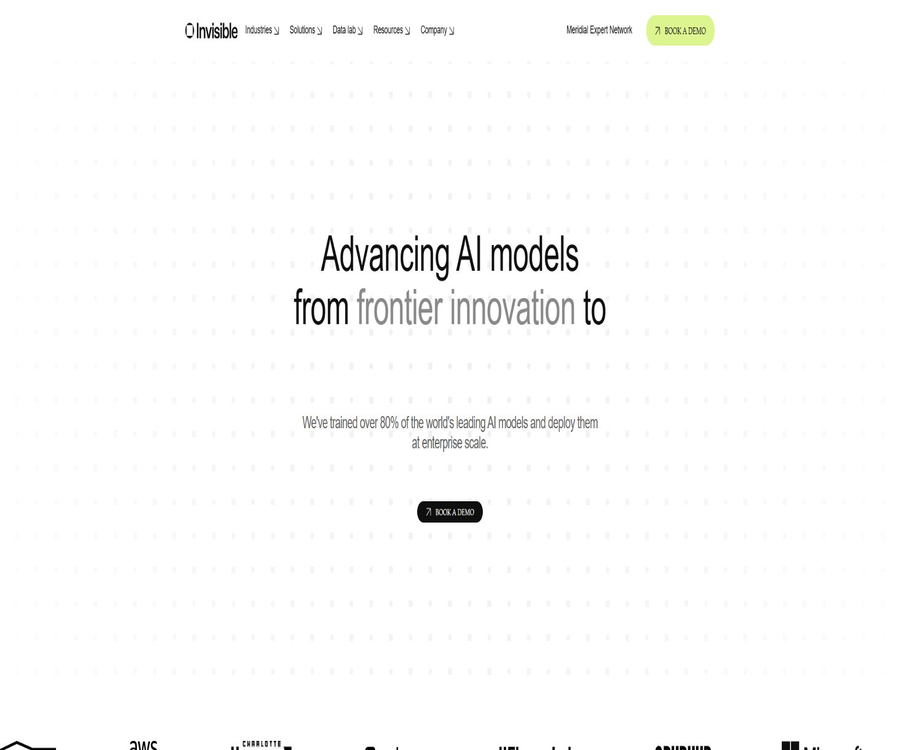
AI Software for Labs and Enterprise
AI Software for Labs and Enterprise – intelligent tools focused on AI programming
Tags:AI programming toolsWhat is Invisible Technologies?
Invisible Technologies is a company that provides enterprise-level AI software and services; its focus is on helping organizations combine fragmented data, manual processes, domain experts, model evaluation techniques, and AI agents to create functional production systems. It is not a general chat tool that can be used immediately after individual users register for it.
A one-sentence summary
Through its modular platform and on-site engineering teams, Invisible transforms an enterprise’s actual workflows into AI applications that are measurable, manageable, and capable of continuous improvement.
What modules does the platform consist of?
| module | Positioning | Main function |
|---|---|---|
| Neuron | Data platform | Connect, clean, transform, and organize structured and unstructured data |
| Atomic | Process Builder | Map business logic and convert manual steps into digital workflows |
| Meridial | Expert network | Involve experts in the field of organization in training, feedback, and validation. |
| Synapse | Evaluation layer | Evaluates model quality, security, and accuracy while supporting continuous improvement |
| Axon | Agent Orchestration | Execute tasks, make decisions, and transfer responsibilities among existing systems |
Neuron data platform
- Access to business systems, databases, data warehouses, and documents.
- Process fragmented data from various sources and formats.
- Convert the data into a format suitable for analysis and use by AI.
- Maintain governance, permission, and quality requirements.
- It provides a unified foundation for subsequent processes, evaluations, and agents.
- Corporate data can remain in the existing systems.
Atomic Process Builder
- Document the actual business steps, rules, and handover of responsibilities.
- Identify the high-frequency, repetitive, or error-prone steps.
- Convert manual tasks into executable processes.
- Connect the old system to the new AI components.
- It supports deploying each workflow individually, rather than replacing the entire system at once.
- Retain the process structure for auditing, optimization, and scale expansion.
Meridial Expert Network
- Find domain experts based on the project’s requirements.
- Provide high-quality annotations and feedback for the model.
- Participate in training tasks such as reinforcement learning with human feedback.
- Verify whether the answers and actions in the professional field are correct.
- It supports human intervention and upgraded processing for complex tasks.
- Expert quality, permissions, and data access must be governed in accordance with project guidelines.
Synapse model evaluation
- Create test sets based on real-world business scenarios.
- Evaluate accuracy, security, quality, and consistency.
- Compare the performance of different models on the target task.
- Identify the weak points of the model in boundary cases.
- Bring production feedback back into the training and improvement process.
- It provides a basis for verification prior to deployment and monitoring after deployment.
Axon Agent Platform
- Create AI agents that are tailored to the company’s processes.
- Orchestrate tasks and decisions across multiple systems.
- Handle the handover between automated steps and manual review.
- The actions that can be performed are restricted according to business rules.
- Track results, anomalies, and operational metrics.
- Agents still require clear mechanisms for permissions, monitoring, and termination.
AI training data services
- Research-grade data annotation and quality control.
- Model training, fine-tuning, and human feedback data.
- Collection of domain expertise and task design.
- Multiple rounds of review and error analysis.
- Evaluations are conducted on the base models and application models.
- Create data for complex reasoning and agent tasks.
Reinforcement learning environment
- Create an interactive environment for agents that resembles real-world work.
- Define states, actions, rewards, and failure conditions.
- Add domain rules, tools, and data constraints.
- Calibrate the reward signal based on expert feedback.
- Test adversarial behaviors, abnormal paths, and recovery capabilities.
- It is necessary to verify the differences between the environment and the actual system before going live.
Automation of backend processes
- Handles document reading, classification, extraction, and routing.
- Connects financial, human resources, procurement, and operational systems.
- Reduce duplicate data entry and manual verification.
- Assign tasks with anomalies and low confidence to humans.
- The performance is evaluated based on throughput, error rate, and cost per transaction.
- It is not suitable to go live in fully automated mode when the rules are unclear.
Computer vision
- Extract event and behavior data from images and videos.
- Assisting in athletic performance, quality inspection, and safety monitoring.
- Combine domain expert-defined labeling and judgment criteria.
- Tests are conducted on changes in lighting, angle, equipment, and scene.
- Continuously monitor model drift after deployment.
- When dealing with images of people, it is necessary to address privacy and authorization issues.
Contact Center
- Analyze calls, texts, and customer interactions.
- Expand the scope of quality inspections.
- Support for auxiliary classification, summarization, routing, and agent assistance.
- Identify high-frequency issues and process bottlenecks.
- Sensitive complaints and high-risk decisions are kept for manual processing.
- When evaluating, one should not consider only the level of automation; attention must also be paid to the resolution rate and customer satisfaction.
Demand forecasting
- Unify sales, inventory, supply chain, and external signals.
- Compare the predicted values with the actual results.
- Generate forecasts by location, category, and time period.
- Track stockouts, backlogs, and forecasting errors.
- Re-calibrate the model after changes in the business environment.
- The predictive output should be integrated with the procurement and operational decision-making mechanisms.
Applicable industries
- Asset management and private equity firms.
- Banks, insurance, and financial services.
- Consumer goods, retail, and supply chain.
- Energy and industrial operations.
- Healthcare and life sciences.
- Public sector and government agencies.
- Sports teams and event organization.
- An AI laboratory where models need to be trained or evaluated.
Typical use cases
- Convert unstructured operational data into usable data.
- Automated high-capacity backend document processing.
- Build governed enterprise AI agents.
- Train and evaluate base models or industry-specific models.
- Establish comprehensive quality analysis for the contact center.
- Improve the accuracy of inventory and demand forecasting.
- Extract performance data from sports videos.
- Create a reinforcement learning environment along with a feedback loop from experts.
How does Invisible implement projects?
The official approach to implementation involves first selecting a workflow with clear value, after which engineers on the front line connect the system and begin its development. The model is deployed after being validated using enterprise operation data, and it is then expanded through various metrics and feedback mechanisms.
Step 1: Select the workflow
- Select processes that offer high business value and have clear boundaries.
- Record the current time taken, error rate, cost, and throughput.
- Identify the data, personnel, systems, and approvals involved.
- Define the scope of tasks that AI can handle and those that must be handled manually.
- Identify the project leader and the acceptance criteria.
Step 2: Connection and verification
- Use masked data to access necessary systems.
- Maps real processes, rules, and abnormal paths.
- Select a model suitable for the task and create a test set.
- Compare with historical data and existing methods.
- Domain experts review the quality and security aspects.
- Enter production only after fixing the failure mode.
Step 3: Launching and expansion
- It starts with a limited number of users and a limited volume of transactions.
- Monitor throughput, error rate, resource efficiency, and cost per transaction.
- Record manual takeover and reasons for anomalies.
- Regularly update the data, evaluation sets, and business rules.
- Expand to more locations or processes after confirming the effectiveness.
- Retain audit documents, versions, and responsible persons.
Platform integration method
- Connects core business systems with operational databases.
- Connect to data warehouses and unstructured documents.
- Modular components are used to avoid the need to replace the entire technology stack at once.
- Select different models based on the task to reduce reliance on a single model.
- Add data and agent workflows to the old system.
- Specific connectors, interfaces, and deployment structures require evaluation based on the project.
Model selection and vendor lock-in
Invisible states that its platform does not impose any restrictions on the type of model to be used; instead, the appropriate model is chosen based on the business requirements. Companies still need to specify in the contract who will supply the models, how data will be stored, how versions will be upgraded, how migration can be carried out, and what changes will occur in terms of costs.
Price and procurement methods
The Invisible official website does not offer monthly subscription plans or self-service billing options for ordinary users; instead, it relies on scheduled demonstrations, requirement assessments, and corporate contract purchases. The costs are influenced by factors such as the modules used, the volume of data, the scope of delivery, the involvement of experts, usage levels, integration needs, and the duration of the contract.
| Procurement method | Public price | Explanation |
|---|---|---|
| Custom solutions on the official website | Contact sales | Quotation based on workflow, modules, data, and scope of implementation |
| AWS Marketplace 12-month contract | Platform fee: $300,000 | The annual platform fee listed on the public product page |
| Additional amount | Separate calculation | Any usage that exceeds the rights stipulated in the contract is charged according to the agreed rates. |
| Cloud infrastructure | It may be charged separately. | Infrastructure costs such as those related to AWS are not necessarily included in the platform fees. |
| AI training and expert projects | Custom quote | It is related to task complexity, expert requirements, and quality standards. |
How to estimate the total cost
- Distinguish between software platform fees, implementation fees, and ongoing service fees.
- Estimate the workload for data cleaning, annotation, and expert review.
- List the costs of external models, cloud computing, and storage.
- Confirm the billing unit and price for excess usage.
- Take into account the costs of integrating the old system, conducting tests, and performing security reviews.
- Incorporate internal business experts and efforts in change management.
- Measure the returns in terms of time saved, improved quality, or changes in revenue.
Free trial and demonstration
- The official website provides a link for scheduling demonstrations.
- There is no public commitment to a free plan available for all users.
- There are no publicly standardized free trial versions available.
- Before the demonstration, it is necessary to prepare the target process, data types, and success metrics.
- The scope, costs, and data processing methods for the proof of concept need to be determined separately.
Contract and exit clauses
- Clarify the contract duration, renewal methods, and usage rights.
- Confirm the additional usage and costs related to third-party models.
- Define the ownership of the data, annotation results, code, and model outputs.
- Define service levels, failure response times, and support durations.
- Specify the processes for exporting and deleting data after termination.
- Verify whether workflows and integrations can be migrated upon exit.
- Business projects cannot assume the existence of consumer-style unconditional refunds.
Safety and compliance
The Official Trust Center lists frameworks such as SOC 2, HIPAA, GDPR data processors, PCI DSS SAQ A, DoD CMMC, and Cyber Essentials Plus. Information regarding the scope of certification, reporting dates, applicable products, and customer responsibilities must be verified through the Trust Center or the sales team.
- Apply for the latest certification and penetration testing documents before making a purchase.
- Confirm the data storage location, cross-border transmission, and subcontractors.
- Adopt the principle of minimum privileges and access by environment.
- Record the model, prompts, data, and output version.
- Special reviews are conducted on projects in the healthcare, financial, and public sectors.
- Confirm the accident notification, backup, and business continuity arrangements.
Data Privacy and Governance
- Establish data classification and permitted usage scopes.
- Only the fields necessary to complete the task are retained in the training data.
- Anonymize personal information, health data, and confidential data.
- Restrict data access for experts and project members.
- Record the data source, authorization, and retention period.
- The contract specifies whether customer data is used to improve other models.
- After the project is completed, the verification data is returned or deleted.
The value of human participation
- Domain experts can define standards for high quality.
- Human feedback helps identify hidden errors in the model.
- Tasks with low confidence and high risk can be upgraded for processing.
- The involvement of experts helps to create assessments that are more closely aligned with real-world work.
- Human involvement also increases costs, as well as the requirements for managing permissions and consistency.
- The proportion of manually managed connections should be measured and continuously optimized.
Project success indicators
| Indicator category | Reference indicators |
|---|---|
| Efficiency | Processing time, throughput, automation rate |
| Quality | Error rate, accuracy rate, rework rate |
| Cost | Individual cost, labor input, infrastructure expenses |
| Customers | Resolution rate, satisfaction level, repeat contact rate |
| Risk | Abnormality rate, manual intervention rate, compliance incidents |
| Adopt | Active users, process coverage, proportion of manual workarounds |
| Business | Changes in revenue, inventory, losses, or resource efficiency |
Product advantages
- It covers the entire chain of data, processes, experts, evaluations, and agents.
- It allows for the selection of modules on a need-to-base, rather than replacing everything at once.
- Integrate software with on-site engineering delivery.
- It is capable of handling complex legacy systems and unstructured data.
- Emphasis is placed on the verification of historical data and quantifiable metrics.
- Model-agnostic strategies can reduce reliance on a single model.
- Experience in large-scale AI training and collaboration with experts.
- A number of enterprise security and compliance frameworks are listed publicly.
Product restrictions
- It is not a tool that can be registered and used immediately by individuals or small teams on their own.
- The official website does not provide clear details regarding the standard package options.
- The threshold for the annual AWS platform fee is relatively high.
- The effectiveness of implementation depends on the maturity of the company’s data and processes.
- Custom integration requires ongoing involvement from internal staff.
- Expert involvement and rigorous evaluation increase costs and timelines.
- Security certifications do not automatically cover all ways in which customers use a product.
- External models and cloud services can still lead to dependencies.
- The platform itself cannot be deployed from public repositories on its own.
GitHub and the open-source status
Invisible Technologies has a verifiable official GitHub organization that makes available various tools, branch projects, and historical code repositories. The public repositories do not contain the complete source code for the Neuron, Atomic, Meridial, Synapse, and Axon enterprise platforms.
Therefore, the Invisible enterprise platform should be classified as a closed-source commercial service; the existence of public repositories by the official organization does not imply support for the deployment of proprietary source code.
Basic information
| Project | Content |
|---|---|
| Tool name | Invisible Technologies |
| Date of establishment | 2015 |
| Tool type | Enterprise AI platforms and customized delivery services |
| Core module | Neuron, Atomic, Meridial, Synapse, Axon |
| Key customers | Large enterprises, the public sector, and organizations dedicated to AI model development |
| Self-service free version | Not provided |
| Official website price | Contact sales |
| AWS annual platform fee | $ |
| Official GitHub | Yes |
| Open-source platform | No |
Recommendation score
Recommendation score: 4.3 / 5. Invisible is suitable for large organizations that deal with complex data, legacy systems, and high-value workflows, as it offers a complete set of tools for project delivery; however, the costs associated with procurement, customization, and ongoing maintenance are relatively high, so it is not appropriate for individual users looking for inexpensive, self-service tools.
Frequently Asked Questions
Is Invisible Technologies a chatbot?
No, it is a platform along with delivery services that connect corporate data, processes, experts, evaluations, and AI agents.
What are the five core modules?
They are the data platform Neuron, the process builder Atomic, the expert network Meridial, the evaluation layer Synapse, and the agent platform Axon.
How much is Invisible?
The official website uses a sales contact approach; the cost of using the platform for 12 months as listed on AWS Marketplace is $300,000, with additional charges possibly applying for extra usage and infrastructure.
Is there a free version?
No public free self-service version or unified free trial is available; the official website offers scheduled demonstrations.
Which industries are supported?
It covers areas such as finance, insurance, consumer goods, energy, healthcare, life sciences, the public sector, sports, and AI model training.
Can it be connected to old systems?
Yes, the official approach focuses on connecting core systems, operational databases, and data warehouses, rather than requiring the replacement of all systems at once.
Should a specific large model be specified?
Officials state that the platform adopts a model-agnostic approach, selecting models based on business requirements.
Is there any security certification?
The Trust Center lists frameworks such as SOC 2, HIPAA, and GDPR data processors; the specific scope of certification should be verified with the authorities.
Is Invisible open source?
The enterprise platform is not open-source, and the public repositories on GitHub do not represent the complete source code of the platform.
Where is the best place to start?
First, select a workflow that has high value, clear boundaries, and allows for the quantification of the current situation; thereafter, establish data connections, conduct historical verification, and implement it on a small scale.
Tools similar to AI Software for Labs and Enterprise



 Guigong Network Security Registration No. 45132202000164