






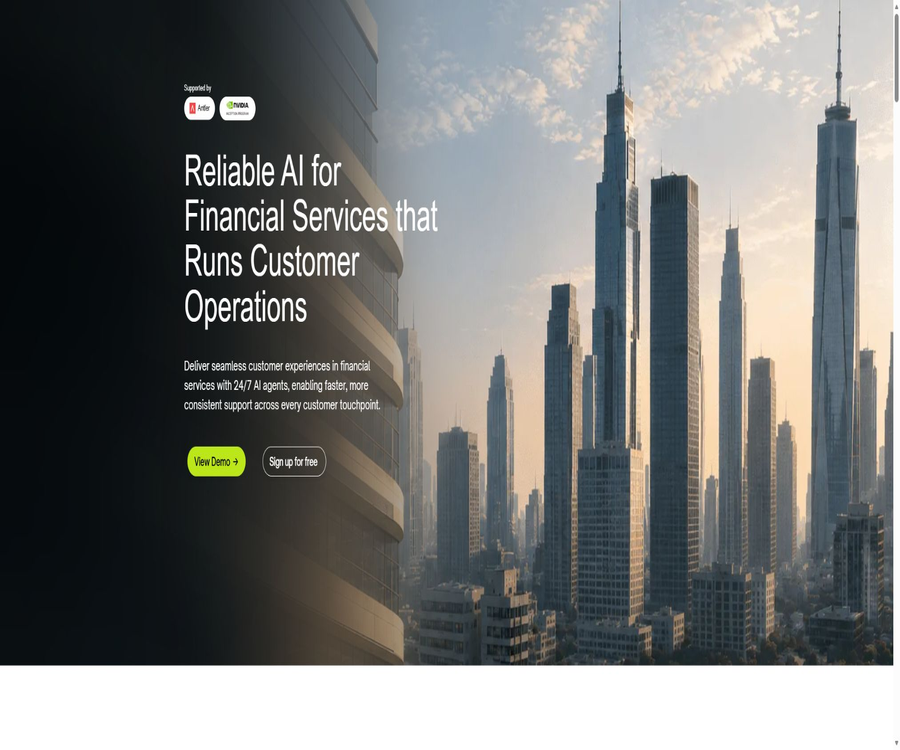
AI for Financial Services
AI for Financial Services: intelligent tools focused on AI programming
Tags:AI programming toolsWhat is BotCircuits?
BotCircuits is an enterprise-grade platform for conversational and agent-based AI, currently focused on serving industries such as banking, lending, insurance, and other sectors with regulated customer operations. Companies can use visual tools to create text or voice agents, and integrate them with internal knowledge bases, business systems, communication channels, as well as various large language models.
The platform emphasizes controlled processes, manual upgrades, operation tracking, and multi-channel deployment – not only for answering common questions. It also introduces the Argus workflow component, which allows businesses that require fixed procedures to have their workflows managed by a deterministic engine, with AI being utilized only at the points where decisions need to be made.
A one-sentence summary
BotCircuits assists financial and corporate teams in creating text and voice-based AI agents that can connect to knowledge bases, business systems, and various channels; it also enhances the reliability of these agents through process control and improved observability.
Core functions
- Visualization of intelligent agents: Defining behaviors and business processes through prompts or drag-and-drop.
- Corporate knowledge base: Upload web pages, PDFs, CSV files, policies, SOPs, and product information.
- Text and voice interaction: Supports chatting, calling, and real-time voice conversations.
- Multi-channel deployment: available via websites, WhatsApp, Instagram, Facebook, text messages, and voice calls.
- Multiple model selection: Connect to OpenAI, Anthropic, Gemini, or enterprise-hosted models.
- Custom model keys: The enterprise has control over the model accounts, usage, and costs.
- System integration: Connects databases, CRM systems, lending systems, and other tools through open APIs.
- Skills and actions: Enable agents to query, update, schedule, or trigger business operations within conversations.
- Dialogue observability: Tracking agent behavior, decision paths, performance, and anomaly patterns.
- Manual upgrade: Hand it over to employees in sensitive, complex, or uncertain situations.
- Argus workflow: Compiles fixed processes into predictable, pauseable, and trackable state machines.
Agent Builder – Intelligent agent constructor
- Create agents using natural language prompts or visual nodes.
- Define roles, tone, allowed response ranges, and prohibited behaviors.
- Bind knowledge bases, models, channels, and external systems.
- Design multi-step workflows and conditional branches.
- Run test conversations before release and address knowledge gaps.
- Create mutually isolated agents for different business functions.
- There is no need to rebuild the same set of business logic for each channel.
Knowledge base and controlled responses
Companies can add policies, SOPs, product information, guides, and frequently asked questions to a knowledge base, ensuring that responses are based on approved materials. This knowledge base helps reduce the risk of the model generating content arbitrarily, but the quality of the materials, their versions, and access rights still require manual management.
- Upload web pages, PDFs, CSV files, and internal business documents.
- Isolate knowledge domains for different customer groups or departments.
- Synchronize knowledge again after updating the policy.
- Restrict the agent to answering only within verifiable data.
- When an unsubstantiated issue is detected, a refusal to respond or manual escalation is triggered.
- Monitor high-frequency miss issues and supplement knowledge.
Voice AI agent
- Handles incoming and outgoing phone calls.
- Understand natural language rather than just providing a fixed set of menu options.
- It supports interruption, real-time response, and context continuity.
- Provides reminders for payment completion, updates on application status, and support for common questions.
- For complex or sensitive issues, connect to a human agent.
- Record the call results and trigger subsequent business actions.
- Before deployment, testing can be conducted regarding accent, noise, latency, and compliant phrasing.
Multiple channels and contextual continuity
The same agent can be deployed on websites, social messaging platforms, mobile devices, text messages, and voice channels. The platform focuses on maintaining context across these different channels, thereby reducing the need for customers to restate their issues when switching communication methods.
| Channels | Tasks that can be processed | Precautions |
|---|---|---|
| Websites and mobile devices | Consulting, guidance, form collection, and account services | Authentication and privacy prompts need to be configured. |
| WhatsApp and social messaging | Progress updates, common issues, and customer follow-up | Subject to channel templates and platform policies. |
| SMS | Reminders, status updates, and brief confirmations | It is necessary to control sensitive information and provide an unsubscribe mechanism. |
| Voice | Call customer service, receive reminders, request support, and be transferred. | It is necessary to verify the regulations regarding recordings, consent, and automated outbound calls. |
| Internal assistant | Queries regarding employee policies, products, and operational procedures | Knowledge and system permissions must be restricted based on roles. |
Integration of the model with external tools
- Models such as OpenAI, Anthropic, and Gemini can be selected.
- It can be connected to large language models hosted by enterprises themselves.
- It supports the use of the company’s own API keys.
- There is no need to rebuild the entire agent logic when switching models.
- Connect to external systems or databases through open APIs.
- Create custom skills to enable agents to perform actions during conversations.
- Model cost, latency, and data paths are determined by the specific choices made.
Argus deterministic workflow
Argus transforms processes described in natural language into deterministic state machines, with the engine – rather than a model – deciding on the next step to take. The AI is responsible only for the actions that need to be understood or generated in the current step, which allows the same input to be processed along the same path more easily.
- Compile fixed steps such as approval, inspection, and routing into processes.
- Generate explicit, repeatable rules for conditional branching.
- Only provide the necessary variables and states for the current step.
- Record each step, the choices made, and the results of the executions.
- It supports pausing and resuming workflows, as well as reusing them across different projects.
- It can be run in host agents such as Claude Code or Hermes.
- It offers both a visual manager and a command-line interface.
Tutorial on creating agents
- First, select a business scenario that has clear boundaries, controllable risks, and quantifiable outcomes.
- Organize the approved products, policies, SOPs, compliance scripts, and upgrade rules.
- Define roles, objectives, prohibited behaviors, and output formats in Agent Builder.
- Upload knowledge materials and set access levels for different user groups.
- Select the model, channel, and external systems that need to be called.
- Establish authentication, manual escalation, abnormal termination, and audit logging.
- Tests are conducted using normal, blurry, malicious, and high-risk questions.
- It is first made available to a small number of users, with continuous monitoring of the hit rate, upgrade rate, and error rate.
- After approval, it can be expanded to more channels and business activities.
Tutorial on building the Argus process
- Install the supported host AI programming agent and Argus components.
- Initialize the runtime environment and workflow directory for the target project.
- Describe the steps, conditions, and required variables using natural language or a visual editor.
- Develop a process to compile readable definitions into deterministic state machines.
- Check each branch, failure path, timeout, and manual approval node.
- Run it repeatedly with fixed inputs to verify that the path matches the output records.
- Add permissions, idempotency, limits, and rollback mechanisms for sensitive actions.
- Monitor the operation logs after deployment, and manage changes to the process versions.
Banking business scenarios
- Explain account, deposit, card, and loan products.
- Check the balance, payment status, or transaction status.
- Guide customers in collecting the documents required for a loan application.
- Initial qualification screening and clue ranking are carried out in accordance with the rules.
- Remind the client to submit the missing documents and arrange follow-up contact.
- Transfer issues related to complaints, fraud, or significant losses to a human agent.
- Provides customer service staff with a knowledge assistant for products and processes.
Loan and mortgage scenarios
- Receive loan inquiries and gather preliminary requirements.
- Explain to the borrower the current application stage and the next steps.
- Proceed with the KYC or KYB data collection process.
- Notifies about missing files and authentication status.
- Provides payment reminders and notifications in case of early overdue payments.
- Filter high-priority leads for mortgage brokers.
- Submit matters that require credit assessment to employees with the appropriate authority.
Insurance business scenarios
- Answer questions regarding the policy coverage, claims process, and common issues.
- Collect preliminary information and documents related to claims.
- Provides updates on the status of claims and any missing documents.
- It automatically handles simple service requests, thereby reducing the workload on call centers.
- Forward to a human agent based on risk and sentiment signals.
- Ensure that the messaging and product information are consistent across different channels.
Which users are it suitable for
- Banks, credit cooperatives, and digital financial service providers.
- Consumer loans, business loans, and non-bank lending institutions.
- Mortgage brokers and loan service team.
- Insurance companies, brokerage firms, and claims handling teams.
- Customer operations departments that require text and voice automation.
- Companies that prefer self-hosted models or private deployments.
- A compliance team that needs to track the agents’ paths and decisions.
- Engineering teams that develop deterministic multi-step automation.
Observability and quality management
- View the steps and calls performed by the agent.
- Monitor response quality, completion rate, upgrade rate, and failure patterns.
- Identify knowledge gaps, incorrect tool usage, and process interruptions.
- Compare the performance of different model, prompt, or workflow versions.
- Identify customer needs and operational bottlenecks through real conversations.
- Save the necessary events and evidence related to processing for compliance checks.
- Implement manual approval and sample review for sensitive operations.
Pricing and cooperation methods
At present, BotCircuits’ main services focus on scheduled demonstrations and partnerships for corporate projects; it does not list fixed pricing plans specific to its current financial agent platform. The actual costs are generally determined by factors such as the volume of messages or voice calls, the models used, the scale of the knowledge base, the methods of integration and deployment, as well as any support requirements.
| Project | Current pricing method | Factors affecting costs |
|---|---|---|
| Platform and Agent Builder | Contact sales for a quote | Number of agents, team size, environment, and functional modules |
| Text channel | Confirm according to the plan and dosage. | Message volume, number of channels, and session retention |
| Voice AI agent | Confirm according to the plan and call usage. | Call duration, number, location, transcription, and voice model |
| Model invocation | Platform solution or proprietary key | Selected model, input/output tokens, and concurrency |
| Enterprise deployment | Custom quote | Private cloud, on-premises deployment, SSO, security, and infrastructure |
| Implementation and support | Confirm by project | System integration, training, deployment, and dedicated support |
| Argus open-source components | The code can be used under Apache 2.0. | There may still be costs associated with host agents, models, computing power, and operation and maintenance. |
What needs to be confirmed before requesting a quote?
- Monthly text messages, voice minutes, and peak concurrency.
- Websites, social media, SMS, and phone channels that need to be deployed.
- Volume of knowledge base files, frequency of updates, and permission partitions.
- The selected model and whether to use the company’s own API key.
- Integration of CRM, core business functions, authentication, and payment systems.
- Requirements for cloud, private cloud, or on-premises deployment.
- SSO, auditing, data regions, retention and deletion policies.
- Implementation, training, SLA, and production support scope.
Safety and compliance considerations
- Financial data must be processed with the minimum level of access and for the specific purposes required.
- Sensitive information such as account details, policy information, or loan details cannot be displayed before authentication.
- Automatic outbound calls, recording, and marketing messages are subject to local laws.
- KYC, KYB, AML, and credit decisions cannot rely solely on generative AI.
- Models, voice, messages, and cloud services form a multi-party data processing chain.
- Companies should request information on data flows, sub-processors, encryption methods, and deletion procedures.
- For high-risk transactions, manual approval, amount limits, and double confirmation should be employed.
- The logs themselves may contain sensitive data, so separate settings are required for access and retention.
Pre-launch testing checklist
- Verify whether the knowledge answers can be traced back to the approved policies and product documentation.
- Testing reveals issues such as injection attacks, unauthorized queries, social engineering, and data leakage.
- Check for incorrect identities, duplicate requests, and faulty session connections.
- Simulated model timeout, channel interruption, and unavailable external systems.
- Ensure that the agent does not bypass manual approval or transaction restrictions.
- Test different languages, accents, noise, and speech interruptions.
- Processing of verification rejections, upgrades, complaints, and emergency situations.
- Establish reproducible test sets and deployment metrics for each process.
Product advantages
- It covers text, voice, and various messaging channels simultaneously.
- It is capable of linking corporate knowledge with external business systems.
- It supports multiple models, custom keys, and self-hosted models.
- Provides clear solutions for banking, lending, and insurance scenarios.
- Observability helps identify issues with agent behavior and processes.
- Argus separates fixed navigation from AI-based decision-making, thereby enhancing the predictability of the process.
- The enterprise solution supports deployment in a private cloud or on-premises.
- Official GitHub releases various components related to Agents, MCP, and knowledge bases.
Usage restrictions and precautions
- The current main site does not disclose the fixed packages and unit prices for data usage on the existing platform.
- Enterprise-level implementation requires process optimization, system integration, and continuous quality management.
- An expired knowledge base or incorrect configuration can lead to seemingly plausible incorrect answers.
- Multiple channels and continuous context increase the difficulty of managing identities and privacy.
- Speech recognition is affected by accent, noise, phone quality, and latency.
- Third-party models and channel services incur additional costs and data pathways.
- Open APIs and custom actions increase permission and operational risks.
- Deterministic processes can only control the path followed, and they cannot guarantee that the contents of the AI steps are entirely correct.
- The recommendation of financial products, the assessment of eligibility, and compliance decisions still require human intervention as well as rule-based systems.
- Open-source components do not mean that commercial platforms can be fully privatized or used for free.
GitHub and open source
BotCircuits has an official GitHub organization that hosts projects related to Argus, BotCircuits Agent, OpenKB, MCP, and the client software. The Argus, Agent, OpenKB, and Node components that have been verified are licensed under the Apache 2.0 license.
These repositories indicate that some of the development components are open source; this does not mean that Agent Builder, the hosting platform, voice services, the enterprise console, and business integration as a whole are open source. The open source status in the catalog should be marked as “the platform is closed source, while some components are open source”.
| Official projects | Primary uses | License status |
|---|---|---|
| BotCircuits Argus | Deterministic workflows, state memory, and host agent execution | Apache 2.0 |
| BotCircuits Agent | Components related to the operation and development of agents | Apache 2.0 |
| OpenKB | Open knowledge base component | Apache 2.0 |
| BotCircuits Node | Node ecosystem clients or integrations | Apache 2.0 |
| MCP and example repository | MCP connection and client examples | Independent licenses are not detected in some warehouses; it is necessary to verify each one individually. |
| Business platforms | Agent Builder, Managed Services, and Enterprise Console | It has not been released as a complete open-source platform. |
Basic information
| field | Content |
|---|---|
| Tool name | BotCircuits |
| Tool type | Enterprise AI agents and dialogue automation platforms |
| Key industries | Banks, loans, insurance, and operations related to regulated clients |
| Key capabilities | Agent Builder, knowledge base, voice, multi-channel, integration, and observability |
| Model | OpenAI, Anthropic, Gemini, and self-hosted models |
| Deployment | In the cloud, with enterprise solutions available for private clouds or on-premises use. |
| Price pattern | Schedule a demonstration and get a corporate quote |
| Whether API is provided | Yes, it is possible to connect to external systems and create skills. |
| Is it open source? | The commercial platform is closed-source; some of the official components use Apache 2.0. |
Recommendation score
4.2 / 5. BotCircuits is suitable for corporate teams that require solutions for financial applications, multiple channels, as well as voice and process visibility; Argus also offers reliable workflow solutions. However, the current pricing is not transparent, and its proper implementation demands strong capabilities in terms of compliance, integration, and operation.
Frequently Asked Questions
What is BotCircuits mainly used for?
It is used to create text and voice AI agents that connect corporate knowledge, business systems, and communication channels.
Which industries are suitable for BotCircuits?
The current official website is primarily aimed at banks, lending institutions, and insurance companies; it can also be used by other enterprises that require controlled customer management processes.
Is voice customer service available?
Supported; it can handle real-time voice communication, interruptions, incoming and outgoing calls, as well as manual escalation.
Can I connect my own model?
You can choose from mainstream models, use your own API keys, or integrate self-hosted models in enterprise solutions.
How much is BotCircuits?
The current main site does not list any fixed packages; for platform, voice, integration, and enterprise deployment services, it is necessary to contact sales for confirmation.
What is Argus?
Argus compiles multi-step workflows into deterministic state machines, with the engine handling navigation while the AI is responsible only for deciding on the current action to take.
Is BotCircuits open source?
The commercial platform is not fully open source, but the official components such as Argus, Agent, and OpenKB are licensed under the Apache 2.0 license.
Can it be used for automatic credit decisions?
High-impact credit decisions should not be based solely on generative AI; rules, compliance requirements, and authorized human review must also be taken into account.
Can it be deployed privately?
The enterprise solution mentions options such as private cloud or on-premises deployment; the specific models, hardware, support services, and scope of the contract need to be determined separately.
Tools similar to AI for Financial Services



 Guigong Network Security Registration No. 45132202000164