






AI Docstrings
AI Docstrings – an intelligent tool focused on AI programming
Tags:AI programming toolsWhat is Trelent?
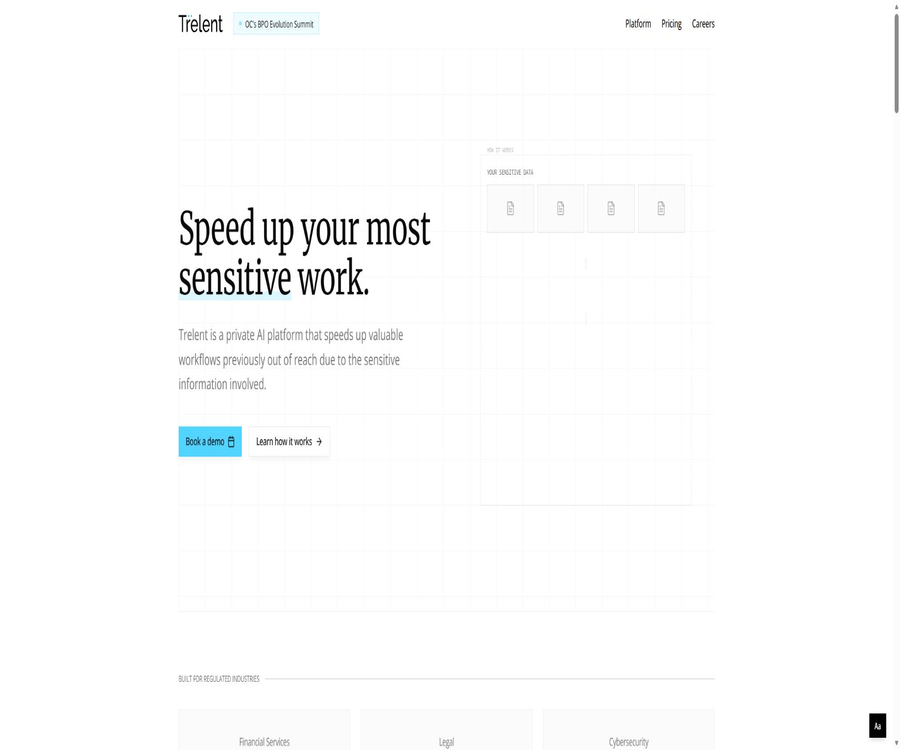
Trelent is a private AI infrastructure designed for handling sensitive data and regulated industries. It helps companies transform files, databases, and real-time data into searchable contexts, and it enables the creation of AI workflows that include multi-step reasoning, human review, and audit trails.
The company initially gained attention thanks to its AI Docstrings development tool, but its official website now focuses on business areas such as financial services, law, and network security. The older version of code comment extensions should no longer serve as the main focus of its current products.
A one-sentence summary
Trelent deploys data ingestion, semantic search, and Agent orchestration in the customer’s own cloud environment, providing private AI automation for sensitive document review, compliance, and customer processes.
Current core platform
- Data integration: Connect to files, object storage, enterprise cloud storage, databases, and real-time data streams.
- AI-ready processing: Converting unstructured data into a format suitable for retrieval and reasoning.
- Smart search: Finds information based on semantics and context, rather than relying solely on keywords.
- Multi-hop reasoning: Conducting the analysis of complex problems by leveraging multiple datasets and relationships.
- Agent orchestration: Organizes multi-step, multi-agent business processes.
- Typed input/output: It structures process data and reduces integration errors.
- Automatic retry: Establishes a recovery mechanism for failed steps.
- Human intervention: Incorporate human review before making critical decisions and performing external operations.
- Observability: Logs process execution, errors, and results.
- Private deployment: It operates within the customer’s own cloud and network infrastructure.
Three-tier platform architecture
| Hierarchy | Key capabilities | Business value |
|---|---|---|
| Foundation data infrastructure layer | Accessing and processing files, databases, object storage, audio/video, and real-time streams | Create a structured corporate context that can be utilized by models. |
| Discovery discovery layer | Semantic search, multi-hop reasoning, scope-based permissions, real-time indexing, and traceable results | Find evidence-based information among large amounts of sensitive data. |
| Intelligence smart layer | Multi-Agent workflows, typed input/output, retry, observation, and manual review | Transform analysis into stable, operational business processes |
Data access
Trelent can connect to S3, Google Cloud Storage, Azure Blob, Google Drive, SharePoint, as well as PDFs and other documents, audio and video files, and real-time data streams. The integration layer processes this data within the customer’s environment into content that can be used for searching and in workflows.
- Contracts, legal documents, and customer materials.
- Financial statements, risk data, and compliance records.
- Enterprise cloud storage, object storage, and internal databases.
- Meeting recordings, videos, and other unstructured materials.
- Business events and real-time data that require continuous access.
Smart search
The discovery layer focuses on understanding semantics, context, and the relationships between various pieces of data, and it supports multi-hop reasoning. The platform also offers scoped access, comprehensive tracking, and real-time indexing, making it suitable for enterprises with strict requirements regarding sources and permissions when conducting searches.
- Find relevant materials with different phrasings based on the meaning of the question.
- Combine evidence from multiple documents to formulate an answer.
- Restrict users to only retrieving data within the scope to which they have access.
- Retain the materials and reasoning clues corresponding to the results.
- Update the index promptly after data changes.
Agent orchestration
The intelligent layer is used to create multi-step AI processes that can operate in a production environment. Companies can combine search functions, rules, models, human judgment, and system operations, and they can enhance stability through type constraints, retry mechanisms, and logging.
- Have different agents be responsible for reading, analyzing, verifying, and outputting respectively.
- Define clear input and output structures for each step.
- Automatically retry on temporary failures, rather than silently losing the task.
- Log the execution process to facilitate auditing and troubleshooting.
- Wait for manual approval before reaching high-risk conclusions or taking external actions.
Private deployment and data boundaries
The platform’s current page states that all components can operate on the customer’s own infrastructure, with no data leaving the customer’s environment. The page sets 100% self-hosting, zero bytes of data leaving the environment, and no external calls as its architectural goals.
Such descriptions still need to be verified through architecture reviews, network logs, contracts, and penetration test reports. If the customer chooses external models or other connectors, the actual data flow may also change depending on the deployment scheme.
Trelent Chat
Trelent also offers a separate chat interface for security-related purposes, emphasizing encryption using customer-managed master keys or proprietary keys. This chat service makes use of Anthropic and Azure OpenAI’s zero-data-retention protocols, and it provides functions for reusing text snippets as well as web scraping.
- Encryption schemes that use the customer’s master key or an existing key.
- Model service providers offer zero-data-retention processing.
- Save frequently used company profiles, brand tones, and product information snippets.
- After pasting the web address, the content is automatically retrieved and added to the conversation.
- Enterprise AI chat experience for sensitive environments.
Which industries are suitable?
- Financial services: Handling customer data, financial documents, as well as matters related to risk and compliance requirements.
- Legal services: Reviewing contracts, evidence, and a large volume of case materials.
- Network security: Analyze sensitive security data and organize response procedures.
- Insurance and professional services: Handling complex onboarding, verification, and documentation tasks.
- Other organizations that require private deployment, fine-grained permissions, and auditing.
Typical use cases
- Customer onboarding: Read the information, check its completeness, and identify any missing data.
- Financial intelligence: Scan financial statements and assess risks in accordance with corporate rules.
- Legal review: Batch examination of contracts, terms, and potential red flags.
- Compliance verification: Incorporate regulations, policies, and customer information into an auditable process.
- Enterprise search: Answers complex internal questions by searching across documents and databases.
- Case and matter management: Extract key information and generate a review checklist.
- Security investigation: Collect evidence of incidents within the scope of authorized permissions.
- Automation of sensitive processes: Transforming repetitive manual steps into observable Agent processes.
Automated customer onboarding
Trelent can be used to process complex customer onboarding data by extracting facts from multiple files, checking for missing items, and triggering subsequent actions. When it comes to identity verification, anti-money laundering measures, or credit assessment, companies should still rely on rule engines, professional review processes, and appeal mechanisms.
Financial and compliance analysis
The platform can read financial statements and carry out risk or compliance checks in accordance with the client’s own rules. Compared to generic chatbots, private deployment and the ability to track evidence make it more suitable for handling confidential financial data.
Review of legal documents
Legal teams can develop processes for reviewing contracts and case documents, enabling the automatic identification of clauses, anomalies, and potential risks. The results generated by AI should serve as a tool to assist lawyers in their review; they should not be used to formulate final legal opinions in the absence of professional judgment.
Trelent Deployment Tutorial
- Select a sensitive workflow that is time-consuming, has relatively clear rules, and whose value can be quantified.
- Sort through the relevant documents, databases, personnel, permissions, and existing review steps.
- Work with Trelent to define the private cloud environment, network boundaries, and the models that can be used.
- Use masked samples to build prototypes for data integration, search, and Agent processes.
- Have business experts examine the evidence, accuracy rates, types of errors, and the points where manual intervention is required.
- Complete permission, key, logging, backup, disaster recovery, and security testing.
- Launch within a limited scope of operations to measure time consumption, costs, risks, and business outcomes.
- Expand the data sources, users, and scope of automation after verifying their value.
How to evaluate a workflow
- Record the time, cost, errors, and waiting steps of the current manual process.
- Define objectively measurable output and success criteria.
- Create a test set that includes normal, boundary, and high-risk cases.
- Evaluate retrieval coverage, factual accuracy, rule-based judgment, and the final result separately.
- Calculate the proportions of manually made changes, false positives, false negatives, and cases that could not be processed.
- Evaluate production operation delays, throughput, recovery time, and total cost of ownership.
- Expand automated operation permissions only after meeting the quality and risk thresholds.
Safety review checklist
- Confirm the actual deployment locations and network paths of all data processing components.
- Check whether external models, telemetry, updates, support, and error reporting are being sent over the network.
- Verify static and in-transit encryption, as well as the processes for key ownership and rotation.
- Test the minimum permissions for users, Agents, and data sources.
- Check whether the audit logs can reconstruct the processes of retrieval, judgment, and operation.
- Review penetration testing, recovery objectives, backup, and data deletion mechanisms.
- The contract should specify the data, model outputs, responsibilities, and the procedures to be followed upon termination of the service.
Current pricing model
Trelent adopts a business partnership approach that involves first demonstrating the value provided, followed by charging based on business outcomes; it does not offer individual subscriptions or fixed packages based on the number of users. In the first phase, the workflow is tested through monthly consulting fees, while in the second phase, the costs are linked to measurable business results.
| Phase | Cycle and price | Delivered content | Billing logic |
|---|---|---|---|
| Discovery discovery | Approximately 1 to 2 weeks; the specific cost will be determined upon confirming the collaboration. | Select workflows, data, and value metrics. | To determine the scope for subsequent verification |
| Stage 1 proves value | A commitment of 2 to 4 months, at 10,000 to 25,000 dollars per month. | Rapid solution development, dedicated engineering support, and process migration | A fixed monthly fee is charged based on the scope. |
| Stage 2 result-based billing | Ongoing cooperation; prices are not fixed. | Expand the validated workflows and maintain their operation. | Charging is based on business metrics such as the number of customers onboarded and the number of issues resolved. |
What is included in the price?
- Solution design and rapid verification for the target workflow.
- Dedicated engineering support, rather than just a self-service software account.
- Migrate existing manual or tool-based processes to the new system.
- Deploy the required platform components in the customer’s environment.
- Jointly determine quantifiable business performance indicators.
- After verification, the long-term cooperation framework is adjusted according to its actual value.
Points to consider for outcome-based billing
- Both parties need to define in advance verifiable indicators that cannot be manipulated.
- It is necessary to distinguish between the contributions of AI systems and the effects of changes in the market, personnel, or processes.
- The contract must specify the source of the data, the calculation period, and the procedures for resolving disputes.
- When costs increase alongside output, budgets, limits, and review points should be established.
- Safety, compliance, and quality cannot be measured solely by the volume of business operations.
Historical AI Docstrings products
In its early stages, Trelent offered tools such as VS Code, IntelliJ, and Python CLI, which used AI to generate Docstrings for functions or projects. The VS Code extension supported C#, Java, JavaScript, and Python, and allowed users to add comments within functions using shortcuts.
The publicly available information for this product line is clearly outdated: the official VS Code repository has been archived, and the latest version of the Trelent CLI available on PyPI dates back to December 2021; moreover, the current official website no longer features docstrings as a key part of its product presentation. Users should not rely on old documentation when purchasing or uploading new code.
Old version Docstring support format
| Language | Default Docstring format of the old version | Current status |
|---|---|---|
| C# | XML comments | Historical scalability – it is necessary to verify on your own whether the service remains available. |
| Java | JavaDoc | Historical scalability – it is necessary to verify on your own whether the service remains available. |
| JavaScript | JSDoc | Historical scalability – it is necessary to verify on your own whether the service remains available. |
| Python | ReST; Google or NumPy format is optional | Historical scalability – it is necessary to verify on your own whether the service remains available. |
Old CLI and code privacy
The older version of the Python CLI allowed for the generation of Docstrings for entire projects; it could also produce files showing the differences or write those Docstrings directly into the source code. The official documentation stated that API keys were stored locally in plain text, and that free upgrades might involve storing anonymized versions of the source code to improve the service.
- Do not upload proprietary corporate code without confirming the current policies.
- Stop using the old API keys that are stored in plain text.
- Establish version control and recoverable backups before generating annotations.
- After automatic insertion, it is necessary to check the semantics of each function and its parameters one by one.
- The security and compatibility risks of extensions that are no longer maintained should be assessed.
Current product advantages
- It is focused on sensitive and high-value processes, rather than general chatting.
- Data integration, semantic search, and Agent orchestration constitute a complete architecture.
- It can be deployed in the customer’s own cloud and network environments.
- Emphasize scope permissions, tracking, retrying, and manual review.
- It is suitable for industries that require evidence and audits, such as finance, law, and security.
- Specialized engineering support and workflow migration services are provided.
- Pricing is linked to business results, facilitating discussions on the actual return on investment.
Usage restrictions and precautions
- During the initial phase, the cost ranges from 10,000 to 25,000 dollars per month, which is not suitable for individuals or small teams.
- To verify the commitments over a period of 2 to 4 months, the customer still needs to invest expertise and data resources.
- Results-based billing requires complex definition of metrics and contract negotiations.
- The current official website does not offer a self-service trial version, standard pricing for seats, or complete public documentation.
- Self-hosting does not mean that all industry regulations are automatically met.
- Access quality, permissions, and enterprise data governance have a direct impact on the results.
- Multi-hop reasoning and Agents can still produce errors or incorrect references.
- The data pathways for the current platform and secure chatting may differ, and each one needs to be evaluated separately.
- The official website claims that the absence of any data leakage still needs to be verified through technical and contractual evidence.
- The older versions of Docstring extensions and the CLI do not reflect the current capabilities or level of support available on this platform.
Trust Center and compliance status
Trelent offers a Trust Center where it is possible to request security-related materials such as network diagrams and penetration test reports. The public pages indicate that the company adheres to industry best practices and is working toward obtaining compliance certifications; however, some policies and security ratings are still under development.
- It lists publicly the control areas such as encryption, backup, data deletion, and access control.
- Infrastructure involves cloud services such as AWS and Azure.
- It is possible to request access to the network diagram and penetration test reports.
- The target recovery time is stated to be 24 to 48 hours.
- Compliance certifications and company policies should still be verified through official documents.
GitHub and open source
The official Trelent GitHub repository contains 17 repositories, which include historical IDE extensions, parsing libraries, embedding services, and encryption tools. The Trelent-VSCode-Extension has been archived; UniversalTree, OpenTextEmbeddings, and some of the tools are licensed under permits such as MIT.
At present, the code related to complete data integration, searching, and Agent orchestration in private AI platforms is not available under an open-source license. The licenses of the public repositories apply only to that specific code, and they cannot be used to justify the self-deployment of such platforms by enterprises or their free commercial use.
Public developer resources
| Resources | Status | License or instructions |
|---|---|---|
| Trelent VS Code Extension | It has been archived; the last public release was in 2023. | The warehouse identifier is not specified as a standard open-source license. |
| Trelent IntelliJ Extension | Public warehouse; the final public release was in 2024. | No license indicated |
| Trelent Python CLI | PyPI 1.0, released in 2021 | MIT plus Commons Clause, restricting sales |
| UniversalTree | Open-source code | MIT |
| OpenTextEmbeddings | Open-source code | MIT |
| Data Ingestion Python SDK | Public PyPI packages | Used to call the data access API; it is not the complete source code of the platform. |
Basic information
| field | Content |
|---|---|
| Tool name | Trelent |
| Current product type | Private AI infrastructure and enterprise workflow automation |
| Key industries | Financial services, law, and cybersecurity |
| Core competencies | Data integration, intelligent search, Agent orchestration, and private deployment |
| Deployment method | Customer’s own cloud or private environment |
| Price pattern | Monthly fee during the validation phase and billing based on subsequent results |
| Historical products | AI Docstrings IDE extension and Python CLI |
| Is it open source? | The core platform is not open-source; some legacy tools and public components are open-source. |
Recommendation score
4.3 / 5. Currently, Trelent is suitable for regulated companies with sufficient budget, those that need to handle sensitive data, and those that wish to implement AI workflows in their own environments; it offers a clear architecture and set of services.
However, its procurement requirements are high, there are limited public technical documents, and the promises regarding security and zero data leakage still need to be verified through formal audits. Users of the older version of Docstrings should consider it a legacy product.
Frequently Asked Questions
What does Trelent do mainly these days?
It enables enterprises to deploy data integration, intelligent search, and Agent workflows within their own environments, with a focus on handling sensitive business tasks.
Is Trelent still an AI Docstrings tool?
The current official website has switched to a private AI infrastructure; Docstrings extensions are part of the products from an earlier stage.
How much is Trelent?
The value validation phase typically lasts 2 to 4 months, at a cost of $10,000 to $25,000 per month; thereafter, the fee is determined based on the results achieved by the business.
Does Trelent support private deployment?
Supported; the current platform emphasizes that all components can be deployed in the customer’s own cloud and network environment.
Will the data be sent to external models?
The core platform’s page claims to enable zero external calls; as for Trelent Chat, it uses Anthropic and Azure OpenAI with zero data retention, and both of these services should be evaluated separately.
Is Trelent suitable for individual developers?
The current prices and delivery options are intended for corporate projects and are not suitable for individuals who only need to generate a small number of code comments.
Is the old version of the VS Code extension still being maintained?
The official GitHub repository has been archived; its public status should not be considered as indicating ongoing maintenance.
Is Trelent open source?
The core platform is not open-source, but the official GitHub provides some historical extensions, SDKs, and components under the MIT license.
Has the security certification been completed?
The Trust Center states that it is working on obtaining compliance certifications, and purchasers should request the latest reports and certification documents.
Tools similar to AI Docstrings



 Guigong Network Security Registration No. 45132202000164