






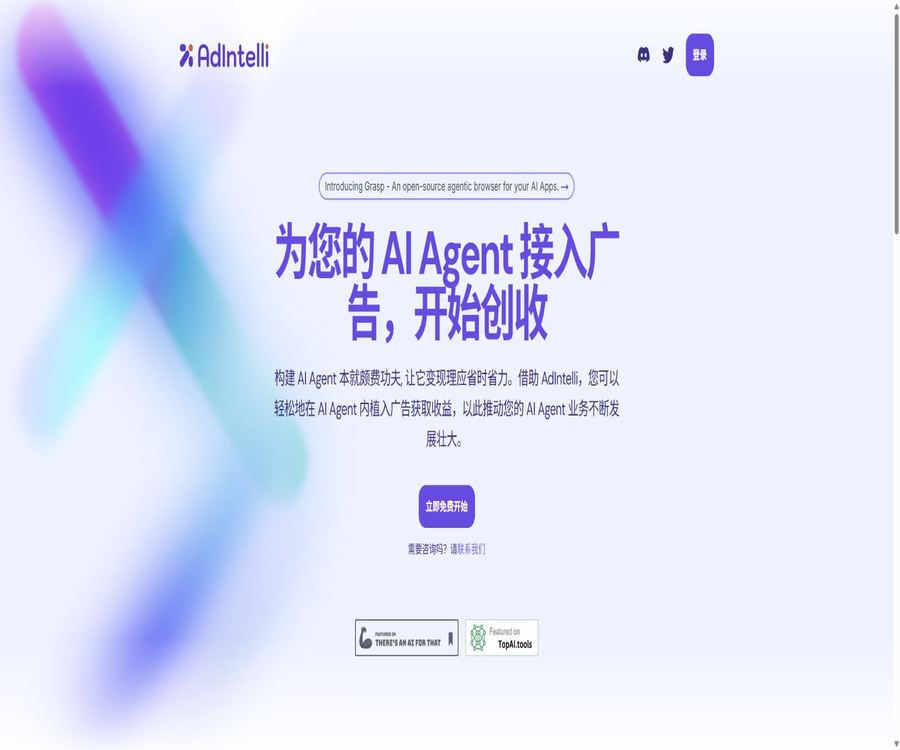
AdIntelli
AdIntelli, an intelligent tool focused on AI programming.
Tags:AI programming toolsWhat is AdIntelli?
AdIntelli is an AI Agent-based advertising monetization platform launched by AirCode Inc.; it helps GPT applications, chatbots, and other conversational products to display relevant ads during conversations. It connects advertisers with advertising needs and selects the appropriate ad content based on the user’s current questions, allowing developers to pursue commercialization without having to sell ads separately.
The product is aimed at operators of AI applications that have real users and a consistent volume of conversations, as well as advertisers who wish to promote their products in AI-driven conversation environments. The insertion of advertisements can affect the user experience and the level of trust between users and the application; therefore, relevance, transparency, privacy, and the frequency of ads displayed are more important than traditional banners.
Main functions
- In-dialogue advertising: Incorporating commercial content into the chat flow of AI Agents.
- Context matching: Select more relevant ads based on the current question and intent.
- Advertising demand connection: Allows multiple advertising sources to compete for display opportunities within the application.
- Automatic timing selection: The system determines the appropriate point in the conversation to display the advertisement.
- Code-free access: The official website states that basic configuration can be completed in a short period of time.
- Monetizing applications: Generating revenue through ad displays, clicks, or other predefined events.
- Reaching advertisers: Helping AI applications and other products enter the users’ environment via Agents.
- Operations backend: Used to manage applications, ad status, performance, and revenue.
- Correlation optimization: Reducing ad distractions that are not related to the issue at hand.
- Global advertising network: Increases the chances of ad placement by leveraging multiple sources of demand.
How do conversational ads work?
The typical process is as follows: the AI application provides AdIntelli with the necessary context of the conversation; the platform then carries out ad matching and sorting, before returning the appropriate commercial content for display. The application must clearly distinguish between ads and regular responses, and it is necessary to record events such as displays, clicks, or conversions.
- Users pose questions or express their needs to the AI Agent.
- The application determines whether this session is suitable for requesting ads.
- Provide the platform with only the minimal and necessary context or classification information.
- The advertising system selects relevant content from the available demands.
- AI applications present their results in the form of clearly labeled advertisements.
- The platform records compliant displays, clicks, or subsequent events.
- The publisher can view the performance of the ads and the estimated earnings in the backend.
AI products suitable for integration
- AI search and Q&A tools for consumers.
- Agents for travel planning, hotel or flight recommendations.
- Shopping assistants, product comparison, and gift recommendation apps.
- Chat tools for efficiency, fitness, a healthy lifestyle, and learning.
- AI characters, entertainment, or social chatting products.
- Website customer service, sales consultation, and product recommendation robots.
- GPT applications with stable traffic.
- AI SaaS products that require advertising support in the free version.
Which AI use cases are not suitable?
- High-risk conversations such as medical diagnoses, legal advice, and crisis intervention.
- Products designed for children that lack age verification and parental consent.
- An internal agent for handling large amounts of corporate confidential data or sensitive personal information.
- Tools with an extremely small number of users, too few to constitute a valid sample for settlement or testing purposes.
- Subscribe to products that promise complete ad-free experience without any changes to their terms.
- It is not possible to clearly distinguish between advertisements and natural responses in the chat interface.
- Companies that require advertising platforms to be fully open-source and self-hosted.
- Any commercial recommendations within a session can undermine the trust that is fundamental to a product.
The difference between contextual advertising and traditional banners
| Comparison items | AdIntelli dialog-based advertising | Traditional display ads |
|---|---|---|
| Display location | Embedded in chat or Agent responses nearby | Fixed area on the page or pop-up window |
| Matching criteria | Current session topic and user intent | Page content, audience, or ad slots |
| User experience | It’s more like a recommendation, and it can be easily confused with an answer. | Advertising formats are usually more noticeable. |
| Main risks | Trust, Misinformation, and Privacy Boundaries | Obstruction, tracking, and page interference |
| Appropriate indicators | Relevance, qualified interactions, and session retention | Impressions, clicks, and visibility |
| Disclosure requirements | It is necessary to clearly distinguish between advertisements and AI-generated responses. | Advertising identifiers are usually used. |
Ad matching and timing of display
- Request ads only when there is a clear commercial intent or relevant topic.
- Exclude sensitive, sad, urgent, or high-risk conversations.
- Limit the frequency of ads in consecutive rounds of conversation.
- Avoid having advertisements interrupt the core answers that users have not yet obtained.
- Give priority to products that are directly related to the current task.
- Matches with low confidence are not displayed.
- Provide users with options to turn off, provide feedback on, or reduce advertisements.
- Ad content is not allowed to alter the AI’s factual judgments.
How do publishers earn revenue?
The official website states that joining is free, and ad networks are used to generate revenue for AI Agents; however, no unified breakdown of profit shares, thresholds for payment, or payment schedules are disclosed. The actual earnings generally depend on factors such as the quality of traffic, location, demand for ads, format of the ads displayed, level of interaction, and identification of irrelevant traffic.
| Profit factors | Possible impacts | Operational recommendations |
|---|---|---|
| User region | Advertising demand and bidding levels vary. | Analyze fill rate and revenue by country |
| Session topic | The strength of commercial intent affects the relevance of advertisements. | Distinguish between information inquiries and purchase intentions. |
| Number of ad impressions | Increasing income opportunities may also damage the experience. | Set a reasonable frequency control. |
| Quality of interaction | It may affect click-through rates or conversion value. | Avoid inducing clicks. |
| Ad fill rate | Decide how many requests will be allowed to display ads. | Record an empty return and check the adaptation. |
| Invalid traffic | Earnings may be deducted or the account may be suspended. | Filtering robots, testing, and recurring events |
| Platform split | Determine the actual income of the publisher | Written confirmation prior to signing |
What is suitable for advertisers to promote?
- Software related to AI tools, productivity, and developer scenarios.
- Digital services that can resolve the specific issues of the current session.
- Products for tourism, shopping, education, and subscriptions.
- Applications that provide clear pages and measurable conversion rates are available.
- Products suitable for GPT Plus or AI Agent users.
- Brands with transparent pricing, genuine functions, and legitimate materials.
- Advertisers who are able to prepare creative ads tailored to different session topics.
Ways that advertisers should avoid using
- Disguised as objective AI conclusions or system recommendations.
- Use claims that cannot be proven, such as those stating it is the best or that guaranteed results will be achieved.
- To take advantage of sensitive health, financial, or psychological conditions.
- Induce users to click on links that are unrelated to the current question.
- Posting counterfeit content, malware, or high-risk downloads.
- Hide prices, subscriptions, or important restrictions within the creative.
- Agents are asked to give distorted answers in order to increase ad conversion rates.
How to understand five-minute code-free integration?
The official website states that basic setup can be completed within about five minutes and without any programming required, but this describes an ideal scenario more suited to account configuration and simple Agent integration. In a production environment, privacy checks, advertising identifiers, event verification, frequency control, error handling, and user experience testing are also necessary.
- Simple GPT applications may only require copying configurations or following the steps on the interface.
- Custom chat products may require backend or frontend development.
- Privacy and compliance audits usually take much longer than the time required for technical access.
- Event statistics require prevention of duplicates and handling of invalid traffic.
- Before going live officially, it is necessary to test ad-free responses and service failures.
- Complex products should be released in a phased manner rather than being made fully available at once.
AdIntelli Integration Tutorial
- Verify that the product terms permit advertising, and identify the sensitive scenarios in which ads should not be displayed.
- Register a publisher account and create the corresponding AI Agent or application.
- Complete the configuration of ownership and application details following the official procedures.
- Choose the appropriate ad format, placement, and frequency of display.
- Integrate the ad request into the testing environment or GPT configuration.
- Add clear identifiers to the ads, as well as options for closing them and providing feedback.
- Test scenarios for relevant, irrelevant, sensitive, and ad-free responses.
- After going live with a low traffic volume, monitor changes in revenue, retention, and complaints.
Advertising Security Testing Tutorial
- Create a list of medical, minor-related, and crisis scenarios in which advertising is prohibited.
- Use normal, vague, misleading, and malicious questions to test matching.
- Ensure that the advertisement does not cover or alter the core answer.
- Ensure that all advertisements have clear indicators indicating their commercial nature.
- Verify that the target of the link, its domain name, and the page to which it redirects are secure.
- The simulation platform experiences timeouts, empty responses, and format errors.
- Check the frequency control for the same user and the same session.
- Log mismatched cases and establish an emergency switch to pause ads.
Tutorial on Return Assessment
- Record the number of sessions before access, retention rates, subscriptions, and user satisfaction.
- Ads are made available only to a small number of random users as the experimental group.
- Track ad requests, impressions, qualified impressions, interactions, and revenue.
- Compare the session depth and retention the next day between the experimental group and the control group.
- Calculate the revenue per thousand sessions and the revenue per active user.
- Subtracting costs related to lost subscriptions, customer service, development, and compliance.
- Set reasonable limits based on region, topic, and frequency of advertising.
- Expansion should only take place when both net profit and user experience are satisfactory.
Prices, Royalties, and Settlements
The AdIntelli website currently describes publisher enrollment as being free, but it does not disclose any fixed subscription fees, revenue sharing ratios, minimum payment amounts, or payment schedules. Advertiser pricing, bidding mechanisms, and minimum budgets are also not specified on the public homepage.
| Project | Public status | It should be confirmed before connecting. |
|---|---|---|
| Publisher registration | The official website states that it’s possible to start for free. | Are there any requirements regarding qualifications, traffic volume, or location? |
| Platform subscription fee | Not disclosed | Does the free version include all functions? |
| Publisher splits | Not disclosed | The ratio of total advertising revenue to the actual amount received as payment |
| Minimum settlement amount | Not disclosed | How to accumulate points when the threshold has not been reached |
| Payment cycle | Not disclosed | Monthly settlement, review period, currency, and payment method |
| Advertiser price | Not disclosed | Charging based on impressions, clicks, conversions, or other events |
| Taxes and deductions | Not disclosed | Tax documents, refunds, and deductions for invalid traffic |
It needs to be confirmed before signing.
- The actual revenue split ratio between the platform and the publisher.
- Definitions of qualified impressions, clicks, conversions, and invalid traffic.
- Minimum payment amount, approval cycle, payment methods, and currency.
- Supported countries, languages, industries, and ad types.
- Capabilities for advertising review, removal, and brand blacklisting.
- Whether the content of the session is sent, saved, or used for model training.
- Methods for handling user requests to reject ads, delete data, and file complaints.
- Data export, outstanding revenue, and event auditing after service termination.
Privacy and data processing
AdIntelli’s privacy policy states that the platform may process information related to customers, devices, sources of access, and service usage; payment and operational tasks are handled with the assistance of service providers. Publishers need to determine in detail the specific fields related to session text, user identifiers, and advertising events, as well as the duration for which such data is retained.
- Only the minimum amount of contextual information necessary for matching advertisements is transmitted.
- Delete names, contact information, and account credentials before sending.
- Do not use medical, financial, or other sensitive conversations for targeting.
- Inform users about advertisements, data processing, and ways to opt out.
- Additional restrictions are established for children and regulated areas.
- Confirm the rules for cross-border data transfer, sub-processors, and data retention.
- Establish response processes for deletion requests and security events.
Advertising identifiers and user trust
- Use clear and visible advertising or sponsorship labels before the ad.
- Do not allow AI to use the first person as if it has personally used the product.
- Separate commercial recommendations from independent answers into different sections.
- Allow users to ask why they are seeing that ad.
- A mechanism is provided to report irrelevant, offensive, or fraudulent advertisements.
- When offering an ad-free option to paid subscription users, it should be implemented.
- Re-test ad display after each product update.
Invalid traffic and ad fraud
- Events generated by development, testing, and internal teams are excluded.
- Filtering robots, as well as requests for refreshes and abnormal high-frequency requests.
- Do not reward or encourage users to click on ads aimlessly.
- Prevent the publisher from repeatedly triggering the display or click callback.
- Verify the source of the conversion events and the deduplication identifiers.
- Monitor abnormalities in national settings, devices, and session modes.
- Save necessary logs to handle deductions and disputes.
Effect evaluation indicators
| Indicators | Function | Risk warnings |
|---|---|---|
| Number of ad requests | Measuring the scale of realizable sessions | Too many requests may damage the experience. |
| Fill factor | Observe how many requests result in the display of ads. | Low filling may stem from region or theme. |
| Qualified display | Used to evaluate the actual billable exposures | The definition shall be governed by the contract. |
| Interaction rate | Observe users' reactions to advertisements. | It cannot be increased through induction. |
| Revenue per thousand sessions | Compare the benefits of different applications and use cases | The platform and operational costs need to be deducted. |
| User retention | Determine whether an advertisement undermines the value of a product. | It should be compared with the ad-free control group. |
| Advertising complaint rate | Measuring relevance and brand safety | High-risk ads should be suspended immediately. |
Product advantages
- A type of advertising specifically designed for AI Agents and chat-based products.
- Contextual matching offers a better chance of providing relevant content than irrelevant banners.
- Publishers do not need to search for and sell ads one by one.
- The official website emphasizes that the basic access is simple and can be started for free.
- Multiple sources of advertising demand help increase the chances of filling slots.
- Provide commercialization options beyond subscriptions for free AI tools.
- Advertisers can reach users who are familiar with AI applications.
Usage restrictions and precautions
- The official website does not disclose details regarding the split of profits, settlements, and advertiser prices.
- Dialog-based ads are often mistaken for objective recommendations made by AI.
- Using conversation contexts for matching poses risks to privacy and sensitive data.
- Ad relevance, fill rate, and revenue vary by region and topic.
- Low-traffic agents may fail to generate significant returns over the long term.
- Advertising affects retention, satisfaction, and conversion rates.
- Higher-risk and child-related scenarios require stricter filtering.
- The code-free five-minute setup only refers to basic access and does not include production management.
- The platform still requires transparent disclosure, human oversight, and the ability to shut down urgently.
The relationship between Grasp and AdIntelli
At the top of AdIntelli’s official website, there is a link to the Grasp open-source agent browser; available information also indicates that the two projects are linked through their development teams. Grasp is a self-hostable browser automation tool, whereas AdIntelli is a commercial platform for conversational advertising – their purposes, code, and licensing models cannot be confused with one another.
| Products | Primary uses | Open-source status | Is it equivalent to AdIntelli? |
|---|---|---|---|
| AdIntelli | AI Agent dialogues, advertising, and monetization | No fully open-source platform was found. | The main content of this entry |
| Grasp | Self-hosted Agent browser and web automation | Public repositories provide code. | It’s not the AdIntelli advertising platform. |
| MCP and A2A of Grasp | Connect to other AI applications and Agents | As specified in the project documentation | It does not represent the advertising interface. |
GitHub and the open-source status
No GitHub repository was found in the course of this search that could be confirmed as belonging to AdIntelli and that makes available the complete source code for its ad matching, bidding, settlement, and operational backends. Third-party projects with similar names for ad analysis, as well as open-source dialogue ad engines, are not related to AdIntelli.
| Project | Status | Explanation |
|---|---|---|
| AdIntelli platform | Closed-source commercial services | The advertising network, matching, and settlement capabilities are not open source. |
| Official AdIntelli repository | Not confirmed | No complete, publicly available repository corresponding to the products on the official website was found. |
| Grasp | Open-source related projects | The Agent browser is not the AdIntelli ad source code. |
| Third-party chat advertising programs | Independent projects | The licenses and the operators are different. |
| Self-hosted advertising platform | No findings were detected. | Enterprise deployment requirements need to be confirmed separately. |
Basic information
| field | Content |
|---|---|
| Tool name | AdIntelli |
| Operating entity | AirCode Inc. |
| Tool type | AI Agent dialogue advertising and application monetization platform |
| Primary users | Developers of GPT, chatbots, and AI applications |
| Main forms of advertising | In-session contextual advertising |
| Publisher price | The official website states that it is possible to start for free, but the payment structure and settlement details are not disclosed. |
| Advertiser price | Not disclosed |
| Is registration required? | Yes |
| Is it open source? | AdIntelli is not open source; Grasp is part of various open-source related projects. |
Recommendation score
3.8 / 5. AdIntelli offers a direct path for monetizing conversations through AI agents on a free basis, with a clear integration framework; however, the information available regarding fees, settlements, data fields, and advertising regulations is limited. It is necessary to conduct assessments of contracts, privacy issues, and user experience before the service goes live.
Frequently Asked Questions
What is AdIntelli mainly used for?
It matches session ads for GPT applications, chatbots, and other AI agents, allowing publishers to generate revenue through these ads.
Is AdIntelli free?
The official website states that publishers can start using the service for free, but it does not disclose all the limitations on features, the profit-sharing ratios, or the settlement terms.
Is programming required to connect?
The official website states that basic setup can be completed without any programming and in about five minutes, but custom AI applications as well as those used in production environments typically still require development and testing.
Where will the ads appear?
Ads are primarily integrated into the dialogue flow of AI Agents; their specific presentation style, timing, and frequency depend on the configuration settings.
How does AdIntelli select advertisements?
The platform selects more relevant ads based on the context of the conversation and the user’s intentions, and tries to display them at the appropriate time.
How much can one earn?
There is no universal answer; earnings depend on traffic, location, topic, fill rate, quality of interaction, and the percentage allocated under the contract. The official website does not provide a table showing how earnings are calculated.
What is the settlement threshold?
The public page does not specify the minimum settlement amount, payment cycle, or payment methods; these details need to be checked in the publisher’s backend or in the contract.
Does it read user conversations?
Context matching usually requires some session information; the sender should determine the fields to be sent, the retention period, and the purpose of training, and first remove any sensitive data.
Is Grasp the open-source version of AdIntelli?
No. Grasp is an open-source Agent browser designed for collaborative teams, while AdIntelli is a standalone commercial platform for conversational advertising.
Is AdIntelli open source?
No official open-source repository for the full AdIntelli advertising platform has been found; its matching, bidding, and settlement systems are part of commercial services.
Tools similar to AdIntelli



 Guigong Network Security Registration No. 45132202000164