






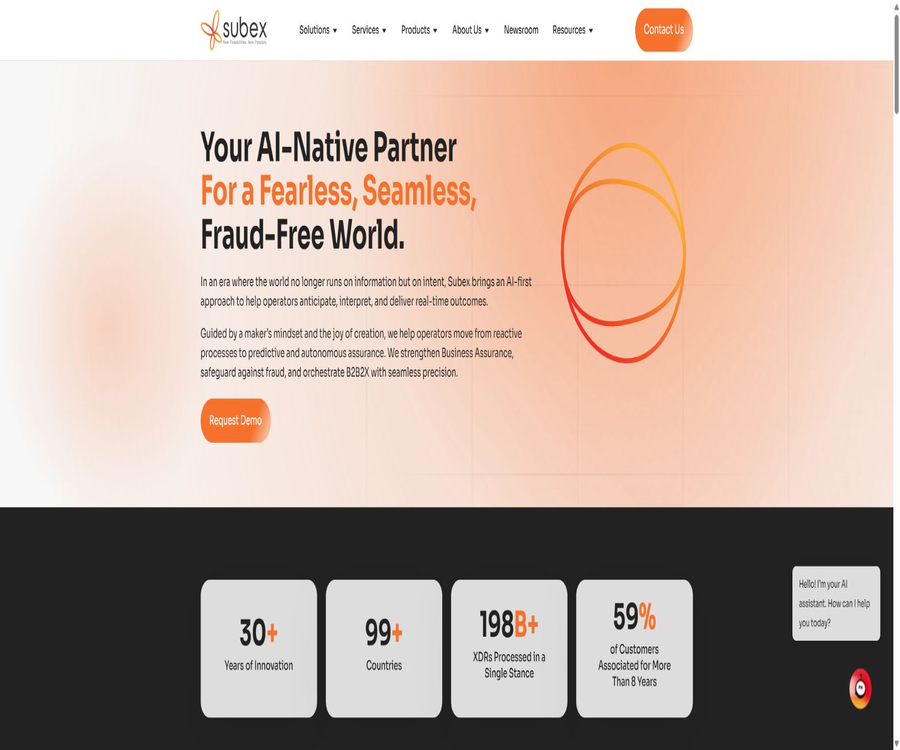
A Telecom AI company enabling Connected Experiences
A Telecom AI company that enables Connected Experiences, offering intelligent tools focused on AI programming.
Tags:AI programming toolsWhat is Subex?
Subex is an AI-driven company that specializes in risk management, fraud detection, and business protection services for telecommunications operators and digital service providers; its headquarters are located in Bangalore, India. With over 30 years of experience in the telecommunications industry, its products and services are available in various countries and regions.
At present, Subex categorizes its capabilities into three main areas: fraud management, business continuity assurance, and management of the partner ecosystem. It utilizes machine learning, behavior analysis, knowledge graphs, and AI agents to help operators shift from reactive handling to predictive actions, prevention strategies, and automated processes under human oversight.
Subex’s current position
- Fearless: Identifies risks related to revenue, services, and user experience in advance, enabling the safe launch of new services.
- Seamless: Digital B2B and B2B2X partnerships, products, order, and settlement processes.
- Fraud-Free: Real-time fraud prevention at the identity, transaction, network, roaming, partner, and interface levels.
- AI Native: Enables the system to detect anomalies, suggest possible causes, and learn continuously.
- Human-Driven Autonomy: High-impact decisions are reviewed, approved, or overridden by analysts.
- Intent-Driven: Moving from analyzing historical data to understanding intentions and predicting outcomes.
Core solution
| Solution | Main problems | Core values |
|---|---|---|
| Fraud Management | Fraud in telecommunications and digital services | Real-time detection, scoring, correlation analysis, and loss prevention |
| Business Assurance | Revenue leakage, billing, and service risks | Reconciliation, verification, anomaly detection, and revenue integrity |
| Partner Ecosystem Management | Complex partners and B2B2X processes | Onboarding, contracts, catalogs, orders, settlement, and dispute resolution workflows |
| AI Agent Squads | Repeat analysis, root cause analysis, and operational knowledge work | Recommendations supported by evidence and automation with human oversight |
| HyperSense | Development of telecom AI and analytics | Build AI use cases by leveraging data, models, and industry knowledge. |
Fraud management
Subex Fraud Management is used for the continuous monitoring of telecommunications identities, subscriptions, usage, payments, roaming activities, partners, and network events. It utilizes rules, behavior models, AI-based scoring, and relationship analysis to identify both known and new types of threats.
- Evaluate high-risk events in real time and address them on a priority basis.
- Anomalies that are not covered by traditional static rules can be identified through changes in behavior.
- Use association and link analysis to identify fraud rings.
- Link alerts to users, devices, numbers, accounts, and partners.
- Automatically recommend possible root causes and subsequent investigation steps.
- Blocking and disposal actions are confirmed, covered, or approved by analysts.
- Continuously provide feedback on survey results to update rules and models.
Types of fraud covered
- International revenue sharing fraud and abuse of expensive numbers.
- SIM Boxes and traffic that bypasses legitimate interconnection billing.
- The Wangiri technique involves hanging up immediately to induce a return call as a form of fraud.
- Subscription, identity theft, and fraud during the account opening phase.
- Roaming, payments, mobile finance, and fraud via digital channels.
- Fraud by partners, distributors, and agency channels.
- Abuse related to device, interface, and machine traffic.
- New types of risks whose rules are not defined yet exhibit abnormal behavior patterns.
From detection to prevention
- Detection: Aggregates data from multiple sources to identify known patterns and abnormal behaviors.
- Rating: Assesses the risk of events, accounts, devices, and relationship networks.
- Explanation: Provides context for models, rules, associations, and evidence.
- Priority: Ranked by potential loss, credibility, and urgency.
- Prevention: Preventing or restricting high-risk transactions within the authorized scope.
- Review: Have analysts confirm the key actions.
- Learning: Feed the outcomes of cases back into rules, models, and handling processes.
Business continuity
Subex Business Assurance is used to ensure that the services provided by operators are measured, billed, settled, and have their revenues recognized correctly. It carries out continuous reconciliation and verification of data from networks, products, orders, billing systems, financial records, and partner systems.
- Unbilled, under-billed, double-billed instances and configuration errors were detected.
- Compare usage records, pricing, bills, and revenue recognition.
- Identify the sources of revenue leakage and their impact on the business.
- Monitor service quality, SLAs, and customer experience risks.
- Verify the readiness of new products, new pricing plans, and new partnership models for launch.
- Reduce manual forms and repetitive checks through automation.
- Provides trackable exceptions, evidence, and resolution status.
Revenue and service risk forecasting
- Identify abnormal trends before financial losses increase.
- Possible root causes are recommended based on historical patterns and real-time events.
- Map exceptions to products, channels, partners, and systems.
- Assess the impact on revenue, customers, and SLAs, and determine priorities.
- Set up dynamic safeguard checks for the product’s launch.
- Include the processing results in ongoing monitoring and model adjustment.
Partner ecosystem management
Partner Ecosystem Management is designed for complex networks of collaboration involving interconnection, roaming, MVNOs, the Internet of Things, cloud services, content, and enterprise services. It integrates processes related to partner onboarding, contracts, catalogs, orders, usage, billing, and dispute resolution into a unified framework.
- Application, review, and compliance checks for digital partners.
- Manage contracts, pricing, SLAs, rules, and expiration dates.
- The design encompasses multi-party products that include connectivity, content, the cloud, and the Internet of Things.
- Manage order, usage, and service status across partners.
- Charges, royalties, and settlements are calculated in accordance with the agreement.
- Provide evidence for invoice discrepancies and disputes.
- Provide operators and partners with a unified view of status and performance.
B2B2X orchestration
- It connects operators, content providers, cloud service providers, IoT partners, and enterprise customers.
- Establish multi-party catalog, quotation, and order relationships.
- Record the usage, service responsibilities, and revenue share of each participant.
- Automatically enforce contract and settlement rules.
- Reduce the time from design to launch for new collaborative products.
- Reduce errors and disputes caused by emails, forms, and standalone portals.
- Complex business rules still require confirmation by legal, financial, and business teams.
AI Agent Squads
Subex integrates AI agents into processes related to fraud detection, revenue assurance, and partner management, using them to summarize evidence, explain anomalies, recommend actions to take, and preserve operational knowledge. These agents focus on providing recommendations and supporting human oversight, rather than replacing professional analysts directly.
- Intelligent agent for abnormal root cause analysis.
- An agent for operational knowledge and configuration checks.
- Agents for assessing partnership and settlement risks.
- An intelligent agent for investigating fraud cases and organizing evidence.
- Agents for explaining revenue leakage and reconciliation anomalies.
- Natural language Q&A and analytical support for business professionals.
- Request manual review, assign responsibilities, and confirm closure before performing critical actions.
PEM AI Agents
The PEM AI Agents presented by the officials are designed to address issues related to billing and settlement for partners. They connect various elements such as invoices, pricing details, routing information, protocols, bills, and service requests, thereby assisting analysts in explaining discrepancies and prioritizing those cases that pose high commercial risks.
- Settlement Variance RCA Agent: Interprets settlement differences by relating various types of data.
- Billing Operations Knowledge Agent: Provides guidance on billing periods, configuration, and anomaly detection.
- Partner Wholesale Billing Risk Score: Ranked based on disputes, delays, and profit risks.
- Attach verifiable operational evidence for each recommendation.
- Preserve expert knowledge to help new employees get up to speed more quickly.
- Analysts can review, cover, assign, and confirm closure.
HyperSense AI platform
HyperSense is Subex’s capability platform for use in telecommunications AI and analysis tasks; it helps companies integrate data, models, industry expertise, and operational processes. It complements Subex’s solutions for fraud detection, risk management, and customer experience.
- Develop machine learning and analysis use cases based on telecommunications data.
- It supports model development, deployment, and operational integration.
- Leverage domain knowledge to reduce the understanding gap of general AI in telecommunications scenarios.
- Help different business roles utilize AI-generated results.
- Improve the reliability of production by combining explanations, monitoring, and human feedback.
- The specific modules, deployment, and authorization scope need to be determined within the project.
Generative AI and Copilot
- Fraud team Copilot: Aggregates alerts, historical cases, and related entities.
- Business Assurance Copilot: Explains discrepancies in account reconciliations and their potential impact on revenue.
- Customer Experience Copilot: Analyzes behavior, preferences, and emotional signals.
- Partners manage Copilot: view protocol details, invoices, and settlement status.
- Natural language queries reduce the barrier to using complex analysis systems.
- The generated results must be verified against the original data and the rules.
Next Best Offer analysis
Subex also offers Next Best Offer analysis tailored for telecommunications customers, recommending suitable products based on their behavior and preferences. It can help improve cross-selling, customer lifetime value, and retention, but it is necessary to respect requirements regarding consent, appropriateness, and fairness.
- Products are recommended based on real-time behavior and customer characteristics.
- Reach out to customers at a time when they are more likely to respond.
- Identify cross-selling and upselling opportunities.
- Reduce the risk of customer churn through relevant incentives.
- Evaluate campaign response, revenue, and long-term customer value.
- Avoid using sensitive attributes to cause discrimination or inappropriate targeting.
Data and technical foundations
- Process high-volume data such as detailed records, transactions, network activities, billing information, and customer events.
- Combining rules, supervised learning, anomaly detection, and behavior analysis.
- Use relationship maps to reveal the connections between accounts, numbers, devices, and partners.
- Flow-based scoring supports near-real-time risk decision-making.
- Integrate domain knowledge, cases, and processes into the agent’s context.
- It provides dashboards, alerts, cases, and an operations dashboard.
- Production deployment must be integrated with the operator’s data lake, BSS, OSS, and security architecture.
Artificially supervised autonomy
- AI first identifies, ranks, and explains anomalies.
- The system recommends the root cause, next steps, and potential business impacts.
- Analysts examine the evidence and approve, modify, or reject the recommendations.
- Manual permissions are reserved for high-risk blocking, accounting adjustments, and handling of partners.
- The confirmation results are feedback from the model and rules.
- All significant actions should have their perpetrator’s identity, time, reason, and prior and subsequent states recorded.
Which customers are suitable?
- Mobile, fixed-line, and converged communications operators.
- Telecom companies that operate mobile finance, payment, or digital services.
- Operators with complex roaming, interconnection, and wholesale services.
- Platforms that manage ecosystems of MVNOs, the Internet of Things, cloud services, or content partners.
- Financial operations teams that need to reduce income leakage and the costs associated with manual reconciliation tasks.
- Security teams that are capable of detecting new types of fraud in real time are needed.
- Companies that wish to use AI agents to preserve expert knowledge and improve operational efficiency.
Typical use cases
- Real-time detection of abnormal international calls and fraudulent numbers with high charges.
- Abnormalities were detected in the SIM Box and roaming mode of operation.
- Use of the reconciliation network, pricing, billing, and revenue recognition.
- Verify the readiness of billing, services, and SLAs before the new package is launched.
- Manage contracts and settlements with interconnected partners, MVNOs, and IoT partners.
- Explain the differences on the bill and generate evidence that can be used in disputes.
- Assign priorities to high-risk partners, invoices, and anomalies.
- Use natural language to query information on fraud, revenue, and operational aspects.
Steps to implement Subex
- Choose quantifiable business problems, such as reducing certain types of fraud losses or revenue leakage.
- Inventory lists, billing, network, CRM, financial data, and partner data sources.
- Standardize the definitions for entities, fields, time, currency, pricing, and case outcomes.
- Use historical data to establish a baseline and validate rules, models, and the false positive rate.
- Configure risk thresholds, manual approval processes, as well as permissions for case assignment and handling.
- Achieve controlled integration with existing BSS, OSS, data platforms, and security systems.
- First, test it out in a particular business or region, and then expand based on losses, efficiency, and user experience.
Steps to launch an AI agent
- Start with operational tasks whose evidence can be verified and whose actions can be reversed.
- Specify the data read by smart fitness systems, the tools that may be used, and the actions that are prohibited.
- Design a fixed output that includes conclusions, evidence, confidence levels, and the responsible party.
- Test with historical cases, edge cases, and aggressive inputs.
- First, let the agent only generate suggestions, without automatically modifying the accounts or shutting down services.
- Establish a closed loop for manual approval, justification, auditing, and feedback.
- Continuously monitor accuracy, false positives, processing time, losses, and model drift.
Price and procurement methods
Subex provides software, platforms, and professional implementation services to large telecommunications companies. Its official website does not disclose any fixed monthly fees, seat charges, or predefined package prices. Customers need to schedule a demonstration in order to receive a quote based on factors such as the number of modules, data volume, deployment requirements, integration needs, the number of countries involved, and the scope of services.
| Products or services | Price status | Main pricing factors |
|---|---|---|
| Fraud Management | Custom quotes for businesses | Volume of events, types of fraud, real-time nature, number of cases, and scope of deployment |
| Business Assurance | Custom quotes for businesses | Revenue streams, reconciliation scenarios, data sources, and country-specific operations |
| Partner Ecosystem Management | Custom quotes for businesses | Number of partners, type of business, complexity of contracts and settlements |
| HyperSense | Custom quotes for businesses | AI use cases, models, users, data, and deployment environments |
| AI Agent Squads | Quotation for a project or proposal | Number of agents, knowledge integration, tool permissions, and operational support |
| Consulting and implementation | Confirm by project | Migration, integration, customization, training, and continuous optimization |
It needs to be confirmed before purchasing.
- Licenses are charged based on module, user, amount of data, country, or revenue level.
- Responsibilities for infrastructure and operations, whether deployed in the cloud, on a private cloud, or locally.
- Costs for migrating historical data, real-time interfaces, and custom connectors.
- Whether model training, updating, interpretation, and continuous monitoring are included.
- Implementation timeline, acceptance criteria, service levels, and support for key events.
- The underlying model of the agent, call costs, and data retention policies.
- Mechanism for exporting data, rules, models, and cases after the contract ends.
Product advantages
- With over 30 years of experience in the fields of telecommunications fraud and income protection.
- It covers three key areas: fraud prevention, business protection, and the partner ecosystem.
- AI capabilities are combined with detailed information, pricing details, billing data, and expertise in the telecommunications industry.
- It extends from anomaly detection to root cause analysis, risk ranking, and recommendations for action.
- It emphasizes autonomous operation under human supervision, and is suitable for high-impact telecommunications operational processes.
- It supports complex B2B2X models, multi-party settlements, and digital service ecosystems.
- The public section of the official GitHub contains research tools for explainable AI and data analysis.
Usage restrictions and precautions
- The product is primarily aimed at large telecommunications companies and is not suitable for ordinary individuals or small teams.
- The official website does not disclose prices, making it difficult to directly compare the costs of procurement and implementation.
- There are numerous data sources and complex legacy systems, resulting in significant challenges in integration and data governance.
- Fraud detection models may produce false positives and affect legitimate customers; therefore, actions taken to block such activities need to be handled with caution.
- The rules regarding telecommunications, finance, privacy, and data localization vary from country to country.
- Generative AI and agents may provide incomplete explanations; it is necessary to retain evidence for verification.
- The model drifts as fraud tactics change, requiring continuous monitoring and updating.
- The case metrics come from specific customers and cannot be regarded as guarantees for all deployments.
Security and Governance
- Restrict access to details by position, as well as to data related to identity, accounting, cases, and partners.
- Mask, encrypt sensitive fields, and minimize their use.
- Multiple approvals are set in place for blocking, accounting adjustments, and penalizing partners.
- Record the model version, inputs, outputs, evidence, and manual overrides.
- Regularly test for false positives, false negatives, deviations, and countermeasures to bypass detection.
- Establish policies for cross-border data, retention periods, and law enforcement requests.
- Prepare manual fallback plans for model failure, data interruption, and agent anomalies.
GitHub and the open-source status
Subex has an official GitHub organization and makes available a small number of projects related to data science and explainable AI, including ExploriPy, STDW, Dominance Analysis, and Counter-Factual Explanation. The core technologies related to telecommunications fraud detection, service assurance, PEM, HyperSense, and AI agent platforms are not fully open sourced.
| Project | Status | License or instructions |
|---|---|---|
| Subex Business Platform | Closed-source enterprise software | Core telecommunications products and hosting services do not constitute complete open-source projects. |
| ExploriPy | Open source | Automatic exploratory data analysis tool under the MIT license |
| STDW | Open source | Table detection code and datasets for the Apache 2.0 license |
| Dominance Analysis | Public warehouse | Used for explainable AI and variable importance analysis |
| Counter-Factual Explanation | Public research projects | Counterfactual explanations for classification and regression |
| HyperSense and AI Agents | Not fully open source | Making research repositories public does not mean making the source code of commercial platforms available. |
Basic information
| field | Content |
|---|---|
| Tool name | Subex |
| Date of establishment | 1994 |
| Headquarters | Bengaluru, India |
| Tool type | Telecom AI fraud prevention, service assurance, and partner ecosystem platform |
| Key customers | Telecom operators, digital service providers, and mobile finance providers |
| Core products | Fraud Management, Business Assurance, PEM, HyperSense, and AI Agents |
| Price pattern | Custom quotes for businesses |
| Is it open source? | The core platform is not open-source; only some of the research tools are made available by the developers. |
Recommendation score
4.5 / 5. Subex combines extensive experience in the telecommunications sector, capabilities for detecting real-time fraud, ensuring revenue stability, handling settlements with partners, and utilizing intelligent agents for oversight – making it suitable for complex operational scenarios. However, its price is not disclosed, the implementation process is lengthy, and it requires high standards regarding data quality, system integration, and model management.
Frequently Asked Questions
What does Subex do mainly?
It helps telecommunications operators detect and prevent fraud, reduce revenue losses, and digitize the complex settlement processes with partners in B2B2X models.
Is Subex a general-purpose AI platform?
No, it is primarily aimed at the telecommunications industry, with AI capabilities being deeply integrated with services related to billing, pricing, networks, and partnerships.
Which types of fraud are supported?
It covers international revenue sharing, SIM Box, Wangiri, subscriptions, identity management, roaming, payments, partners, and other telecommunications frauds.
What is Business Assurance?
It continuously monitors services, usage, pricing, billing, settlements, and the revenue stream, helping to identify leaks, errors, and deployment risks.
What is Partner Ecosystem Management?
It manages various processes related to partner onboarding, contracts, catalogs, orders, usage, revenue sharing, settlement, and disputes.
Does Subex offer AI agents?
It is possible for the agent to explain abnormalities, organize evidence, and recommend actions; it is also important to emphasize that professional personnel should review and oversee these processes.
How much is Subex?
The official website does not provide a unified public price; a quote from the company is required, depending on the product modules, volume of data, deployment requirements, integration needs, and scope of services.
Can it be deployed locally?
Large-scale telecommunications projects typically have deployment plans designed in accordance with security and data requirements; the choice between cloud, private cloud, or on-premises solutions must be confirmed with the authorities.
Is it suitable for small and medium-sized enterprises?
It is generally not suitable; the product is designed to address issues related to high capacity at the operator level, complex billing processes, fraud, and the management of partners.
Is Subex open source?
The core platform is not open-source, but the official GitHub offers a small number of public projects such as ExploriPy, STDW, and explainable AI.
Tools similar to those of A Telecom AI company, which enable connected experiences.



 Guigong Network Security Registration No. 45132202000164