






AIniroTeam
AIniroTeam, an intelligent tool focused on AI programming.
Tags:AI programming toolsWhat is AINIRO?
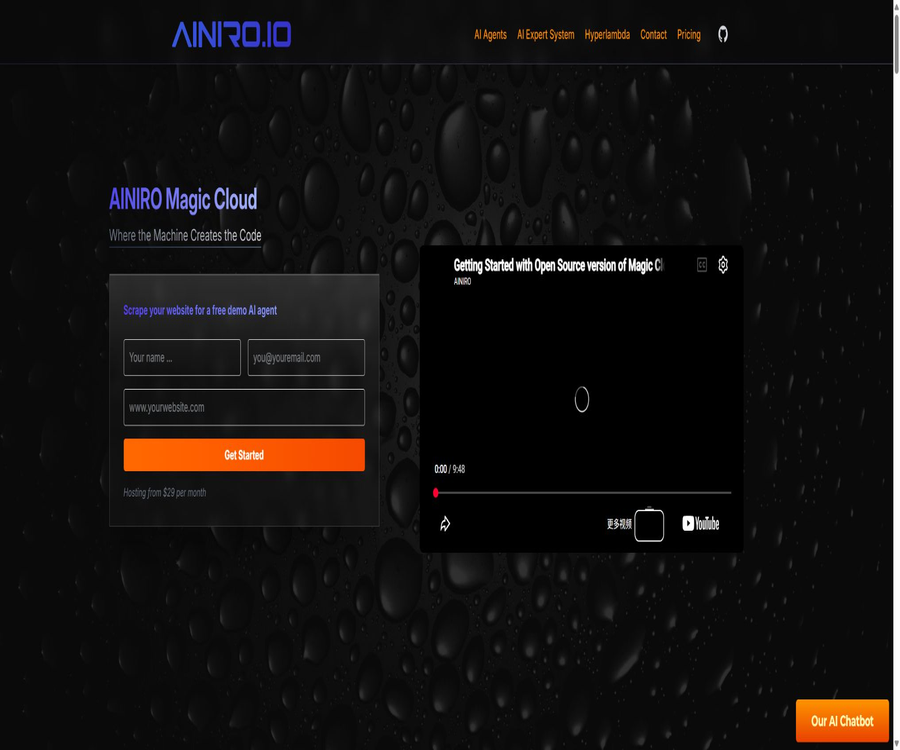
AINIRO is an AI software company based in Cyprus, whose flagship product is Magic Cloud. This platform integrates enterprise knowledge base chatbots, AI agents capable of performing tasks, natural language application development, and backend automation in one single system.
Companies can purchase the private Cloudlet services hosted by AINIRO along with related implementation support, or they can deploy it using the Magic open-source code under the MIT license. The product is available for both code-free business users, developers, service providers, as well as corporate teams that require compliance controls.
What is Magic Cloud?
Magic Cloud is a software development and deployment platform based on AI, low-code, and no-code concepts. Users can use natural language to create chatbots, agents, databases, backend interfaces, automated workflows, and full-stack business applications.
It is not a prototype tool that merely generates a single code archive; rather, it includes capabilities for runtime handling, permissions management, database operations, workflow management, file management, and deployment. The core automation language, Hyperlambda, is used to define the backend logic in a way that makes it possible to review and maintain it.
Core functions
- Crawl corporate websites and create a RAG knowledge base
- Upload PDF, XML, JSON, YAML, and text files
- Create a multilingual AI customer service bot that can be embedded on websites
- Connect databases and external services to create executable tools
- Create AI agents and workflows using natural language.
- Generate database structure, CRUD interfaces, and business applications
- Use the platform as an MCP server to connect with AI programming clients.
- Self-hosted deployment using Docker or source code
Website AI customer service robot
AINIRO can capture pages based on the sitemap, and if necessary it will use crawlers to gather content. The system cleans, removes duplicates from, and indexes the information, so that the chatbot can respond by relying primarily on the company’s own content.
- Include or exclude web pages to be crawled based on their path.
- Complies with site crawler rules and supports scheduled re-crawling.
- Include images, links, charts, or micro-apps in the response.
- Collect names and email addresses and remember the user session.
- Use colors, fonts, and button text to match the website design.
- Forward questions that cannot be answered to human support.
RAG knowledge base
- Compile corporate information from website content, files, databases, and APIs.
- Clean the text, split it, remove duplicates, and create a vectorized index.
- Retrieve facts related to the question and provide them to the language model.
- Keep public information up to date by performing regular re-fetches.
- Isolate different business materials based on knowledge type and permissions.
RAG can reduce unfounded responses, but it cannot eliminate hallucinations. Before going live, it is still necessary to use real questions to check the retrieved content, the boundaries of the answers, as well as the risks of outdated information and leakage of sensitive data.
AI agents and tool invocation
Once a chatbot is connected to a database or business interface, it can evolve from a Q&A assistant into an AI agent capable of performing actions. The specific permissions are set by the developers; high-risk operations such as writing, deleting data, or handling payments should not be enabled by default.
- Check order status and customer details
- Create or update customer service tickets
- Send an email to the specified recipient.
- Read and update CRM records
- Call the internal enterprise interface to execute the standard process.
- Upgrade to manual assistance when it’s not possible to complete.
Visual AI agents
Magic allows micro-apps to be displayed dynamically during conversations, rather than only text being output. Agents can show interactive interfaces such as charts, forms, product cards, or shopping carts based on the user’s intentions.
- Present business data charts within the conversation
- Display structured options for goods and services
- Collect form fields and proceed with the subsequent steps.
- Embed in shopping cart or other transaction components
- Interface components are automatically selected based on the tool’s results.
Creating full-stack applications with natural language
Users can describe CRM systems, databases, or business applications in natural language, and Magic uses this information to create authentication mechanisms, role-based permissions, data tables, CRUD interfaces, backend APIs, as well as a responsive frontend. The resulting products still require engineering review, testing, and proper deployment processes.
- Create database tables, relationships, and migration scripts
- Automatically generate protected create, read, update, and delete interfaces.
- Configure logging in, roles, and fine-grained access control.
- Generate basic front-end pages and data manipulation interfaces.
- Modify and test Hyperlambda in the built-in development environment.
- Manage applications through version control and release processes
Hyperlambda
Hyperlambda is a declarative meta-programming language used by Magic; it represents function calls, parameters, and workflows in a tree structure. It helps to keep the backend logic generated by AI organized, allowing developers to view, edit, manage versions of such logic, and reuse it.
| Features | Function |
|---|---|
| Declarative structure | Reduce traditional template code |
| Metaprogramming | Executable logic is created through the combination of platforms. |
| Sandbox execution | Limit the execution boundaries of dynamic code |
| Text-based source file | Facilitates review and version control |
| Plugin node | Add databases, email, and other capabilities through expansion. |
Database and interface generation
Magic can connect to databases such as MySQL, MariaDB, PostgreSQL, and SQL Server, and it generates secure, modern interfaces for existing tables. Teams can also design the database first, after which the platform will create the necessary migrations and endpoints.
- Read the existing database structure
- Generate CRUD endpoints in bulk
- Configure authentication and role permissions for endpoints.
- Use natural language to generate backend business logic.
- Expose endpoints to the frontend, bots, or MCP clients
MCP support
After installing the appropriate plugins, Magic can function as an MCP server, transforming the business endpoints within the modules into tools that can be invoked by AI clients. This allows Codex, Claude, or other compatible clients to operate on enterprise systems within the limits of their authorized permissions.
- Convert existing business endpoints into agent tools
- Centralized management of authentication and access controls
- Allow the client application to query the database or trigger workflows.
- Reduce the need to write a connector separately for each AI client.
- Retain the endpoint’s own validation, logging, and permission logic.
Third-party system integration
The delivery cases listed by AINIRO cover Slack, Shopify, WooCommerce, HubSpot, Salesforce, NetSuite, Microsoft Dynamics 365, Zendesk, and Intercom. Whether it can be used directly depends on the package, existing plugins, and any customization required.
- E-commerce: product inquiries, order tracking, and shopping assistance
- CRM: Read leads, update customers, and create follow-up tasks
- Customer service: Provides automated responses and forwards complex inquiries to a human agent.
- Collaboration: Addressing upgrade issues in Slack channels and providing responses
- Database: Use natural language queries or perform authorized operations.
How to create a website chatbot
- Choose a website with a clear structure that allows crawling.
- Submit the site information and wait for the system to crawl, clean, and index the pages.
- Check the number of pages, duplicate content, excluded paths, and image materials.
- Test knowledge retrieval and answering using pre-sales, post-sales, and boundary scenario tests.
- Configure name, welcome message, colors, font, and multilingual settings.
- Set limits for email collection, manual escalation, and sensitive operations.
- Copy the embedded code to the testing site and check it on mobile devices as well as its loading speed.
- Observe unanswered questions and incorrect answers, continuously update knowledge, and re-index it.
How to self-host Magic Cloud
- First, read the current repository instructions, license, and deployment documentation.
- Prepare a dedicated server, domain name, encrypted connection, and persistent storage.
- Use the official Docker deployment method to start the required containers and data volumes.
- Configure databases, model keys, email, and other external services.
- Create an administrator account and immediately restrict the default permissions as well as the public ports.
- Test backup, restoration, updates, and failure rollback in a non-production environment.
- Set minimum permissions, approval processes, and audit logs for agent tools.
- Complete the security assessment before migrating corporate data and real user traffic.
Which users are it suitable for
- Small and medium-sized enterprises that need AI customer service and sales assistance on their websites
- Teams that wish to connect AI to CRM, order, and ticketing systems
- A private Cloudlet is required, along with a professional organization that can provide implementation support.
- Developers who wish to host their own open-source AI agent platforms
- A technology company that provides clients with white-label chatbot services
- Engineering teams that need a natural language generation backend and business applications
Typical use cases
- Automatically answer customer questions based on the help center and product documentation.
- Providing product recommendations and order inquiries on e-commerce websites
- Upgrade complex customer service issues to the human team on Slack
- Allow employees to query permission-protected databases using natural language.
- Create an internal CRM or management tool based on the business description.
- Provide enterprise endpoints as MCP tools for developing agents.
- Create your own white-label AI chatbot service
Product advantages
- Chatbots, agents, integrated application development and runtime.
- Supports various knowledge sources such as corporate websites, files, databases, and APIs.
- It allows connection to human customer service and popular enterprise software.
- Magic is currently available under an MIT license and allows self-hosting.
- Hyperlambda workflows are readable, modifiable, and version-manageable.
- Offers managed Cloudlets, setup support, and enterprise delivery services.
- The built-in MCP capabilities facilitate connection to next-generation AI clients.
Usage restrictions
- Self-hosting requires servers, containers, networking, databases, and capabilities for security operations.
- It offers more features than ordinary no-code tools, and its learning curve is relatively steeper.
- RAG cannot completely eliminate incorrect responses and faulty tool calls.
- External models, emails, databases, and infrastructure incur additional costs.
- The Mini and Developer hosting plans do not include support services.
- High-risk write operations require the team to define permissions and approval processes on its own.
- Some of the marketing performance data comes from individual customer cases, and therefore cannot be considered a general guarantee.
Security and access control
Magic offers enterprise-level access control features such as role-based permissions, cryptographic mechanisms, OAuth, and OpenID Connect; it also restricts the execution of Hyperlambda through sandboxing. Incorrect configurations can still lead to unauthorized access, data breaches, or unsafe use of tools.
- Grant each agent tool only the permissions necessary to complete its tasks.
- Different roles and credentials are used for read and write endpoints.
- Manual approval is required for operations such as deletion, payment, and batch modification.
- Model keys and database passwords are stored in secure configurations rather than in prompt texts.
- Record tool parameters, execution results, user identity, and reasons for failure.
- Pre-launch tests identify scenarios of injection, unauthorized access, and data leakage.
Hosting packages and prices
AINIRO’s current hosting plans are charged on a monthly basis; all of them come with a 7-day free trial and a 30-day refund guarantee. The differences between the plans lie mainly in the number of robots or agents, the amount of data storage available, the private Cloudlet option, and the level of support provided.
| Package | Monthly fee | Agents or robots | Knowledge capacity | Cloudlet and support |
|---|---|---|---|---|
| Mini | 29 dollars | 1 chatbot | Up to 50 web pages | No support available. |
| Developer | 98 dollars | 10 AI agents | 30,000 facts | Private Cloudlet: no support available |
| Professional | 298 dollars | 10 AI agents | 30,000 facts | Private Cloudlet, with support for configuration |
| Enterprise | 498 dollars | 30 AI agents | 100,000 facts | Private Cloudlet, advanced support |
Free trial and refund
- The hosting package includes a 7-day free trial.
- The official website offers a 30-day refund guarantee.
- The payment method after the trial period ends should be confirmed on the settlement page.
- Eligibility for a refund and the timing thereof still need to be verified in accordance with the terms of service.
- Model invocation, custom development, and third-party services may incur additional charges.
The actual cost of open-source self-hosting
The Magic source code can be used for free, but operating it in a production environment is not cost-free. The team has to cover the expenses related to servers, databases, backups, domain names, model invocation, monitoring, security updates, as well as the costs associated with maintenance staff.
| Cost items | Open-source self-hosted | AINIRO hosting |
|---|---|---|
| Software license | MIT is usually free. | Included in the monthly fee |
| Server | Purchase and maintain it on your own. | Provided by the Cloudlet solution. |
| Model invocation | Configure it yourself and take responsibility for it. | Confirm according to the plan and configuration. |
| Backup and monitoring | Build it yourself | The scope of responsibility for the hosting solution needs to be confirmed. |
| Technical support | Community and self-diagnosis of issues | Professional and above include |
| Safety responsibilities | It is mainly the responsibility of the person who deploys it. | Both parties share the costs according to the scope of services provided. |
GitHub and the open-source status
The official GitHub repository is the Magic project under the name polterguy; it is licensed under the MIT license. At the time of verification, the repository had around 1,179 stars and 174 forks. The default branch is master, and updates related to authentication, rate limiting, and cross-site script protection will continue to be released on August 18, 2026.
| Project | Verification results |
|---|---|
| warehouse | polterguy / magic |
| License | MIT |
| Creation time | March 2019 |
| Current starmark | About 1,179 |
| Current replica | About 174 |
| Default branch | master |
| Recently verified and submitted | August 18, 2026 |
| Self-hosting | Support |
Judgment based on historical open-source announcements
AINIRO’s old blog posted a statement announcing that maintenance of the open-source version would cease and that a commercial license would be adopted, but later the code was made available again. To determine the current status, one should refer to the repository that is currently under maintenance, the existing MIT license, the official website, and the latest documentation, rather than relying solely on those old announcements.
- Check the license file for the target version before downloading.
- Check whether the warehouse still contains recently submitted items and security fixes.
- Do not apply historical commercial quotes to the current open-source version.
- Commercial hosting and open-source self-hosting represent different delivery methods.
Basic information
| field | Content |
|---|---|
| Product name | AINIRO Magic Cloud |
| Company | AINIRO.IO Ltd |
| Location | Cyprus |
| Founder | Thomas Hansen |
| Product type | AI agents, customer service robots, and application development platforms |
| Core language | Hyperlambda |
| Knowledge approach | Websites, files, databases, and RAG interfaces |
| Minimum holding price | $ |
| Free trial | 7 days |
| Refund guarantee | 30 days |
| Is MCP provided? | Yes |
| Is it open source? | Yes, MIT license. |
| Can it be self-hosted? | Yes |
Recommendation score
4.4 / 5. AINIRO is suitable for teams that need to integrate knowledge bases, business interfaces, and AI agents within the same operating environment; its open-source nature and self-hosting capabilities represent clear advantages. However, its deployment complexity, the size of its ecosystem, and the requirements related to managing high-risk tools make it more complex than ordinary website bots.
Frequently Asked Questions
Can AINIRO be used for free?
The Magic source code is licensed under the MIT license, allowing for self-deployment; the hosted service offers a 7-day trial period, with official plans starting at $29 per month. Self-hosting still incurs costs for servers and models.
How much is the lowest package at AINIRO?
The Mini package costs $29 per month and includes one chatbot as well as up to 50 web pages; it does not include support services.
Is it possible to scrape the entire website?
A knowledge base can be created using sitemaps and crawlers, with options to include or exclude certain paths. The number of pages is limited by the package chosen and by the actual configuration settings.
What types of files can be uploaded?
The official website lists formats such as PDF, XML, JSON, YAML, and text; the specific size, quantity, and quality of parsing need to be verified during the trial period.
Can it connect to databases and CRM?
Yes. The platform supports databases and business APIs, and there are implementation examples for Shopify, Slack, HubSpot, Salesforce, etc.; complex integrations may require customization.
Is it possible to have a connection to a human customer service representative?
Supported. AINIRO can send questions that the robot is unable to answer to platforms such as Slack, where a human can provide a response before it is sent back to the original conversation.
Can Magic Cloud generate a complete application?
It is possible to create databases, interfaces, permissions, and a basic frontend, but before deployment in production, code review, security testing, and business validation are still required.
Is MCP supported?
Supported. After installing the relevant plugins, the business endpoints in Magic can be used as tools that are compatible with AI clients for invocation.
Can AINIRO be deployed in a private environment?
It can be deployed using open-source code and Docker, or you can purchase a hosted package that includes a private Cloudlet.
Is Magic still open source?
Yes. The official repository is continuously updated and uses the MIT license; the official website as well as the latest documentation also explicitly support open-source self-hosting.
Tools similar to AIniroTeam



 Guigong Network Security Registration No. 45132202000164