






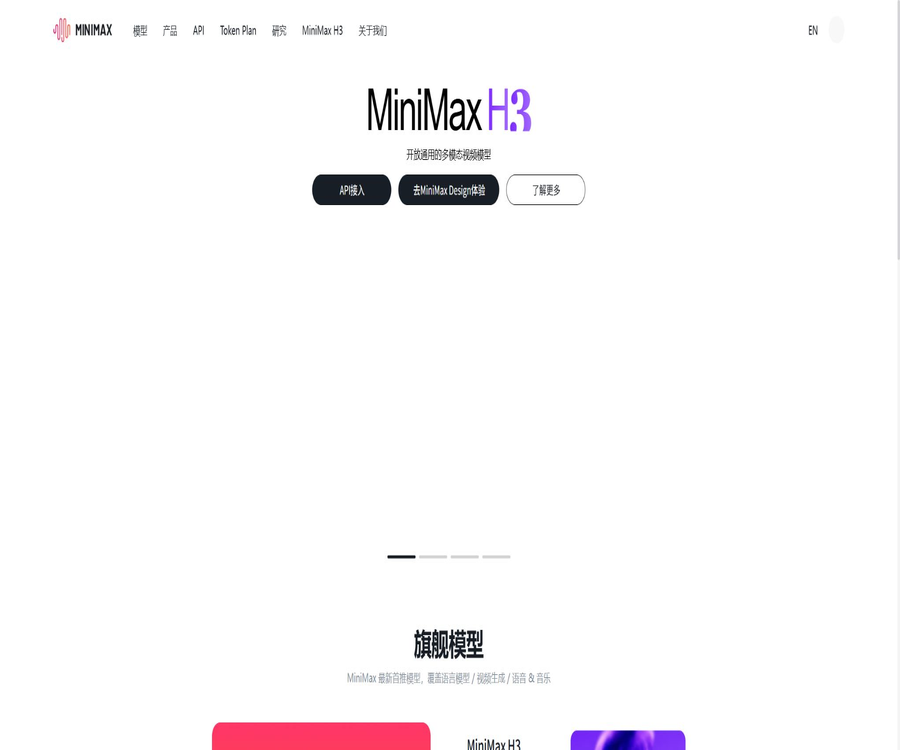
Minimaxi
Minimaxi, an intelligent tool focused on AI programming
Tags:AI programming toolsWhat is MiniMax?
MiniMax is a general artificial intelligence company founded in 2022, offering models for text, code, images, speech, music, and video. Its services are intended for both individual creators, developers, and corporate clients; the Chinese-language platform uses the MiniMax brand along with related product interfaces.
The current product portfolio includes MiniMax Code, MiniMax Design, MiniMax Audio, Talkie, as well as the open platform API. Users should distinguish between consumer-oriented application memberships, API pricing for developers, and the official open models – these options do not share the same set of packages.
MiniMax core model
| Model | Key capabilities | Typical uses | Current status |
|---|---|---|---|
| MiniMax M3 | Code, Agents, Long Contexts, and Multimodal Understanding | Programming agents, complex tasks, long documents | Current flagship language model |
| MiniMax M2.7 | Text reasoning, code, and Agent tasks | Application development and automation | The open platform is available for purchase. |
| MiniMax H3 | Multiple media types, audio and video, as well as video generation | Advertising, short videos, and content creation | Current flagship video model |
| Speech 2.8 | Natural speech synthesis | Podcasts, audiobooks, digital avatars, and customer service | Turbo and HD are available. |
| Music 3.0 | Music and song generation | Music scoring, songs, and musical composition | Provide product access points and open weights. |
| image-01 series | Text-to-image generation and reference image creation | Posters, concept art, and visual materials | The open platform charges per sheet. |
Main functions
1. Text, code, and Agents
M3 and M2.7 can handle tasks such as dialogue, reasoning, code generation, tool invocation, and agent workflows. M3 is noted for its ability to manage contexts involving millions of elements as well as its multimodal capabilities, making it suitable for working with large codebases, planning complex tasks, and carrying out operations on a continuous basis.
2. Video generation
H3 supports the creation of content by combining text, images, audio, and video materials, and charging is based on the output resolution and duration. The platform also offers an interface for converting content from 768P to 2K, as well as models designed for context understanding.
3. Speech synthesis and timbre
Speech 2.8 offers two text-to-speech options: Turbo and HD, and it provides control over parameters such as speech speed, tone, volume, and other audio settings. Developers can also use voice tone customization and rapid replication, but they must obtain explicit permission from the rights holders of those voices.
4. Images and music
The image interface allows for the creation of images based on text or reference images, while music-related tools are used for songs, soundtracks, and various creative projects. The models, quotas, and commercial terms may vary depending on the entry point used; therefore, it is not possible to determine the benefits associated with consumer product memberships based on API prices.
5. MiniMax Code
MiniMax Code is a product designed for programming and agent-based tasks; it enables the organization of agent teams, the learning of working habits, and the reuse of skills. It is better suited for understanding code libraries, carrying out tasks, and facilitating ongoing development, rather than just performing single-round code completion.
6. MiniMax Design
MiniMax Design is designed for commercial content creation, allowing it to combine generation models with content workflows. Brand, advertising, and social media content still require manual verification regarding facts, copyrights, permissions for using certain individuals’ images, and platform guidelines.
What use cases are suitable?
- Developer: Access text, code, image, voice, and video capabilities through APIs.
- Programmer: Uses Code to work with code libraries, fix issues, and organize Agent tasks.
- Content team: Creates ad scripts, posters, short videos, voiceovers, and music.
- Podcast and audiobook team: Generates multiple language voiceovers and character voices in bulk.
- Digital human applications: Create interactive experiences by integrating voice, video, and dialogue models.
- Games and social products: Generate character text, audio, images, and dynamic content.
- Corporate teams: Develop customer service tools, knowledge assistants, process automation solutions, and internal applications.
- Model researchers: Download the officially available weights and assess the capabilities in terms of inference and deployment.
What situations are not very suitable
- It is requested that AI generate outputs that can be used in medical, legal, or investment decisions without the need for any approval.
- There are no generation tasks that have obtained authorization for use of portraits, voices, music, or other materials.
- Organizations that cannot accept the processing of confidential data in the cloud and do not have a self-hosted solution.
- The budget is not sufficient to cover projects that involve high-resolution long videos and frequent calls to agents.
- Use the generated content as if it were real news, evidence, or original photography, and publish it directly.
- Teams that require complete open-source availability for all products, models, and training code.
MiniMax API Usage Guide
Create and test the API
- Register for an account on the open platform and complete the required authentication.
- Log in to the corresponding console based on your region, and create a regular API Key or a subscription Key.
- Choose Pay-as-you-go, Token Plan, or a point package, and check whether the desired model is included in the scope.
- Store the key in environment variables or a key management service, rather than in the frontend or public repositories.
- Send the minimal request using the official example to check the model name, input format, and output results.
- It records the actual usage of tokens, images, characters, video duration, and tool calls.
- Set the budget, concurrency limits, timeout values, retry settings, and content security policies before going live.
Access to video or voice
- First, determine the output duration, resolution, audio quality, and type of material.
- Confirm whether the target interface uses synchronous response or asynchronous tasks.
- Check the permissions for images, videos, music, people, and audio before uploading.
- Create a task and save its task number; use the document to check the processing status.
- After downloading the result, check the image, lip movements, subtitles, noise, and any abnormal content.
- The cost per transaction is calculated based on the actual number of seconds, characters, and additional materials.
- Keep manual review, copyright records, and AI content identifiers before publication.
Select the billing method
- Use a set of representative requests to measure the quality, speed, and resource consumption of each model.
- For low-frequency or variable usage, it is preferable to compare the pay-as-you-go balance with the credit packages.
- For the stable and high-frequency needs related to text, images, and audio, the Token Plan can be evaluated.
- Check whether special features such as H3, timbre design, and quick replication are excluded from the package.
- When the team is in use, it checks the seats, shared points, Key types, and quota limits.
- On the settlement page, verify the taxes and fees, renewal options, validity period, and refund policies.
Token Plan subscription price
As of August 19, 2026, the platform available in China offers three tiers of Token Plans – Plus, Max, and Ultra – on a monthly basis. These plans rely on subscription keys, and the amount of usage is limited by five-hour and weekly quotas; it is not an unlimited number of calls.
| Package | Monthly fee | Suitable scenarios | Official indication of Agent usage amount | Resource description |
|---|---|---|---|---|
| Plus | 49 yuan per month | Lightweight personal development and daily testing | 3 to 4 Agents | Shares for text, images, audio, etc. |
| Max | 119 yuan per month | High-frequency programming Agent and multimodal invocation | 4 to 5 Agents | Suitable for more ongoing development tasks |
| Ultra | 469 yuan per month | Intensive Agent workflows and long-term use | 6 to 7 Agents | The quota is still governed by the window rules. |
The package includes resources such as M3, M2.7, images, and audio, but a few special models like H3, tone design, and quick replication are not supported for now. The so-called number of agents refers to the values indicated in the official scenarios and should not be construed as a guaranteed concurrent usage limit.
Price of the points package
| Purchase price | Earn points | Conversion rules | Validity period |
|---|---|---|---|
| 30 yuan | 4,285 points | 1,000 points are equivalent to 7 yuan. | 365 days from the date of purchase |
| 150 yuan | 21,430 points | Deduction is made based on the price in the resource catalog. | 365 days from the date of purchase |
| 500 yuan | 71,435 points | The package quota takes precedence, with points covering any excess amount. | 365 days from the date of purchase |
Pay-as-you-go pricing for language models
The table below shows the discounted prices as indicated in the official Chinese documentation on the date of verification, with the unit being per million Tokens. The M3 page displays both the regular price and the permanently discounted price; the actual amount charged shall be based on what is shown in the console.
| Model | Enter | Output | Cache read | Notes |
|---|---|---|---|---|
| M3: Input should not exceed 512k. | 2.10 yuan | 8.40 yuan | 0.42 yuan | Standard service is currently 50% off. |
| M3: Input exceeds 512k | 4.20 yuan | 16.80 yuan | 0.84 yuan | Long-context segmentation |
| M2.7 | 2.10 yuan | 8.40 yuan | 0.42 yuan | Cache write: 2.625 yuan |
| M2.7-highspeed | 4.20 yuan | 16.80 yuan | 0.42 yuan | High-speed version |
M3 priority service is charged at 1.5 times the standard rate, which enhances the level of priority and reliability in access. There is no one-to-one correspondence between Chinese characters and Tokens; the official estimate is that approximately 1,600 Chinese characters correspond to 1,000 Tokens.
Prices for voices, images, and tools
| Resources | Model or interface | Price on verification date | Billing unit |
|---|---|---|---|
| Voice Turbo | speech-2.8-turbo | 2 yuan | Per 10,000 characters |
| Voice HD | speech-2.8-hd | 3.5 yuan | Per 10,000 characters |
| Timbre design | Voice Design | 9.9 yuan | Each sound color used for the first time |
| Quick replication | Voice Cloning | 9.9 yuan | Each sound color used for the first time |
| Image | image-01 series | 0.025 yuan | Each one |
| Visual tools | API-vlm | 0.025 yuan | Every time |
| Online search | web_search | 0.03 yuan | Every time |
Video API pricing
| Project | Resolution or type | Price | Explanation |
|---|---|---|---|
| H3 output | 768P | 0.50 yuan/second | Charged based on the length of the generated video |
| H3 output | 2K | 0.80 yuan/second | Charged based on the length of the generated video |
| 768P regenerated to 2K | 2K | 0.30 yuan/second | Recharge based on the original task’s input materials |
| Image materials | First 5 | Free | For any amount exceeding that, H3 is charged at 0.20 yuan per sheet. |
| Video footage | Based on input duration | 768P: 0.50 yuan per second; 2K: 0.80 yuan per second | Corresponds to the output resolution |
| H3 Context IR | Text Token | Enter 5.80 yuan; the output is 23 yuan. | Per million Tokens |
Adjustment of music API
According to the official pricing document, as of August 20, 2026, the paid music and lyrics APIs will no longer be available to new users, while existing paid users will be able to continue using them; the free music API will also cease to function. New users can turn to the MiniMax Audio product or the Music 3 model made available by the official team.
This adjustment takes place on the day following the verification date, and after it is implemented it is necessary to check again whether the document has indeed come into effect. Historical prices do not mean that new accounts can still use the corresponding APIs.
The difference between consumer products and APIs
| Entrance | Primary users | Billing method | Precautions |
|---|---|---|---|
| MiniMax Code | Programmers and Agent users | It is based on the current membership status or quota of the product. | Not equivalent to the open platform Token Plan |
| MiniMax Design | Commercial content creators | Subject to the product media package. | The rights related to videos and materials are verified separately. |
| MiniMax Audio | Voice and music creators | Refer to the product page. | Understand them separately from music API adjustments. |
| Talkie | Consumers and users who interact with roles | In-app benefits | Not equivalent to developer API |
| Open platform | Developers and enterprises | Pay-as-you-go, Token Plan, or Points | Use an API Key or subscription key. |
Product advantages
- It covers various modalities such as text, code, images, speech, music, and video.
- It also provides consumer products, developer APIs, and some open models.
- M3 is designed for long-context, code, and Agent workflows.
- H3 supports the input of various types of materials and video generation on a per-second basis.
- The voice model offers Turbo, HD, timbre customization, and quick replication.
- In the Chinese market, pricing is in RMB, with clear distinctions between package plans and pay-as-you-go options.
- Three options are available: Token Plan, point packages, and pay-as-you-go balance.
- The official GitHub page continuously releases models, tools, skills, and research projects.
Usage restrictions and precautions
- Consumer memberships, Token Plans, points, and pay-as-you-go balances cannot be considered as part of the same set of benefits.
- The Token Plan comes with five-hour and weekly usage limits, and calls cannot be made indefinitely.
- Resources such as H3, timbre design, and quick replication are not included in the current Token Plan.
- When videos are billed both per second and based on the amount of material used, the cost of long-duration tasks increases rapidly.
- When the M3 value exceeds 512k, it enters a higher price category.
- The model may generate incorrect facts, unsafe code, and abnormal visuals.
- Sounds, portraits, music, and training materials involve licensing and compliance responsibilities.
- The API will process the data submitted by users, and any confidential information must undergo a security assessment.
- Platforms in different regions offer different currencies, models, prices, and levels of service availability.
- The music API is in the adjustment phase; after it is released, its status needs to be verified again.
GitHub and the open-source status
On its official GitHub repository, MiniMax has made available projects such as M3, M2 series, H3, Music 3, Mini-Agent, MCP, and various skills. Different repositories may use licenses such as MIT, Apache 2.0, custom model licenses, or other terms; therefore, the license of one repository cannot be applied to all models and commercial products.
The MiniMax online products and open platform are not entirely open-source. Before downloading weights, deploying models, fine-tuning them, redistributing them, or providing commercial services, it is necessary to check the licenses in the respective repositories and model cards one by one.
Basic information
| field | Content |
|---|---|
| Tool name | MiniMax |
| Date of establishment | 2022 |
| Tool type | Multimodal large models, AI products, and open platforms |
| Flagship language model | MiniMax M3 |
| Flagship video model | MiniMax H3 |
| Speech model | Speech 2.8 Turbo and HD |
| Developer billing | Pay-as-you-go, Token Plan, Points Package |
| API | Provide |
| Open-source status | Some models and tools are available, but the entire platform is not open source. |
| Supports Chinese. | Yes |
Recommendation score
4.7 / 5. The MiniMax model offers a wide range of products, and the pricing in RMB for text, Agent, voice, and video APIs is fairly transparent; however, there are many changes regarding the product lineup, key types, package offerings, and music interfaces, so it is necessary to check each detail before making a purchase or starting development.
Frequently Asked Questions
Can MiniMax be used for free?
Some products may offer trial versions or limited amounts for special promotions, but to use the platform on a stable basis it is necessary to have a balance, a subscription plan, or points. The free amounts and promotional offers are subject to change; the details can be found in the console after logging in.
Does the Token Plan include H3 videos?
The current official documentation lists the MiniMax H3 as one of the few special models that are not supported. The cost of using video content with this model should be calculated based on the price for the H3 package or according to the available video subscription plans.
Is the API Key the same as the subscription key?
It’s different. A regular API Key is used for pay-as-you-go usage, while a subscription Key is used for the Token Plan and points; therefore, it is necessary to choose the appropriate key depending on the billing method during development.
Is MiniMax open source?
MiniMax has made available the weights of various models, as well as tools and research projects, but not all of the company’s products and its open platforms are fully open source; the license for each repository must be checked separately.
Is it possible to clone anyone’s voice?
It is not allowed. Replicating timbres raises issues related to personal rights, privacy, copyright, and fraud risks; therefore, explicit authorization is required, and the use of such replicated timbres must comply with the platform’s rules.
How to estimate the cost of video generation?
First, multiply the number of seconds of output by the price per unit for that resolution, and then add the cost associated with any images or videos that exceed the free quota. When the output is resized to 2K, the original input materials will be charged again.
Can the music API still be used?
The official documentation indicates that, starting from August 20, 2026, paid music and lyrics APIs will no longer be available to new users, and the free music interface will cease to function. Existing paid users, Audio products, and open models require separate consideration.
Tools similar to Minimaxi



 Guigong Network Security Registration No. 45132202000164