






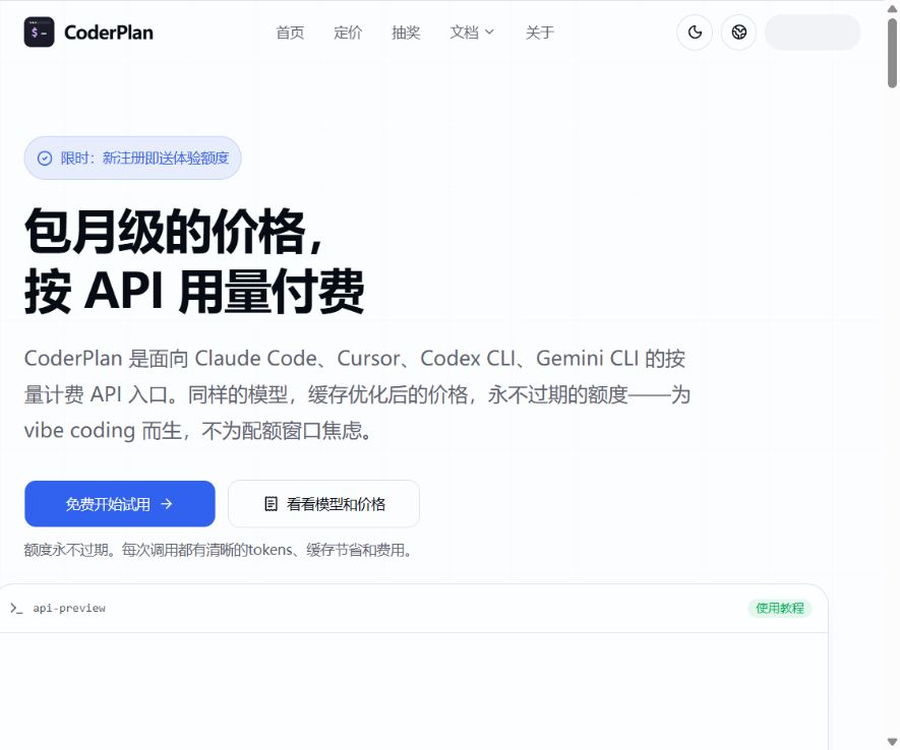
CoderPlan
CoderPlan, an intelligent tool focused on AI programming.
Tags:AI programming toolsWhat is CoderPlan?
CoderPlan is a multi-model API gateway designed for AI programming tools and developers. It brings together dozens of models such as Claude, GPT, Gemini, Grok, Kimi, DeepSeek, and MiniMax under one account, charging fees based on the actual amount of usage.
Users can configure it in tools such as Claude Code, Codex CLI, Cursor, or Gemini CLI. CoderPlan is responsible for forwarding requests, tracking usage, and handling billing; however, it is not a code editor nor an independent AI programming agent.
The relationship between CoderPlan and AI programming tools
| Project | The role played by CoderPlan | The interface actually used by the user |
|---|---|---|
| Claude Code | Provides Anthropic-compatible model request and billing services. | Claude Code terminal |
| Codex CLI | Provides OpenAI-compatible model request and billing services. | Codex CLI terminal |
| Cursor | As a configurable third-party model endpoint | Cursor editor |
| Gemini CLI | Offers optional models and a unified balance. | Gemini CLI terminal |
| Self-built applications | Receive requests via compatible APIs and return model results. | The user’s own web pages, scripts, or services |
Therefore, the main value of CoderPlan lies in connecting to and managing models, rather than replacing those tools. Whether a particular model can be used, or whether tool invocation or caching capabilities are available, depends on the client version and the support provided by the current gateway.
Core functions
Unified model interface
CoderPlan offers both interfaces that are compatible with OpenAI and those that are compatible with Anthropic. For existing projects, it is usually sufficient to change the API address, the model name, and the key – there is no need to rewrite the entire logic for calling the models.
Multi-model switching
One account can invoke various models from different model providers. Developers can switch between models depending on tasks such as code generation, complex reasoning, rapid completion, and cost control.
Pay-as-you-go
The platform does not require a fixed monthly fee; the cost is calculated based on actual usage such as data input, output, and cache reads. The price per model varies according to the policies set by upstream providers and the platform itself, and it is the price displayed in the console at the time of invocation that serves as the basis for billing.
Sequential call records
Each request is logged with information on the model used, the input and output tokens, cache reads, charges incurred, and changes in balance. Developers can use this information to identify abnormal consumption patterns and compare the costs of using different models to complete the same task.
The top-up balance remains valid for an extended period.
The official pricing page states that the top-up amount does not expire, making it suitable for individual developers whose usage frequency is not consistent. It is still advisable to check the current rules regarding refunds, account suspension, and balance handling before making a purchase.
List of main functions
- Use a single account to manage multiple model services, thereby reducing the need for repeated top-ups and key changes.
- It is compatible with the common request formats of OpenAI and Anthropic, facilitating the migration of existing tools.
- It supports AI programming clients such as Claude Code, Codex CLI, Cursor, and Gemini CLI.
- Charging is based on input, output, and cache read volumes, so there is no need to purchase a fixed monthly plan.
- It displays the log of individual requests, facilitating tracking of the model, token quantity, costs, and balance.
- Multiple top-up options are available, and the amount that has been topped up does not expire according to the official guidelines.
- A trial credit is available after registration; the actual amount will be indicated on the new account page.
What use cases are suitable?
- Individual developers who often switch between models such as Claude, GPT, and Gemini.
- Users of AI programming tools such as Claude Code or Codex CLI who wish to set a unified balance.
- Product teams that need to quickly compare the code quality, speed, and per-use cost of different models.
- Prototypes are being developed for chat, content generation, code assistance, or automated workflows.
- Small teams that wish to focus on reviewing model invocation records without having to manage bills from multiple vendors.
- Ideal for learners and independent developers whose usage is inconsistent, and who prefer to pay based on actual consumption.
It is not very suitable for which users
- Companies that must enter into a direct contract with the model’s manufacturer and obtain its official service level agreement.
- Organizations with strict requirements regarding data residency, auditing, industry compliance, and the supply chain.
- Projects that require local deployment, operation offline, or operation without any third-party gateway.
- It is unacceptable for intermediate services to potentially introduce delays, failure points, and additional steps in data processing.
- Teams that stick to using only one specific model and have already obtained a more favorable original manufacturer price or corporate discount.
Methods for configuring OpenAI-compatible tools
- Register and log in to CoderPlan, then obtain a trial quota or top up funds from the console.
- Create a dedicated API key; do not store the key in public code repositories.
- In the client, select a custom OpenAI-compatible service and enter the interface address provided by the platform.
- Enter the API key and the names of the models currently supported by the console.
- Send a short test request first to confirm that streaming output, tool calls, and error handling are working properly.
- Return to the call log to check the model, the number of tokens, cache hits, and the actual charges incurred.
Configuration method for Claude Code
- Generate a key specific for Claude Code in the CoderPlan console.
- Set the Anthropic-compatible interface address and authentication details in accordance with the official integration instructions.
- Select the currently available Claude model; do not use the names of older models that are no longer in use.
- Reopen the terminal session to apply the new environment settings.
- Use small projects that do not contain sensitive code to test reading, editing, and command invocation.
- Check the call logs and balance to ensure that there are no unexpected loops or repeated requests from the client.
Reference for current model prices
The following are the prices of some models as displayed on the official pricing page during verification; the unit is per 1 million tokens. The platform adjusts the models and discounts dynamically, so it is necessary to recheck these details in the control panel before actual use.
| Model | Enter price | Output price | Cache read | Page scale indicator |
|---|---|---|---|---|
| GPT-5.6 Sol | ¥1.75 | ¥10.50 | ¥0.18 | 0.35x |
| GPT-5.6 Terra | ¥0.70 | ¥4.20 | ¥0.07 | 0.35x |
| Claude Opus 5 | ¥2.50 | ¥12.50 | ¥0.25 | 0.5x |
| Claude Sonnet 5 | ¥1.00 | ¥5.00 | ¥0.10 | 0.5x |
The low magnification level and the savings percentage are indicators of the platform’s efficiency in terms of routing and caching; they should not be interpreted as meaning that all tasks will receive the same discount. When comparing costs, it is also necessary to take into account factors such as response quality, the number of retries, the length of the context, and the cache hit rate.
Recharge levels
The official website uses a payment system based on RMB, with the account balance being displayed in US dollars; it is stated that a top-up of 1 RMB corresponds to 1 US dollar worth of account balance. Current top-ups are processed by Stripe, and international bank cards are accepted; availability of invoices for mainland China should be confirmed before making a payment.
| Payment amount | Obtain the quota | Validity period |
|---|---|---|
| ¥50 | $50 | The official statement remains valid indefinitely. |
| ¥150 | $150 | The official statement remains valid indefinitely. |
| ¥350 | $350 | The official statement remains valid indefinitely. |
| ¥700 | $700 | The official statement remains valid indefinitely. |
Page prices, payment methods, and conversion rules may change; the details listed on the settlement page shall prevail. It is recommended to obtain a trial credit or choose a lower package for the first use, and then decide whether to top up based on the actual usage needs.
How to understand billing and caching?
- The input tokens include prompts, system instructions, historical conversations, and the code context sent to the model.
- The output tokens are text, code, and tool invocation content generated by the model.
- Cache reading can reduce the cost of processing repeated contexts, but not every request will hit the cache.
- AI programming tools can automatically read multiple files, and the amount of data entered is usually greater than when questions are asked manually.
- Agent loops, retry on failure, and parallel tasks significantly increase the number of calls.
- The actual charges as recorded in the daily logs should be taken as the basis, rather than estimating the cost based solely on the number of words in the conversations.
Suggestions for cost control
- Keys are created separately for the development, testing, and production environments, which helps in identifying abnormal usage.
- First, compare the models using short tasks, and then integrate large codebases and complex agents into the platform.
- Restrict the sending of irrelevant files, and reduce overly long historical conversations as well as repeated contexts.
- Regularly check the call logs, paying attention to high output, low cache hit rates, and repeated attempts.
- Set a maximum number of steps, timeout period, and budget limit for automated tasks.
- Alerts are issued when the balance is insufficient or before a price adjustment, to prevent sudden interruptions in production tasks.
Product advantages
- A single account allows you to use multiple models, making it suitable for model evaluation and rapid prototyping.
- It is compatible with common API formats, resulting in minimal effort required to migrate existing AI programming clients.
- There is no need for a fixed monthly fee; users who use the service infrequently can pay based on the actual amount of usage.
- The call logs are detailed by model, token, and cost, making it easier to track expenses.
- The top-up amount remains valid for an extended period as specified by the officials, which helps to reduce waste of monthly credits.
- It provides clear use cases for integrating with Claude Code and Codex CLI.
Usage restrictions and precautions
- CoderPlan is a third-party transit gateway; it is not the same as purchasing APIs directly from the manufacturer of the model.
- The list of models, prices, routing options, speed limits, and available regions may change at any time.
- The gateway handles prompts, code context, model outputs, and usage information.
- Intermediate services add layers of availability and latency concerns, requiring production systems to have fallback plans in place.
- The source of the models displayed on the platform, as well as the discounts and percentage savings, are part of the service details; users still need to conduct their own tests.
- Tool calls, streaming responses, long contexts, and caching behavior may differ from those of the original vendor’s interfaces.
- The rules regarding balance refunds and account closure should be confirmed prior to making large deposits.
- For projects that require strict compliance, written explanations regarding data processing, retention periods, and subcontractors must be obtained first.
Key and code security
- Store API keys only in environment variables or a controlled key manager.
- Do not write the key in code, screenshots, logs, front-end pages, or public repositories.
- Different projects use different keys; once a key is compromised, it is immediately revoked and replaced with a new one.
- During testing, masked code is used; passwords, tokens, customer data, and confidential business information are not sent.
- Before enabling detailed client logging, check whether the full prompt and source code will be recorded.
- Before going live, verify the model’s identity, output quality, rate limits, failure retry mechanisms, and data retention policies.
Official GitHub and open-source status
CoderPlan’s official GitHub organization has made available tutorials on how to integrate tools such as Claude Code, Codex, and Cursor, as well as projects related to relaying. These repositories help in understanding the configuration process; however, there is no evidence that the online gateway, billing system, and core backend have been fully made open source.
The open-source status indicated in the catalog should show that the platform itself is not open source, while some tutorials and integration projects are available publicly. It is necessary to examine each repository individually with regard to its license, level of activity, and security; merely having an organization’s account in a repository does not mean that the service can be deployed privately.
Platform and service status
| Project | Current situation |
|---|---|
| Web console | Provides registration, keys, balance, top-up, and call logs. |
| OpenAI-compatible API | Available, compatible with Codex CLI, Cursor, and custom applications |
| Anthropic-compatible API | Available, compatible with clients such as Claude Code. |
| Local client | There is no independent client; it primarily connects to third-party tools. |
| Official GitHub | Public access tutorials and some relay-related repositories |
| Is it fully open source? | No, the complete open-source code for the core online gateway has not been found. |
Basic information
| field | Content |
|---|---|
| Tool name | CoderPlan |
| Tool type | Multi-model API gateway, AI programming model services |
| Support tools | Claude Code, Codex CLI, Cursor, Gemini CLI, and others |
| Model scope | Claude, GPT, Gemini, Grok, Kimi, DeepSeek, MiniMax, and others |
| Price pattern | Register for a trial, pay-as-you-go, top up balance |
| Fixed monthly fee | None |
| Whether API is provided | Yes, it is compatible with OpenAI and Anthropic formats. |
| Is it open source? | The platform is not open-source; some tutorials and integration repositories are available publicly. |
Recommendation score
4.2 / 5. CoderPlan is suitable for developers who wish to use a single account to connect to multiple models and control the costs associated with AI programming; however, third-party gateways introduce additional risks related to data processing, service continuity, and the verification of the origin of the models.
Frequently Asked Questions
Is CoderPlan an AI programming software?
No. It is an API gateway that provides model invocation and unified billing for tools such as Claude Code, Codex CLI, and Cursor; the actual programming interfaces are still provided by these clients.
Is a subscription required for CoderPlan?
There is no need for a fixed monthly subscription. The platform charges based on the actual amount of data input, output, and cached, after a top-up is made; the trial credit amount and the real-time price are specified in the control panel.
Does the top-up balance expire?
The official pricing page states that the top-up amount does not expire. As account and refund policies may change, it is still advisable to check the latest terms before making large top-ups.
Can it be used with Claude Code and Codex CLI?
Yes. The platform offers access methods compatible with Anthropic as well as OpenAI, but the model names, tool calls, and client versions must be configured in accordance with the instructions provided in the current documentation.
Is CoderPlan safe?
Acting as an intermediate gateway, it handles prompts, code, and model outputs; therefore, it cannot be considered equivalent to a direct connection to the original manufacturer. For sensitive projects, it is necessary to first examine policies regarding privacy, data retention, subcontractors, and compliance.
Is CoderPlan open source?
The online gateway and billing platform are not fully open source. The official GitHub repository provides some setup tutorials as well as repositories related to relaying, but this does not mean that the core services can be deployed in a private environment.
Tools similar to CoderPlan



 Guigong Network Security Registration No. 45132202000164