






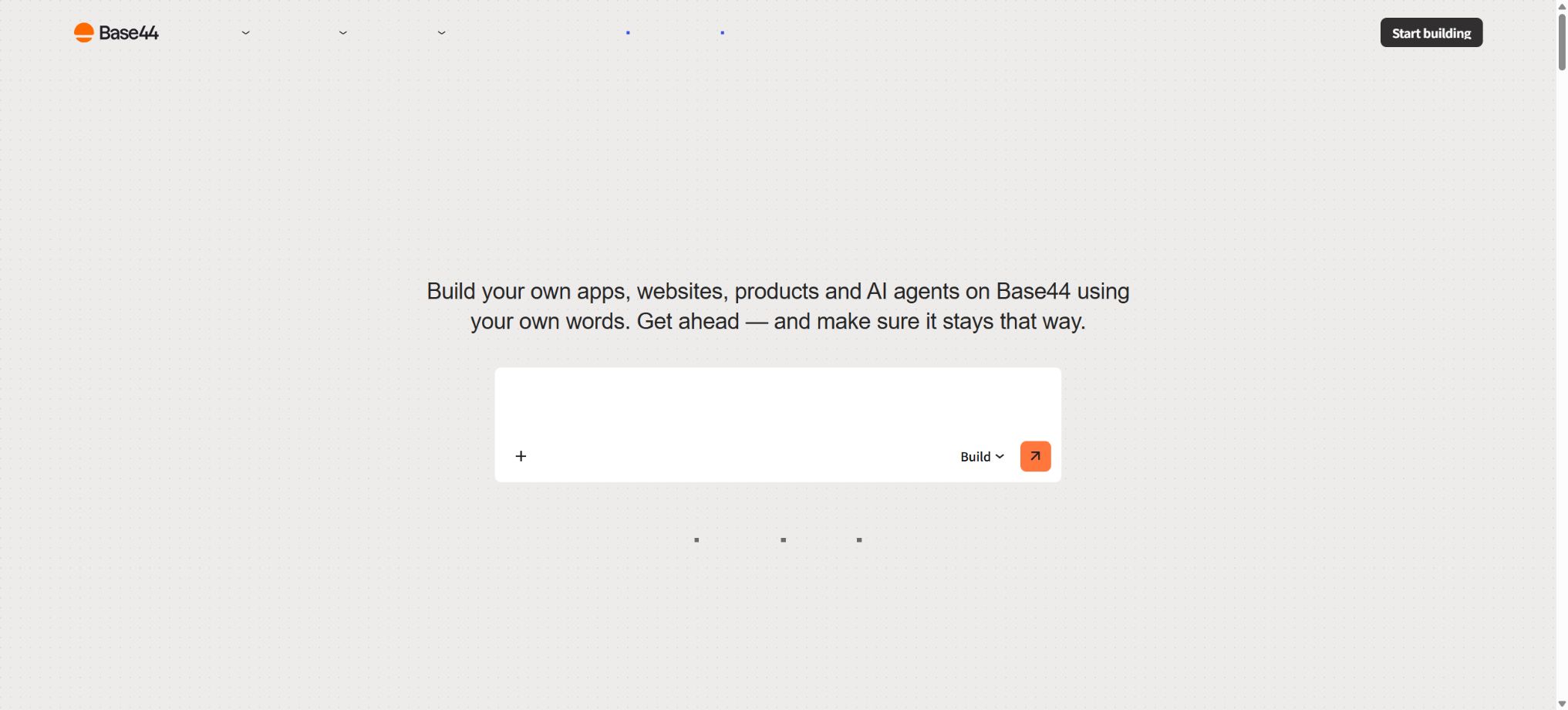
Base44
An AI platform that enables the creation and deployment of complete web applications using natural language.
Tags:AI programming toolsWhat is Base44?
Base44 is an AI full-stack application development platform driven by natural language. After users describe their business requirements, the system can generate a web interface, data entities, user login mechanisms, permission settings, backend functions, file storage solutions, as well as a deployment environment. It is suitable for creating internal tools, customer portals, membership systems, administration backends, directory websites, booking applications, and SaaS prototypes.
It is usually classified as part of AI-based no-code development tools or Vibe Coding tools, but it is not limited to generating static pages only. Base44 provides a hosted backend and an environment for running applications, allowing users to modify projects through conversations, visual editors, or code editors.
Wix has completed the acquisition of Base44, and it is now part of Wix’s portfolio of AI products.
Full-stack application for natural language generation
When creating a project, users can specify who the application is intended for, which pages are needed, what data fields are required, what role permissions should be in place, and what the business processes are. The AI will set up the React and Vite frontends and configure the Base44-based backend for hosting.
Subsequently, additional requests can be made to modify the layout, add elements, integrate services, or fix issues.
High-quality prompts should specify the user role, page structure, data relationships, success criteria, and error handling. A general idea expressed in just one sentence can usually result in a demonstration prototype, but for production applications it is still necessary to verify permissions, data integrity, payment status, and boundary conditions one by one.
Visual interface editing
Base44 offers visual editing capabilities; users can select page elements and adjust text, colors, spacing, layout, and various component properties. It is suitable for operations, product, and design staff who are not familiar with front-end coding, and it also helps to reduce the need to consume AI message credits for minor style adjustments.
Even after making visual adjustments, it is still necessary to check the responsive behavior on desktop and mobile devices, keyboard navigation, contrast levels, and error messages related to forms. Just because the resulting interface appears complete does not mean that its accessibility and performance across all screen sizes have been tested.
Code editing and activity monitoring
The paid plan offers in-app code editing, allowing developers to view and modify the generated frontend code. Activity monitoring enables the tracking of function executions, requests, and errors, which helps in identifying integration failures, permission issues, and operational abnormalities.
Directly modifying the code provides more flexibility, but it may also interact with subsequent AI-driven modifications. For important projects, version control, testing environments, and a clear release process should be used; online previews should not be relied on as the only form of backup.
Databases and data entities
Base44 manages structured data through an Entities framework. Users can create entities such as customers, orders, tasks, inventory, and articles, define their fields and relationships, and perform operations like adding, querying, updating, deleting data, as well as setting up real-time subscriptions from the frontend.
The platform is responsible for hosting databases and common data interfaces.
When creating a table, it is necessary to distinguish between public data, data belonging to logged-in users, and data belonging to administrators. Just having fields does not ensure security; rules must be set separately for reading, creating, modifying, and deleting data, and it is also important to test whether ordinary users can access the records of other people.
User login and permissions
- The platform includes built-in identity authentication and user management capabilities, which are used for registration, logging in, inviting members, and displaying functions based on roles.
- By combining data access rules, it is possible to create a member area, a team workspace, and multi-role business systems.
- When it comes to organizational isolation, payment permissions, or sensitive data, server-side authorization should be implemented – it is not sufficient to simply hide buttons on the frontend.
- Administrators or service roles can bypass regular permissions; such capabilities should be used only within backend functions, and under no circumstances should they be included in public frontend code.
Backend functions and business logic
Backend functions are used to handle logic that is not suitable for execution in the browser, such as calling third-party APIs that require keys, processing payment callbacks, sending emails, generating reports, and executing scheduled tasks. The new version also offers capabilities such as multi-file functions, code sharing, and runtime keys.
Functions should include input validation, permission checks, timeout handling, retry mechanisms, and idempotent processing. Any price data, user identity, or role information provided by the client should not be trusted outright.
Integration and connectors
Base44 can connect emails, payment systems, files, CRM platforms, collaboration tools, and AI services; it also supports the creation of custom integrations based on OpenAPI specifications. The connectors can either provide shared accounts supplied by the application developers, or each end user can authorize their own account.
Before establishing the connection, it is necessary to verify the OAuth permissions and the scope of data access. A shared connection means that all related operations within the application are carried out through the same account.
User connections are more suitable for scenarios where access to external services is required on a personal basis.
Payments, emails, and documents
Applications can incorporate common functionalities such as payment processing, email notifications, file uploading, and cloud storage. They are suitable for use in subscription-based products, order management, registration systems, and customer data management; however, third-party services may require a separate account and incur additional costs.
Payment applications must verify server-side callbacks and maintain the status of transactions; the email functionality needs to handle replies, unsubscriptions, and the domain names from which emails are sent. When it comes to file uploads, restrictions must be placed on file type, size, and access rights. The Base44 encoding process cannot replace these security checks related to business operations.
AI features and AI Gateway
Base44 enables text generation, image generation, and intelligent agents within applications; it also allows connection to external AI services such as OpenAI, Claude, Groq, and Mistral via keys. The AI Gateway provides a unified way to invoke models for backend code, facilitating the integration of AI capabilities into business applications.
Model invocation typically involves both Base44 encoding fees and charges for model services. Before going live, it is necessary to set limits on the number of inputs per transaction, daily requests, and attempts at retrying failed requests; moreover, customer privacy data or trade secrets should not be sent to unverified model providers.
Two-way synchronization on GitHub
Solutions from Builder and above support connecting applications to GitHub. The initial connection must be carried out by the application owner, after which the project code will be synchronized automatically.
Local modifications, once merged into the branch named main, can be returned in Base44 format; currently, it is not possible to use the master branch as a substitute.
Even after the code is synchronized, it still needs to be published manually in Base44 format; merging it into GitHub does not mean that it has been updated in the production environment. Connecting to GitHub also changes the way version history is managed, and there are restrictions related to repository names when connecting or disconnecting. It is necessary to read the current instructions and create backups before carrying out such operations.
Code export and migration boundaries
Official statements indicate that users own their own code, data, and accounts, and can obtain the project source code via GitHub. This reduces the risk of the front-end code being completely locked down, and it also facilitates local development and code review.
However, the React and Vite frontends that are exported may still rely on a Base44 backend, authentication mechanisms, entities, functions, and environment variables. If migrating to another cloud service, it is necessary to rebuild the database, login systems, permission settings, storage solutions, functions, and deployment processes from scratch.
The fact that the source code can be exported does not mean that the entire application can run independently of the platform with just one click.
Publishing, hosting, and custom domain names
Base44 is responsible for application hosting and online deployment; users can preview the application in the editor before uploading it manually. Plans starting with Builder include the option to use a custom domain name, and the official pricing page indicates that eligible plans come with a free domain name for the first year.
Before the official release, it is necessary to distinguish between preview and production configurations, and to check the domain name, HTTPS setup, search engine indexing, privacy policy, analytics code, as well as rollback procedures. Domain name renewal and certain external services are not necessarily included in the subscription cost.
Mobile apps
Applications generated using Base44 are, first and foremost, responsive Web applications. The platform offers capabilities for mobile deployment or file submission for eligible paid plans, thereby assisting projects in entering the distribution process for iOS and Android.
The review process in app stores is still carried out separately by Apple and Google. Features such as cameras, notifications, background tasks, in-app purchases, privacy settings, and native interactions require separate verification; it should not be assumed that just because an app is ready for submission, it will necessarily pass the review or offer a complete native user experience.
Team collaboration and version control
The platform supports collaborative editing by multiple users, project sharing, and version tracking, making it suitable for product, design, development, and business professionals to work together on the same application. The team should first agree on who is allowed to modify the data structure, who can publish changes, and how to review those changes generated by AI.
Multiple people modifying something at the same time can lead to conflicts, and AI systems may also rewrite existing components in order to meet new requirements. Important versions should have their commits preserved on GitHub, along with notes detailing the release.
Analysis and security checks
Base44 offers capabilities for application analysis, logging, and security scanning, which can help identify dependencies, static code, keys, and common configuration issues. The enterprise version also provides features such as single sign-on, advanced security measures, and dedicated support.
Automatic scanning covers only some of the risks. Applications that serve real customers still require permission testing, dependency auditing, data backup, compliance with privacy regulations, and manual code review, especially in areas such as payments, healthcare, finance, and internal corporate data.
CLI, SDK, and developer platform
Developers can use the Base44 CLI to create, log in to, link, and deploy projects locally; they can also access entities, authentication mechanisms, functions, integrations, logs, and real-time data through the JavaScript SDK. Official SDKs and examples are available for languages such as Swift and Kotlin, and the hosted backend can be used in conjunction with a custom frontend.
The service roles of the SDK bypass normal data permissions and can only be placed in trusted backends. The frontend should utilize the permissions of the currently logged-in user, and the keys should be stored in the platform’s Secrets section or in a separate key management system.
MCP and Agent Skills
The official developer resources provide an MCP service for project management and document retrieval; Agent Skills are released on GitHub to help coding agents understand Base44 CLI, SDKs, data permissions, and troubleshooting procedures. These capabilities are suitable for developers who use AI programming agents to maintain Base44 projects.
MCPs and skills expand the range of tools available to agents; it is necessary to restrict project, account, and write permissions, and to require manual approval before deployment and data changes.
Price and version comparison
| Package or version | Prices, quotas, and core benefits |
|---|---|
| Free version | The Free plan costs $0; it provides 25 message credits and 100 integration credits per month, allows for the creation of up to 5 applications, and includes core functionalities such as authentication, databases, and analysis. It is suitable for testing products and developing small prototypes. The free version offers a limited number of messages, and it does not include full code editing capabilities, GitHub synchronization, or the option to use a custom domain name. Complex requirements may result in the consumption of multiple messages during debugging. |
| Starter price | When purchased on an annual basis, the Starter plan amounts to 16 dollars per month; it includes 100 message credits and 2,000 integration credits per month, and allows for the creation of an unlimited number of applications as well as code editing within those applications. The monthly pricing is higher, with the official statement indicating that an annual payment offers a 20% discount overall. The Starter plan is suitable for continuously developing multiple prototypes, but it does not include advanced features such as GitHub synchronization, model selection, and custom domain names that are available in the Builder plan. |
| Builder price | When billed annually, Builder amounts to 40 dollars per month; this plan includes 250 message credits and 10,000 integration credits per month, in addition to the option to choose models, a custom domain name, a free domain name for the first year, 25 sharing credits, and GitHub integration. Individual developers who need code synchronization, a proper domain name, the ability to develop locally, or integration with external AI services should generally consider Builder as an option. It is also necessary to check the requirements of the current plan when using connectors and backend payment features. |
| Prices for Pro, Elite, and Enterprise | For Pro, the annual pricing amounts to 80 dollars per month; it includes 500 message credits and 20,000 integration credits, as well as advanced features and access to some early access options. Elite costs 160 dollars per month, offering 1,200 message credits and 50,000 integration credits, in addition to enhanced support. Enterprise pricing is based on individual requirements and includes customizable credits, a dedicated architect, single sign-on, advanced security measures, and customer support services. For large-scale applications, it is necessary to inquire about the number of end users, usage levels, desired level of support, and data governance policies. |
Free version
The Free plan costs $0; it provides 25 message credits and 100 integration credits per month, allows for the creation of up to 5 applications, and includes core functionalities such as authentication, databases, and analysis. It is suitable for testing products and developing small prototypes.
The free version allows for a limited number of messages, and it does not include full code editing capabilities, GitHub synchronization, nor the option to use a custom domain name. Complex tasks may require multiple messages during the debugging process.
Starter price
When purchased on an annual basis, the Starter plan amounts to 16 dollars per month; it includes 100 message credits and 2,000 integration credits per month, and allows for the creation of an unlimited number of applications as well as code editing within those applications. The price for a monthly subscription is higher, with the official statement indicating that an annual payment offers a 20% discount overall.
Starter is suitable for continuously creating multiple prototypes, but it does not include the advanced features such as GitHub synchronization, model selection, and custom domain names that are available with Builder.
Builder price
When paid on an annual basis, Builder costs $40 per month; this plan includes 250 message credits and 10,000 integration credits per month, as well as the option to choose models, a custom domain name, a free domain name for the first year, 25 sharing credits, and GitHub integration.
Individual developers who need code synchronization, a proper domain name, options for local development, or integration with external AI systems should generally start by evaluating Builder. When using connectors and backend payment features, it is also necessary to check the requirements of the current solution.
Prices for Pro, Elite, and Enterprise
When paid annually, Pro costs 80 dollars per month; it includes 500 message credits and 20,000 integration credits, as well as advanced features and access to some early access options. Elite costs 160 dollars per month, offering 1,200 message credits and 50,000 integration credits, in addition to advanced support.
Enterprise offers quotes on demand, and it is possible to configure points, dedicated architects, single sign-on, advanced security features, as well as a customer support team. For large-scale applications, it is necessary to inquire about the number of end users, usage levels, the level of support required, and the rules regarding data management.
Message points and integration points
Message credits are used to establish AI interactions with applications; different operations and models may require different amounts of these credits. Integration credits are used for external services and platform operations that take place during the execution of an application, and the amount required varies depending on the specific function.
The quota is usually refreshed on a monthly basis, and paid users can purchase additional points.
When evaluating costs, don’t consider only the monthly fee. Frequent generation, debugging, emails, AI inference, and automation result in ongoing usage; it is necessary to monitor the actual consumption through the activities and usage page.
Third-party fees
Third-party services such as Stripe, SendGrid, and OpenAI are billed separately by their respective providers; domain name renewals and fees associated with app stores may also apply. A Base44 subscription does not mean that these services are available indefinitely at no cost.
Before the official launch, it is necessary to estimate together the costs related to platform subscriptions, additional points, model tokens, payment fees, email services, domain names, and operational support.
Is it open source?
The online builder for Base44, as well as its hosted backend and core platform, are not fully open-source products. The official GitHub repository provides a CLI, JavaScript SDK, mobile SDKs, Agent Skills, and example applications; some of these repositories are licensed under open-source licenses such as MIT.
Making development tools available publicly does not mean that platform services, generation models, or all of the backend source code are made public as well. In the catalog, Base44 should be labeled as a closed-source SaaS product, with it being noted that official open-source SDKs and tools do exist.
Base44 Usage Tutorial
Complete a basic task.
- Define the code tasks to be carried out in Base44, the scope of the repository, and the acceptance criteria.
- Connect to or import the test project, and first back up the current branch;
- First, use natural language to create a plan for generating the full-stack application, and then verify the modified files.
- Use a visual interface to make minor edits;
- Run tests, static checks, and builds; unverified code is not accepted directly.
- Manually check permissions, keys, dependencies, and handle exceptions before merging;
Create reusable professional workflows
- Select a low-risk, real-world project as a template;
- Fix the order of use for full-stack applications for natural language generation, visual interface editing, code editing, and activity monitoring;
- Record the environment, model, prompts, and failure conditions;
- Set up manual approval for write, deploy, and delete actions;
- Compare speed, cost, test pass rate, and the amount of rework;
- Expand to a team or production environment only after stability has been verified;
Which users is it suitable for?
- Entrepreneurs who wish to quickly test SaaS solutions, portals, or internal tools;
- Products and operators that need to build database applications using natural language;
- Independent developers who wish to combine visual editing with code control;
- Technical teams that require GitHub synchronization, SDKs, and custom front-ends;
- Service providers that deliver prototypes and business automation applications to clients.
Product advantages
- Integrated creation from the interface to the database, as well as for authentication and hosting;
- Code-free, visual editing, and code modification can be used in combination;
- Built-in data entities, functions, connectors, and analysis capabilities;
- Above the Builder version, two-way synchronization with GitHub and custom domain names are supported;
- Provides CLI, SDK, MCP, and Agent Skills;
- The free version allows you to verify the overall approach of the application directly.
Restrictions and Precautions
- The free points are limited, and they may be used up quickly during complex debugging processes.
- Running the application also incurs integration fees and third-party costs, so the cost cannot be assessed solely based on the subscription price.
- AI-generated applications may suffer from issues such as unauthorized access, data exposure, incorrect payment status, and dependency risks.
- Before going live, it is necessary to test permissions, backups, logging, privacy, and failure handling procedures;
- Exporting the front-end source code does not mean that the back-end can be migrated without any cost;
Frequently Asked Questions
Is Base44 free?
There is a free version that provides 25 message credits and 100 integration credits per month, allowing the creation of up to 5 applications; features such as code editing, synchronization with GitHub, and custom domain names require an upgrade.
What can be developed with Base44?
It is suitable for use in management backends, customer portals, membership systems, booking applications, catalogs, internal tools, and SaaS prototypes; it can also incorporate database functions, login systems, payment capabilities, email services, and AI features.
Can Base44 be used to export code?
Versions Builder and above allow for the synchronization of project code via GitHub, but the exported frontend may rely on a Base44-based backend; migrating the database, handling authentication, and managing functions require additional development work.
How much is Base44?
The annual price equivalents are: Starter at $16 per month, Builder at $40 per month, Pro at $80 per month, and Elite at $160 per month; for Enterprise, a quote is required as the monthly cost is higher.
Is Base44 Wix’s?
Yes. Wix has officially acquired Base44, and it is now part of Wix’s portfolio of AI application development products.
Is Base44 open source?
The core hosting platform is not open source, but the developers have made available on GitHub various development tools such as CLI, SDKs, skills, and examples; the specific licensing terms apply to each respective repository.
Tools similar to Base44



 Guigong Network Security Registration No. 45132202000164