






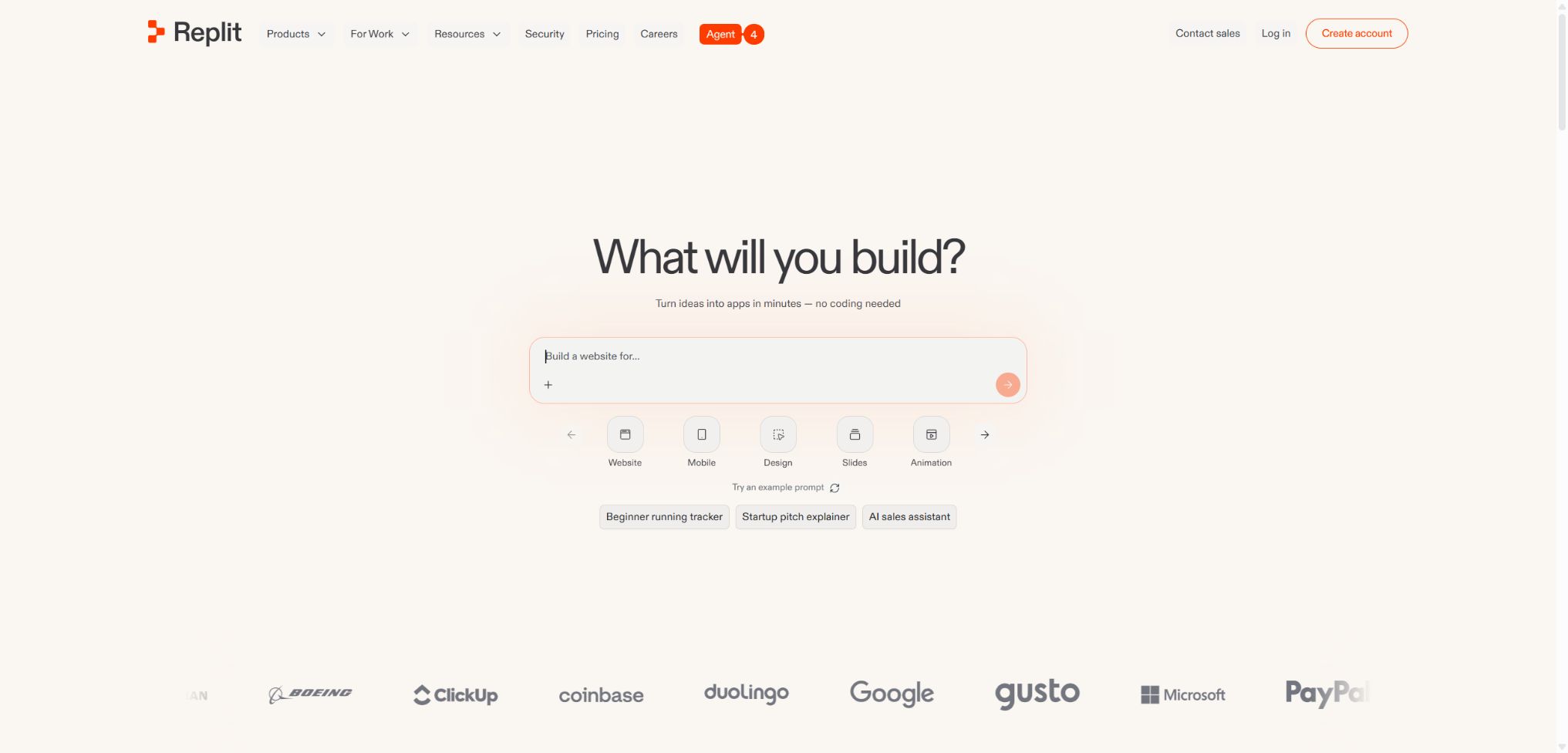
Replit
Use Replit Agent to build, test, and deploy applications from an idea.
Tags:AI programming toolsWhat is Replit?
Replit is a development platform that combines AI-driven application creation, cloud-based code editing, collaboration, and deployment. Users can start by using prompts, templates, or GitHub repositories, and then carry out writing, running, debugging, and deploying tasks in the browser.
Replit Agent can plan tasks, modify code, invoke tools, and fix errors; its outputs are not limited to websites. It is now also possible to create mobile interfaces, data visualizations, slides, videos, and AI Agents within the same project, while allowing for the sharing of backends and data.
Main features of Replit
- Generate runnable full-stack applications from ideas using natural language;
- The cloud editor includes a terminal, preview functionality, package management, and version control;
- The Agent supports Plan, Lite, Economy, Power, and Pro-specific Turbo options;
- Multiple Agent tasks can be started in parallel to handle different functions;
- It includes PostgreSQL databases for development and production, object storage, as well as a Secrets management system;
- Replit Auth enables quick integration of various login methods and user management features.
- Connectors and MCP can be connected to Google, Stripe, and external tools;
- Supports Autoscale, Reserved VM, Scheduled, and Static deployment;
- It allows for the binding of custom domain names, as well as viewing logs, performing analyses, and checking SEO scores.
- Real-time collaboration for multiple users, team workspaces, and enterprise access control.
Replit Agent and various modes
The Agent can create plans based on objectives, generate files, install dependencies, run tests, and read the results. Lite is suitable for making minor modifications, Economy focuses on cost efficiency, Power is appropriate for complex projects, while Pro’s Turbo mode offers faster speeds but at roughly double the cost.
Plan Mode also incurs costs, as the model continues to process the context and perform reasoning. The more ambiguous the task, the larger the project, or the more revisions are needed, the higher the cost under the effort-based pricing system usually is.
Design Canvas and Visual Editor
The Design Canvas is used to explore interface concepts and create visual variations, while the Visual Editor allows for direct adjustments to the content and layout of an application. Ultimately, any visual changes still need to be checked for responsiveness, component reusability, accessibility, and any differences in the actual code.
Cloud development and GitHub
Each Replit App includes an isolated cloud-based project, automatic saving, a preview URL, and version control tools; existing repositories can be imported from GitHub. Developers can also edit code and terminal commands directly, without having to rely entirely on the Agent.
Neither GitHub synchronization nor Replit’s history can replace branch protection, external backups, and approval processes for releases. Access to sensitive repositories should be restricted in terms of invitations, connectors, and secrets.
Databases, authentication, and object storage
Each application comes with a free development database, and an independent production database can be created upon deployment. The Agent can modify the structure of the development database, but it cannot directly manipulate the data in the production database; any structural changes are transferred during the deployment process.
Replit Auth supports login methods such as Google, GitHub, Apple, and email; object storage is used for storing the files of applications. Production databases are charged based on the amount of computing time used and the storage space consumed, and recovery windows as well as historical data also take up storage space.
Connectors, MCP, and AI integration
Connectors enable agents to access external services once authorized by the user, while MCP allows the addition of custom tools and data sources. Replit AI Integrations, which utilize third-party models during application execution, also incur charges against the account credits.
External connections may have read and write permissions; before enabling them, it is necessary to verify the scope of access and use a test account. Do not include long-term API keys in prompts or repositories – they should be stored in Secrets and rotated regularly.
Release and Deployment Types
Autoscale is suitable for Web applications and APIs with fluctuating traffic, as it does not incur any computing costs when there is no activity; Reserved VMs are appropriate for applications with a steady and constant load.
Scheduled is suitable for scheduled tasks, while Static is appropriate for pure front-end content and global distribution.
Starter includes an application that can be released once, with a validity period of 30 days; Core and Pro allow unlimited releases.
Deployment, outbound network traffic, requests, and the production database can all result in charges deducted from the monthly credits, leading to additional expenses.
Mobile apps and various types of projects
Replit allows for the creation of mobile-first applications that can be tested on simulators or actual devices; it also enables the inclusion of web pages, slideshows, videos, and data dashboards within the same project. To be published in app stores, however, a signature, a developer account, and an approval process are required.
Comparison of Replit’s core capabilities
| Ability | Primary uses | Charging or restrictions | Precautions |
|---|---|---|---|
| Agent | Planning, generation, debugging | Charged based on task allocation | Each interaction may incur a fee. |
| Develop a database | Testing and rapid iteration | Each app is included for free | Production data cannot be released. |
| Production database | Serve real users | Charged based on computation and storage | Separated from the development library |
| Autoscale | Dynamic Web and APIs | Base fee, requests, and calculations | A budget needs to be set. |
| Reserved VM | Continuous workload | Fixed monthly fee | Idle time is also subject to charging. |
| Static | Static site | Primarily based on outbound traffic | Do not run the traditional backend. |
Replit prices
The Replit subscription includes monthly credits that can be used to cover costs related to agents, deployment, storage, databases, and AI integrations. The table below shows the current prices in US dollars as listed on the official website; taxes and fees for excessive usage are additional.
| Package | Price | Monthly credits | Primary interests |
|---|---|---|---|
| Starter | Free | Daily Agent quota and limited cloud quota | Basic Agent, development database, 1 application for release within 30 days |
| Core | $ | 25 dollars | 5 collaborators, 2 parallel Agents, unlimited publishing, 7-day database recovery |
| Pro | $ | Starting from $100 | 15 builders, 50 viewers, 10 parallel Agents, Turbo, and 28-day recovery |
| Enterprise | Custom quote | Contractual agreement | SSO, single tenant, region, static IP, VPC, auditing, and advanced privacy features |
Credits and deployment costs
| Project | Billing method | Examples or rules |
|---|---|---|
| Agent | Based on task complexity and effort required | Plan Mode is also charged; Turbo costs about twice as much. |
| Core credits | Automatic deduction per cycle | Unused credit is not carried over. |
| Pro credits | Available for team sharing and can be purchased in tiers | The unused credit limit can be carried forward for up to two months. |
| Autoscale | A base fee of $2 is charged for each deployment, with additional charges for requests and computations. | No computing fees when idle |
| Reserved VM | Monthly fee fixed according to specifications | The cost for sharing a medium-sized one is around 15 dollars, while the price for a dedicated unit is higher. |
| Scheduled | The basic deployment costs around $2, with additional charges for operation. | Suitable for scheduled tasks |
Once the credits are exhausted, the service can continue to incur costs if pay-as-you-go is enabled or a subscription package is purchased. The official options are subscription packages worth 100, 300, 500, and 1,000 dollars, with discounts available for the higher tier packages.
It is necessary to set the budget, notifications, and usage limits simultaneously.
Replit usage tutorial
Create an application using Agent.
- Identify the users, problems, core processes, and minimum viable functions;
- Select Web, mobile, or other project types;
- Use Plan Mode to confirm the technical solution and acceptance criteria;
- Generate an end-to-end main process first;
- Add authentication, databases, and external services in batches;
- Run tests and check the agent’s modification history;
- A preview version is released, and it is only made available officially after manual approval.
Securely deploy database applications
- Use fictitious test data in the development library;
- Design user and administrator permissions for each table;
- Place the keys in Secrets and use the minimum required permissions;
- Check for structure migration and backup before deployment;
- Confirm that sensitive test records have not been copied to the production database;
- Test login, privilege escalation, concurrency, and rollback on failure;
- Set cost limits, as well as strategies for log and database recovery.
Controlling Agent and cloud resource costs
- Define the scope, limitations, and completion criteria for the task;
- For partial modifications, Lite is preferred, while Economy is used for cost-sensitive tasks;
- Turbo is enabled only for high-value urgent tasks;
- Prevent multiple agents from modifying the same file repeatedly;
- Regularly check the details of the costs associated with Account usage.
- Set budgets for deployment, databases, and AI integration;
- Shut down idle VMs, old deployments, and services that are no longer in use.
Who is Replit suitable for?
- Beginners: Can learn and work on projects without the need to set up an environment;
- Independent developers: Quickly build and release applications from an idea;
- Product and designers: Create interactive prototypes and visual concepts;
- Startup team: Shared projects, credits, and parallel Agents;
- Data team: Creates dashboards, analysis tools, and data applications;
- Teachers and students: online teaching, collaboration, and submitting assignments;
- Enterprises: Use single sign-on as well as controls for network and data governance.
The advantages of Replit
- AI generation, editors, databases, and deployment are all integrated in one platform;
- It supports a variety of project outputs, not just web pages;
- The Agent pattern allows for a choice between speed, capability, and cost.
- The development database is separated from the production database, which reduces direct modifications to the data in use.
- Multiple deployment options are available to suit different workloads;
- Real-time collaboration among multiple users and parallel agents are suitable for teams;
- Security scanning, packet firewalling, and release checks cover the development cycle.
Usage restrictions and precautions
- The output of the agent is probabilistic, and it may result in business or security errors;
- Every interaction with the Agent may incur a fee, even if it is merely for discussing options;
- Subscribed credits cover multiple types of services, and there is no unlimited number of agents.
- Producing databases, networks, and carrying out deployments can result in ongoing excess costs;
- The release of the database structure may cause temporary downtime or data risks;
- Database recovery and project code rollback are not the same mechanism;
- Connectors are capable of reading from and writing to external services, and their authorization scope must be reviewed;
- Mobile apps do not come with a store account or any guarantee regarding approval.
Privacy, Security, and Corporate Governance
Replit runs projects in isolated cloud environments, while the Security Center utilizes dependency scanning, static analysis, and agent-based security checks. Applications released through this platform remain exposed to the public internet; scanning cannot replace professional penetration testing, permission reviews, or ongoing patching.
Enterprise offers SSO/SAML, advanced privacy features, single-tenant architecture, region selection, static outbound IPs, and VPC integration. Before processing trade secrets, regulated data, or customer source code, it is necessary to review the contract terms, configuration settings, retention periods, and any sub-processors involved.
- Use Secrets to store keys and rotate them regularly;
- Grant the minimum permissions to connectors, databases, and cloud services;
- Enable Package Firewall, dependency scanning, and release checks;
- Conduct manual audits of authentication, payment, and permission codes;
- Set up backup and recovery drills for production data;
- Restrict permissions for workspace members, visitors, and public Remix.
API, GitHub, and open-source information
Replit offers GitHub import, connectors, MCP, as well as various cloud services for application integration; however, its core Agent and hosting platform are not open-source projects that can be fully self-hosted. The specific automation interfaces and enterprise APIs must be confirmed according to the official documentation and plans available.
Replit has made some of its tools, templates, and infrastructure projects available publicly on GitHub, but this does not mean that all of its commercial editors, Agent models, deployment, and database services are open source. Users can export their code or connect it to Git, yet they still need to comply with the license terms and platform rules.
Frequently Asked Questions
Is Replit free?
Starter is free and provides a daily limit on the number of agents, a development database, and the possibility to release an application within 30 days. For continuous development, multiple app releases, and high usage levels, Core or Pro plans are required.
How much does Replit Core cost?
Core costs $25 per month or $240 per year, and includes 25 credits per month. These credits can be used for Agents and cloud services, but any unused Core quota is not carried over.
How much is Replit Pro?
The Pro plan costs $100 per month; the annual rate is equivalent to $95 per month. It includes shared credits starting at $100, as well as support for up to 15 builders and 10 parallel Agents.
Is there an additional cost for deploying on Replit?
It might be necessary. The monthly credits are first used to cover costs related to deployment, requests, outbound traffic, and databases; once those credits are exhausted, a pay-as-you-go pricing model may come into effect and continue to generate charges.
Is Replit open source?
The Replit Business platform and Agent are not fully open-source products; the GitHub projects made publicly available by the company do not represent the fact that all services can be self-hosted.
Tools similar to Replit



 Guigong Network Security Registration No. 45132202000164