






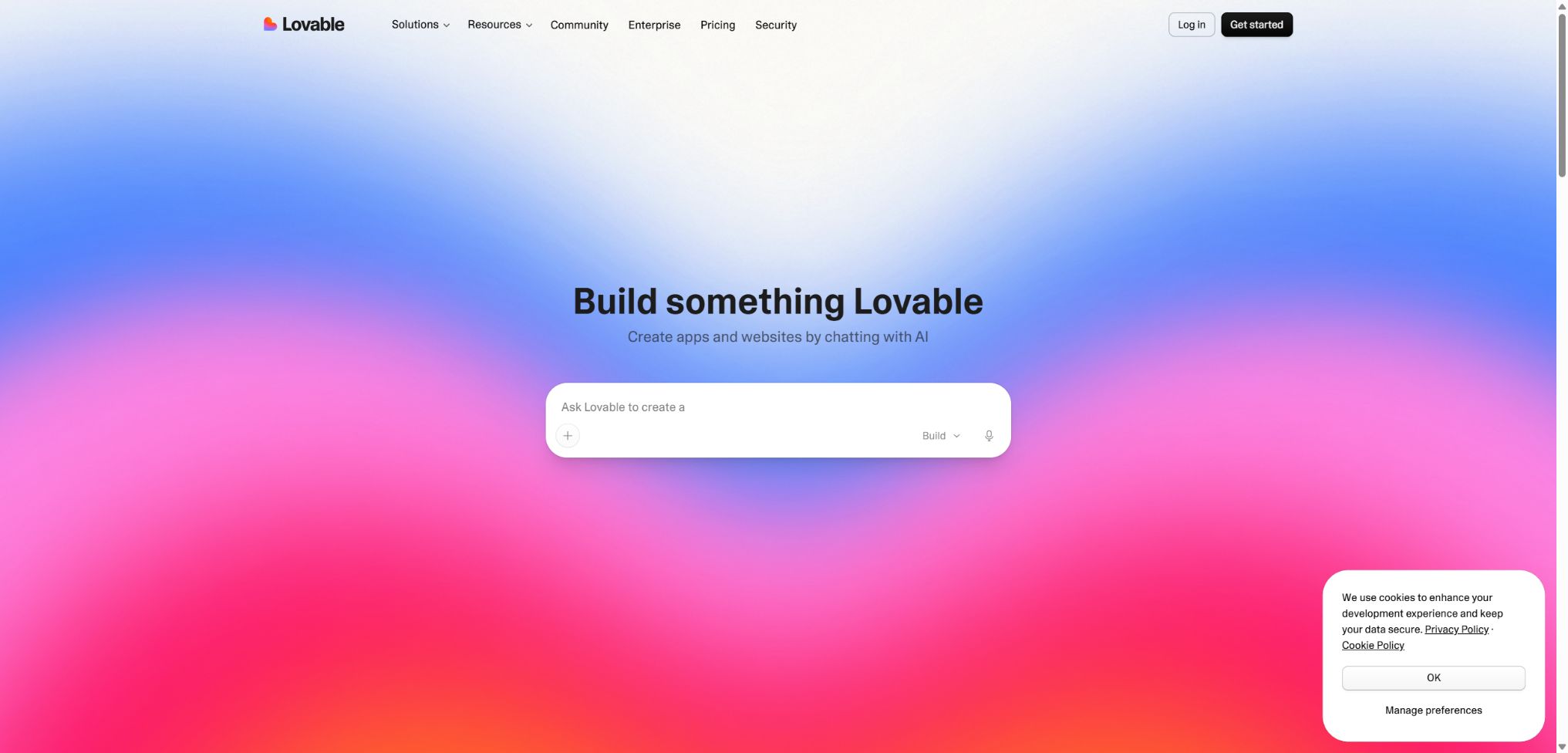
Lovable
Build and deploy full-stack web applications using natural language.
Tags:AI programming toolsWhat is Lovable?
Lovable is an AI-based software engineering platform that enables the creation of websites and full-stack Web applications using natural language. After users describe the products, pages, and business processes, the AI generates code based on React, TypeScript, and modern front-end tools; this code can then be further modified, tested, and deployed.
The platform includes Lovable Cloud, which offers PostgreSQL databases, user authentication, file storage, real-time data processing, and server-side functions. Users can also connect their own Supabase, GitHub, or GitLab accounts to integrate their code and infrastructure into their existing development processes.
Main functions of Lovable
- Generate a complete Web application based on textual instructions, screenshots, and reference images;
- Use the Plan mode to analyze requirements and compare options without modifying the code;
- Use the Build mode to encode across files, debug, and verify the results;
- Directly edit text, select elements, add annotations, and leave comments in the preview;
- Test the responsive layout by clicking, filling out forms, and using a real browser from a remote location;
- Use Cloud databases, authentication, storage, real-time features, and Edge Functions;
- Add Stripe, Paddle, Shopify, HubSpot, and external APIs;
- Enhance the capabilities of the generated applications through built-in AI connectors;
- Publish to Lovable hosting, a custom domain name, or an external cloud platform;
- Develop and automate processes through Git synchronization, MCP, and API integration.
Plan mode and Build mode
The Plan mode is used to clarify requirements, examine the code, compare different technical approaches, and develop an implementation plan. Each message costs 1 point, and it does not modify the project. It is suitable for confirming the data structure, permissions, and boundaries before starting to work on complex functions.
In the Build mode, the code is modified directly, and it is possible to carry out browser testing, front-end testing, Edge Function validation, web searches, and image generation. The cost is calculated based on the actual complexity: minor modifications may cost less than 1 point, while large-scale transformations, cross-file restructurings, and multiple rounds of validation require more resources.
Preview, visual editing, and testing
The preview toolbar allows users to select page elements, modify text inline, add annotations, and leave comments. For minor adjustments such as color, spacing, and wording, it is a more direct approach than rewriting lengthy descriptions.
Browser testing is carried out in a remote virtual environment; it allows users to click buttons, fill out forms, view the console and network requests, as well as check the layout on mobile devices, tablets, and desktops. It uses the current preview environment and does not take over the user’s local browser.
Lovable Cloud
Built on Supabase’s open-source foundation, Cloud offers PostgreSQL, authentication, storage, real-time updates, and Edge Functions. When login is required, data needs to be saved, files need to be uploaded, or server-side logic is needed, Lovable can automatically activate Cloud or request confirmation based on the permissions of the workspace.
Each Cloud project makes use of an isolated backend, and it offers functions such as database browsing, viewing of RLS policies, and daily database backups. Database backups do not include Storage files; therefore, important uploaded files still need to be exported and backed up separately.
AI, connectors, and payments
The built-in AI connector enables secure application calls to various models; keys and server-side calls are managed by Cloud. AI calls within an application and the proxies created by Lovable represent two different types of usage, with runtime credits being deducted based on the actual consumption such as models, inputs and outputs, as well as images, videos, or audio.
Connectors enable integration of services such as Slack, Notion, HubSpot, and Google Workspace into chat or publishing applications. Built-in payment support is available for Stripe and Paddle; users on the Pro plan and above can issue real subscriptions or one-time payments after testing in a trial environment.
Git synchronization and external deployment
All plans support Git synchronization with GitHub or GitLab; the paid plans also allow for direct downloading of the code repository. Users can continue developing in their local IDE, review changes through Pull Requests, and deploy the frontend to other hosting platforms.
A Git repository contains only the code and database migration scripts; it does not include the actual data stored in the database. When migrating to a Cloud backend, it is necessary to export the data, Storage files, authentication settings, and environment keys, and then reconfigure the relevant services.
Methods of construction, operation, and delivery
| Stage | Lovable ability | Billing source | Precautions |
|---|---|---|---|
| Demand planning | Plan mode, code analysis, and solution comparison | 1 point per message | Do not modify the code. |
| Application building | Build mode, testing, image and web search | By task complexity | Charging is still applied based on the work completed, even when the task is stopped. |
| Run in the cloud | Databases, networks, storage, computing, and real-time services | General points deducted after Cloud Grant. | An increase in traffic and data volume raises costs. |
| In-app AI | Model invocation, images, audio and video, and automation | General points are deducted after an AI Grant. | Separated from the amount used to create proxies |
| Code delivery | Git synchronization, downloading, and external deployment | It depends on the plan and external services. | Data and keys need to be migrated separately. |
Lovable price
Lovable currently offers Free, Pro, Business, and Enterprise plans. For the Pro and Business plans, the pricing is not based on the number of seats; instead, the credits purchased and the billing are shared across the entire workspace, with no limit on the number of members.
| Package | Starting price | Base limit | Primary interests |
|---|---|---|---|
| Free | $ | 5 points are earned per day, up to 30 per month. | Private projects, Git synchronization, 20 Cloud credits and 4 AI credits per month |
| Pro | $ | Starting from 100 generic points per month | Unlimited 5 build points per day, code editing and downloading, custom domain names, data anonymization, and member permissions |
| Business | $ | Starting from 100 generic points per month | All Pro rights, role permissions, SSO, Security Center, templates, internal releases, and priority support |
| Enterprise | Contact sales | Use according to the promised amount | SCIM, audit logs, scheduled security scans, release control, custom connectors, and dedicated support |
All versions – Free, Pro, and Business – currently include a limited number of gifts per month: 20 Cloud credits and 4 in-app AI credits; the official statement indicates that these gifts are part of a temporary policy. Once they are used up, Cloud credits and in-app AI credits will continue to be deducted from the general credits available in the workspace.
Multiple price tiers for Pro and Business
| Monthly points | Pro monthly plan | Total annual Pro subscription cost | Business Monthly Payment | Annual total cost for Business plan |
|---|---|---|---|---|
| 100 | 25 dollars | 250 dollars | 50 dollars | 500 dollars |
| 200 | 50 dollars | 500 dollars | 100 dollars | 1,000 dollars |
| 400 | 100 dollars | 1,000 dollars | 200 dollars | 2,000 dollars |
| 800 | 200 dollars | 2,000 dollars | 400 dollars | 4,000 dollars |
| 2,000 | 480 dollars | 4,800 dollars | 960 dollars | $ |
| 10,000 | $ | $ | 4,300 dollars | 43,000 dollars |
The authorities also offer intermediate amounts of points such as 1,200, 3,000, 4,000, 5,000, and 7,500 points. Points are still issued on a monthly basis for annual subscriptions; an additional 50 points costs 15 dollars for the Pro plan, and 50 points cost 30 dollars for the Business plan.
The validity period of the points and insufficient balance
The monthly points under the monthly payment plan are valid for 2 months from the date of issuance, while the points for the annual payment plan are issued on a monthly basis and become invalid 1 month after the end of the annual period; the additional points are valid for 12 months.
Daily build points, as well as those granted for use in Cloud and AI services, are not transferable.
Once the balance reaches zero, construction will stop, the AI functions within the application will cease to work, and databases, authentication systems, and storage services that rely on the cloud backend may become unavailable. The statically published pages can still be accessed, and services will resume once points are obtained again.
Lovable usage guide
Create the first full-stack application from a requirement.
- Specify the user, core tasks, necessary pages, and success criteria;
- First, use the Plan mode to discuss data, permissions, and technical boundaries;
- After confirming the plan, switch to Build mode to create the first version;
- Check the desktop and mobile layouts in the preview;
- The browser is required to test registration, login, and the main business processes;
- Fix errors one by one and check the actual points consumed each time;
- Connect the domain name and publish it after passing the test.
Create secure databases and login systems.
- List the access levels for visitors, regular users, and administrators;
- Enable Cloud authentication and create the necessary data tables;
- Set RLS policies with minimum permissions for each table;
- Place the payment and external API logic in Edge Functions;
- Save all keys in the server’s Secret storage;
- Run basic or in-depth security scans and address the findings;
- Test for privilege escalation, deletion, and abnormal input using different accounts.
Synchronize with GitHub and prepare for independent deployment
- In the project settings, connect to a specified GitHub account or organization;
- Select a new warehouse and confirm that the initial code has been successfully synchronized;
- Pull the project locally and create a feature branch;
- AI and manual edits are reviewed through Pull Requests;
- Configure the build and environment variables for the external hosting platform;
- If migrating the backend, export the database and Storage files separately;
- Switch the traffic after completing domain name setup, authentication callbacks, backup, and monitoring.
Which users are it suitable for
- Non-technical entrepreneurs: Quickly test SaaS solutions, the market, and product processes;
- Product Manager: Transform the requirements document into a practical, functional application;
- Designer: Moving from interface references to functional full-stack prototypes;
- Marketing and Operations: Creating landing pages, event tools, and internal systems;
- Developer: Generate the initial version of the code and continue to maintain it using Git;
- Agency: Quickly set up portable projects for multiple clients;
- Enterprise teams: Built collaboratively under governance, identity, and security controls.
The advantages of Lovable
- Generate standard React and TypeScript projects directly from natural language;
- Separation of Plan and Build allows for decision-making first and then execution;
- Built-in browser testing, front-end testing, and Edge Function validation;
- Cloud reduces the initial setup required for databases, authentication, and deployment;
- Git’s two-way synchronization and code download provide a pathway for migration;
- The workspace has no limit on the number of members and shares points, making it suitable for collaborative experiments;
- MCP, API, connectors, and the official SDK support automation.
Usage restrictions and precautions
- Free provides up to 30 daily build credits per month, which are quickly exhausted in the case of complex applications;
- Building, running on the cloud, and using AI within an application all draw from the same general balance.
- High traffic, large databases, and frequent AI calls increase ongoing costs;
- AI-generated code may contain issues related to privilege escalation, injection attacks, and flaws in business logic.
- Git synchronization does not include the actual data in the database or the Storage files;
- Daily database backups do not cover file storage;
- When the balance is zero, the Cloud backend and the AI built into the application may stop working;
- Native mobile apps are not Lovable’s current primary delivery format.
Security, privacy, and code ownership
The official corporate page of Lovable indicates that it meets the SOC 2 Type II and ISO 27001 standards, and it offers SSO as well as a security center for Business and Enterprise users. Platform-level certification does not guarantee that each application created is secure; RLS, server-side authentication, and input validation remain the responsibility of the respective projects.
Users own the code they generate, as well as the websites and applications they create, and the customer data stored in Lovable; however, they are still subject to the constraints imposed by the underlying AI models and the rights related to third-party materials. When releasing commercial projects, it is necessary to check the licensing agreements, image copyrights, privacy policies, and data processing terms.
- All security and data integrity logic is located on the server side;
- Check RLS table by table to avoid anonymous access or full-table exposure;
- Restrict the scope of permissions for Git, connectors, and external collaborators;
- Export data in advance of production and establish an independent disaster recovery plan;
- Payment and personal information fields should undergo manual security review.
API, MCP, and open-source details
Lovable offers Build with URL, an official MCP server, and a gradually expanding set of public APIs. MCP is compatible with ChatGPT, Claude, Claude Code, Cursor, and VS Code; it enables the creation of projects, sending build messages, checking code, and deploying applications.
The official TypeScript SDK allows users to utilize the Lovable public API to create, iterate on, and publish Remix projects; it is licensed under the MIT license. The core hosting platform for Lovable is not an open-source product – GPT Engineer was its open-source predecessor, while Open Lovable is a project developed by an independent community.
Frequently Asked Questions
Can Lovable be used for free?
Yes, Free grants 5 build credits per day, up to 30 per month; in addition, there are 20 Cloud credits and 4 in-app AI credits available each month. These credits are intended for specific purposes only and cannot be carried over to subsequent months.
How much is Lovable Pro?
The Pro plan starts at $25 per month or 100 points, with an annual fee of $250. Multiple tiers of monthly points ranging from 200 to 10,000 are available; there is no limit on the number of workspace members, and the credit can be shared among them.
Can the code generated by Lovable be exported?
Yes, all plans support Git synchronization; paid plans also allow direct downloading of the code repository. Database data, files, and keys must be exported separately.
Can Lovable be used for the backend?
Yes, Lovable Cloud offers PostgreSQL, authentication services, storage solutions, real-time data capabilities, and Edge Functions; it also allows connection to users’ own Supabase projects.
Is Lovable open source?
The core platform is not open-source software. The official TypeScript SDK and some of its components are available under open-source licenses; GPT Engineer represents the open-source version of it, but it is not equivalent to the complete source code of the current Lovable version.
Tools similar to Lovable



 Guigong Network Security Registration No. 45132202000164