






Emergent
Build, test, and deploy full-stack web and mobile applications using natural language.
Tags:AI programming toolsWhat is Emergent?
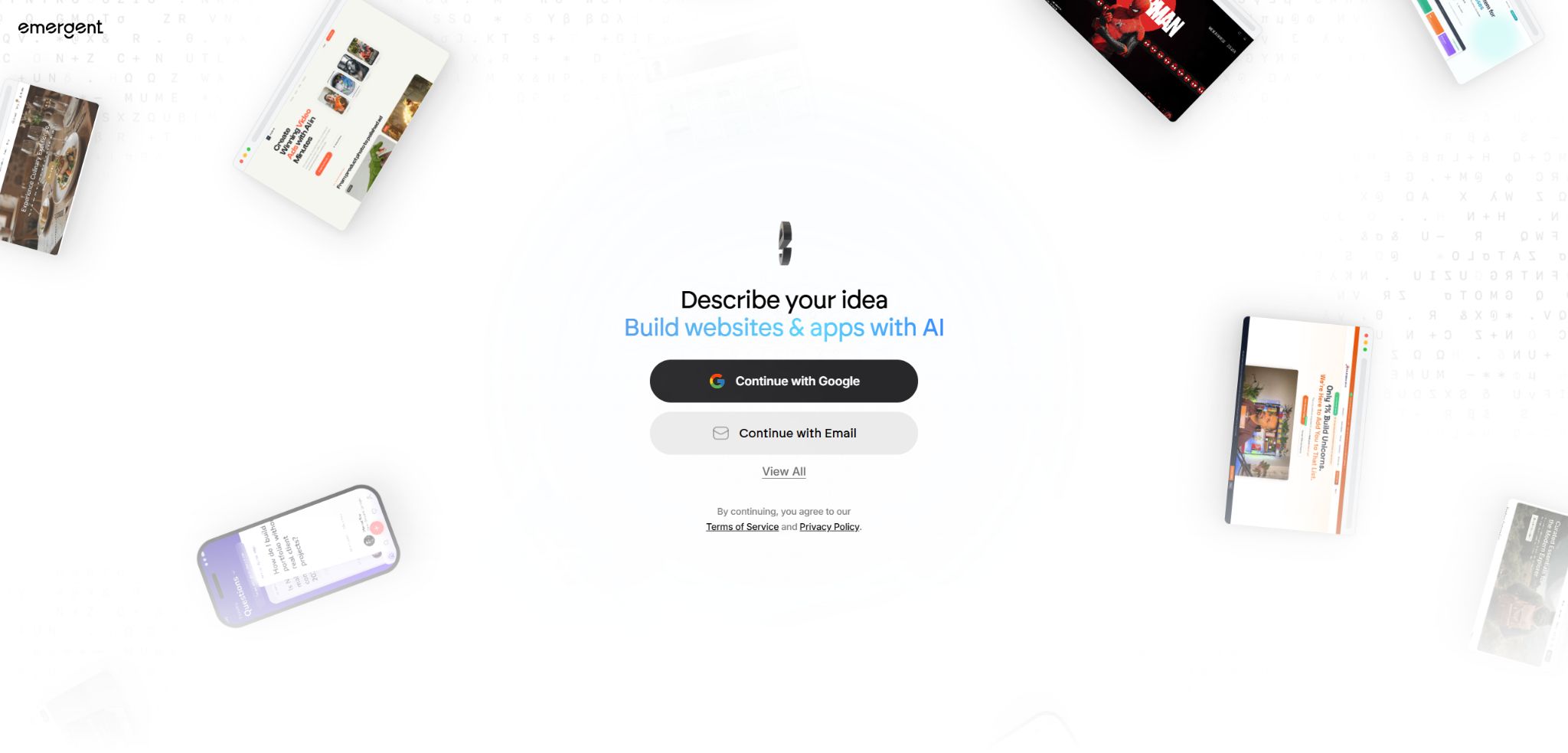
Emergent is a full-stack platform for building conversational AI applications. After users describe the objectives of the product, as well as the pages, data, and business processes involved, the coding agents within the platform plan the tasks, generate the front-end and back-end components, run tests, fix any issues, and provide previews or enable deployment.
It not only generates static pages, but it can also create web or mobile applications with databases, user login systems, file upload capabilities, payment functions, and integration with third-party APIs. Its target users include entrepreneurs who do not have a full engineering team, product managers, small businesses, and developers who need to quickly test their ideas.
Main functions of Emergent
- Create complete websites, SaaS applications, and internal tools through natural language generation;
- Automated planning, coding, testing, debugging, and iteration by the agent;
- Handle the front end, back end, database, and authentication simultaneously;
- Offers real-time preview, one-click deployment, automatic SSL setup, and custom domain names;
- Use Mobile Agents to create Expo-based iOS and Android applications;
- Integration with Stripe, Supabase, Twilio, and external REST APIs;
- Access GPT, Claude, and Gemini via the Universal LLM Key;
- Connect to GitHub for pushing, pulling, branch management, and version control;
- Use Fork Tasks to explore features or design directions in parallel;
- Manage build tasks via MCP from ChatGPT, Claude, or Codex.
From requirements to full-stack code
Users can specify the target audience of the application, its core processes, data fields, and visual preferences; the agent will then break down the tasks and create a functional project. The official introductory documentation lists common technology combinations such as React for the frontend, Node.js or API for the backend, and MongoDB; external services like Supabase can also be integrated as needed.
The generation process consumes different amounts of credits depending on the agent, context, and level of complexity. The more vague the requirements are, the more rework, debugging, and file modifications are needed; therefore, it is usually more cost-effective to first determine a minimal viable version rather than trying to include all features at once.
Proxy and construction patterns
Emergent offers various agents for production applications, routine development, complex tasks, rapid prototyping, and mobile apps. High-quality or advanced modes require more time and computing resources; prototypes are better suited for testing interfaces first, and should not be considered as fully functional production systems.
Deployment and custom domain names
The preview link is used to check the appearance of the application during development, while the deployment link provides access to the actual application that is available on a continuous basis. The platform can host the frontend, backend, and database, and it supports custom domain names, DNS verification, automatic SSL encryption, as well as continuous deployment.
Cloud deployment continuously consumes points; the official documentation indicates that 50 points are required per month for each cloud deployment. Multiple projects that remain active over an extended period may quickly exhaust the Standard quota, so it is necessary to account separately for costs related to development, debugging, deployment, and third-party services used within the application when planning the budget.
GitHub and code control
Versions Standard and above support GitHub integration, allowing users to create or select repositories, push automatic commits, and pull code from existing branches to continue development. Teams can use feature branches and Pull Requests for manual review, thereby preventing AI-driven changes from directly overwriting stable versions.
Universal LLM Key and MCP
The Universal LLM Key integrates multiple models into a single key and balance system, so that the applications developed using it do not require separate configuration for each model’s account. The cost of invoking these models is part of the operating expenses after the application goes live; it is not the same type of cost as the monthly credits required to create proxies.
Emergent MCP is available for both free and paid accounts; it allows users to create tasks from AI clients that support MCP and OAuth, answer agent-related questions, check status, obtain previews, and pause tasks. It is a hosted connector, and it does not mean that the core Emergent platform is open source.
Common application types
| Type | Content that can be generated | Common integrations | Key points before going live |
|---|---|---|---|
| Marketing website | Home page, landing page, forms, and content pages | Analysis, emails, CRM | SEO, form notifications, and mobile devices |
| SaaS products | Accounts, subscriptions, backend, and business processes | Stripe, OAuth, databases | Permission, billing, and data isolation |
| Internal tools | Tables, filtering, approval, and dashboards | Tables, APIs, enterprise data sources | Access control and auditing |
| AI applications | Chatting, generation, analysis, and knowledge Q&A | Universal LLM Key | Model costs, prompt injection, and content security |
| Mobile apps | React Native interface and business logic | Expo, push notifications, and device capabilities | Real-device testing, signing, and store approval |
Emergent price
Emergent currently offers Free, Standard, and Pro subscription plans; Business and Enterprise plans are priced based on the specific needs of each organization. The official website shows the equivalent costs for monthly and annual payments, and in addition to points, there may be additional fees related to deployment, models, SMS messages, payments, databases, and other third-party services.
| Package | Monthly price | Annual equivalent | Monthly points and key benefits |
|---|---|---|---|
| Free | $ | $ | 10 points per month, core features, web and mobile experience, advanced models and LLM integration |
| Standard | $ | 17 dollars per month | 100 points per month, hosting of private projects, the option to purchase additional points, GitHub and Fork Tasks |
| Pro | $ | $ | 750 points per month, 1 million contexts, Ultra Thinking, system prompt editing, custom proxies, and priority support |
| Business | Custom quote | Custom quote | Added RBAC, SSO, shared team spaces, and real-time collaborative editing on top of Pro. |
| Enterprise | Custom quote | Custom quote | Member quotas, audit logs, self-hosted databases, SLAs, user groups, VPCs, and usage analysis |
Points and additional costs
| Cost items | How is billing done? | Included in the subscription? | Control method |
|---|---|---|---|
| Proxy construction | Points are deducted based on the complexity of planning, coding, testing, and debugging. | Use monthly points. | First create an MVP and break down the tasks. |
| Cloud deployment | Currently, each deployment earns 50 points per month. | Deducted from the balance of points. | Suspend unused projects and reduce the number of deployments. |
| Extra points | Add more purchases when the balance is insufficient. | Not included | Check the task consumption before purchasing. |
| Universal LLM Key | Call according to the actual model within the application | Top up balance separately | Set limits, caching, and model degradation. |
| External services | Billed by Stripe, Supabase, Twilio, etc. | It is usually not included. | Set budgets and alerts separately. |
Emergent usage tutorial
Create the first full-stack web application
- First, clarify the target audience, the core issues, and the sole key indicator of success.
- Limit the first version to three to five essential functions;
- Create a task and specify the page, data fields, and visual requirements;
- Answer questions raised by the agent regarding product and technical details;
- In the preview, test each of the registration, input, saving, and error-handling processes one by one;
- Only one specific issue should be corrected at a time, followed by another test;
- Deploy after confirming the budget, domain name, and permissions.
Connect to GitHub and establish a version control process.
- In the personal settings, authorize Emergent to access specific GitHub repositories;
- After the first stable version is completed, it is pushed to the new private repository;
- Create a separate branch for each important feature;
- Pull the latest code from the remote repository before starting the task;
- Check for differences, keys, and database migration before submitting;
- Tests are run via Pull Request and subject to manual review;
- After merging, pull again and verify the deployed version.
Securely launch applications that require login and payment.
- List the administrator, regular user, and visitor permissions one by one;
- Require mandatory authentication on the backend, not just hide the buttons on the frontend;
- Store payment details, database credentials, and API keys in server-side environment variables;
- Use the payment testing mode to cover successful, failed, and refund processes;
- Test for unauthorized access, malicious input, file uploads, and rate limiting;
- Establish processes for logging, backup, alerts, and data deletion;
- It is made available to actual users only after being reviewed by engineering or security personnel.
Which users are it suitable for
- Non-technical entrepreneurs: Quickly test the demand for SaaS products or services;
- Product Manager: Convert the specification documents into interactive prototypes and applications;
- Small businesses: Creating reservations, orders, customer portals, and internal systems;
- Operations team: Develop dashboards, approval processes, and automation tools;
- Agency: Delivers the first version of the project to clients quickly;
- Developer: Reduce boilerplate code while maintaining the GitHub workflow;
- AI Application Team: Use a unified model key to quickly access multiple models.
The advantages of Emergent
- It covers the entire process chain of planning, coding, testing, debugging, and deployment;
- It generates the frontend, backend, and data layer simultaneously, rather than focusing only on the interface;
- Supports web and Expo-based mobile apps;
- Built-in preview, hosting, custom domain names, and automatic SSL;
- GitHub integration facilitates code storage, review, and migration;
- Universal LLM Key reduces the barriers to integrating multiple models;
- MCP allows for the direct creation and management of build tasks from common AI assistants.
Usage restrictions and precautions
- The 10 points available for free are suitable only for understanding the process and conducting small experiments;
- Debugging, redoing, making changes to multiple files, and deploying all increase the amount of points consumed.
- 100 points in the Standard tier are not sufficient to cover both complex constructions and multiple deployments at the same time;
- AI-generated code may pose issues related to security, performance, and maintainability;
- Payments, permissions, and personal data cannot rely solely on automated testing;
- Mobile apps still require testing on a real device, a developer account, and approval from the app store;
- The limitations, prices, and outages of external services are reflected in the application that generates them.
- Production projects must maintain separate backups of code, data, and keys.
Security, privacy, and code ownership
Applications that are generated automatically may have access to customer data, authentication credentials, and payment information; therefore, automatic generation cannot be considered a form of secure authentication. Before going live, it is necessary to examine the boundaries of permissions, server-side validation, potential vulnerabilities, logging practices, backup procedures, deletion requests, as well as the privacy requirements in different regions.
Integration with GitHub allows paid users to store their code in their own repositories, and they can continue to develop it there or choose to use external hosting solutions. The database contents, domain names, third-party accounts, and API keys should still be under the user’s direct control, so as to prevent the project from becoming entirely dependent on a single platform.
- Only grant Emergent access to the necessary GitHub repositories;
- The key is stored in backend environment variables and rotated regularly;
- The production database has backup, access control, and deletion policies enabled;
- AI-generated content requires vulnerability and license checks to be performed;
- Enterprises should verify the SSO, RBAC, auditing, SLA, and VPC contracts as needed.
API, MCP, and open-source details
Emergent provides an official MCP connector that, through OAuth authentication, enables the creation, querying, previewing, and pausing of building tasks using AI tools. The platform also allows integration with external APIs in the generated applications, but this does not mean that a public REST API for application generation is provided.
The core agents, hosting environment, and generation platform of Emergent are not open-source projects. The neural network or C++ projects on GitHub under the name Emergent have nothing to do with this product; users can integrate their own generated code into their personal repositories via the official GitHub interface.
Frequently Asked Questions
Can Emergent be used for free?
Yes, it’s available at a cost of $0; 10 points are provided per month. This quota is sufficient for testing the interface and handling simple tasks, while using the full functionality of the application typically requires paid points.
How much is Emergent Standard?
The Standard plan costs $20 per month; when paid annually, the cost is $17 per month. It includes 100 points per month, private project hosting, as well as GitHub and Fork Tasks. Deployment and complex debugging tasks still require the use of points.
Can Emergent be used to create mobile apps?
Yes, Mobile Agents can be used with Expo and React Native to develop iOS and Android applications. To publish them to app stores, a developer account, signing, testing on actual devices, and approval are still required.
Can the code generated by Emergent be exported?
Versions Standard and above allow projects to be pushed to the user’s repository via GitHub integration, and it is also possible to pull existing code for further development. Before migrating, it is necessary to take care of the database, environment variables, and configurations for external services as well.
Is Emergent open source?
No, the core AI agent and hosting platform is not fully open-source. Users can control the code that is generated, but GitHub projects with the same name are usually not related to Emergent.sh.
Tools similar to Emergent



 Guigong Network Security Registration No. 45132202000164