






EmbedAPI
EmbedAPI – makes AI models work more efficiently and simply.
Tags:AI training modelsWhat is EmbedAPI?
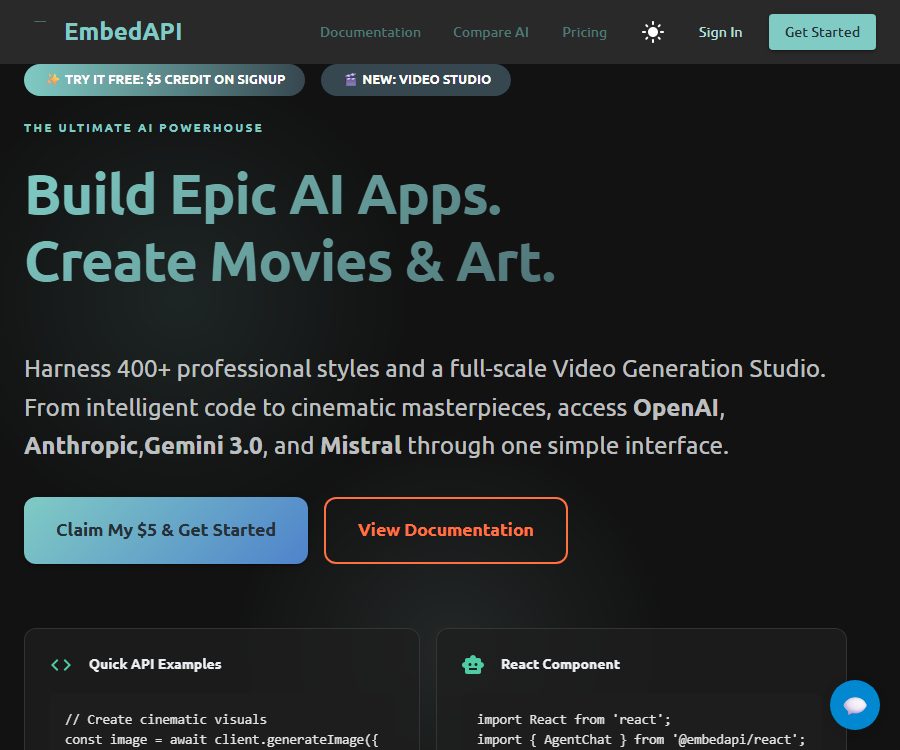
EmbedAPI is a unified generative AI interface platform operated by 01TEK LLC, designed for developers and teams that need to use multiple models within their applications. It combines authentication, model selection, billing, and call analysis in one account, thereby reducing the necessity of managing separate accounts and keys for different suppliers.
The current products support text, image, and video generation, as well as document and image understanding. Users still need to choose a service provider and a specific model based on their tasks; EmbedAPI does not make the capabilities, context windows, and compliance requirements of different models identical automatically.
Main functions
Unified multi-model invocation
- Services such as OpenAI, Anthropic, Google Gemini, Meta, Mistral, and AWS Bedrock can be invoked using the same EmbedAPI key, which facilitates switching between models within a single codebase.
- The request should specify the service provider, model, message, and generation parameters; the response will include uniformly formatted content, information on token usage and status codes, as well as images or retrieval metadata when the model supports it.
- The model list interface can be used to retrieve the models currently available for a account along with their pricing information; it is suitable for creating dynamic model selectors, thereby avoiding the need to hardcode model names in the frontend.
- The same prompt can be sent to multiple models simultaneously in order to compare the quality of their responses, as well as their latency and cost; each parallel request still results in separate usage charges.
Text generation and parameter control
- The text interface receives system messages and user messages, and can be used for chatbots, content drafts, summaries, categorization, code assistance, and structured question-answering.
- It is possible to set the maximum number of tokens to be generated, the temperature parameter, Top P, the stopping sequence, and the user identifier; the actual range of supported values depends on the model chosen, and it cannot be assumed that all parameters are accepted by all suppliers.
- The response includes the generated text as well as information on token usage, which allows the application to keep track of costs, set budget alerts, or conduct benchmark tests across different models.
- The error examples distinguish between invalid keys, insufficient balance, and excessive request rates, which facilitates the implementation of retry mechanisms, fallback strategies, and user notifications in the business layer.
Image, video, and style generation
- The image interface accepts textual instructions, models, and optional style parameters, and outputs the resulting images, which are suitable for concept diagrams, draft marketing materials, and visual prototypes.
- The video interface uses textual prompts and video models as its main inputs to produce the results of video processing tasks; it is suitable for testing short video segments and validating camera concepts.
- The platform offers over 400 preset generation styles, allowing users to include style parameters in their image or video requests; this helps to maintain a consistent visual style and reduces the need for repeated instructions.
- Image size, video duration, generation speed, content moderation, and costs are determined by the specific model; it is necessary to conduct actual tests using the target model before going live.
Image and document understanding
The Node.js documentation shows how to send multimodal messages containing text and files using the Anthropic model; these messages can be used for describing images, interpreting tables, and answering questions about documents. Files are sent along with the message along with their type, MIME information, name, and encoding data.
| Enter category | The listed formats | Restrictions | Suitable for tasks |
|---|---|---|---|
| Image | PNG, JPEG, GIF, WebP | Up to 20MB per file | Image description, visual question answering, content inspection |
| Document | PDF, CSV, DOC, DOCX, XLS, XLSX, HTML, TXT, MD | Up to 20MB per item | Abstracts, information extraction, table and document analysis |
| Complete request | Text combined with multiple files | The total size must not exceed 100MB. | Comprehensive Q&A on Multiple Materials |
The fact that a certain format is accepted by the interface does not mean that the model can reliably understand all formats. Scanned documents, complex spreadsheets, and very long documents should first be tested on a sample basis, with attention paid to the numbers presented, the locations of references, and any missing content.
REST APIs, SDKs, and development tools
| Access method | Primary uses | Key features | Suitable for users |
|---|---|---|---|
| REST API | Initiate a generation request from any backend. | Authentication is performed using request header keys, and services, models, and messages are submitted. | Multilingual development team |
| Node.js SDK | Call it in JavaScript or TypeScript projects | Provides methods for generation, connection testing, and model listing. | Web and Node.js developers |
| Command-line tools | Fast dialogue and model switching in the terminal | It allows listing models, switching services, and saving keys locally. | Development testing and scripting users |
| React components | Embed a chat interface in the frontend. | Access specified agents and topics through the proxy component package. | React Product Team |
| Web console | Manage keys, balances, bills, and analytics | View call and consumption details in one place | Project manager and finance officer |
What can the Node.js SDK do?
- Initialize the client and test the API connection to help identify key or network configuration errors before deployment.
- Read the list of available models and then send messages to the specified services and models, thereby reducing the amount of code needed to manually construct the underlying requests.
- TypeScript projects are supported, and the documentation also describes the capability to automatically handle transient errors through retries; however, in a production environment it is still necessary to define one’s own timeout values, number of retries, and idempotency strategies.
- Multimodal examples can include images and documents, but it is necessary to avoid including keys or sensitive files directly in the browser code.
Attention should be paid to the functional status.
The Node.js documentation lists streaming responses, function calls, batch processing, WebSockets, and advanced rate limiting as future capabilities, while the REST documentation includes examples of streaming parameters. These descriptions are not entirely consistent; developers should rely on the actual response from their specific endpoints and prepare fallback solutions for situations where such features are not available.
From registration to the first call
- Create an EmbedAPI account and log in, then generate an API key for use with the project in the console.
- Check the registered testing quota and account balance, then select REST API, Node.js SDK, or command-line tools based on the programming language.
- Store keys in server environment variables or key management systems; do not commit them to code repositories, nor embed them directly in public web pages.
- First, read the current list of models, select a service provider and a model, and verify the input type, price, and contextual capabilities of that model.
- Construct a message array, set the necessary parameters such as the maximum token and temperature, and send a low-cost test request.
- It records the returned content, status codes, and token usage; it handles cases of authentication failure, insufficient balance, excessive request rates, and supplier-related issues separately.
- Before going live officially, implement budget limits, usage alerts, log data masking, timeout settings, retry mechanisms, and backup model strategies.
Typical workflow
Comparison of multi-model quality and cost
- Prepare a set of reproducible, real-world prompts along with expected evaluation criteria, to avoid drawing conclusions based on just a single demonstration question.
- Send the same input in parallel to multiple candidate models, and save the answers, latency, token usage, and failure status.
- Accuracy, compliance with formatting rules, stability, and cost are evaluated by manual methods or testing programs.
- Set up alternative routes for the main model, and conduct regular retests after model updates or price changes.
File analysis process
- Verify the file format, size, and sensitivity level; if necessary, mask or split the data first.
- Place the problem description along with the encoded file in a multimodal message, and select a model that explicitly supports this type of input.
- It is required to present the information in clear fields or tables, with each amount, date, name, and conclusion being checked individually.
- Logs and results are processed in accordance with the organization’s data retention rules; the model’s responses are not regarded as the final audit conclusions.
Input and output
| Project | Content | Usage tips |
|---|---|---|
| Text input | System, user, and context messages | Control the length and avoid sending unnecessary personal information. |
| File input | Images, documents, tables, and encoded data | First, check whether the model supports that format and size. |
| Generation control | Model, maximum tokens, temperature, Top P, stop sequence | The parameter ranges for different models may vary. |
| Tool parameters | Tools for searching or web scraping, etc. | It is valid only when the corresponding model and account are supported. |
| Main output | Text, image, or video results | The generated content must undergo fact-checking, copyright verification, and security checks. |
| Call metadata | Token usage, status codes, and optional search information | Used to monitor costs, errors, and quality. |
Suitable for users
- Application developers who need to compare or switch between multiple large models within a single codebase.
- Startup teams that are developing chatbots, content generation tools, document analysis systems, or multi-modal workflows.
- Technical leaders who wish to achieve centralized management of model bills, keys, and call analytics.
- Engineers who need to quickly test the differences between prompts and models using the command line.
- Enterprise customers who require dedicated infrastructure, SLAs, private endpoints, or the deployment of custom models.
Typical scenarios
- Configure a primary model and a backup model for customer service or internal knowledge assistants, so that a switch can be made in case of issues with the supplier.
- Compare the quality, latency, and resource consumption of different models for the same prompt in bulk, to determine the optimal production approach.
- Draft articles, product descriptions, summaries, or code suggestions are generated in the background, and then reviewed manually before being published.
- Accept PDFs, tables, and images, extract key information, and generate a structured draft.
- Create concept samples of images or short videos in predefined styles for the design team to further edit.
- Use React components to quickly create a prototype for chat interactions, and then gradually replace it with a custom interface.
Product advantages
- A single key along with a unified calling method reduces the repetitive tasks associated with connecting to multiple suppliers, making payments, and tracking usage.
- REST, Node.js, CLI, and React components cover various stages ranging from interface testing to product integration.
- Pay-as-you-go is suitable for starting with small-scale testing, and the list of models along with analysis information helps to control costs.
- Text, files, images, and video capabilities can be combined within the same platform, facilitating the creation of multimodal workflows.
- Parallel invocation of multiple models is suitable for benchmarking or disaster recovery planning, as it is not necessary to tie the business operations entirely to a single model.
Capacity limits and usage restrictions
- EmbedAPI serves as a model aggregation layer; the quality of the output, the context window, the review rules, and the available regions are still influenced by the underlying suppliers.
- The pricing page states that the Starter plan has no speed limits, but the terms require compliance with speed limits and usage quotas; the SDK also defines errors related to too many requests being sent. The actual limitations depend on the account, the model, and the runtime response.
- Parallel calls are billed separately, and they may also cause failures or delays on the part of multiple suppliers; it is not sufficient to focus only on the result that is returned first.
- The documentation status for streaming, function calls, batch processing, and WebSocket varies, so they should not be considered essential features until they have been tested.
- The generated content may contain factual errors, biases, copyright issues, or fail to meet industry standards; high-risk areas such as healthcare, law, and finance require professional review.
- The service is provided as it is; the terms permit modifications or discontinuation of certain functions after notification, and new restrictions may also be introduced.
Prices and billing
| Package or version | Price | Billing cycle | Core benefits or quota | Suitable for users |
|---|---|---|---|---|
| Starter | Pay based on actual usage | Charged based on usage | A $5 testing credit is provided upon registration, along with access to all models, multiple keys, as well as analysis and usage alerts. | Individual developers, prototypes, and small to medium-sized applications |
| Enterprise | Custom quote | In accordance with the contract | Bulk discounts, dedicated infrastructure, custom restrictions, SLAs, private endpoints, and customized deployment | Organizations with high usage levels and governance requirements |
The cost of models is expressed in dollars; the prices stated on the page reflect those set by the supplier, with no additional charges. Each model is consumed based on the number of tokens or generation tasks, and the specific unit price may vary depending on the supplier. The CLI documentation can be purchased starting from 5 dollars, and the final amount, taxes, and available balance should be checked on the account settlement page.
Payments are processed by Stripe, and the terms allow for price adjustments after giving 30 days’ notice; overdue payments may result in the suspension of services. Refunds are not granted automatically within a set timeframe – they are decided on a case-by-case basis. Therefore, it is necessary to verify the availability of the relevant system and the organization’s policies regarding refunds before making large deposits.
API, SDK, and open-source status
| Project | Current status | License or instructions |
|---|---|---|
| EmbedAPI hosting platform | Commercial online services | It has not been confirmed that the entire platform is open source. |
| Node.js core package | Public software package, current version 1.0.11 | Package metadata labeled MIT |
| React component packages | Public software package, current version 1.0.5 | Package metadata is labeled with MIT, and a code repository field is provided. |
| Command-line tools | Public software package, current version 1.0.8 | Package metadata labeled MIT |
| Mobile apps and browser extensions | No official version was confirmed this time. | The main ways of using it are through the web console and development tools. |
The software package is licensed under the MIT license; this only indicates the licensing terms for that specific release, and it cannot be used as evidence that the server-side platform, model services, or user-generated content are open source. When using the underlying models, it is also necessary to comply with the usage policies and content restrictions set by the respective suppliers.
Privacy and data security
- The service collects account information such as name, email address, and password, as well as data on API usage, logs, and communication preferences.
- Billing information is handled by Stripe; the data is used to provide services, process payments, send technical notifications, respond to inquiries, and analyze usage patterns.
- The privacy statement only outlines the adoption of appropriate technical and organizational measures; it does not provide information on the specific retention period for prompts and outputs, their uses in training, the deadlines for deletion, a list of sub-processors, or details regarding cross-border data transfers.
- The homepage mentions end-to-end encryption, access control, SOC 2 compliance, and 99.99% availability, but no public audit reports, information on the scope of certification, or records of its status were provided; teams with compliance requirements should request such materials before making a purchase.
- The command-line documentation states that local keys are encrypted using AES-256-CBC along with a random initialization vector, and that permissions on configuration files are restricted; users should still use separate keys, rotate them regularly, and revoke any compromised credentials promptly.
Copyright, Commercial Use, and Account Responsibilities
Users must be at least 18 years old, be responsible for any activities carried out under their accounts and API keys, and comply with the usage limits. The terms prohibit bypassing these limits, reverse engineering, and any illegal use.
The public terms do not provide a uniform commercial warranty that applies to all generated content. For commercial projects, it is necessary to examine the ownership of the content, the training data, the brand, and the rules regarding restricted uses provided by the selected model supplier, while also keeping records of any manual reviews conducted.
Selection and deployment recommendations
- First, use the registration test quota to verify the target model, region, file format, and error handling, before deciding whether to top up the account or sign a corporate contract.
- Place the model name, routing, and budget in the backend configuration, so that there is no need to republish the frontend when supplier prices or versions change.
- Production invocation settings include timeouts, a limited number of retry attempts, balance alerts, and alternative models; “no rate limit” is not considered a guarantee of capacity.
- When client data is involved, first confirm with the sales team regarding log retention, deletion, training, sub-processors, and data location, and include these details in the contract or data processing agreement.
- Establish copyright, fact-checking, and security review processes for image, video, and text outputs to prevent the automatic release of unverified results.
Frequently Asked Questions
Is EmbedAPI a free tool?
It is not a permanently free public interface. Starter requires payment based on actual usage; the page for newly registered accounts indicates a free credit of 5 dollars for testing, and recharging is necessary after that amount is used up. For enterprise needs, custom quotes are provided.
Which models can a key be used to invoke?
The platform is available for services such as OpenAI, Anthropic, Google Gemini, Meta, Mistral, and AWS Bedrock. The specific models available may vary; it is necessary to check the list of current models in the account before making a request.
Is there really no speed limit?
The pricing page states that there is no rate limit for the Starter plan, but the terms and documentation related to the SDK still mention quotas and restrictions on the number of requests. The actual capacity available depends on the specific account, the underlying models, and the response time.
Is EmbedAPI an open-source project?
It has not been confirmed that the hosting platform is entirely open source. The metadata for the publicly available Node.js, React, and command-line software packages is labeled as MIT; however, the license of these packages does not apply to the server-side services or the underlying models.
Can it handle PDFs and spreadsheets?
The Node.js documentation lists document formats such as PDF, CSV, DOCX, and XLSX; the size of a single file should not exceed 20MB, while the total size of all files in a request should not exceed 100MB. The actual outcome depends on the model and the structure of the documents, and it is necessary to review the key data carefully.
Are stream responses and function calls available?
The status of different documents is not consistent: the Node.js page lists them as future features, while the REST page shows stream-based parameters. Testing should be carried out first on the target endpoints and accounts; the architecture cannot be determined solely based on examples.
How are refunds handled?
Refunds are handled on a case-by-case basis; there is no fixed, universal deadline for unconditional refunds. It is necessary to confirm the applicable conditions before making a top-up or signing a contract, and to keep records of the transactions and communications involved.
Summary
EmbedAPI is suitable for developers who wish to test and manage multiple generative AI models through a single interface; REST APIs, Node.js SDKs, CLI tools, and React components facilitate the testing and integration processes. Its value lies in providing a unified way of accessing these services and handling payments, rather than eliminating the differences in quality, price, usage limits, and compliance aspects among the underlying models.
Before official deployment, it is essential to verify the status of functions such as the target model, actual rate limits, and streaming capabilities, as well as the rules for saving and deleting prompts and outputs. Start with small-scale tests, set budgets and alternative routes, and then decide whether to expand use based on actual usage data.
Tools similar to EmbedAPI



 Guigong Network Security Registration No. 45132202000164