






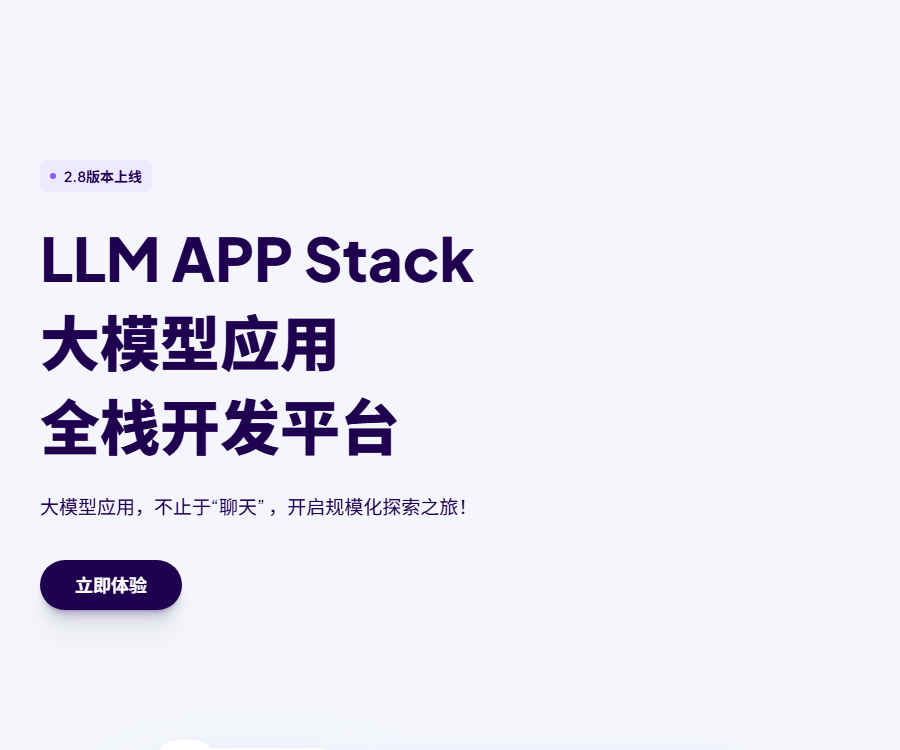
What is Tianrang Xiaobai?
Tianrang Xiaobai is a full-stack development platform for large-model applications, launched by Shanghai Tianrang Intelligent Technology Co., Ltd.
Users can publish web applications or integrate them via APIs by using visual configuration models, prompts, knowledge bases, and workflows.
Main functions
- Create a text-generation AI application.
- Build a multi-turn dialogue robot.
- Create knowledge retrieval applications.
- Orchestrate multi-node AI workflows.
- Configure models, parameters, and prompts.
- Upload documents to create a RAG knowledge base.
- Integration of external languages and Embedding models.
- Set context and sensitive word rules.
- Publish a accessible Web App with one click.
- Automatically generate application API documentation.
- Check usage statistics and user feedback.
- Supports privatization and enterprise customization.
Four types of applications
| Application type | Primary uses | Typical scenarios |
|---|---|---|
| Text generation type | Generate fixed-structure content based on the form. | Copywriting, reports, and summaries |
| Dialogue-based | Conduct multiple rounds of sequential interaction | Customer service, assistant, and training FAQs |
| Search-based | Retrieve answers from documents or data. | Enterprise knowledge search |
| Workflow | Connect multiple models to processing nodes | Automation of complex business processes |
Text generation applications
Text-generation applications are suitable for mapping user input into standardized templates, such as product descriptions, emails, reports, and summary messages.
- Define the content that needs to be generated in the end.
- Split the variables that must be filled in by the user.
- Create role, task, and formatting prompt words.
- Limits on word count, tone, and prohibited content.
- Select the appropriate model and generation parameters.
- Tests are conducted using multiple sets of real examples.
- Record failed inputs and keep optimizing.
Dialog-based applications
Dialogue applications support multi-turn context, making them suitable for customer service, internal assistance, answering questions related to courses, and providing business consultations.
- Establish clear boundaries for identities and services.
- Controls the length of retained historical conversations.
- Provide fallback solutions for questions that cannot be answered.
- Mark high-risk issues that require manual handling.
- Add authentication for sensitive operations.
- Do not allow the model to carry out unauthorized actions directly.
Search-based applications
Search-based applications first locate relevant document fragments and then organize the responses based on those fragments; they are suitable for knowledge-intensive scenarios.
| Stage | Configuration details | Key points of inspection |
|---|---|---|
| Data preparation | Documents, tables, and structured fields | Version and permissions |
| Splitting | Fragment length and overlap range | Semantic integrity |
| Vectorization | Embedding model | Language and domain adaptation |
| Recall | Similarity and number of results returned | Relevance and coverage |
| Generate | Context and response prompt words | Answer only based on the information provided. |
| Display | Source snippets and search results | Traceability and permission isolation |
Workflow applications
A workflow can combine input, models, document retrieval, Embedding, other application calls, and output nodes.
- Draw the business inputs and final outputs.
- Split the processing steps that can be verified independently.
- Declare input variables for each node.
- Configure model or external service parameters.
- Set the paths for success, failure, and timeout.
- Check the inputs and outputs node by node.
- Use abnormal data for stress testing.
- Add logs and alerts before deployment.
Model and parameter configuration
The platform includes various versions of the Tianrang Xiaobai language model and Embedding models; it also allows the integration of external models that meet the specified standards.
| Parameters | Impact | Suggestions |
|---|---|---|
| Maximum output length | Length of response and cost | Set limits based on business needs |
| Temperature | Output randomness | Lower values are used for knowledge quizzes. |
| Context | Information that can be used as a reference for the model | Only transmit necessary content. |
| Prompt | Roles, tasks, and format | Specify the boundaries and failure handling. |
| Sensitive words | Input/Output Security Control | Updated with manual review. |
Prompt development
Prompt words support the insertion of text and dropdown variables, allowing generic applications to be configured as tools tailored for specific business needs.
- Define the roles, objectives, and audience.
- Provide field descriptions for the input variables.
- Specify the output format and required fields.
- Specify the range of facts that cannot be guessed.
- Provide examples of correct and incorrect answers.
- Design a fixed response for insufficient data.
- Use version numbers to record each modification.
Document sets and RAG
A document set can transform corporate data into a search context, ensuring that responses are based primarily on specified knowledge rather than model memories.
- Delete duplicate and invalid files.
- Add sources and effective dates to the document.
- Grouped by department, product, and permissions.
- Upload and check the parsing results.
- Set appropriate splitting and retrieval parameters.
- Test recall using questions with known answers.
- Check whether the answer can lead to the original text.
- Rebuild relevant indexes after the data is updated.
Structured document fields
For structured documents, it is possible to select which fields to include in the context, in order to reduce irrelevant information and prevent sensitive data from being exposed.
| Field type | Is it recommended to enter the context? | Reason |
|---|---|---|
| Title and Abstract | It is generally recommended to | Help in determining the topic. |
| Main text content | Select by business | Provide the basis for the answer. |
| Update time | Suggestions | Determine whether the information is old or new |
| Permission tags | Participation in filtering is necessary. | Prevent unauthorized recalls |
| Personal sensitive information | Not selected by default | Reduce privacy risks |
| Internal notes | Choose carefully. | It may contain confidential judgments. |
Embedding model
The Embedding model converts text into vectors, which can be used for semantic retrieval, similarity matching, recommendations, and knowledge base retrieval.
- Use a model that matches the primary language.
- Test the performance of technical terms and abbreviations.
- Compare semantic retrieval with keyword retrieval.
- Create relevant and irrelevant test sets.
- Record the model version and vector dimension.
- Regenerate the index after changing the model.
Integration of external models
The platform allows the configuration of external language models and Embedding services that are accessible, and requires that the interfaces comply with the specifications set by the respective suppliers.
| Model type | Agreed capacity | Deployment requirements |
|---|---|---|
| Language models | Dialogue generation | Provide accessible service addresses. |
| Embedding model | Text vectorization | Return the stable vector result |
| Proprietary models | Enterprise-specific reasoning | Configure authentication and network policies. |
| Third-party models | Invoke cloud capabilities | Comply with third-party data policies |
The official documentation examples include dialogues and vector routing, but companies still need to protect their addresses, keys, and call logs on their own.
Web App release
Once the configuration is complete, the application can be accessed as a Web App via a link, making it suitable for quickly testing internal or external usage processes.
- Set the application name and description of its purpose.
- Configure the opening message and input prompt.
- Limit the scope of calls made by anonymous users.
- Test the display on mobile and desktop devices.
- Add privacy and AI content prompts.
- Set up feedback and live support channels.
- Monitor for abnormal requests after going live.
Use API
The platform can automatically generate API documentation for the applications created, and it keeps track of call data, usage levels, and user feedback.
- Use different keys for testing and production environments.
- Save the key on the server side.
- Set the call frequency and budget limit.
- Verify all input parameters.
- Log the request ID instead of the sensitive content.
- Handle timeouts, rate limiting, and retry on failures.
- Regularly rotate and revoke keys.
Tutorial for Tianrang Xiaobai
- Register and access the Tianrang Xiaobai open platform.
- Create a separate workspace.
- Choose generation, dialogue, search, or workflow.
- Configure the model and the necessary generation parameters.
- Write prompt phrases and input variables.
- Upload documents as needed to build a knowledge base.
- Set recall fields, context, and sensitive words.
- Use real-world cases for testing and debugging.
- Check for incorrect answers and privilege escalation risks.
- Publish a Web App or generate an app API.
- Configure throttling, permissions, logging, and monitoring.
- Continuous iteration based on usage and feedback.
Price and service methods
The official website does not disclose a fixed price for the model; the available options include certain free privileges, payment based on usage, and customized solutions for enterprises.
| Service method | Public price | Applicable scenarios |
|---|---|---|
| Initial user | Some features are available for free. | Experience and prototype validation |
| Model API | Charged based on usage | Continuous calls from online applications |
| App store products | Display on the corresponding page | Buy ready-made AI applications |
| Private deployment | Contact the official for a quote. | High security and intranet environment |
| Custom development | Quotation after needs assessment | Complex business processes |
Before making a purchase, it is necessary to confirm the unit price of the model, storage capabilities, concurrency limits, data traffic volume, technical support options, deployment methods, as well as the data-related responsibilities specified in the contract.
How to choose the deployment method
| Demand | Suggested approach | Key points for judgment |
|---|---|---|
| Rapid prototyping | Online platforms and Web Apps | Upload speed and free quota |
| Product integration | Use API | Concurrency, cost, and stability |
| Proprietary models | Integration of external models | Network, authentication, and compatibility |
| Internal knowledge base | RAG search application | Permission and data updates |
| Sensitive industries | Consultation on private deployment | Data location and audit requirements |
Data security
Enterprise knowledge bases, prompts, and invocation content may contain sensitive information, which should be controlled from the perspectives of permissions, network security, and logging.
- Delete irrelevant personal information before uploading.
- Isolate different customer data by workspace.
- Enforce permission tags during retrieval.
- The keys are stored only in the server-side key system.
- Logs should avoid recording the full sensitive content.
- Establish processes for file updates and deletion.
- Assess privatization options for high-risk businesses.
Content security and reliability
Sensitive words and contextual restrictions can help reduce risks, but they cannot guarantee that the model’s responses will always be correct or fully compliant.
- Define the scope of responses allowed for the business.
- Prepare a set of test questions with accurate facts.
- Add induction, privilege escalation, and prompt injection tests.
- Check whether to refuse to respond when there is insufficient information.
- Conclusions indicating high risk require manual verification.
- Monitor user feedback and abnormal outputs.
- Run the regression tests again after updating the policy.
API and open-source status
Tianrang Xiaobai provides application APIs and specifications for integrating external models, but the platform itself is not open source.
| Project | Open status | Explanation |
|---|---|---|
| Use API | Support | Automatically generate documentation for created applications. |
| External language models | Supports connection | The supplier’s interface specifications must be met. |
| Embedding model | Supports connection and invocation. | Can be used in workflows |
| Platform source code | Not open source | No open-source license for the product was found. |
| Official GitHub | Not confirmed yet | Research code is not the same as the platform’s source code. |
Which users are it suitable for
- Product teams that need to quickly validate AI applications.
- An operations and IT team for building an enterprise knowledge base.
- Developers who integrate AI capabilities through APIs.
- Automation teams that require workflow orchestration.
- Enterprise users that possess their own models.
- Sensitive industry organizations that require private deployment.
Product advantages
- Four types of applications are also provided.
- It supports two deployment methods: Web App and API.
- Integrates RAG, Embedding, and workflows.
- It is possible to connect to external language models.
- Provides sensitive word and context control.
- Supports usage tracking and user feedback records.
- You can inquire about privatization and customization services.
Usage restrictions
- The official website does not disclose a unified price for the model.
- The model’s output may still produce hallucinations.
- The quality of the knowledge base determines the upper limit of responses.
- Complex workflows require testing of abnormal paths.
- External models are affected by the stability of third parties.
- Privatization and customization need to be evaluated separately.
- The platform itself has not confirmed that it is open source.
Frequently Asked Questions
What can Tianrang Xiaobai mainly do?
It can be used to create text generation, dialogue, search, and workflow applications, and it supports RAG knowledge bases, Web App deployment, and API integration.
Can one use Tianrang Xiaobai without knowing how to program?
Yes, the platform allows applications to be built using models, prompts, document sets, and node configurations; it is not necessary to write complete code for the basic prototype.
Which models is Tianrang Xiaobai compatible with?
The platform incorporates the Tianrang Xiaobai language and Embedding models; it also supports the integration of external language models and vector models that comply with relevant standards.
Can Tianrang Xiaobai create an enterprise knowledge base?
Yes, users can upload document sets; by using embedding and retrieval techniques, it is possible to create Q&A applications based on corporate data.
How much does Tianrang Xiaobai charge?
Initial users can use certain features for free; the API is charged based on usage, while private and customized services require contacting the authorities to obtain a quote.
Does Tianrang Xiaobai provide APIs?
It offers the ability to automatically generate API documentation once an application is created; it also allows one to monitor usage levels and receive feedback, as well as to publish the application as a Web App.
Is Tianrang Xiaobai an open-source platform?
No, although there are API and model integration specifications, no verifiable open-source repository or open-source license specific to this platform has been found yet.
Tools similar to those designed for complete beginners



 Guigong Network Security Registration No. 45132202000164