






Jiuzhang Large Model (MathGPT)
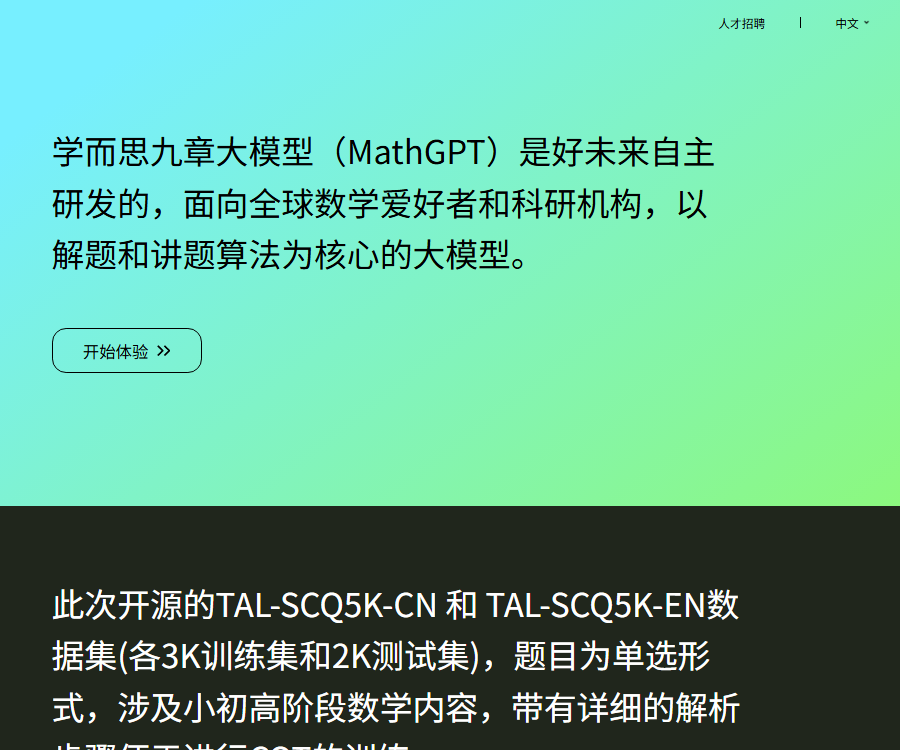
The Xueersi Nine Chapters Large Model is an algorithm developed independently by Good Future; it is designed for mathematics enthusiasts and research institutions around the world, and it is a large model centered on algorithms for solving and explaining mathematical problems.
Tags:AI training modelsWhat is the large-model MathGPT with nine chapters?
MathGPT, the large-scale model developed by Good Future Education Group, is an educational model designed for use in mathematics problem-solving and explanation. It is intended for learners, educational institutions, and research purposes. The current product portfolio includes information on this large-scale model and related research findings, the consumer-oriented application Nine Chapters Love Learning, as well as enterprise solutions provided through Good Future’s AI open platform.
Jiuzhang Aixue serves as a more straightforward access point for ordinary users, offering services such as photo-based question answering, guided explanations of problems, assignment grading, and personalized practice exercises. Corporate clients can request additional functions like problem solving and grading, which can be used as aids for lesson preparation, to answer students’ questions, and to integrate into teaching tools.
Product composition and current status
| Composition | Primary target | Current use | Status description |
|---|---|---|---|
| Jiuzhang Large Model MathGPT | Researchers and educational institutions | Display model positioning, technical reports, and open research data | The product overview page is accessible. |
| Nine Chapters on the Love of Learning | Students and parents | Answering questions regarding photos, explaining topics, grading work, and providing practice exercises | Mobile apps and mini-programs offer |
| Good Future AI Open Platform | Schools, education companies, and development teams | Access to problem-solving, grading, and other educational AI capabilities | Provide registration, documentation, trial versions, and consultation on collaboration. |
| Old website experience | Early experience users | Try it directly in the browser | The current entry point returns an error; it is not suitable as the primary method of use. |
Main functions
Socratic AI lecture style
- After the user takes a photo of the problem or uploads it, the system identifies the question and provides interactive explanations; it is suitable for dealing with problems for which one does not know how to proceed or only understands some of the steps involved.
- The Teacher Xiao Si approach does not simply provide the final answer; instead, it guides the user by posing successive questions to help them analyze the conditions, choose the appropriate methods, and carry out the reasoning process.
- The Teacher Xiao Zhi mode breaks down the complete solution into key steps, allowing users to ask further questions about the parts where they get stuck; it is suitable for learners who wish to identify the problem quickly.
- Video explanations of key concepts are used to supplement those concepts and methods, but the content generated and the identification results still need to be verified by referring to textbooks, teachers, or standard answers.
General photography inquiries, answers to questions, and assignment grading
- Current mobile apps support taking photos of entire pages, and they can be used to grade assignments and answer questions in subjects such as Chinese, English, mathematics, physics, and chemistry.
- The input can be assignments, test papers, or photos of individual questions; the system first identifies printed text, handwritten content, and formulas, and then provides the judgment result along with an explanation.
- The grading results, together with the standard answers, the reasoning behind the solutions, and video explanations, can help students identify the incorrect steps, rather than merely showing whether a response is correct or not.
- The quality of the images, the handwriting, any obstructions in the layout, as well as the type of questions and the academic context all affect the accuracy of recognition and scoring; important exam questions should be checked manually.
AI-driven targeted practice and error management
- AI Precision Training diagnoses the weak areas based on performance during practice, and recommends appropriate exercises of suitable difficulty levels for daily reinforcement or preparation for exams.
- The function for organizing incorrect questions helps users save the questions that need to be reviewed; together with the capabilities for erasing and printing test papers, it enables the creation of materials for further practice.
- Personalized recommendations rely on the learning data stored in the account; changing the account number, having insufficient data, or errors in question recognition can affect the diagnostic results.
Multimodal virtual classrooms and AI companionship
- The mobile application offers a multimodal virtual classroom with annotations and highlights, enabling the explanation process to focus on the key aspects of the topic.
- The AI companion feature is intended for everyday interaction and learning purposes, and it should not replace teachers, guardians, or professional psychological support.
- The app also includes features related to the campus; the specific access points and availability may vary depending on the version, grade level, account status, or region.
Corporate problem-solving solutions
- Enterprise users can submit photos or text of the questions, and in return they will receive suggestions on how to solve them, step-by-step solutions, an overview of the knowledge points involved, and a summary of the skills required.
- The solution covers various question types from multiple K12 subjects, and integrates capabilities such as OCR, formula recognition, handwriting recognition, as well as the separation of printed text from handwritten text.
- The identified questions can be categorized by topic, and used for searching for questions, recommending similar questions, assisting teachers in lesson preparation, or providing a platform for students to get answers to their queries.
- The company page offers trial versions and consultation services for partnerships; the scope of applications, concurrency levels, response times, and service guarantees in the production environment are to be determined as per the contract.
Enterprise grading solutions
- The system allows enterprises to review photos of assignments or tests, provides the results for each question, and can also include explanations of how to solve the questions, the correct answers, as well as video tutorials.
- The teacher platform enables the processing of batch assignments and the generation of learning analyses, while the student version offers immediate corrections and additional practice exercises.
- Complex handwriting, open-ended questions, multiple-answer questions, and subjective questions still carry a risk of misjudgment; therefore, automatic grading cannot be used as the sole basis for assessment.
Chapter 9: Tutorial on Using Aixue
- Choose between the iPhone, iPad, Android installation packages or WeChat mini-programs based on your device; before installing, verify the app name and its provider.
- Register or log in to your account; minors should read the terms of service, privacy policy, and rules regarding child information under the supervision of a guardian.
- When shooting individual questions, entire pages of assignments, or test papers, ensure even lighting and a complete image, while trying to avoid wrinkles, shadows, and finger obstructions.
- Check the topics and subjects identified by the system, then choose between guided explanation, key steps, page-wide correction, or targeted practice.
- First, think independently about the questions posed by the system, then check the next set of instructions; if there are issues with formulas, units, conditions, or answers, take another photo.
- Include the representative wrong answers in a collection of such errors, carry out targeted practice, and verify the key conclusions using the textbook, the teacher’s guidance, or the standard answers.
Input, output, and applicable tasks
| Task | Main inputs | Main output | Suitable scenarios |
|---|---|---|---|
| Interactive lecture on topics | Title photo and follow-up questions | Guiding questions, key steps, and explanations of important concepts | Independent learning and parental guidance |
| Grading assignments | Photos of individual questions, entire pages of homework, or test papers | Right or wrong, analysis, answers, and video explanations | Assignment checking and correction |
| Precise practice | Practice records and learning performance | Weakness diagnosis and personalized questions | Daily reinforcement and exam preparation |
| Solving problems for businesses | Image or text title | Summary of ideas, steps, knowledge points, and skills | Lesson preparation, answering questions, and educational applications |
| Enterprise correction | Images of assignments or tests | Grading results, correct answers, and analysis | Teachers’ corrections and study reports |
Supported platforms
| Platform | Current status | Main functions | Precautions |
|---|---|---|---|
| iPhone and iPad | Available now | Jiuzhang Aixue features complete mobile functionality. | iOS or iPadOS 13 or later is required. |
| Android | Official installation packages are provided. | Learning on mobile devices and photo-taking functions | Before installation, it is necessary to check the external installation instructions for the system. |
| WeChat Mini Program | Provide an entrance | A mobile experience that requires no separate installation | The functions and version may differ from those of the native app. |
| Google Play | Not confirmed yet | The official store page could not be verified at the moment. | Do not consider third-party applications with the same name as Jiuzhang Aixue. |
| Enterprise open platform | Available now | Documents, capability trials, and cooperative integration | Production requests require an application along with confirmation of the commercial terms. |
Prices, trials, and refunds
| Package or version | Price | Billing cycle | Core benefits or quota | Suitable for users |
|---|---|---|---|---|
| Jiuzhang Aixue Mobile App | Free download | No download fees | The specific free features and usage limits are as indicated in the account. | Students and parents |
| Consumer-paid content | Not yet made public | The settlement page shall prevail. | Some digital content or services may require payment. | Users who need additional features |
| Trial of the enterprise’s openness capability | Free trial | Based on the application result | Specific capabilities, usage volume, and deadlines need to be confirmed in the backend. | Development and proof of concept |
| Enterprise production plan | Contact sales | Contractual agreement | Interfaces, concurrency, service reliability, and customized business authorization | Schools and education companies |
Free download does not mean that all features will remain free forever; the exact amount and limits associated with premium membership are not made public for consumer users. Free use or trials on the corporate page also do not imply unlimited access for production purposes; it is necessary to check the account settings and the contract before starting use.
- For paid services, a payment reminder will be displayed before purchase; the price, duration, and benefits are subject to those indicated on the actual settlement page.
- Unless the product has major defects, the platform breaches its obligations significantly, the agreement provides otherwise, or legal requirements apply, refunds are generally not granted after payment without a valid reason.
- Purchased content or services should be used within their respective expiration periods; unused rights after that time generally cannot be refunded in cash.
APIs, SDKs, and enterprise integration
- Register an account on the Good Future AI Open Platform to view the currently available services for solving problems, grading assignments, and other related educational functions.
- Read the access guide and API documentation, create an application as required, obtain the necessary credentials, and implement signature-based authentication.
- Use masked text or image questions to verify recognition, problem-solving, and grading results, while keeping track of failure rates for different subjects and question types.
- Confirm with the business team the free quota, QPS, concurrency levels, pricing, data processing capabilities, content licensing rules, service guarantees, and compliance requirements regarding minors.
- Before going live, implement manual review, error handling, log anonymization, permission isolation, and credential rotation to prevent the model’s outputs from being used directly as the final scores.
The presence of API documentation on the open platform does not mean that all the functions provided by 9Chapter can be used without any restrictions, nor does it imply that the benefits associated with a 9Chapter account can be converted into API credits. As of now, there is no official list of SDKs specific to 9Chapter; developers should refer to the documentation available in their accounts.
Open-source status and research resources
| Project | Status | License or scope of availability | Boundary |
|---|---|---|---|
| Weights of the Nine-Chapter Large Model | Not disclosed | No official model weight license was found. | Models cannot be deployed locally or redistributed. |
| Chapter 9: Aixue product code | Not open source | No license for the product’s source code was found. | The availability of a mobile app does not mean that its code is open. |
| TAL-SCQ5K dataset | Public | MIT License | Only the multiple-choice question data for the mathematics competitions in Chinese and English are available. |
| MathEval evaluation project | Public | Make the evaluation code and processes public. | It is a evaluation tool, not the JiuZhang model itself. |
TAL-SCQ5K is available in both Chinese and English versions; each version contains 5,000 multiple-choice questions on math competitions along with detailed solutions, and these questions are categorized by grade level – elementary school, middle school, and high school. The fact that the dataset or assessment tools are open source cannot be equated to the open sourcing of the JiuZhang large model.
Privacy and data security
- Registration may involve processing phone numbers, account details, and device information; in some cases where answers need to be viewed or to meet compliance requirements, real name and ID information are necessary.
- Taking photos and posing questions requires camera or storage permissions; with the user’s consent, the images can be uploaded to cloud storage, and the server will store the address so that the history of questions can be viewed.
- Voice input requires microphone permissions to process audio; once these permissions are disabled, the related functions become unavailable, but other functions that do not depend on these permissions can still be used.
- Information collected and generated within the country is, in principle, stored in encrypted form on the Chinese mainland, and the retention period is determined in accordance with the objectives of providing the services and the requirements of applicable laws.
- Users can access, correct, delete, or copy their personal information, revoke consent, and close their accounts; once an account is closed, the information is deleted or anonymized, unless otherwise required by law.
- Users under 18 years of age should use the service under the supervision of a guardian, and children under 14 must also obtain their guardian’s consent regarding the rules regarding their personal information.
Copyright, commercial use, and considerations regarding AI-generated content
- The questions, images, text, and other materials uploaded by users must be owned by them or for which they have legitimate authorization; it is not allowed to violate copyright laws or the rights related to privacy and personal information.
- In principle, the rights to user-generated content belong to the users or the respective rights holders, but the act of uploading such content grants a non-exclusive license necessary for the operation of the platform.
- The Nine Chapters Learning Agreement specifies that the generated content is to be regarded as reference material only, and users are prohibited from using the AI-generated output for commercial purposes or from sharing it on other platforms.
- When publicly releasing content generated by AI, it is necessary to comply with the applicable requirements regarding AI-generated identifiers; such identifiers added by the platform must not be removed, altered, or falsified.
- If enterprise clients wish to use the outputs in products, courses, reports, or commercial services, they must enter into a contract to clarify the terms regarding data, outputs, redistribution, and commercial usage rights.
Suitable for users and typical use cases
- Student: Take photos of the homework to check it, understand the steps where difficulties arise, organize the mistakes made and carry out targeted practice.
- Parents: Use AI to assist with homework and help in understanding questions, but not rely on its results as the sole basis for judgment.
- Teacher: Obtain ideas for lesson preparation, tools for batch grading and learning analysis, while still retaining the option for manual review.
- Education Product Team: Integrates problem-solving, grading, and question-identification capabilities into Q&A systems, question banks, or teaching platforms.
- Researcher: Mathematical reasoning can be studied using public datasets and evaluation tools, but the weights of the nine-chapter model cannot be determined based on these.
Advantages and limitations
Main advantages
- It integrates question identification, interactive explanations, assignment grading, identification of weak areas, and personalized exercises to create a closed-loop learning system.
- Consumer applications operate alongside enterprise open platforms; individuals can learn directly, while organizations can assess the feasibility of integrating such systems.
- The problem-solving mode focuses on the process and key steps, making it more suitable for learning situations than simply providing the final answer.
Usage restrictions
- AI may misinterpret the questions, overlook certain conditions, or produce incorrect steps; complex questions, subjective questions, and those with significant scoring criteria require manual review.
- The experience of the old website is currently unavailable; ordinary users should prefer to use the Jiu Zhang Ai Xue application or mini-program.
- The amounts associated with consumer memberships, the free usage quotas, and the production costs for enterprises are not fully disclosed; therefore, free downloads and installations cannot be considered as services with unlimited access.
- The model weights and product codes are not made available publicly, and the available datasets and evaluation tools cannot be used to claim that the JiuZhang large model can be deployed locally.
Frequently Asked Questions
What is the relationship between the JiuZhang large model and JiuZhang Aixue?
Jiuzhang Large Model is an underlying education model and a research brand, while Jiuzhang Aixue is an application designed for students and parents. Ordinary users make use of functions such as photo-based question answering, explanation of problems, grading, and practice through Jiuzhang Aixue.
Can Jiu Zhang Ai Xue be used for free?
The application can be downloaded for free, and the enterprise platform also offers a trial version; however, the free features, limits, and paid content available to consumers are not fully disclosed. The actual rights and benefits depend on the account status after logging in and on the settlement page.
Does the JiuZhang large model support only mathematics?
The core starting point of JiuZhang is mathematical problem-solving and explanation; currently, JiuZhang’s learning tools as well as the services provided for enterprises in terms of problem-solving and marking assignments cover various K12 subjects. The range of subjects supported by different functions may vary, so it is necessary to check the relevant details before using them.
Is it possible to access the capabilities of JiuZhang through an API?
The Good Future AI Open Platform offers access guides, API documentation, as well as enterprise solutions related to 9Chapters. Specific interfaces, trial quotas, concurrency limits, and prices can be viewed after registration or by contacting the sales team for confirmation.
Is the Nine Chapters large model open-source?
No official open-source releases of the weights associated with the Nine Chapters model or of the code related to Nine Chapters AiXue have been found. The publicly available TAL-SCQ5K dataset and the MathEval evaluation project are research resources only; they do not indicate that the models are open source.
Can the results generated by AI for explaining topics be used directly in business courses?
The agreement provided by JiuZhang AiXue for consumers prohibits the use of the generated content for commercial purposes or its dissemination across different platforms. For commercial use by enterprises, a separate contract must be signed to define the rights related to the output, materials, data, and their redistribution.
Will the pictures taken during questioning be saved?
With the user’s consent, the images of the questions can be uploaded to cloud storage, and the storage address is kept for displaying historical records. Users can manage their permissions and personal information; upon cancellation, such data is deleted or anonymized in accordance with the relevant policies, except in cases where retention is required by law.
Summary
The MathGPT large model is suitable for individuals and organizations that need guided explanations, photo-based correction services, and integration with educational AI tools. Ordinary users should start by using the Jiuzhang Aixue application or mini-program, while companies need to verify the interfaces, costs, and licensing aspects through the open platform; they must also always retain the option for manual review of the identification, reasoning, and scoring results.
Tools similar to the MathGPT large model



 Guigong Network Security Registration No. 45132202000164