






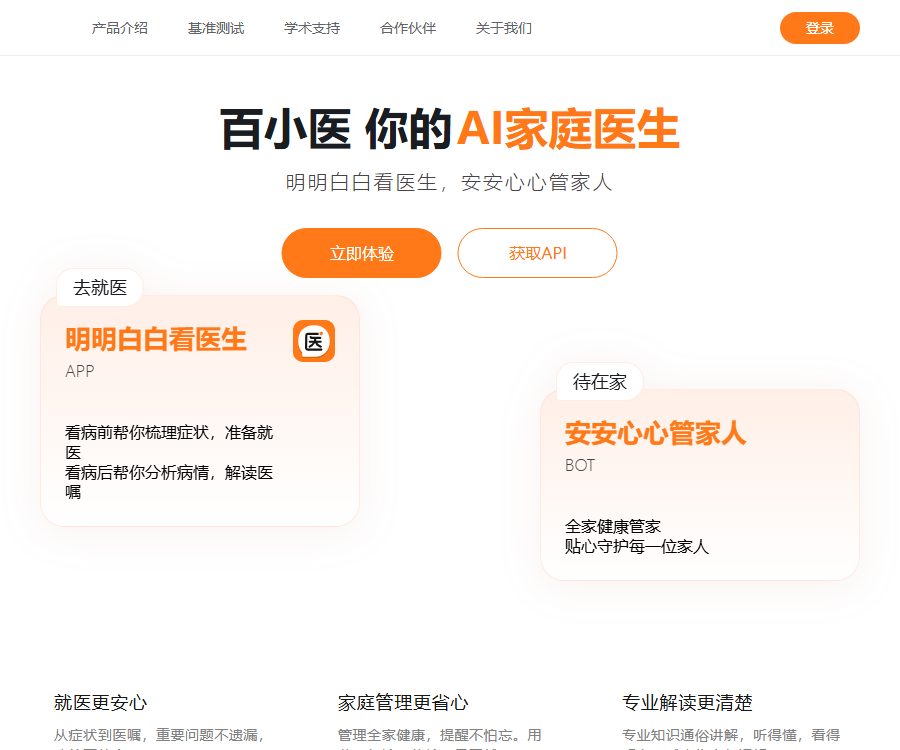
Baichuan Intelligence
BaiChuan Intelligence helps AI models operate more efficiently and simply.
Tags:AI training modelsWhat is BaiChuan Intelligence?
BaiChuan Intelligence is a large-model company founded by Wang Xiaochuan in 2023; it initially released several bilingual models for both Chinese and English, and its current focus lies on AI applications in the medical field. Its products include the BaiXiaoYi home health assistant, medical enhancement models, open platform interfaces, search enhancement tools, knowledge bases, and open-source models.
BaiChuan Intelligence is both a provider of online products and business interfaces, as well as a publisher of open-source models. BaiXiaoYi and its open platform are not fully open source; only specific models, code, and weights are made available under their respective licenses.
A one-sentence summary
Baichuan Intelligence is a company that focuses on large models designed for medical applications; it offers home health assistants, pay-as-you-go interfaces, knowledge bases, search services, as well as open-source models that can be deployed privately.
Current main products
| Products | Positioning | Key capabilities | Usage method |
|---|---|---|---|
| Bai Xiao Yi | AI Home Health Assistant | Preparation for medical visits, interpretation of medical instructions, home health management | Applications and intelligent assistants |
| Baichuan-M3-Plus | Evidence-based enhanced medical model | Consultation process, medical search, and evidence support | Business interfaces or organizational plans |
| Baichuan-M3 | Open-source medical enhancement model | History collection, reasoning, examination, and assistance in diagnosis | Interface or private deployment |
| Baichuan-M2 series | Medical reasoning model | Health Q&A and Medical Reasoning | Interface or open-source deployment |
| Universal model | Text and dialogue | Generation, summarization, Q&A, and search enhancements | Open platform interface |
| Knowledge base | Enhanced corporate data search | Vectorization, file storage, and knowledge answering | Open platform interface |
Functions of BaiXiaoYi
Summary of symptoms before seeking medical care
Users can organize their symptoms, duration, triggers, and questions they want to ask the doctor before seeing a healthcare professional. The list generated by AI can aid in communication, but it cannot carry out triage or rule out emergencies.
Condition after seeking medical care and interpretation of medical advice
BaiXiaoYi can transform technical terms into explanations that are easier to understand, and it can also assist with organizing matters related to examinations, medication use, and follow-up appointments. Any information that conflicts with the doctor’s original instructions should be verified again with the medical institution.
Family health management
The product allows for the management of health information related to family members, and it provides continuous reminders regarding medication use, follow-up appointments, and medical check-ups. The information about family members is highly sensitive, so authorization from the individual themselves or their guardian must be obtained before it can be added.
Persistent questioning and straightforward explanations
Users can ask repeated questions regarding the same health issue in order to understand the relevant concepts, assessment indicators, and general precautions. No matter how detailed the answers are, they do not equate to an understanding of physical examinations, a complete medical history, or the information available at the clinical site.
Baichuan-M3 series
Baichuan-M3
Baichuan-M3 is a medical enhancement model with 235 billion parameters; its training objectives focus on actively collecting medical history, establishing pathways for medical reasoning, and reducing factual errors. The official version provides both regular weight versions and quantized versions, allowing it to be deployed using mainstream reasoning frameworks.
The model achieved high scores in tests conducted on HealthBench as well as in assessments using custom clinical workflows; however, these benchmark tests cannot demonstrate its safety in real-world clinical settings. The model is intended solely for research and reference purposes, and it cannot replace professional diagnosis and treatment.
Baichuan-M3-Plus
M3-Plus is a commercial interface version that includes evidence-based enhancement processes; it triggers medical searches automatically during use and incurs additional costs. It is suitable for medical education and clinical support scenarios that require evidence-based support, and it is not a tool for automatically prescribing medications to patients.
Baichuan-M2 and M1
M2 is a 32B medical-enhanced inference model; its public version is suitable for research and deployment at a relatively low cost. M1 is a 14B medical-enhanced model. The licenses and commercial terms vary from one repository to another, so it is necessary to read the details of each model card before downloading it.
The Plan to Embrace All Rivers
BaiChuan Intelligence offers institutions that serve medical professionals the option to use the M3-Plus interface free of charge, after the application has been approved. This service is intended for use in clinical decision support and medical education, and it must be applied in real-world scenarios.
- The applicants are institutions that serve medical professionals, not all individual developers.
- The product must display a logo indicating the capabilities provided by BaiChuan.
- The interface must not be used for the mass production of data.
- No modifications should be made to the model’s output that could affect its accuracy.
- Access and final interpretation are at the discretion of BaiChuan Intelligence.
Open platform API pricing
The price information was verified on August 24, 2026; the platform charges based on each thousand Tokens or per service provided. Generally, one Token is equivalent to about 1.5 Chinese characters, and the actual amount used depends on the instructions given, the context, and the length of the output.
| Model or service | Enter price | Output price | Context | Explanation |
|---|---|---|---|---|
| Baichuan-M3-Plus | 0.005 yuan per thousand Tokens | 0.009 yuan per thousand tokens | 32K | Medical searches are triggered automatically and are charged separately. |
| Baichuan-M3 | 0.01 yuan per thousand Tokens | 0.03 yuan per thousand tokens | 32K | Medical enhancement model |
| Baichuan-M2-Plus | 0.01 yuan per thousand Tokens | 0.03 yuan per thousand tokens | 32K | Medical searches are triggered automatically and are charged separately. |
| Baichuan-M2 | 0.002 yuan per thousand tokens | 0.02 yuan per thousand Tokens | 32K | Medical reasoning model |
| Baichuan4-Turbo | 0.015 yuan per thousand tokens | 0.015 yuan per thousand tokens | 32K | Total input and output |
| Baichuan4-Air | 0.00098 yuan per thousand Tokens | 0.00098 yuan per thousand Tokens | 32K | Total input and output |
| Baichuan4 | 0.1 yuan per thousand tokens | 0.1 yuan per thousand tokens | 32K | Total input and output |
| Baichuan3-Turbo-128k | 0.024 yuan per thousand tokens | 0.024 yuan per thousand tokens | 128K | Total input and output |
The models and prices may change; older models might be taken out of use or automatically redirected to alternative versions. Before they go live, it is necessary to verify the model identifiers, real-time unit prices, throttling rules, and balance regulations in the control panel.
Search, vector, and knowledge base fees
| Billing items | Price | Billing method | Explanation |
|---|---|---|---|
| Search enhancement | 0.03 yuan per transaction | Based on the actual number of triggers | Once it is enabled, the interface determines whether to perform a search. |
| Medical search | 0.03 yuan per transaction | Triggers automatically with the Plus model | M3-Plus and M2-Plus |
| Text vector model | 0.0005 yuan per thousand Tokens | By Token | Used for vectorization and knowledge bases |
| Knowledge base file storage | 1.5 yuan/GB/day | By capacity and number of days | The maximum per user is 5GB. |
| Assistants API | Free for a limited time | Active phase | It should not be considered a permanent zero price. |
Interface capabilities
- Multiple rounds of dialogue, streaming responses, and conventional text generation.
- Optional search enhancements, incorporating real-time internet information.
- Medical models can provide evidence-based support in conjunction with medical searches.
- Vector models support text representation and semantic retrieval.
- The knowledge base allows for the uploading of corporate information, enabling the creation of search-enhanced Q&A responses.
- The capabilities of assistants allow for the organization of agent workflows using built-in or custom tools.
Developer tutorial
- Register an account on the open platform and complete the required real-name verification or corporate verification.
- Create an interface key, and set up balance alerts, call limits, and a separate environment.
- Select a model based on general or medical tasks, and determine the context and unit price.
- First, use desensitized test data to create a minimal request in order to check the flow and any error responses.
- When a search is needed, the switch must be set explicitly, and the additional number of search calls is counted.
- In medical scenarios, additional rules for manual review, emergency routing, and refusal of requests have been introduced.
- After going live, it records the model version, prompt templates, latency, costs, and security events.
Comparison of open-source models
| Model | Parameter scale | Main positioning | Public License Overview |
|---|---|---|---|
| Baichuan-M3 | 235B | Medical consultation and decision support | Apache-2.0, permitted for research and commercial use |
| Baichuan-M2 | 32B | Medical enhanced reasoning | Apache-2.0, permitted for research and commercial use |
| Baichuan-M1 | 14B | Medical enhancement model | The license terms of the model community must be followed. |
| Baichuan2-13B | 13B | Universal Multilingual Model | The code and model community licenses apply together. |
| Baichuan2-7B | 7B | Universal Multilingual Model | The code and model community licenses apply together. |
| Baichuan-7B and 13B | 7B and 13B | Bilingual Chinese-English model | Commercial use may require an application in accordance with the instructions. |
\"Open source for commercial use\" cannot replace a license review; it is particularly important to distinguish between code licenses, model weight licenses, training data, and product trademarks. The terms of different versions may vary, and companies should keep the license text obtained at the time of download when deploying the software.
Requirements for private deployment
The Baichuan-M3 model is quite large; its full deployment requires multiple high-memory GPU cards as well as advanced capabilities for inference and operation. The quantized version reduces memory usage, but it still isn’t a lightweight model suitable for use on personal computers. The M2 and M1 models are more appropriate for research and testing environments with limited resources.
- Evaluate video memory, throughput, context length, and concurrency targets.
- Test the changes in accuracy and medical safety after quantification in an isolated environment.
- Configure access control, audit logs, data encryption, and version rollback.
- Medical data is authorized, anonymized, and minimized before being fed into the model.
- Establish processes for doctor review, error reporting, and escalation of high-risk issues.
Which users are it suitable for
- Application developers who need to call the Chinese large-model interface.
- Institutions that develop systems for medical education, physician assistants, or clinical support.
- A research team that studies medical reasoning, the process of patient consultation, and the factual aspects of models.
- Technical teams are needed for search enhancement, vectorization, and enterprise knowledge bases.
- Companies and universities that wish to deploy open-source Chinese or medical models.
- Home users who need to prepare for medical visits and require straightforward explanations of medical instructions.
Product advantages
- Medical models, consumer-side assistants, business interfaces, and open-source weights form a complete set.
- The public weights of M3 and M2 facilitate research, evaluation, and private deployment.
- The prices for these interfaces are made public, with costs related to medical searches and database storage listed separately.
- A charitable usage program is available for medical institutions, aiming to lower the barriers to trying out these solutions in compliance-related scenarios.
- It supports generic models, search enhancement, vectorization, and agent development.
Restrictions and medical risks
- Any model may produce errors, missed diagnoses, excessive recommendations, or fabricated evidence.
- Rating lists and low hallucination metrics cannot be equated with clinical approval.
- Bai Xiao Yi cannot replace medical check-ups, doctor diagnoses, prescriptions, or emergency care.
- The free program for medical institutions is subject to approval, and there are requirements regarding the target recipients, purposes, and way in which it should be presented.
- The storage in the knowledge base is charged on a per-GB basis per day, and the long-term costs can be higher than those associated with calling the models.
- Private deployment of open-source large models still incurs costs related to computing power, compliance, security, and maintenance.
- Old models may be taken out of service or redirected; production systems require their versions to be fixed and monitored.
Emergency and high-risk situations
In cases of chest pain, difficulty breathing, disturbance in consciousness, severe bleeding, acute allergies, or a risk of self-harm, it is necessary to contact emergency services immediately or go to the hospital. Do not wait for further questions from AI, and do not stop taking medications or change their dosage based on the responses provided by the system.
Clinical support systems must identify the ultimate responsible person and keep records of evidence, audits, and corrections. Products intended for patients should avoid providing definitive diagnoses or treatment instructions that have not been confirmed by a doctor.
Privacy and data security
BaiXiaoYi’s services for family memory and health management handle sensitive data such as medical history, medications taken, test results, and family relationships. Users should minimize the amount of unnecessary personal information provided, while the organization must implement mechanisms for legitimate authorization, access control, defined retention periods, and data deletion.
When using commercial APIs, it is also necessary to take into account the provisions regarding log retention, use of data for training purposes, cross-border data processing, and fault support. Open-source solutions for private deployment enable better control over data, but the responsibility for security falls on the party that carries out the deployment.
Basic information
| Project | Content |
|---|---|
| Company name | Baichuan Intelligent Technology Co., Ltd. |
| Date of establishment | March 2023 |
| Founder | Wang Xiaochuan |
| Core direction | Medical enhancement large models and language AI |
| Consumer products | Bai Xiao Yi |
| Development platform | Models, search, vectors, and database interfaces |
| Whether API is provided | Yes |
| Is it open source? | Some of the models are open source, while the platform and BaiXiaoYi are not. |
Recommendation score
It has a rating of 4.6 points and is suitable for research in medical AI, the development of Chinese-language model interfaces, and validation by compliant organizations. No matter how advanced the medical capabilities may be, they must still be under the supervision of professionals and within actual clinical settings.
Frequently Asked Questions
Can Baichuan Intelligence be used for free?
Certain experiences, open-source models, and time-limited services are available free of charge, while the open platform operates on a pay-as-you-go basis. The Hai Na Bai Chuan program is intended only for medical service providers that have passed the approval process.
What is the difference between M3 and M3-Plus?
M3 comes with publicly available weights and can be deployed privately; M3-Plus is the commercial version that includes evidence-based enhancements and medical search capabilities. Using M3-Plus incurs costs related to medical searches.
Can BaiXiaoYi replace doctors?
No, it is suitable for organizing symptoms, preparing for medical visits, explaining terms, and providing reminders for family members. Diagnosis, prescription writing, discontinuation of medications, and emergency decisions must be carried out by medical professionals.
How is billing for the interface handled?
Models are typically charged on a per thousand tokens basis, searches are charged per occurrence, and the knowledge base incurs fees for vectorization and file storage. It is necessary to check the real-time prices before settling the bill.
Is BaiChuan Intelligence open-source?
Some models are open source, but BaiXiaoYi, the open platform, and the commercial services are not open source. The licensing for the code and weights of each model must be checked separately.
Can it be deployed privately?
Public models can be deployed; M3 supports the major inference frameworks as well as their quantized versions. Those responsible for deployment must provide their own computing resources, ensure data security, and comply with medical regulations.
Summary
BaiChuan Intelligence has evolved from a company focused on general-purpose large models to a platform centered on medical AI, offering three approaches: BaiXiaoYi, commercial interfaces, and open-source models. When making a choice, it is necessary to take into account the performance of the models, any additional costs associated with searches, the licensing terms, as well as the boundaries of medical responsibility.
Tools similar to BaiChuan Intelligence



 Guigong Network Security Registration No. 45132202000164