






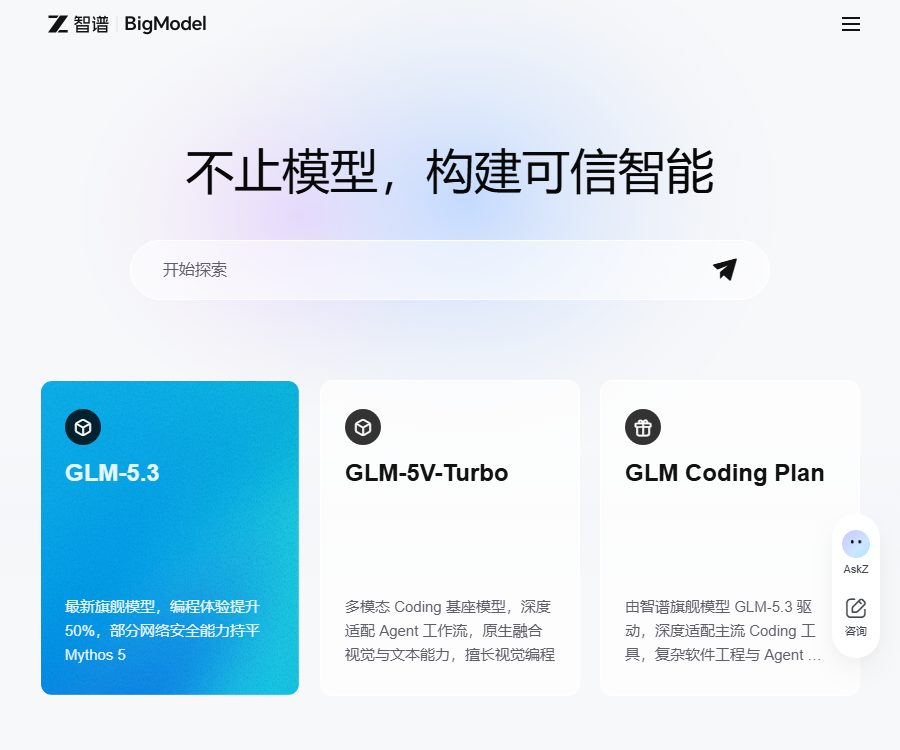
Bigmodel
Bigmodel: makes AI models work more efficiently and simply.
Tags:AI training modelsWhat is BigModel?
BigModel is an open platform for large-scale models launched by Beijing Zhipu Huazhang Technology Co., Ltd.; it provides developers and enterprises with GLM series of models as well as the necessary AI development tools. This platform functions as a one-stop model-as-a-service environment, offering services such as model experience, API calls, fine-tuning, evaluation, knowledge bases, web search, intelligent agents, and private deployment.
A one-sentence summary
BigModel is a domestic AI development platform based on GLM models; it allows for the creation of applications for text processing, multi-modal tasks, search functions, knowledge bases, and intelligent agents, through APIs and official SDKs.
Core functions
Text and reasoning models
The platform offers GLM models designed for general conversations, complex reasoning, code generation, and agent tasks. The current flagship model, GLM-5.3, has a context capacity of millions of tokens, and it is optimized to improve performance in complex software engineering tasks as well as in long-term agent operations.
- It supports multi-turn conversations, content generation, information extraction, structured output, and tool invocation.
- It offers various options in terms of performance, speed, and cost, making it easy to select the appropriate model based on the business workload.
- Some models support context caching, which can reduce the cost of making repeated requests.
- Model versions are continuously updated; in production environments, it is necessary to lock down the names and conduct regression tests.
Vision, images, videos, and audio
In addition to text models, the platform also offers visual understanding, image generation, video generation, speech synthesis, speech recognition, and vector models. The input formats, output constraints, and pricing for different modalities vary, and it is necessary to integrate them using the respective model documentation.
Online search
Search tools can enhance large models with the ability to retrieve information from web pages in real time. Currently, there are a basic version, an enhanced version, as well as versions that integrate with various search services. Developers can combine the search results with the model’s responses to create improved Q&A systems or research applications.
Knowledge base retrieval
Users can upload documents, web pages, or structured data to create a knowledge base, and then use retrieval techniques to generate answers to questions related to corporate information. The capacity of the knowledge base, its vectorization level, the efficiency of retrieval, and access rights need to be configured based on the actual amount of data available.
Model fine-tuning
BigModel offers LoRA as well as full-parameter fine-tuning for certain models, allowing it to be used to create models that better suit industry terminology, writing styles, and business processes. Fine-tuning does not guarantee accuracy on its own; it is still necessary to prepare training sets, validation sets, and tools for safety assessment.
Model evaluation
The model evaluation function is used to assess performance, efficiency, and stability based on datasets and various metrics; it is suitable for conducting regression tests before upgrading a model. Companies should take into account factors such as the accuracy of business operations, the rate of false outputs, latency, costs, and content security when evaluating models.
Agents and MCP services
The platform offers an agent market, tools for making calls, and MCP service interfaces, which enable models to be connected to search systems, knowledge bases, or business tools. When agents carry out external operations, minimum permissions, manual verification, and comprehensive auditing should be implemented to prevent erroneous actions by the models.
Dedicated and private deployment
For enterprises with high requirements regarding stability, data isolation, and inference performance, they can opt for cloud-based private instances, annual privatization packages, or on-premises deployment solutions. Private deployment involves computing resources, operation and maintenance, security, model licensing, and implementation services, and its costs are significantly higher than those of public APIs.
Model and service types
| Service type | Typical uses | Billing method | Suitable for users |
|---|---|---|---|
| Text and reasoning models | Dialogue, writing, coding, reasoning, and agents | By input and output tokens | Application developers and corporate teams |
| Visual understanding | Image Q&A, document understanding, and content analysis | Based on Token or model rules | Document, education, and content review teams |
| Image and video generation | Marketing materials, design, and video creation | Per use or per model specification | Creators and visual product teams |
| Speech model | Speech recognition, speech synthesis, and audio processing | By duration, characters, or model rules | Customer service, media, and voice applications |
| Online search | Real-time Q&A, data retrieval, and enhanced searching | By number of calls | Search and research applications |
| Knowledge base | Enterprise document retrieval and internal Q&A | Capacity and model invocation costs | Corporate Knowledge Management Team |
| Model fine-tuning | Industry adaptation, style control, and specialized tasks | Select by training token or resource | A professional team with training data |
API Usage Tutorial
- Register for a BigModel account and complete the identity or corporate verification required by the platform.
- Create API keys in project management, and store those keys in environment variables or a dedicated key management system.
- Go to the model overview and select a model based on context, mode, speed, price, and task type.
- Existing applications can be migrated using standard RESTful interfaces, official Python or Java SDKs, as well as OpenAI-compatible methods.
- Send a small number of requests in the testing environment to check the response content, Token usage, error codes, latency, and content security results.
- Set timeouts, retry options, concurrency limits, cost budgets, log masking, and key rotation for production services.
- Before upgrading the model, a fixed test set is used for regression evaluation, after which the production traffic is introduced in phases.
Prices and packages
The price information was verified on August 24, 2026. In China, BigModel offers a pricing model that includes pay-as-you-go options, subscription plans, and enterprise deployment solutions. The figures listed below represent the typical prices on the current public page; taxes, discounts, and the final amount will be indicated on the settlement page.
| Model or service | Enter price | Output price | Cache hits or other fees | Main features |
|---|---|---|---|---|
| GLM-5.3 | 8 yuan per million tokens | 28 yuan per million tokens | 2 yuan per million tokens for cache hits | 1M context, advanced programming and Agent flagship |
| GLM-5.2 | 8 yuan per million tokens | 28 yuan per million tokens | 2 yuan per million tokens for cache hits | 1M context, long-term tasks |
| GLM-5-Turbo | 5 to 7 yuan per million tokens | 22 to 26 yuan per million tokens | Cache hit: 1.2 to 1.8 yuan per million tokens | Categorized by input length |
| GLM-4.7-FlashX | 0.5 yuan per million tokens | 3 yuan per million tokens | Cache hit: 0.1 yuan per million tokens | 200K context, low-cost high-speed invocation |
| GLM-4.7-Flash | Free | Free | The current page shows it is free. | 200K context, suitable for trials and light tasks |
| Search-Std | 0.01 yuan per transaction | Not applicable | By number of calls | Basic web search |
| Search-Pro | 0.03 yuan per transaction | Not applicable | By number of calls | Higher recall rate |
| Expansion of knowledge base | 0.04 yuan/GB/hour | Not applicable | Based on actual capacity and duration | Dynamically expand the knowledge base capacity |
GLM Coding Plan
The GLM Coding Plan is a subscription service designed for AI programming tools; it features limits set per 5 hours and per week, along with various usage tiers available. The subscription quota can only be used with officially supported programming tools, and it cannot be utilized as a general API quota for custom websites, robots, or SaaS applications.
Enterprise deployment costs
Cloud-based private instances are typically charged on a per computing unit and per day basis; the current average price is around 100 to 175 yuan per computing unit per day. Annual cloud privateization packages and on-premises deployments can result in costs comparable to those of enterprise-level projects, and it is necessary to consult a sales representative to take into account factors such as the model used, computing power, training volume, and scope of services.
Refunds and automatic renewal
If no usage has taken place within 7 days of purchasing a subscription service, it is possible to contact customer service to request a full refund; refunds are generally not provided in cases where there is already record of usage. Refunds are usually not offered after 7 days, and in cases of early termination or removal of the service due to platform reasons, the remaining period and usage rules outlined in the agreement apply.
Charges are only made at the end of a cycle if the user chooses automatic renewal; it is possible to disable this feature 3 days before the current subscription period ends. Subscriptions purchased through different channels may be subject to the refund and renewal rules of the app store or third-party payment services.
Which users are it suitable for
- Application developers who need to integrate domestic large language models and multimodal models.
- It is necessary to form teams for building corporate knowledge bases, intelligent customer service systems, search-enhanced Q&A functions, and agents.
- An algorithm team that aims to develop industry-specific capabilities through model fine-tuning and evaluation.
- Organizations that require RMB-based settlement in the Chinese market, as well as enterprise services and private deployment options.
- Developers who use tools such as Claude Code and Cline and wish to purchase dedicated programming credits.
Product advantages
- The model types are comprehensive, covering text, visuals, images, videos, audio, vectors, and search.
- It also offers pay-as-you-go APIs, programming subscriptions, private instances, and on-premises deployment to suit different scales.
- It supports RESTful interfaces, official SDKs, and OpenAI-compatible methods, resulting in low barriers to migration and integration.
- It offers capabilities for fine-tuning, evaluation, knowledge bases, and agents, thereby creating a complete development cycle.
- The public RMB price in the Chinese market is clear, which makes it easy to estimate the costs associated with tokens, as well as for searching for and storing them.
Restrictions and Precautions
- Models, prices, and contextual specifications change rapidly; applications that run over the long term require version and cost monitoring.
- Free models may be subject to constraints related to concurrency, speed, fair usage, or operational policies, and do not represent unlimited service.
- Large models may generate factual errors, code defects, and unsafe outputs; manual review is necessary in high-risk scenarios.
- The effectiveness of fine-tuning and knowledge bases depends on data quality; incorrect materials can be amplified by the model or cited incorrectly.
- The scope of use for Coding Plan differs from that of generic APIs; improper use may result in quota restrictions or account suspension.
- Private deployment still requires computing resources, operations and maintenance, security governance, and model license evaluation.
Privacy and security
The platform handles information related to accounts, authentication, transactions, devices, usage logs, and API calls, and stores data in accordance with the needs of the services and legal requirements. When it comes to personal information, corporate secrets, or regulated data, masking, access control, determination of retention periods, and contract reviews must be carried out prior to any use of such data.
API keys should be submitted using Bearer authentication, and stored in environment variables or key management systems; they must not be included in frontend code or made available in public repositories. Production systems should also implement key rotation, access whitelisting, usage alerts, and log anonymization.
API, SDK, and open-source status
BigModel offers standard RESTful APIs, and it supports integration using official SDKs such as those for Python and Java, as well as the OpenAI SDK. The current Python documentation recommends the use of the zai-sdk; older zhipuai packages still include compatibility examples, but developers should prefer to use the modern interfaces.
The BigModel hosting platform itself is not an open-source product; the official Python, Node.js, and Java SDK repositories are licensed under the MIT license. Some of the code or weights related to GLM models are available in public repositories, but it is necessary to check the license specific to each model – making the models available publicly does not mean that the platform service itself is open source.
Supported platforms
| Platform or method | Support status | Primary uses | Requirements |
|---|---|---|---|
| Web console | Support | Model experience, projects, keys, billing, and resource management | Register an account |
| API interface | Support | Access to various servers and applications | API keys and network environment |
| Python SDK | Support | Script, data, and AI application development | Install the current SDK |
| Java SDK | Support | Enterprise backend and high-concurrency services | Java build environment |
| Compatible integration with OpenAI | Support | Migrate existing clients and agent tools | Modify the interface address and model name. |
| Local privatization | Enterprise solutions | Data isolation and dedicated inference | Contact sales and complete the deployment assessment. |
Basic information
| Project | Content |
|---|---|
| Product name | Zhipu BigModel Open Platform |
| Operating company | Beijing Zhipu Huazhang Technology Co., Ltd. |
| Tool type | Large model APIs, model services, and AI development platforms |
| Core model | GLM text, multimodal, generation, speech, and vector models |
| Price pattern | Free models, pay-as-you-go pricing, subscription plans, and enterprise deployment |
| Is registration required? | It is necessary. |
| Whether API is provided | Yes |
| Is it open source? | The platform is not open-source; however, the SDK and certain model projects are available. |
| Primary language | Chinese documents and development interfaces |
Recommendation score
It has a recommendation score of 4.7 points, and is suitable for developers and organizations that need API access to domestic models, a complete set of development tools, as well as capabilities for enterprise-level deployment. The platform offers a wide range of models and billing options, but when using them in production, it is still important to pay attention to model regression, security measures, and ongoing cost monitoring.
Frequently Asked Questions
Can BigModel be used for free?
The platform currently offers some free models and trial features, but not all models and tools are available for free. The limits on free usage, as well as the rules regarding concurrency and promotions, can change; it is therefore necessary to check the real-time status in the control panel.
How much is GLM-5.3?
The current public prices in the Chinese market are 8 yuan for input and 28 yuan per million tokens for output, while 2 yuan per million tokens is charged for cache hits. The actual billing amount is also affected by the length of the requests, caching, and other tool calls.
Does BigModel support the OpenAI SDK?
It supports integration compatible with OpenAI, making it suitable for migrating existing clients. Developers need to modify the interface settings, model names, and test the compatibility of the parameters.
Can the Coding Plan be used for self-built applications?
It cannot be used as a general API quota for custom applications, robots, websites, or SaaS services. This package is intended solely for officially supported AI programming tools and specific use cases.
Can I fine-tune my own model?
The platform supports LoRA or full-parameter fine-tuning for certain GLM models. The available methods, context requirements, pricing, and deployment constraints depend on the specific model.
Is API calling secure?
The platform offers security measures, but developers are still responsible for carrying out tasks such as data classification, data masking, permission management, key handling, and log management. For sensitive applications, it is necessary to further evaluate contract options and private deployment solutions.
Is BigModel an open-source platform?
The hosting platform is not an open-source product; the official SDKs and certain model projects are available for public viewing. When using it, it is necessary to comply with the relevant SDK guidelines, model weight specifications, and business service agreements.
Summary
BigModel integrates GLM models, APIs, search functions, knowledge bases, tuning tools, evaluation mechanisms, and enterprise deployment capabilities within a single platform, making it suitable for the entire AI development process, from prototyping to production. When selecting a model, it is necessary to take into account the actual tasks, context, speed, cost, and security requirements, rather than focusing solely on the most modern models available.
Tools similar to Bigmodel



 Guigong Network Security Registration No. 45132202000164