






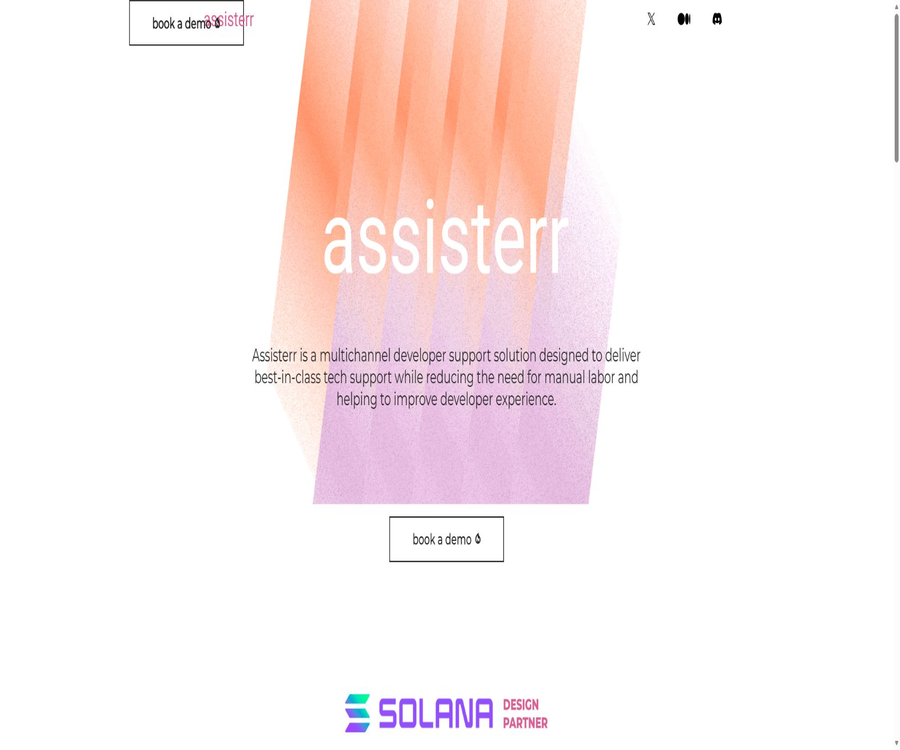
Assisterr
Assisterr, an intelligent tool focused on AI model training
Tags:AI training modelsWhat is Assisterr?
Assisterr is a product ecosystem built around professional small language models, AI agents, and the commercialization of such agents. The official website currently offers task-specific AI Agents to enterprises, and through the ATaaS service it assists AI startup teams with product development, tokenization, and entry into the market.
It began as a tool to support Web3 developers, and later expanded to include capabilities for creating no-code SLMs and facilitating community collaboration. It is important to understand these different stages; otherwise, it is easy to confuse old test network credits, developer support services, with the current enterprise solutions.
Product evolution and current positioning
| Phase | Main products | Problems solved | Current reading mode |
|---|---|---|---|
| Developer Support Phase | Chainnect and multi-channel Q&A | Compile documentation and answer developers’ questions through community channels | It belongs to the category of early-stage products; relevant information can still be found on the existing older websites. |
| Code-free SLM phase | AI Lab, SLM Store, and the contributor network | Create professional models, validate the data, and make these models available for use by the community. | The relevant concepts can still be found in technical documents and Litepapers. |
| Enterprise Agent Phase | Professional SLMs and task-oriented AI Agents | Convert corporate knowledge and processes into deployable, specialized agents. | The core services offered by the current official website to businesses |
| ATaaS phase | Agent Tokenization as a Service | Provide incubation, token structure, liquidity, and market support for AI products. | New services currently available for AI startup teams |
Key capabilities of the Enterprise AI Lab
- Task-specific models: Small language models are developed based on specific job roles, industry knowledge, or operational procedures.
- Agent development: Combining models, knowledge, tools, and business rules to create AI Agents that can carry out tasks.
- Enterprise knowledge integration: Organize documents, Q&A responses, processes, and internal materials into a searchable knowledge base.
- Secure integration: Connects existing systems based on the enterprise environment, and controls data and operational permissions.
- Ongoing optimization: Utilize feedback from actual use to improve search functions, suggestions, datasets, and model performance.
- Real-time adaptation: Updating specialized knowledge and working logic in response to changes in business operations.
- Cost control: Use task-specific small models to handle appropriate tasks, thereby reducing the reliance on large, general-purpose models for all requests.
What is the difference between SLM and general large models?
SLM is typically trained or adapted for narrower domains and tasks, with an emphasis on efficiency, professional consistency, and deployment flexibility. It is not inherently more accurate than large models; its performance still depends on data quality, task boundaries, and evaluation methods.
| Comparison items | Assisterr professional SLM | Universal large model |
|---|---|---|
| Scope of knowledge | Focus on specific industries, products, or tasks | Covers a broader range of general knowledge |
| Deployment target | Stably complete enterprise tasks with clearly defined boundaries. | Handling open-ended questions and multi-type generation |
| Calculate costs | It can be lighter for suitable tasks. | Usually, more reasoning resources are required. |
| Customization method | Datasets, tools, rules, and continuous feedback work together to ensure proper adaptation. | It mainly relies on hints, retrieval, or general fine-tuning. |
| Main risks | Too narrow a scope, data biases, and failures outside the intended tasks | Hallucinations, costs, privacy, and behavioral instability |
How to plan a corporate-specific intelligent agent
- Choose a task with clear boundaries and whose effectiveness can be measured, such as internal knowledge queries or first-line technical support.
- Organize the documents that are permitted to be used, past issues, standard answers, business rules, and exceptional cases.
- Define the data that the agent can read, the tools it can invoke, and the actions that must be handled manually.
- Baseline tests are established using representative samples to examine accuracy, citation, rejection rates, and task completion rates respectively.
- Access to enterprise systems is granted in a controlled environment, with identity management, least-privilege principles, logging, and approval processes in place.
- After a small-scale trial run, analyze the failed cases and then update the data, prompts, tools, or models.
- Once the quality threshold is met, the scope of use is gradually expanded, while versioning and rollback mechanisms are retained.
Code-free SLM creation process
Assisterr’s technical documentation describes AI Lab as a code-free SLM development environment, allowing users to prepare data and create agents around a specific professional topic. The actual entry points, test network access requirements, and token rules may change; it is necessary to refer to the information displayed in the account before taking any actions.
- Define the specialized field of SLM, its target users, the types of input, and the desired output.
- Prepare high-quality Q&A pairs, domain-specific documents, and validation samples capable of identifying incorrect answers.
- Create a project in the AI Lab, specify its purpose, and configure the parameters of the model or agent.
- Generate or import training data, after which contributors or experts in the field review the quality of the samples.
- After completing the training or adaptation, run the test set, focusing on edge cases and incorrect rejections.
- Publish it to the available environment or model store, and continuously collect queries and user feedback.
Suitable business scenarios
- Developer Relations: Answer questions regarding integration, APIs, and troubleshooting based on the product documentation.
- Enterprise Knowledge Assistant: Search for information on policies, processes, and product knowledge in the authorized materials.
- Technical support: Categorizes common issues, provides troubleshooting steps, and forwards complex tickets.
- Industry research: Generation of structured summaries and preliminary analyses based on data from specific vertical sectors.
- Operational automation: Uses tool calls to carry out information collection, categorization, and standardization.
- AI startup projects: Turning intelligent agents or data products into operational market initiatives.
- Trading and data products: Designing business models for professional agents or data services that have clear risk management frameworks.
Which users are it suitable for
- Enterprise innovation and digitalization teams that need to deploy specialized knowledge agents internally.
- AI application development teams that aim to reduce the inference costs of general-purpose models.
- Industry organizations that possess high-quality data in specific fields and intend to develop specialized models.
- The DevRel team is responsible for developer documentation, community support, and technical inquiries.
- There are existing AI agents, models, or data products, and startup teams that need incubation and market support.
- Web3 developers who study decentralized AI, incentives for model contributions, and agent economies.
Early multi-channel developer support
The older version of the official website positioned Assisterr as a multi-channel developer support platform that could convert static documents into searchable knowledge bases. This system was designed to handle integration and technical issues related to Web3 protocols, and it was available for use on Discord, Telegram, and various social media communities.
- Aggregates protocol documents, tutorials, common questions, and historical community responses.
- Provide consistent developer Q&A across multiple community channels.
- Reduce the amount of time spent on repetitive issues, thereby freeing up core engineers and DevRel staff.
- Identify frequent issues to provide insights for document updates and product improvements.
Early official data indicated a high rate of automatic processing, but this referred to figures specific to certain projects and periods as per official standards. When conducting evaluations, companies should use their own sets of questions, as well as the rates of issue resolution and the need for manual intervention, in order to verify these figures.
SLM Store collaborates with the community
The ecosystem described in the litepaper includes AI Lab, SLM Store, data contributions, peer review, and a model repository. Its goal is to enable experts in the field to contribute their knowledge, to allow model creators to receive feedback on their work, and to maintain the quality of data and models through appropriate incentive mechanisms.
- The model creator defines the domain, tasks, and quality standards.
- Contributors submit or verify training data and professional Q&A.
- Peer review is used to identify low-quality, redundant, or biased samples.
- The model store helps users discover and access suitable professional SLMs.
- The model treasury is used to record the ecological incentives associated with a specific model.
ATaaS Intelligent Agent Tokenization Service
ATaaS is the abbreviation for Agent Tokenization as a Service; it is intended for teams that already possess agents, models, data products, or prototypes. It offers a range of services ranging from project selection and token design to aspects related to liquidity and market entry. However, tokenization does not mean that the product already generates actual revenue.
| Stage | Key points of the official plan | The team needs to verify it. |
|---|---|---|
| Project incubation | Clarify the product positioning, narrative, and market entry strategy. | Whether the technology is available, user requirements, and delivery capabilities |
| Token structure | 80% of the supply is locked in according to the rules, while 20% is allocated for phased releases. | Legal attributes, holder rights, and regional compliance requirements |
| Long-term ownership | 80% of it is allocated over 48 months, with a 6-month cliff period. | Unlocking the main entity, execution methods on the chain, and permission changes |
| Price discovery | 20% is used for market price discovery and liquidity creation through Meteora DBC. | Slippage, liquidity, robotic trading, and market volatility |
| Market support | Provides community, exposure, commercialization, and GTM infrastructure | Scope of services, fees, delivery metrics, and exit procedures |
ATaaS application and evaluation steps
- Prepare intelligent agents, models, data products, or other AI applications that can be demonstrated.
- Organize the target users, actual usage data, revenue sources, technical architecture, and team background.
- Submit an application for incubation or collaboration to Assisterr, and confirm the selection criteria and scope of services.
- Obtain legal, tax, and securities compliance advice from the relevant authorities before deciding on tokenization.
- Verify the token supply, ownership, liquidity mechanisms, contract control rights, and risk disclosure.
- Clarify market support, community management, costs, revenue distribution, and phased acceptance criteria.
- After going live, ongoing public disclosure of product progress, treasury activities, and significant changes in risks is provided.
Prices and billing methods
Assisterr does not currently offer any fixed currency-based packages for its Enterprise AI Lab or ATaaS services; corporate projects require consultation with the team for an assessment. The sASRR mentioned in older documents is a synthetic token used in the test network, and it cannot be converted into the current service prices or the value of real assets.
| Product or project | Public billing status | Explanation |
|---|---|---|
| Enterprise-specific SLM and AI Agents | Contact sales for a quote | The price depends on the scope of data, models, integration, deployment, and ongoing optimization. |
| AI Lab and the SLM ecosystem | Based on the current product interface. | The rules of the historical testing network do not apply to the official commercial packages. |
| Old version SLM deployment | The document indicated 1 synthetic sASRR. | This is a synthetic unit in the testing environment; it is not a quote based on real currency. |
| Old version SLM query | The document once used synthetic sASRR on a per-use basis. | The relevant units are used to test the vault mechanism of the network model. |
| ATaaS service | Apply or negotiate | The public materials describe the structure of the tokens, but do not specify a fixed service fee. |
| Public code | It can be used in accordance with the warehouse license. | The costs related to deployment, auditing, computing power, and development are borne by the user. |
Tokens and financial risks
- Token prices can fluctuate sharply, and there is no guarantee of liquidity or investment returns regarding the progress of the product.
- Curved issuance and automatic market-making can give rise to risks such as slippage, front-running, robotic trading, and liquidity withdrawal.
- The ownership plan requires verification of the on-chain contracts, control permissions, beneficiaries, and the possibility of making modifications.
- Different judicial jurisdictions may consider tokens to be securities, virtual assets, or regulated financial products.
- There must be a clear and actionable relationship among an agent’s revenue, the value of its tokens, and its governance rights.
- Before participating, it is necessary to independently review the contract, audit reports, risk disclosures, as well as tax and legal opinions.
Product advantages
- Consider domain-specific small models, agent tools, and enterprise processes within the same solution.
- The task-focused model is suitable for scenarios where cost, latency, and professional consistency are important considerations.
- Possesses experience in developer support and Web3 community management, suitable for technical products.
- The code-free SLM approach reduces the barriers to entry for domain experts in terms of participating in the development of data and models.
- ATaaS covers various aspects such as incubation, token structure, liquidity, and market entry.
- The official GitHub provides some quality verification, demonstration, and integration code to facilitate technical evaluation.
Usage restrictions
- The current official website, the old website, GitBook, and Litepaper reflect different stages in the product’s development.
- The enterprise solution does not have a fixed public price; the implementation timeline and overall cost need to be assessed separately.
- The absence of a coding requirement does not mean that there is no need to prepare data, define evaluation criteria, or carry out security work.
- Professional SLMs may perform significantly poorly on tasks outside their area of expertise; therefore, mechanisms for refusing such requests and transferring them to human operators are necessary.
- Community contribution data may contain errors, biases, as well as copyright or privacy issues.
- ATaaS introduces tokenization, market, and regulatory risks, and is not suitable for teams that only need standard SaaS pricing.
- Some historical functions and test network rules may have changed, so they cannot be considered as current commitments.
Recommendations for data security and governance
- First, distinguish between public, internal, confidential, and regulated data, and then determine the scope of access for the model.
- Preprocess personal information, keys, customer data, and copyrighted content before training or retrieval.
- Configure minimum permissions, manual approval, rate limiting, and operation logging for agent tool calls.
- An independent test set is created to continuously monitor for hallucinations, prompt injection, data leakage, and off-task responses.
- Clarify the ownership of data, model weights, generated content, feedback, and derived assets.
- Before making a purchase, a company should determine the location of the data, the retention period, the deletion procedures, and who is responsible for responding to incidents.
GitHub and open source
Assisterr’s official GitHub organization has made available repositories related to quality verification, demonstrations, SLM integration, and hackathons. The fact that these repositories are public does not mean that Enterprise Platform, AI Lab, SLM Store, or ATaaS are all open source.
| Project | Public status | Primary uses | Open-source assessment |
|---|---|---|---|
| quality-oracle | Public, MIT license | Verify the quality of AI Agents or MCP services through challenge-response and multi-dimensional scoring. | It can be reviewed and reused according to the license. |
| quality-oracle-demo | Public | Display quality certificates and verification processes | Only for demonstration purposes. |
| slm-integrations | Public | Provide SLM-related integration materials. | It does not include a complete business platform. |
| Hackathons and historical warehouses | Partially public or archived | Document early experiments and activity projects | It cannot be used as the complete source code for the current product. |
| Enterprise AI Lab and ATaaS | No complete source code has been made public. | Enterprise agent development and tokenization services | Understood as a commercial service. |
Basic information
| Project | Content |
|---|---|
| Product name | Assisterr |
| Tool type | Enterprise SLM, AI agents, no-code model ecosystem, and ATaaS services |
| Current main customers | Corporate AI teams and AI agent startup projects |
| Early direction | Web3 multi-channel developer support and knowledge base Q&A |
| Technical ecosystem | Specialized small language models, community-driven data verification, and the Solana ecosystem |
| Public pricing | There is no standard currency package available; you need to contact sales or submit an application. |
| Is it open source? | The platform is not open-source; only some of the official repositories are made public. |
| Main risks | Product phase changes, data quality, enterprise integration, and token compliance |
Recommendation score
The comprehensive recommendation score is 4.0 out of 5 points. It is suitable for teams that wish to explore professional SLM solutions, enterprise agents, or the tokenization of AI products; however, it is necessary to verify the available modules, scope of delivery, prices, and compliance responsibilities before making a purchase.
Frequently Asked Questions
What is Assisterr mainly doing at the moment?
At present, the main focus is on developing SLMs and AI Agents tailored for corporate use, as well as providing ATaaS services to AI startup teams.
Is it still a developer customer service tool?
Developer support was an initial focus; relevant information can still be found on the old website, but the current main site has shifted towards enterprise agents and the tokenization of agents.
Is Assisterr suitable for ordinary individual users?
It is more suitable for enterprises, development teams, and AI startup projects; it is not a consumer-oriented tool designed primarily for ordinary chat users.
Is it possible to create SLM without coding?
The technical documentation describes the no-code AI Lab process, but the entry requirements, eligibility criteria, and available functions need to be verified based on the current status of the product.
What is sASRR?
sASRR is a synthetic token unit from the older version of the test network documentation; it should not be regarded as the actual price of tokens or as an equivalent in fiat currency.
What is ATaaS?
It is a service that helps AI agents, models, or data products to go through the process of incubation, token design, liquidity deployment, and market entry.
What does the 80/20 structure represent?
The proposed plan allocates 80% of the supply for long-term ownership, while the remaining 20% is intended for phased releases and price discovery; the specific details depend on the relevant contracts.
Is there a public price for Assisterr?
There is currently no unified corporate currency package; both Corporate AI Lab and ATaaS require contact with the relevant team for confirmation.
Is Assisterr open source?
The complete platform is not an open-source product, but the developers have made available certain repositories related to quality verification, demonstrations, and SLM integration.
What is the most important thing to verify before a company uses it?
Priority should be given to verifying the task accuracy, data boundaries, system permissions, scope of delivery, and total cost; when tokens are involved, legal and contractual reviews must also be carried out.
Tools similar to Assisterr



 Guigong Network Security Registration No. 45132202000164