






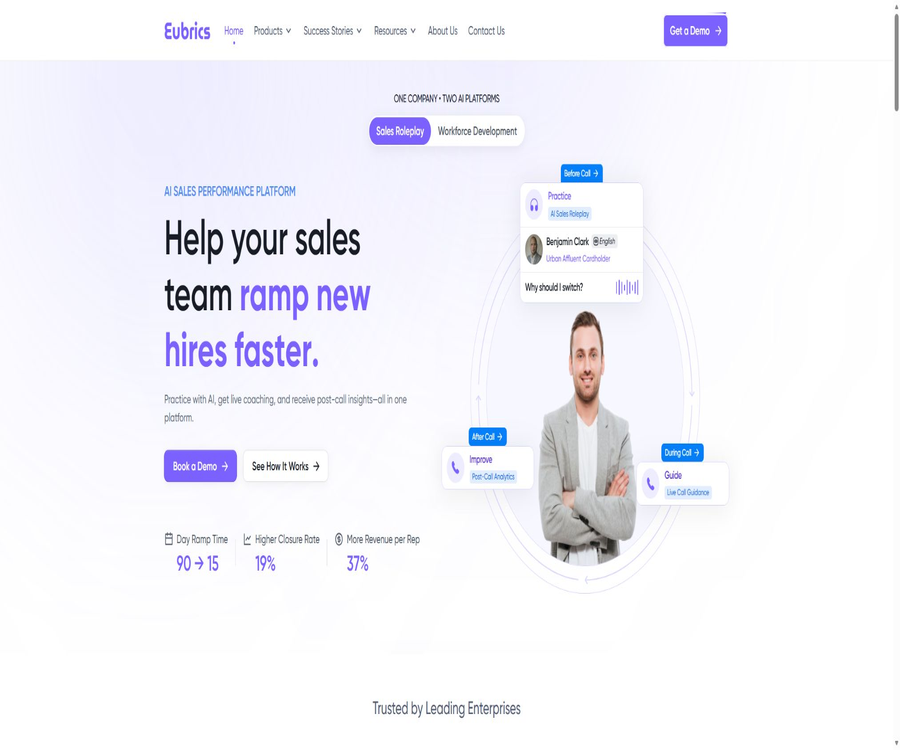
AI Sales Roleplay & Sales Training Software
AI Sales Roleplay & Sales Training Software – an intelligent tool focused on the training of AI models
Tags:AI training modelsWhat is Eubrics?
Eubrics is an AI-driven sales training and organizational development platform developed by Eubrics Digital Pvt. Ltd., led by its co-founders Nikita Jain and Maxim Dsouza. It uses AI-powered customer simulations to replicate real sales conversations, allowing employees to practice identifying customer needs, introducing products, handling objections, ensuring compliance, and closing deals before actually interacting with clients.
The platform is not merely a tool for role-playing; it also provides functions such as knowledge verification, real-time suggestions, post-call ratings, personalized training plans, analysis of team capabilities, and assessment of an organization’s learning capacity. The key industries it serves include insurance, banking, wealth management, B2B sales, and call centers.
A one-sentence summary
Eubrics allows sales professionals to practice real conversations repeatedly with customizable AI clients, and converts each performance into a score, along with guidance and tasks for further training.
Core functions
- AI sales role-playing: Conduct voice-based sales conversations with simulated customers.
- Customized customer profiling: Define industry, position, requirements, budget, and attitude.
- Scenario customization: Simulates cold calling, discovery, demonstration, negotiation, and closing a deal.
- Objection handling training: Practice dealing with common obstacles such as price, trust, competitors, and timing.
- Real-time guidance: Provides appropriate reminders during the practice process.
- Analysis after the call: Identify strengths, mistakes, and deviations from the sales process.
- Ability rating: Sales performance is assessed based on metrics defined by the company.
- AI Mentor: Generates personalized suggestions for improvement.
- Training plan: Weekly practice and learning materials are arranged based on the skill gaps.
- Team analysis: Check the readiness of individuals, teams, and batches.
- Knowledge verification: Assessing employees’ understanding of the products and compliance requirements.
- Corporate learning: Supports onboarding, certification, and continuous skill development.
AI sales role-playing
- AI clients provide dynamic responses based on the role background.
- For the same scenario, different personalities and levels of disagreement can be set.
- Employees can practice at any time, without having to wait for a manager to accompany them.
- The dialogue covers the opening, asking questions, conveying value, addressing objections, and closing.
- The scenario can be configured around the company’s actual products and sales processes.
- The training environment does not expose real customers.
- Repetitive training helps new employees develop a consistent structure for conversations.
Supported sales scenarios
| Sales phase | Practice content | Main evaluation points |
|---|---|---|
| Cold calling and outbound calling | Spark interest and move on to the next step | Introduction, relevance, and time management |
| Requirement discovery | Identify pain points, goals, and decision criteria | Asking questions, listening, and following up |
| Product Introduction | Transform functions into customer value. | Clarity, relevance, and evidence |
| Handling of objections | Responding to questions about prices, competitors, and trust | Empathy, clarification, and logical processing |
| Negotiations | Handling budgets, terms, and concessions | Conditions for value preservation and exchange |
| Deal closed | Confirm intent and take action. | Purchase signals, conclusion, and next steps |
| Customer service | Managing anger, escalation, and retention | Emotion management, accuracy, and processes |
Customer Profiles and AI Bots
- Define the target customer industry, scale, and role.
- Designate decision-makers, influencers, or members of the procurement committee.
- Define the customer’s objectives, pain points, budget, and timeline.
- Choose attitudes such as neutrality, curiosity, skepticism, or impatience.
- Include the actual objections encountered by the company as well as those of its competitors.
- Adjust the difficulty based on the salesperson’s experience.
- Avoid using real customer identities and confidential information.
Real-time coaching and feedback after calls
- Real-time prompts help employees continue the conversation when there are pauses.
- After the call, summarize the aspects in which the salesperson performed well.
- Identify missed issues and process steps.
- It points out shortcomings in value expression, empathy, and handling of dissent.
- It provides quantitative scores and targeted suggestions for improvement.
- Have the manager review the evidence rather than relying only on the total score.
- Transform weak areas into tasks for the next round of practice.
Scores and custom metrics
- Define the scoring dimensions based on the company’s sales methods.
- Measure discovery, expression, compliance, objections, and closing separately.
- Assign different weights to various positions and sales stages.
- View specific evidence and recommendations from a single call.
- Compare individual, team, and training batch trends.
- Use the ratings for developmental guidance rather than as a sole basis for punishment.
- The AI scores are regularly calibrated by sales experts.
Personalized training plan
- Identify individual skill gaps automatically based on the scores.
- Arrange weekly role-plays corresponding to the weak areas.
- Recommended product knowledge, case studies, and learning materials.
- Provide clear action items and practice objectives.
- Continuously monitor the baseline, progress, and readiness.
- Have the manager devote his time to more targeted guidance.
Insurance sales training
- Simulate clients for life insurance, health insurance, auto insurance, home insurance, and commercial insurance.
- Practice addressing needs, risks, premiums, and product explanations.
- Handle issues related to prices, trust, and claims settlement.
- Check the necessary compliance phrases and procedures.
- Complete scenario authentication before the actual customer call.
- AI-generated content must not be regarded as formal insurance or legal advice.
Banking and wealth management training
- Practice with loan offerings, bank cards, and the sale of financial products.
- Simulate the objectives, risks, and trust issues related to high-net-worth clients.
- Clear explanation for training complex data.
- Balance sales opportunities, suitability, and customer interests.
- Practice cross-selling without misleading or pressuring others.
- All content must be reviewed by the institution’s compliance team.
B2B and technology sales training
- Simulate SDR cold calls, AE discovery, demonstrations, and negotiations.
- Train in conducting conversations with decision-makers, influencers, and purchasing teams.
- Practice addressing business pain points, budgeting, timelines, and competitor positioning.
- Address concerns regarding pricing, integration, security, and return on investment.
- Create scenarios based on the company’s ICP, products, and market.
- Transform complex functions into business value that customers can understand.
Call center training
- Simulate high-frequency customer inquiries and complaints.
- Train on procedures for calming angry customers and handling escalations.
- Measure communication, accuracy, efficiency, and compliance.
- Conduct a large number of low-risk exercises before employees go live.
- Arrange repeated training based on individual weaknesses.
- Simulated scores cannot completely replace actual quality inspection.
Tutorial on creating sales scenarios
- Select a sales stage that has a significant impact on business operations and whose boundaries are clear.
- Define the target customers, products, objectives, and successful outcomes.
- Collect the real, anonymized objections and common errors.
- List the sales and compliance rules that must be followed.
- Configure AI customer profiles, attitudes, difficulty levels, and scenarios.
- Establish scoring dimensions, weights, and evidence criteria.
- Have high-performing sales and compliance staff carry out the sample testing.
- Release it to a small group of employees after correcting the errors.
Employee training tutorials
- Read the scenario background, customer profile, and practice objectives.
- Review the product documentation and the compliance boundaries that must be adhered to.
- Complete the conversation just as you would in a real customer call.
- View call history, ratings, and specific suggestions for improvement.
- Choose one or two weak areas to focus on with targeted practice.
- Complete the same or similar scenario once again.
- Compare the pre- and post-assessment scores with the dialogue evidence.
- Upon meeting the team standards, a random check or certification by the manager will be conducted.
Enterprise pilot tutorial
- Determine the target position, number of participants, and current baseline.
- Apply to Eubrics for a demonstration and provide the sanitized business requirements.
- Select two to three training scenarios with quantified results.
- Confirm the data, security, recording, integration, and permission requirements.
- The scores are calibrated jointly by the sales, training, and compliance teams.
- Conduct a pilot project with a limited duration for the team.
- Compare usage rates, skill improvement, manager time, and business metrics.
- Deployment is expanded only once the evidence meets the target.
Which teams are suitable?
- Companies that need to quickly train a large number of new sales staff.
- Insurance and finance teams dealing with complex products and a wide variety of objections.
- Organizations that need to standardize the sales processes in multiple locations.
- A manager cannot provide frequent coaching for each employee in such a team.
- Identify sales and operations departments that lack evidence-based identification capabilities.
- Call centers that require ongoing certification and compliance training.
- Companies that wish to transform LMS learning into actual conversational skills.
Typical use cases
- New employees practice the standard sales process before starting work.
- Quickly develop new selling points and counterarguments when the product is launched.
- Conduct warm-up simulations before calls with key clients.
- Special training is provided on price objections, competing products, and the closing process.
- Test readiness without contacting actual customers.
- Provide managers with information on the distribution of team capabilities and key areas for coaching.
- Pre-employment certification is carried out in accordance with compliance rules.
Scenarios where direct reliance is not appropriate
- Using AI scores as the sole basis for dismissal, promotion, or compensation.
- Simulating real financial or insurance advice without compliance approval.
- Upload the real customer names, recordings, and confidential transaction data.
- Use simulation results to replace real customer feedback and business metrics.
- Training is needed to address complex ethical, legal, and regulatory issues.
- Performance evaluations that lack manager review and employee appeal mechanisms.
Free trial and demonstration
The Eubrics official website offers a free trial version as well as a option to schedule a demonstration; the details of these demonstrations are adjusted according to the industry, specific scenarios, and organizational structure of the company. The website does not disclose information regarding the duration of the free trial, the number of practice sessions allowed, the maximum number of users, or the scope of functions available.
Pricing method
The official website does not provide information on the standard monthly fee, the price per user, or any fixed package options; companies must submit their requirements in order to receive a customized quote. Third-party listings sometimes show conflicting starting prices, and such listings cannot replace the official contracts and quotes.
| Procurement phase | Official price | Main content | Confirmation is needed. |
|---|---|---|---|
| Product demonstration | Free | Display AI role-playing by industry | Demonstrate whether custom scenarios are used. |
| Team trial | Contact the authorities. | Tested within the context of this company | Number of people, duration, and number of simulations |
| Official deployment | Custom quote | Role-playing, coaching, analysis, and learning | Seats, usage volume, modules, and contract duration |
| Enterprise integration | Custom quote | Connection to CRM, LMS, or identity systems | Implementation, maintenance, and interface costs |
What should be confirmed when requesting a quote?
- The fees are calculated based on the number of users, active users, number of simulations, or team size.
- Are there any additional charges for the length of the audio, transcription, and AI analysis?
- Is there a fee for customizing scenarios, customer profiles, and rating sheets?
- Costs of implementation, administrator training, and content migration.
- Costs for CRM, LMS, single sign-on, and API integration.
- Minimum contract duration, minimum number of seats, and rules for price increases upon renewal.
- Data storage, export, and deletion upon contract termination.
- Technical support, successful service delivery, and service levels.
Suggestions for selecting a plan
| Enterprise needs | Suggested range | Key points of procurement |
|---|---|---|
| Only verify AI role-playing. | Demonstration and group pilot testing | Simulation quality and rating reliability |
| New employees can start working quickly. | Role-playing plus knowledge verification | Readiness standards and certification |
| Ongoing sales coaching | AI Mentor plus training program | Progress trends and manager workflows |
| Financial compliance training | Custom scenarios with compliance scoring | Audit, content approval, and manual review |
| Large-scale corporate learning | Platform with LMS and identity integration | Permissions, deployment, and total cost |
Effect evaluation indicators
- The time it takes for new employees to go from starting work to being ready to take on their duties.
- Scene completion rate, repetition practice rate, and employee engagement.
- Changes in discovery, value expression, objections, and closing ability.
- Time for manager coaching, listening to recordings, and manual quality inspection.
- The quality of actual calls, conversion rates, and compliance errors.
- Differences in performance among different teams, locations, and positions.
- Employees’ evaluations of the accuracy of feedback and psychological safety.
Security and compliance capabilities
The Eubrics official website states that it holds ISO 27001 certification and meets SOC 2 Type II standards; its controls cover security, availability, and confidentiality. When making a purchase, it is necessary to obtain the current certificates, information on the scope of audits, any exceptions, and a list of subcontractors, rather than relying solely on marketing claims.
- Ensure that the certification covers the actual products and infrastructure in use.
- Verify the data storage location and cross-border transmission mechanisms.
- Information on role permissions, audit logs, and single sign-on is required.
- Verify the backup, recovery, vulnerability, and incident notification processes.
- Implement client-side approval for financial and insurance-related matters.
- Regularly review changes in the models and scores.
Privacy and training data
Role-playing involves handling employees’ names, voices, conversations, performance scores, feedback, and skill profiles – all of which are sensitive data related to professional performance. Eubrics’ privacy policy states that it may collect names, phone numbers, mailing addresses, log data, and Cookie information, and it allows service providers to access the necessary information in order to carry out their tasks.
- Before going live, clearly explain to employees the purposes of recording, transcribing, and scoring.
- Do not include real customer information and confidential business data in the scenario.
- Limit managers to viewing only the team data within their scope of responsibility.
- Specify the retention periods for audio, transcription, scoring, and reports.
- Establish processes for access, correction, deletion, and appeal.
- Verify whether the data is used to train general-purpose models.
- Verifiable export and deletion are required at the end of the contract.
Fair use of AI-generated scores
- Speech recognition can be affected by accent, noise, and the device used.
- Differences in communication style should not be automatically interpreted as a lack of competence.
- The rating scale must be directly related to the job requirements.
- The total score should be accompanied by evidence of the dialogue and manual verification.
- It is not possible to use AI scoring to determine personality, health, or protected characteristics.
- The error rates and pass rates of different groups should be compared.
- Employees should be able to understand the results and request a reevaluation.
Product advantages
- Transform real sales conversations into repeatable, low-risk exercises.
- Scenarios, customer profiles, objections, and ratings can all be customized according to the needs of the enterprise.
- Includes hints during the practice sessions and analysis after the practice.
- Supports individual training plans and team readiness views.
- Industry scenarios are provided for insurance, banking, wealth management, and B2B.
- Reduce the time spent by managers on repeated coaching and manual scoring.
- The official documentation demonstrates the security capabilities associated with ISO 27001 and SOC 2 Type II.
Product restrictions
- The official website does not disclose standard prices or trial quotas.
- The deployment outcome depends heavily on the scenario, the quality of scoring, and the compliance settings.
- AI clients are unable to fully replicate the emotions and decision-making of real humans.
- Speech recognition and scoring may lead to inaccuracies related to accent and style of expression.
- Employees may learn to cater to ratings rather than truly understanding customers.
- Companies must invest in sales experts, as well as in training and personnel responsible for ensuring compliance.
- Simulated progress does not necessarily translate directly into an increase in actual sales.
- The technical details of the public integration and the API documentation are limited.
APIs and Integration
Eubrics’ official materials state that it can be integrated with CRM and LMS systems, and the official blog mentions Salesforce, HubSpot, and Microsoft Dynamics as systems that are compatible. The public website does not provide self-service API keys, complete endpoints, pricing information, or rate limits; therefore, any specific integration needs to be confirmed through corporate demonstrations and contracts.
GitHub and the open-source status
No official GitHub organization or product source code that can be verified in connection with Eubrics Digital Pvt. Ltd. or its official website was found. The open-source sales role-playing examples that were discovered belong to other organizations, and therefore cannot be considered as Eubrics’ code.
Therefore, Eubrics should be classified as a proprietary enterprise SaaS solution; its official website does not offer a version for local deployment or one that can be hosted manually.
Basic information
| Project | Content |
|---|---|
| Tool name | Eubrics |
| Operating company | Eubrics Digital Pvt. Ltd. |
| Tool type | AI-powered sales role-playing and corporate training |
| Key industries | Insurance, banking, wealth management, B2B, and call centers |
| Core competencies | Simulation, real-time feedback, scoring, coaching, and team analysis |
| Free trial | Free trials and demonstrations are available. |
| Official price | Custom quote |
| Safety Statement | ISO 27001, SOC 2 Type II |
| Public API | No self-service documentation is available. |
| Open-source status | Not open source |
Recommendation score
Recommendation score: 4.3 / 5. Eubrics is suitable for corporate teams that need large-scale, quantifiable sales training; it offers excellent capabilities in terms of industry-specific scenarios and scoring customization. However, its pricing is not transparent, and its implementation requires ongoing content calibration, privacy management, and the involvement of human trainers.
Frequently Asked Questions
What does Eubrics do?
It allows sales staff to practice real conversations with AI clients, and provides real-time feedback, scoring, and follow-up training plans.
Is Eubrics free?
The official website offers a free trial and demonstration, but there is no publicly available permanent free version.
How much is Eubrics?
The official party does not provide a fixed standard price; quotes must be customized based on the team, use case, volume of usage, and integration requirements.
Can customers and objections be customized?
Yes, the platform allows for the configuration of AI clients based on products, ICPs, markets, objections, and sales processes.
Which industries are supported?
The focus is on insurance, banking, wealth management, B2B technology, and call centers.
Can it replace the sales manager?
No, AI is suitable for providing additional practice and initial feedback; managers are still needed to carry out adjustments, reviews, and provide in-depth guidance.
Can it be used for employee evaluation?
It can serve as supporting evidence, but AI scores should not be the sole basis for important personnel decisions.
Is Eubrics safe?
The official website states that the organization is certified under ISO 27001 and complies with SOC 2 Type II standards; nevertheless, it is necessary to verify the existence of valid reports as well as the scope of compliance when making purchases.
Are public APIs available?
There are no public self-service API documents available; the scope of enterprise integration must be confirmed with the authorities.
Is Eubrics open source?
It is not open source, and there is no verifiable official repository for the product’s source code.
Tools similar to AI Sales Roleplay & Sales Training Software



 Guigong Network Security Registration No. 45132202000164