






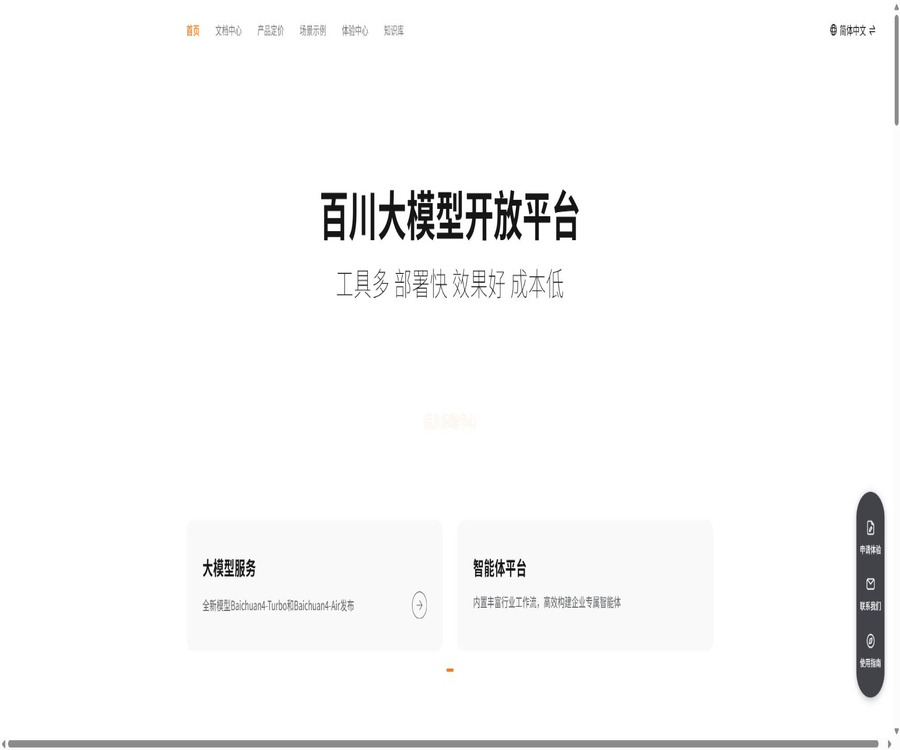
Baichuan Intelligent Financial Large Model
BaiChuan Intelligent Financial Large Model – an intelligent tool dedicated to the training of AI models.
Tags:AI training modelsWhat is the BaiChuan Intelligent Financial Large Model?
The official name of the BaiChuan intelligent financial model is Baichuan4-Finance; it is a specialized model that builds upon Baichuan4-Turbo through further training and adaptation for use in financial applications. It is designed for financial institutions and corporate projects, and it is not a personal investment software that provides direct buying or selling recommendations.
Baichuan Intelligence was founded in March 2023 by Wang Xiaochuan. The company has made public models for various fields such as general applications, finance, and healthcare; Baichuan4-Finance is designed to address issues related to the understanding of financial concepts, the generation of business-related documents, and the support of business processes.
Model version and positioning
| Version | Positioning | Primary uses |
|---|---|---|
| Baichuan4-Finance-Base | Basic models in the financial sector | Research, continued training, and assessment of financial capabilities |
| Baichuan4-Finance | Financial dialogue model with instruction alignment | Q&A, analysis, generation, and business scenario applications |
| Baichuan4-Turbo | Underlying general model | It provides a foundation for universal languages and reasoning; it is not equivalent to the financial enhanced version. |
The technical report describes the basic version and the dialogue version separately. In the table of contents, Baichuan4-Finance should be regarded as a set of financial enhancement models, rather than all BaiChuan models being classified as financial models.
Core competencies
- Understanding of financial knowledge: Handling professional concepts related to banking, securities, insurance, corporate finance, and investment mergers and acquisitions.
- Chinese finance Q&A: Provides explanations based on Chinese regulations, exams, as well as product and business-related materials.
- Processing of financial information in English: Understanding certain English-language reports, systems, and professional content.
- Summary of complex materials: Extracting key points from due diligence documents, business reports, and operational data.
- Report assistance generation: Create drafts of due diligence, analysis, or business reports based on available data and templates.
- Compliance check assistance: Identifies potential risk points in processes, wording, and materials that may require review.
- Business data analysis: Generates interpretations and insights by combining structured data with business context.
- Financial intelligence compilation: Aggregating public information to create thematic analysis insights.
- Multiple rounds of business discussions: Continuous questioning, clarification, and revisions regarding the same financial task.
- Security alignment: It enhances compliance and sets clear risk boundaries for financial content, but it cannot replace the institutional frameworks in place.
Training and technical approach
The technical report covers the financial data quality pipeline, domain-specific continuous pre-training, supervised fine-tuning, and reinforcement learning based on human and AI feedback. Its goal is to acquire financial knowledge while retaining as much of the capabilities of general-purpose models as possible.
- Filter, clean, classify, and conduct multi-level quality assessments on financial data in both Chinese and English.
- Domain self-constraint training is employed to reduce the risk of a decline in general capabilities as a result of continued training.
- Enhance the ability to understand financial instructions and carry out tasks through supervised fine-tuning.
- Optimize the quality of conversations and the safety boundaries by combining human feedback with AI feedback.
- Use financial authentication questions and real-world business scenarios to evaluate the performance of the model.
- Combine general evaluations with financial evaluations to avoid focusing solely on scores from a single industry.
Professional data and expert involvement
According to the official statement, the model incorporates high-density financial data in both Chinese and English, and a team of experts from the School of Finance at Renmin University of China was involved in defining and evaluating this data. The involvement of experts helps to enhance the professionalism of the model, but it does not mean that the output of the model automatically carries professional endorsement.
- Financial corpora require a distinction between regulatory documents, textbooks, research materials, as well as product and business data.
- Time-sensitive content must be dated and linked to the most up-to-date reliable sources.
- Internal organizational materials require authorization, data masking, and access control.
- Expert evaluation should cover facts, logic, compliance, appropriateness, and explainability.
- Synthetic data requires preventing incorrect knowledge from being reinforced repeatedly.
Model evaluation
Baichuan4-Finance has publicly presented the results of various assessments such as FLAME-Cer, FLAME-Sce, FinanceIQ, and OpenFinData. FLAME was developed by the School of Finance at Renmin University of China, and it is used to measure financial knowledge and the ability to handle different financial scenarios.
| Evaluation or dataset | Areas of focus | Points to note when reading the results |
|---|---|---|
| FLAME-Cer | Financial expertise and certification-related skills | Exam scores do not equate to the actual availability in real-world operations |
| FLAME-Sce | Capabilities for financial scenario tasks | It is necessary to check the task template and the criteria for scoring. |
| FinanceIQ | Financial knowledge and reasoning | The prompts and versions of different models should be consistent. |
| OpenFinData | Tasks related to the disclosure of financial data | Public data performance does not reflect private data performance. |
| General evaluation | Language, reasoning, and instruction abilities | Used to determine whether training in a specific domain impairs general capabilities. |
The lead margins shown on the official website are results obtained under specific versions, datasets, and evaluation settings. Companies should retest using their own business samples, and should not simply convert the scores from those lists into an accuracy rate for actual production use.
Main application scenarios
- Process compliance review: Checks for any possible deviations from established procedures in the business steps and related documents.
- Credit card customer service: Answers questions regarding products, bills, benefits, and common procedures.
- Assistance in marketing pension financial products: Generate draft explanations based on rules and check the way risks are presented.
- Generation of due diligence report: Summarizing company information, risk factors, and items that require verification.
- Business data analysis: Explaining changes in indicators and preparing summaries for management.
- Financial intelligence collection: Aggregating public information on companies, industries, policies, and markets.
- Assistance in serious illness underwriting: It summarizes relevant materials and rules, but it cannot replace the decision made by the underwriting officer.
- M&A Analysis: Examining business, financial, legal, and integration aspects.
Process compliance audit
The model can compare institutional frameworks, process descriptions, and business documents, identifying missing steps, conflicting statements, or areas that require manual attention. It is better suited as a tool for the first round of screening rather than an automated approval system.
- Organize effective systems and procedural rules into a searchable knowledge base.
- The model is required to indicate the basis of the rules, the location of the materials, and the uncertainties.
- Manual review and escalation pathways are established for high-risk hits.
- Retain input, version, output, modification, and approval logs.
- Update the knowledge base and test sets promptly after any changes are made to regulations or internal policies.
Credit card and financial customer service
In customer service scenarios, Baichuan4-Finance can be used for issue classification, knowledge retrieval, draft preparation of responses, and providing assistance to agents. When it comes to matters related to fees, accounting, credit ratings, complaints, and account operations, real-time system data and official rules must be followed.
- Answers regarding product benefits, application requirements, and common business processes.
- Convert complex terms into explanations that are easy to understand without altering their meaning.
- Identify complaints, fraud, privacy issues, and significant property risks and route them to human agents.
- Recommend the next steps for verification to the agent based on the customer’s context.
- Models are prohibited from modifying accounts on their own, offering discounts, or making credit decisions.
Due diligence and M&A analysis
The model can create a due diligence framework based on business plans, financial statements, contract summaries, interview records, and industry materials. It helps to improve the efficiency of reading such materials, but it cannot replace financial, legal, tax, and business experts.
- Define the scope of transactions, industries, regions, time period, and key assumptions.
- Classify the materials, remove duplicates, perform permission checks, and handle sensitive information.
- Have the model extract facts from the business, financial, legal, tax, and operational perspectives.
- It is required that each significant conclusion be associated with the specific location in the materials or the source of the data.
- Generate a list of issues, a list of conflicts, and a list of information that needs to be added.
- Various specialized teams verify the facts and assess the significance of the risks.
- The confirmed contents will be included in the official report, with manual signatures and approvals retained.
Operational data and financial intelligence
Financial models can combine structured indicators with news, announcements, and research materials to create draft analyses. Even in the absence of reliable data connections and time stamps, the models may still refer to outdated information or fabricate reasons.
- Explain the changes in income, costs, profits, cash flow, and risk indicators.
- Organize public financial information by company, industry, or event.
- Generate draft daily, weekly reports, or special analysis reports for management.
- Mark abnormal data, changes in criteria, and missing fields.
- It outputs hypotheses that require further verification, rather than definitive predictions.
Which institutions are suitable?
- Customer service and operations teams at banks, consumer finance companies, and payment institutions.
- Data analysis teams for securities, funds, and research institutions.
- The customer service, underwriting, claims processing, and compliance teams of insurance companies.
- Corporate finance, strategy, investment, and M&A departments.
- Audit, consulting, rating, and professional service firms.
- University teams that need research on the evaluation and application of models in the financial sector.
- Large organizations that possess their own financial data, knowledge bases, and governance systems.
Scenarios that are not suitable for direct use
- It automatically recommends stocks, funds to individuals, as well as the optimal times for buying and selling.
- Decisions regarding credit approval, underwriting, or denial are made without any manual review.
- Prepare legal opinions, audit reports, or regulatory filing documents independently.
- Making decisions for high-frequency trading in the absence of real-time market data and validation.
- Sending customer sensitive information to an environment that has not yet undergone compliance assessment.
- Use a single model response in place of a complete process for disclosing suitability and risks.
- Treat the promotional evaluation scores as a guarantee of accuracy for all services.
Access and usage methods
The official Baichuan4-Finance website currently provides main access points for partnership consultations and trial applications; it does not offer a complete self-service interface like ordinary chat platforms. Companies usually need to first explain their specific requirements regarding use cases, data, security, and deployment.
| Method | Current confirmed status | Explanation |
|---|---|---|
| Direct chatting on the web page | There is no separate, publicly available entry point for all users. | The financial model page is primarily used for product introduction and partnership requests. |
| Experience testing | Application is possible. | It is necessary to submit a request for collaboration and wait for business discussions. |
| Open platform invocation | It needs to be confirmed separately. | The public model list and price page do not list financial enhancement models separately. |
| Corporate projects | You can ask for advice. | Designed based on scenario, data, system, and compliance requirements |
| Private or dedicated deployment | Business confirmation is required. | The specific deployment format and capabilities cannot be determined directly from the public page. |
Enterprise implementation process
- Choose a financial task that has clear boundaries, controllable risks, and whose value can be quantified.
- Organize existing processes, systems, data, interfaces, and manual approval steps.
- Submit an application for testing or collaboration to confirm the model version, delivery method, and costs.
- A baseline set and a risk case set are established using masked historical samples.
- Evaluate factuality, completeness, compliance, bias, and stability separately.
- Design mechanisms for retrieval, permissions, logging, manual review, and failure recovery.
- Test it in a controlled user group and monitor false positives, false negatives, and business impacts.
- After passing the acceptance, the scope is gradually expanded, with continuous re-evaluation.
Prices and billing
As of this verification, Baichuan4-Finance does not provide any publicly available, independent fixed prices or self-service packages; formal use of its services requires consultation with the relevant team. The prices of the general and medical models available on its public platform cannot be applied directly to its financial enhancement models.
| Products or services | Price pattern | Notes |
|---|---|---|
| Baichuan4-Finance experience | Apply for a trial | The amount, duration, and scope of use are determined based on the outcomes of the discussions. |
| Integration of financial modeling companies | Company quote request | It is related to the volume of calls, concurrency, use cases, and service requirements. |
| Knowledge base and data integration | Quotation for projects or resources | It is influenced by the volume of documents, storage requirements, as well as the frequency of retrieval and updates. |
| Dedicated environment or privatization | Project quotation | Whether it will be provided and under what conditions it will be deployed need to be confirmed through business discussions. |
| Implementation and custom development | Project quotation | Including processes, interfaces, evaluation, security, and operations. |
| Other models on the BaiChuan Open Platform | Charged per thousand tokens or per number of calls | It belongs to a related service; it does not indicate the price of the financial model. |
Reference prices for other models on the open platform
The public pricing page of Baichuan lists the pay-as-you-go options for general and medical models, which helps developers understand the platform’s billing mechanism. The items listed below are not part of Baichuan4-Finance’s pricing; it is still necessary to verify them separately before using the financial models.
| Publicly listed billing items | Price on current page | Billing instructions |
|---|---|---|
| Baichuan-M3-Plus | Input: 0.005 yuan, Output: 0.009 yuan | An additional fee may apply for medical searches per thousand Tokens. |
| Baichuan-M3 | Enter 0.01 yuan, output 0.03 yuan | Per thousand Tokens |
| Baichuan-M2 | Enter 0.002 yuan, output 0.02 yuan | Per thousand Tokens |
| Baichuan4-Turbo | 0.015 yuan | For every thousand Tokens, the page indicates merged input and output. |
| Baichuan4-Air | 0.00098 yuan | For every thousand Tokens, the page indicates merged input and output. |
| Search enhancement | 0.03 yuan per transaction | Charging is based on the actual number of triggers once it is enabled. |
| Text vector model | 0.0005 yuan | Per thousand Tokens |
| Knowledge base file storage | 1.5 yuan/GB/day | The page indicates the maximum capacity per user. |
Prices, models, and the amount of free credits may change; the actual costs shall be based on the console, contract, and billing pages. Developers also need to take into account the costs associated with storage, retrieval, networking, testing, manual review, and maintenance.
It should be confirmed before making a purchase or entering into a partnership.
- The accurate version of the financial model, the context length, and the knowledge cutoff date.
- Call unit price, concurrency limits, rate limits, and excess fees.
- Does it support deployment in dedicated environments, in a private setup, or in specific regions?
- Rules for the retention and deletion of input, output, log, and knowledge base data.
- Will corporate data be used for model improvement and the corresponding exit mechanism?
- Service availability, fault response, version updates, and rollback procedures.
- Can content security policies be integrated with an organization’s own compliance rules?
- Data export after the project is completed, account reclamation, and handling of knowledge assets.
Data security and compliance
Financial services often involve information related to identities, accounts, transactions, credit histories, as well as undisclosed operational details. Before accessing such data, it is necessary to determine the scope of processing based on data classification, customer authorization, regulatory requirements, and institutional policies.
- Provide the model only with the minimum amount of data required to complete the task.
- During the testing phase, prioritize the use of masked, synthetic, or authorized historical samples.
- Implement role-based access control for models, knowledge bases, interfaces, and logs.
- Secure mechanisms that can be verified for transmission, storage, backup, and deletion settings.
- Protect against injection attacks, unauthorized data retrieval, data corruption, and bulk data export.
- Add risk warnings, manual verification, and complaint channels to the content visible to customers.
- Conduct regular security tests, compliance reviews, and third-party risk assessments.
Responsible financial AI
The security guidelines for the BaiChuan Open Platform require developers to pay attention to verification, accuracy, robustness, biases, network security, and data security. Financial institutions should also incorporate these models into their own models risk management and business accountability systems.
- It is clear that the model only provides supplementary information and does not have the authority for final approval.
- For outcomes with a significant impact on property values, manual review and appeal options are retained.
- Monitor unfair disparities among different populations, regions, and occupations.
- Give prominent indication to incorrect facts, erroneous citations, and uncertain conclusions.
- Re-validate after the version change; the test results from the old version are not applicable.
- Establish procedures for accident response, impact assessment, notification, and correction.
Product advantages
- Continuing the training in the financial sector using the general model provides a clear focus.
- It covers financial knowledge, exam questions, and real-world business scenarios.
- It also offers technical approaches for both the basic version and the dialogue alignment version.
- Pay attention to the quality of financial data in both Chinese and English, as well as to professional evaluations.
- Both financial capabilities and general capabilities are taken into account in the assessment.
- The scenarios cover banking, insurance, corporate finance, and investment mergers and acquisitions.
- It is suitable for integration with institutional knowledge bases, processes, and human experts.
- Public technical reports facilitate the study of training methods and evaluation results.
Usage restrictions and risks
- Models may generate false facts, incorrect calculations, and nonexistent premises.
- Financial knowledge and policies are time-sensitive, and model parameters cannot replace real-time data.
- Public evaluation results do not reflect the actual accuracy of production in companies.
- The official website does not disclose the fixed price of the financial model independently.
- The current onboarding process is geared toward business partnerships, making it difficult for individual users to try it out directly.
- The complete model weights and production code for Baichuan4-Finance are not made public.
- Investment, credit granting, underwriting, and compliance decisions all involve high-risk responsibilities.
- Improper data access can lead to privacy breaches and risks related to trade secrets.
- Biases in prompts or knowledge bases can affect the fairness of the output.
- Retrieval enhancement may also refer to outdated, incorrect, or low-quality information.
- Long-term use requires continuous evaluation, manual review, and costs associated with model management.
GitHub and the open-source status
BaiChuan Intelligence has an official GitHub organization, through which it has released models such as Baichuan-7B, Baichuan2, Baichuan-M1, Baichuan-M2, Baichuan-M3, as well as multi-modal models. To date, no official complete model weights or production code repository for Baichuan4-Finance have been found.
| Project | Open state | License or instructions |
|---|---|---|
| Baichuan4-Finance | The complete model weights and production code are not made public. | Provide experience and corporate services through collaborative consulting. |
| Technical report | Public | The paper is used to illustrate the methods, evaluations, and research results. |
| Baichuan-7B code | Public | Different terms apply to code and model weights. |
| Baichuan2 | Public | Academic research is open, while commercial use requires compliance with the relevant model licenses. |
| More modern medical models | Partially public | It cannot be equated with financial enhancement models. |
The fact that BaiChuan Intelligence has open-source models does not mean that Baichuan4-Finance is also open-source. When deploying any such model, it is necessary to verify separately the code license, the permissions related to the model weights, the commercial usage terms, and the data compliance requirements.
Basic information
| field | Content |
|---|---|
| Model name | Baichuan4-Finance |
| Chinese name | Baichuan Finance Enhanced Large Model |
| Development company | Beijing Baichuan Intelligent Technology Co., Ltd. |
| Publication time | December 2024 |
| Base model | Baichuan4-Turbo |
| Model type | Basic models in the financial sector and dialogue alignment models |
| Primary language | Financial content in Chinese and English |
| Access method | Applications for trials, partnership consultations, and corporate projects |
| Public pricing | The fixed price of the financial model is not listed separately. |
| Is it intended for individual investors? | No. |
| Whether investment advice is provided | It should not be used as a licensed investment advice. |
| Is it open source? | Baichuan4-Finance does not disclose the complete weights and production code. |
Recommendation score
4.4 / 5. Baichuan4-Finance offers a clear path for financial training, professional evaluations, and various business scenarios, making it suitable for organizations that possess data, expertise, and governance capabilities to use it for verification; however, its accessibility and price transparency are limited, and any high-risk financial decision must still have human oversight.
Frequently Asked Questions
Can Baichuan4-Finance be used to trade stocks directly?
No. It is a model that enhances financial knowledge and business scenarios; it is not a securities trading system, nor can it guarantee predictions or profits.
Can individual users use it for free?
The current financial modeling page offers cooperation consultations and application services; there is no separate, permanent, free access available to all individuals.
How much is Baichuan4-Finance?
The official website does not specify a fixed price; quotes must be requested based on factors such as usage volume, concurrency, deployment requirements, data volume, and implementation needs. The prices of the standard models available publicly cannot be considered as quotes for financial models.
Can it generate a due diligence report?
It can assist in organizing materials and creating frameworks and drafts, but it must be reviewed by finance, legal, tax, and business experts before it can be used for formal decision-making.
Can it perform compliance audits?
It can be used for rule comparison and risk alerts, but no approval decisions should be made automatically. Institutions need to rely on the latest regulations, evidence chains, and manual review.
Is Baichuan4-Finance open source?
As of this verification, the complete weights of its model and the production code have not been made public. Other open-source projects developed by BaiChuan cannot be considered equivalent to financial models.
Are the technical reports made public?
Public. The report covers the basic version and the conversational version, data pipelines, domain-specific self-constraint training, alignment methods, and evaluation results.
Can financial data be uploaded directly?
It is not recommended to upload real sensitive data before completing the security and compliance assessments. Companies should first establish rules regarding authorization, data masking, deployment, retention, and deletion.
Does being at the top of the evaluations mean the best production quality?
It doesn’t mean that. The rankings reflect only specific model versions and testing conditions; the actual performance depends on business data, search functions, prompts, permissions, and manual processes.
Tools similar to the BaiChuan Intelligent Financial Large Model



 Guigong Network Security Registration No. 45132202000164