






LLM Pricing
LLM Pricing, an intelligent tool focused on the training of AI models
Tags:AI training modelsWhat is LLM Price Check?
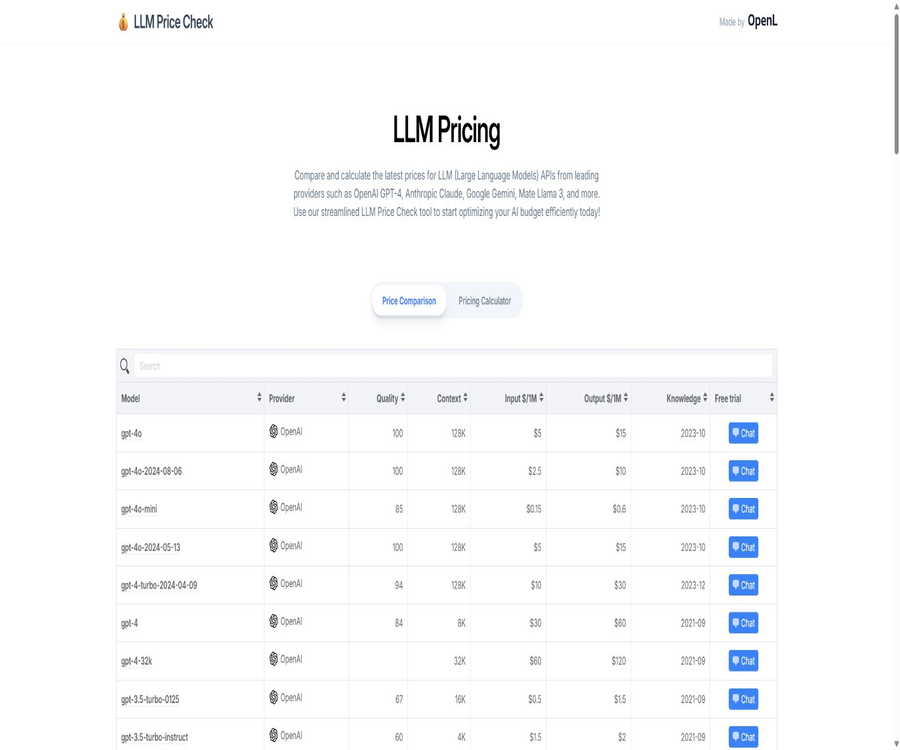
LLM Price Check is a web tool designed to compare the prices of large language model APIs; it offers information such as the models available, the service providers, the context window size, the price per unit of input, the price per unit of output, and quality scores. The site also provides a cost calculator to help users estimate the expenses based on the amount of tokens used.
It is suitable for a preliminary screening of model costs, but it is not the official billing system provided by the model suppliers. During verification, the page still shows numerous old models and historical prices; to obtain an accurate budget, one must go to the current pricing page of the respective manufacturer.
Current data status
As of this verification, the main table on the homepage still lists GPT-4o, Claude 3, Gemini 1.5, Llama 3.1, and the earlier Mistral models, along with various historical unit prices that have changed over time. The page does not indicate clearly when each row was last updated.
Therefore, the catalog should no longer be described as a reliable database of real-time prices. A more accurate description would be that it is a free tool useful for understanding price structures and conducting historical comparisons, with real-time prices needing to be verified through official sources.
Core functions
Model price comparison table
The main table lists the providers, quality scores, context length, input price, output price, knowledge cutoff date, and trial information for each model. Users can quickly see the cost differences between different models.
Token cost calculator
The calculator estimates the cost of a single invocation or of batch invocations based on the input tokens, output tokens, and the price per million tokens. It is suitable for rough budgeting; the actual bill may also include costs related to caching, tool calls, images, audio, and batch processing.
Model details page
Some models have their own dedicated detail pages, on which it is possible to view information such as the provider, context, and price details. The data contained in these detail pages comes from the same source as that in the main table; therefore, it is still necessary to pay attention to the update date.
Quality indicators
The page uses a ranking based on third-party models to determine a quality score, thereby helping users take both price and performance into consideration. A single quality score reduces the differences among models in terms of code, inference capabilities, language support, and handling of long contexts.
Official price source link
The page lists the sources for pricing, such as OpenAI, Anthropic, Google, Mistral, Cohere, Amazon Bedrock, and Groq. Users should use the pages of these suppliers as the ultimate source for verification.
List of main functions
- Compare the unit price of input and output tokens for different providers and models.
- View the model context window and basic quality metrics.
- API fees are calculated based on the expected amount of input and output.
- View information on a specific model on the model details page.
- Jump from the price list to the online experience page for certain models.
- Verify once again by referring to the official supplier price sources.
- Quickly identify models that are inexpensive to input but costly to output.
- Establish preliminary budgets for prototypes, batch processing, and production traffic.
What use cases are suitable?
- AI application developers: Understand the basic structure of token-based pricing.
- Product manager: Estimate the cost levels of different models in the early stages of the planning process.
- Startup team: Quickly filter the API models that require further testing.
- Instructor: Demonstrate the difference between input and output Token prices.
- Cost analyst: Establish a comparison between historical prices and different model generations.
- Individual developers: Estimate the monthly cost of calls for small projects.
What situations are not very suitable
- Procurement decisions require the latest model for 2026 as well as accurate real-time prices.
- Complex invoices that require caching, batch processing, as well as hierarchical pricing and regional pricing for long contexts.
- Multimodal projects that involve comparing the prices of images, videos, audio, embeddings, and fine-tuning.
- Enterprises that require API availability, low latency, high throughput, and service level guarantees.
- A cost platform that allows for the automatic retrieval of real-time prices through program interfaces.
- Users who need channels in the Chinese market, RMB-related taxes and fees, as well as local invoice information.
Price comparison usage guide
- First, clarify the type of task, the target language, as well as the length of the context and the minimum quality standards.
- Filter the models in the table that meet the contextual requirements.
- Record the input and output prices separately; do not focus only on a single unit price.
- Check the quality score, while also looking for an independent benchmark for the corresponding task.
- Record the candidate models and prices in a list to be verified.
- Visit the official pricing pages of each model manufacturer to check the current model and its unit price.
- Use real request samples to measure tokens, latency, and success rate.
Tutorial on cost calculation
- Calculate the average input Token and output Token for a typical request.
- Estimate the daily request volume, peak concurrency, and monthly growth.
- Multiply by the price per million tokens for input and output respectively.
- Add system prompts, tool results, retry options, and multiple rounds of historical tokens.
- Separate fees are charged for caching, batch processing, images, searches, and other such services.
- Set aside a buffer for exchange rates, taxes, and excess usage.
- Verify the estimates using the manufacturer’s bills and perform regular calibrations.
Model Selection Tutorial
- Select a high-quality model and a low-cost model as baselines.
- Prepare internal test sets for simple, ordinary, and difficult tasks.
- Run the candidate models using fixed prompts and parameters.
- Record quality, tokens, latency, error rate, and actual cost.
- Calculate the cost of each successful task, rather than only considering the price per million tokens.
- Try to route simple tasks to smaller models.
- Set budget, throttling, and fallback strategies before production.
How to understand input and output prices?
| Price items | Billing details | Common influencing factors | Optimization methods |
|---|---|---|---|
| Enter Token | System prompts, user messages, history, and tool results | Context length and repeated content | Shorten prompts, summary history, use caching |
| Output Token | Text or structured results generated by the model | Length of answer and reasoning process | Limit the maximum output and require a concise format. |
| Cache read | Repeating prefix or cached context | Cache hit and validity period | Stable system prompts and shared prefixes |
| Cache write | Create a reusable cache | Supplier rules and retention time | Evaluate the number of reuse times before writing again. |
| Batch processing | Asynchronous processing of large numbers of requests | Time limit requirements and supplier discounts | Convert non-real-time tasks to batches |
| Tools and Search | Networking, code execution, or external tools | Number of calls and result length | Reduce unnecessary calls and trim the results. |
Cost calculation formula
The basic estimation for a text model can be expressed as: the input tokens divided by one million, multiplied by the unit price per input token, plus the output tokens divided by one million, multiplied by the unit price per output token. In multi-turn conversations, the historical content sent in each round must also be taken into account.
| Scene | Enter Token | Output Token | Key points for estimation |
|---|---|---|---|
| Short Q&A | Less | Less | Price differences are usually not significant. |
| Summary of the long text | Many | Medium | It is more important to enter values related to long-context hierarchical structures. |
| Content generation | Medium | Many | The unit price of output is the main cost. |
| RAG Q&A | System prompts, search snippets, and a large amount of history | Medium | Searching for redundancy increases the input cost. |
| Agent | The results from multiple rounds of the tool are continuously accumulated. | Multiple rounds of output | Retries and loops can quickly inflate bills. |
| Batch classification | Short input repeated many times | Ultra-short output | Suitable for small models and batch processing |
Why the lowest unit price does not equal the lowest cost
If cheaper models require more retries, longer prompts, or manual intervention, the total cost per successful task can be higher. High-quality models, on the other hand, may be more cost-effective overall since they complete the task in one attempt.
- Compare the average number of calls required for a successful task.
- Include the time required for manual review and error correction in the costs.
- Measure the actual output length of the model, rather than relying only on the theoretical price.
- Take into account rate limits, timeouts, and failure recovery.
- Multiple model routing is employed based on the task difficulty.
- At the same time, compare the impact of latency and throughput on business operations.
Common fees missing from the price list
| Cost category | Coverage of LLM Price Check | Where do I need to go to confirm it? |
|---|---|---|
| Prompt cache | Most old entries are not fully displayed. | Official pricing from model manufacturers and cache documentation |
| Batch discount | Not fully displayed | Manufacturer Batch Instructions |
| Long-context hierarchical pricing | Not fully displayed | Corresponding model price list |
| Inference Token | Not displayed uniformly | Explanation of billing for inference models |
| Images and audio | It is not a key element of the main table. | Multimodal API Pricing Page |
| Online searching and tools | Not displayed uniformly | Explanation of tool invocation pricing |
| Fine-tuning and storage | Not displayed | Fine-tuning file storage pricing |
| Regional processing and taxes | Not displayed | Account region and settlement page |
How should one interpret the quality score?
The page quality score is derived from third-party ranking lists and is suitable for rough sorting; it does not indicate that the model performs equally well in all tasks. The capabilities related to coding, mathematics, Chinese language, tool utilization, and handling long documents need to be tested separately.
- Verify the source and update time of the quality data.
- Do not compare unexplained scores from different benchmarks and versions.
- View the classification metrics that match the business.
- Run a unified internal test set on the candidate models.
- Include hallucinations, security, and format stability in the scoring.
- Calculate the cost of meeting quality standards based on the price.
Risk of data freshness
The prices and names of large models change frequently: manufacturers introduce new models, reduce prices, discontinue older versions, or alter caching rules. Third-party tables that lack an update date may lose their relevance as a reference for purchasing decisions within just a few weeks.
- Be vigilant when retired or older model versions appear in the table.
- Check whether the model ID matches the actual API call name.
- Check whether the price unit is per thousand or per million Tokens.
- Confirm whether input, output, caching, and long context are billed separately.
- Record the verification date and a snapshot of the official page in the budget document.
- After going live, use actual bills to continuously calibrate the price list.
Is the website itself charged?
The price list and calculator provided by LLM Price Check are available for direct access; no user-based membership subscriptions or paid plans are offered. It displays the prices of third-party model APIs, but it is not responsible for selling these model licenses.
| Project | Costs | Explanation |
|---|---|---|
| View price list | Free | There is no need to purchase model quotas. |
| Use a calculator | Free | It is only for estimation purposes; no API calls are generated. |
| Open the model to experience it. | Decided by an external platform | Login or payment may be required. |
| Call the model API | Charged by the model provider | The amount is subject to the provider’s invoice. |
| Corporate budgeting and monitoring | The website does not offer a complete range of services. | A separate gateway or monitoring tool is required. |
Data and Privacy
The calculator only requires the number of tokens and the price of the model; under normal circumstances, there is no need to enter actual prompts, customer content, or API keys. Users should not input their production credentials on any third-party price comparison websites.
- Only the number of tokens needs to be entered; the actual business text does not need to be submitted.
- Do not paste the API Key in the web page parameters or notes.
- Sensitive budgets are calculated using local spreadsheets or internal cost systems.
- Official procurement is confirmed through the supplier console and contract.
- Before using a service, businesses should check the website’s privacy policies, Cookie settings, and information regarding the entity that operates it.
Product advantages
- The interface is simple, allowing for quick understanding of the prices of input and output tokens.
- Compare multiple model providers in the same table.
- It provides auxiliary fields such as context, quality, and knowledge cutoff.
- Calculators are suitable for teaching and preliminary budgeting.
- Free access; no membership subscription required.
- Some official price sources are listed for easy verification.
Usage restrictions and precautions
- The current models and prices are significantly outdated, and cannot be used as a basis for real-time purchasing.
- Each row lacks a clear and consistent final verification date.
- The old model may have been retired, renamed, or had its context adjusted.
- The source of the quality score and the version do not reflect all business capabilities.
- Prices for caching, batch processing, inference, and long contexts are not fully covered.
- Costs for images, videos, audio, embedding, and fine-tuning are not covered.
- The same model may have different prices and terms across various cloud providers.
- The calculation results do not include taxes, exchange rates, retry attempts in case of failures, or labor costs.
- The website lacks a verifiable official source code repository as well as complete operational information.
GitHub and the open-source status
As of the time of verification, no official source code repository could be found that was explicitly linked on the LLM Price Check website and from which the origin of the code could be confirmed. The OpenChat repository associated with the database was merely the source for the OpenChat model in the price list; it was not the code for the LLM Price Check website.
Therefore, this website should be labeled as “No official open-source repository found”. Other projects with similar names such as llm-prices, llmpricing, or PriceToken are separate tools and should not be confused with the source code of this website.
Basic information
| field | Content |
|---|---|
| Tool name | LLM Price Check |
| Tool type | Large model API price comparison and cost calculator |
| Main fields | Model, provider, quality, context, input price, output price |
| Price unit | Primarily based on the price per million tokens in dollars. |
| Usage fee | Free |
| Is registration required? | Basic tables and calculators are not required. |
| Data status | There is a noticeable delay at the moment. |
| Do you sell APIs? | No |
| Whether a public API is provided | No findings were detected. |
| Is it open source? | No verifiable official repository was found. |
Recommendation score
3.2 / 5. The LLM Price Check interface is user-friendly and useful for understanding token-based pricing as well as for getting an initial idea of past prices; however, the data available is clearly outdated, lacks information on when it was updated, and does not take into account complex pricing factors, so it cannot be used for making a final decision in 2026.
Frequently Asked Questions
Is LLM Price Check free?
The price lists and calculators are available for free, and no membership plans have been identified. To use the models in the lookup table, it is still necessary to pay the corresponding API service provider.
Are the prices on the website up to date?
It cannot be used with real-time data. The current page still contains a large number of old models and historical prices; to obtain the official budget figures, it is necessary to visit the supplier’s official website.
How is the cost of a single request calculated?
Divide the input and output Tokens by one million, multiply by the respective unit prices, and then add them together. Additional costs such as those related to caching, tools, retries, and multimodality must also be included.
Is a higher quality score meaning it’s more worth buying?
Not necessarily. The overall quality score does not reflect specific tasks; it is necessary to compare the quality, latency, and total cost of each successful task.
Can I enter an API Key?
It is not necessary, nor should it be entered. This tool is merely a price list and calculator; it is not responsible for accessing the user’s model account.
Is caching and batch pricing supported?
The current main table does not cover all of these complex billing items in its entirety. It is necessary to consult the latest price lists and documentation provided by the respective manufacturers for clarification.
Is LLM Price Check open source?
No verifiable official source code repository was found. The OpenChat GitHub account merely indicates the source of the models, and it has nothing to do with the source code of the website.
Tools similar to LLM Pricing



 Guigong Network Security Registration No. 45132202000164