






302.ai
302.ai, an intelligent tool focused on the training of AI models
Tags:AI training modelsWhat is 302.AI?
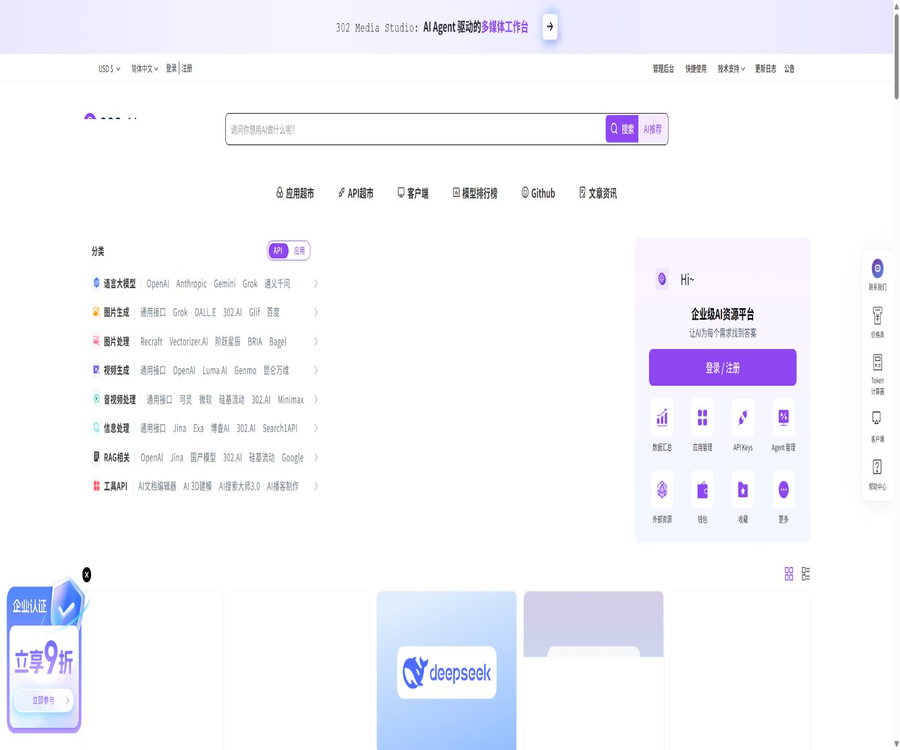
302.AI is an enterprise-level resource platform that aggregates various AI models, APIs, and online applications. Users only need to maintain one platform account and balance to access functions such as those related to language processing, image handling, video processing, audio processing, search, file processing, and RAG; there is no need to make separate payments to each model provider.
The platform offers an API store, a tool store, chat and drawing robots, knowledge base robots, a team backend, as well as 302 AI Studio. Its core value lies in unified access and pay-per-use pricing, rather than requiring users to train their own models and possess all the underlying models listed on the platform.
Core products and services
1. Full-model API platform
Developers can create API keys to invoke models from different suppliers through a unified gateway. Some of these interfaces are compatible with the common request formats used by OpenAI and Anthropic, while dedicated endpoints are also available for tasks related to images, videos, audio, searching, and documents.
2. AI Tool Supermarket
Users who do not write code can make use of the platform’s tools for image processing, video creation, translation, research, paper searching, e-commerce content management, and multimedia handling. There is no fixed package for these tools; instead, charges are applied based on the models used, the number of times they are utilized, the duration of use, or the amount of data processed.
3. AI robots
The platform allows users to create chat, drawing, application, and knowledge-base robots, and to set parameters such as models, prompts, access methods, and other advanced settings. These robots can be shared with others, with the costs typically being deducted from the creator’s account balance or the relevant account’s funds.
4. Knowledge base and RAG
The knowledge base functionality is used for uploading materials, splitting them into segments, searching for information, and leveraging large models to answer questions. The official API allows specifying the knowledge base, model, search criteria, historical messages, the number of results to be returned, as well as the similarity threshold; it is suitable for use in internal Q&A systems and as a document assistance tool.
5. 302 AI Studio
302 AI Studio is a cross-platform desktop AI application that supports multi-model dialogue, file processing, tool invocation, Skills, MCP, and Vibe Coding. Its official code repository is available publicly, and the desktop version is available for Windows, macOS, and Linux.
6. Team and usage management
Companies can manage balances, API Keys, members, usage records, and consumption details through the backend interface. A unified billing system facilitates centralized cost control, but it is still necessary to assign separate keys, quotas, and access rights for different projects.
Which AI capabilities are supported?
- Language models: dialogue, reasoning, long texts, code generation, structured output, and tool invocation.
- Image generation and processing: text-to-image, image-to-image, local editing, image cropping, zooming, and style adjustment.
- Video generation: Converting text or images into videos, translating videos, and handling other multimedia tasks.
- Audio and voice: text-to-speech, speech recognition, as well as capabilities for music and audio/video processing.
- Information retrieval: online searching, research, web page extraction, and various search services.
- Document processing: PDF, OCR, translation, content extraction, and analysis of large files.
- RAG and knowledge bases: document segmentation, vector retrieval, and question-answering based on private data.
- Developer tools: code assistant, Claude Code, Codex CLI, Dify, Coze, and integration with LangChain.
Which users are it suitable for
- Developers and startup teams: Quickly compare and integrate multiple models, reducing the need to manage multiple supplier accounts.
- Enterprise technology department: Provides centralized management of keys, balances, members, and usage of cross-modal APIs.
- Content and design team: Direct use of tools for images, videos, audio, and text.
- Knowledge Management Team: Creates corporate databases, as well as applications for answering questions and facilitating document retrieval.
- AI enthusiasts: Experience different models and online applications at a lower initial cost.
- Teams that require privatization transformation: secondary development based on official open-source applications and development templates.
How to use 302.AI to call the model API
- Register for an account and top up a small amount of funds; first, check the current billing unit and price for the target model.
- Create a separate API Key in the backend, and set the name, permissions, and budget limits for each project.
- Verify the request path, model name, parameters, input constraints, and output format from the API documentation.
- Use a non-sensitive sample to complete the first request on the online debugging platform.
- Configure the platform gateway address and API Key in the SDK, application, or development tools.
- Log the input/output tokens, number of calls, failure rate, latency, and cost per task.
- Before going live, configure key rotation, error retry, content moderation, balance alerts, and supplier switching strategies.
How to create and share AI tools or robots
- Select the category of application, whether it is for chatting, drawing, accessing a knowledge base, or using tools, and define the intended use case.
- Select a model, enter the system prompts, and configure the temperature, context, and output rules.
- To obtain private data, create a knowledge base and test the slicing and retrieval performance.
- Use representative questions to check accuracy, rejection boundaries, and cost consumption.
- Set sharing permissions, access passwords, or other controls supported by the platform.
- After it is released, continuously monitor the usage volume and consumption records; if any abnormalities are detected, disable it or replace the key.
Pricing model
The main platform of 302.AI operates on a model with no monthly fee – users need to make a upfront payment and then be charged based on actual usage. The official help center states that all tools are billed on a usage-based basis, with no fixed packages offered; the recharge balance remains valid for an extended period. The conversion rate is 1 PTC equal to 1 US dollar.
| Service type | Billing method | Explanation |
|---|---|---|
| Language models | By input and output tokens | Different models and caching rules have different prices. |
| Image generation and processing | By sheet or per use | The model, resolution, and processing method affect the price. |
| Video generation | By usage, duration, or specification | The price is related to the model, number of seconds, and resolution. |
| Audio and voice | By character, duration, or frequency | Refer to the specific interface documentation. |
| Search and Information Processing | Per use or by data volume | Different search providers have different prices. |
| Online AI tools | Charging is based on the resources that are utilized. | The tool page shows the corresponding consumption. |
| Enterprises and large-scale use | Contact for inquiries | Batch purchasing and service support are available for discussion. |
Why not list fixed model prices?
The platform offers a large number of models, and the prices provided by suppliers can change; therefore, fixing a price for a particular model will soon become outdated. Users should check the current costs using real-time price lists, the relevant API documentation, product cards, or price inquiry interfaces.
Price of the 302 AI Studio version
The Vibe mode in Studio offers three modes of operation: cloud sandbox, cloud host, and local version; its pricing structure differs from that of regular model APIs. The prices listed below are those provided in the official Studio billing documentation at the time of this verification.
| Version | Price | Billing method | Explanation |
|---|---|---|---|
| Cloud Sandbox Version | $ | Based on the actual number of seconds of operation | No sandbox operation fees are charged during the suspension period. |
| Cloud Host Edition | 20 PTC/month | Monthly subscription | Dedicated instances that run continuously and can be automatically renewed. |
| Local version | Free | Local deployment | You need to set up a Docker or Podman environment on your own. |
| Custom models | 0.05 PTC/day | By day | Integration with third-party models; the costs associated with the model providers are to be borne separately. |
API compatibility and developer ecosystem
- API documentation and explanations of request parameters are provided for online debugging.
- Some chat and image interfaces are compatible with the calling formats of common SDKs.
- It supports integration with Dify, Coze, LangChain, Cherry Studio, and various chat clients.
- Provide configuration tutorials for development tools such as Claude Code, Codex CLI, and Cursor.
- Some interfaces support calling multiple models in a unified format, thereby reducing the cost associated with switching between models.
- It is possible to view the model prices, API keys, usage amounts, and detailed consumption information.
Open-source projects and licenses
On its official GitHub repository, 302.AI makes available a wide range of applications such as 302 AI Studio, development kits, as well as tools for searching videos, podcasts, papers, verifying facts, and participating in model competitions. Different repositories may use different licensing agreements; for example, Studio is licensed under AGPL-3.0, while the API integration Skill is licensed under Apache-2.0.
What is open source are the specific clients, tools, or templates; this does not mean that 302.AI’s accounts, billing system, model gateway, and hosting services are all open source. Before performing any re-deployment, it is necessary to read the licenses, environment variables, model dependencies, and brand usage requirements for each repository.
Data security and privacy
The official FAQ states that by default, information is stored locally and not on the server; Studio also offers local session and incognito modes. However, the actual location of the data depends on the tools used, cloud-based models, knowledge bases, synchronization functions, and third-party providers, so it should not be assumed that no requests leave the device.
- Different projects use different keys, and permissions as well as the maximum allowable consumption are restricted.
- Do not include the key in frontend code, public repositories, screenshots, or shared documents.
- Before handling customer, medical, financial, and internal data, confirm the data flow and retention policies.
- Re-evaluate the privacy boundaries when enabling cloud synchronization, a knowledge base, or external search.
- Configure log masking, key rotation, and alerts for abnormal consumption in the production system.
Product advantages
- One account covers various types of resources such as text, images, videos, audio, search, and RAG.
- No monthly subscription is required; it is suitable for infrequent use, model evaluation, and early-stage product testing.
- It offers two ways of use: online tools and APIs, catering to both non-technical users and developers.
- The help center, online debugging documentation, and tutorials for integrating third-party tools are quite comprehensive.
- It boasts a large ecosystem of official open-source applications, which facilitates further development and customization for private use.
- From the team backend, it is possible to view balances, keys, as well as usage and consumption details in one place.
Usage restrictions and precautions
- There are many models and tools available, and it is necessary to check each path, parameter, version, and price individually.
- Aggregation platforms introduce an additional layer of service dependencies; production systems should have plans in place for dealing with failures and for switching to alternative suppliers.
- Although there is no subscription threshold for pay-as-you-go pricing, high concurrency, long output volumes, and video tasks can still cause the balance to be depleted rapidly.
- The data policies, content restrictions, regional availability, and output quality vary among different models.
- The fact that the platform’s marketing capabilities allow for unlimited concurrent operations does not mean that the underlying suppliers and specific interfaces have no limits regarding speed or capacity.
- Open-source applications usually still require API keys, model fees, a deployment environment, and maintenance efforts.
- Third-party model names and service statuses change frequently; therefore, it is advisable to avoid using a single model permanently.
Platform support
| Platform or method | Support status |
|---|---|
| Web management backend | Supports account, balance, key, team, and consumption management. |
| Online AI tools | Supports use directly in the browser. |
| HTTP API | Supports interfaces for multimodal models and tools |
| 302 AI Studio | Supports Windows, macOS, and Linux. |
| Knowledge bases and robots | Supports creation, configuration, and sharing. |
| Open-source deployment | Some applications and the Studio can be deployed in accordance with their respective licenses. |
| Technical support | Help center, online customer service, account managers, and technical discussion groups |
Basic information
| field | Content |
|---|---|
| Tool name | 302.AI |
| Tool type | Enterprise AI resource platform, model API aggregation, AI toolkit |
| Key capabilities | Language, images, videos, audio, search, documents, and RAG |
| Price pattern | Zero monthly fee, top-up balance, pay-as-you-go |
| Unit of measurement | 1 PTC is equal to 1 dollar. |
| Validity period of balance | The official help center states that the top-up balance remains valid for an extended period of time. |
| Whether an API is provided | Yes |
| Is Chinese supported? | Yes |
| Is it open source? | The platform as a whole is not open source; Studio and various applications are open source. |
Recommendation score
4.4 / 5. 302.AI is suitable for developers and enterprises that seek a unified experience or access to various AI capabilities; its advantages include a wide range of resources, pay-as-you-go pricing, and an open-source tool ecosystem. When using it, it is important to manage dynamic prices, data pathways, and platform dependencies carefully.
Frequently Asked Questions
Does 302.AI require a subscription?
The main platform does not require a unified monthly membership; typically, a payment is made upfront and then charges are applied based on the actual usage of the models or tools. Independent products such as Studio cloud servers incur monthly fees.
Does the top-up balance expire?
The official help center states that the top-up balance remains valid indefinitely and does not expire. As for whether the free credits offered as part of promotions or special balances follow the same rule, it depends on the account guidelines.
Does 302.AI have its own large model?
The main purpose of this platform is to provide aggregation and unified access; the models listed on its pages come from different suppliers. The fact that a particular model can be called does not mean that the platform owns that model.
Can it be used in a production environment?
The platform provides services to enterprises, but companies still need to carry out their own capacity testing, error handling, balance monitoring, key security, data compliance, and failover procedures.
Is 302.AI completely open source?
No. The official team has made Studio, development templates, and many specific applications available publicly, but the account management, billing, and hosting API platforms are not fully open source.
How can I check the real-time price of a particular model?
It can be viewed on the official website’s price list, in the specific API documentation, on product cards, or through the price inquiry interface. Model prices may change, so it is not recommended to rely solely on the figures listed in previous articles.
Tools similar to 302.ai



 Guigong Network Security Registration No. 45132202000164