






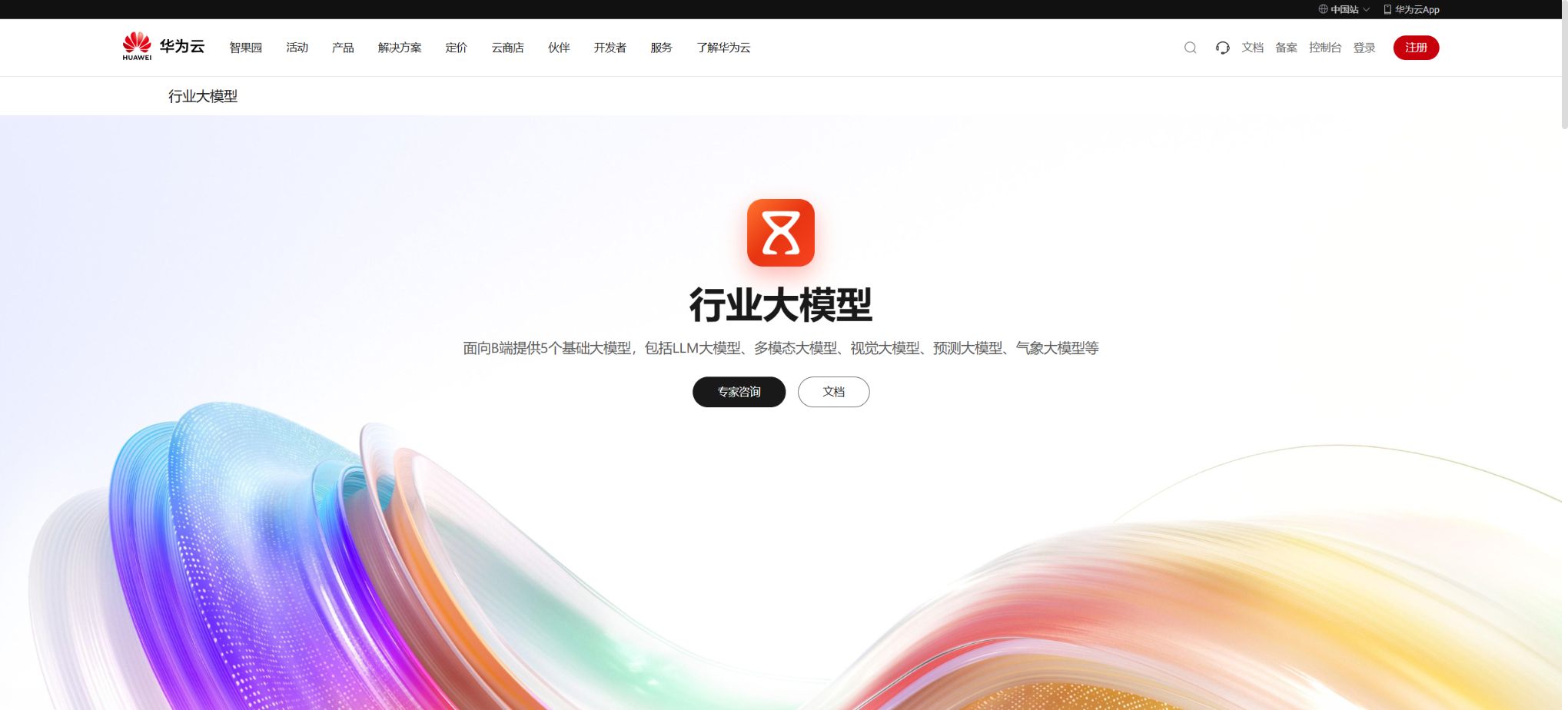
Huawei Pangu Large Model
Huawei Cloud’s large-model ecosystem for industry applications and enterprise intelligence
Tags:AI training modelsWhat is Huawei’s Pangu large model?
Huawei’s Pangu large model is a set of foundational models and solutions provided by Huawei Cloud for the advancement of intelligence in various industries. It includes not only general language models but also solutions for computer vision, multimodal processing, prediction, and scientific computing. Companies can use ModelArts Studio to experience these models, carry out data engineering tasks, train them, fine-tune them, quantize them, evaluate them, deploy them for inference purposes, and develop agents.
Pangu is designed more for industry models and their implementation in enterprises, rather than being a free chatbot intended for ordinary consumers. Users typically need a Huawei Cloud account, identity verification, service authorization, as well as regional resources; the costs are determined based on model subscriptions, data volume, training, and inference settings.
Core capabilities of the Pangu large model
Pangu NLP large model
Pangu NLP is used for tasks such as text generation, question answering, summarization, information extraction, classification, code processing, and complex reasoning. ModelArts Studio presents language models based on Pangu with varying scales and capabilities, allowing users to make choices based on performance, context handling, speed, and deployment costs.
The model name, parameters, and available range will be updated; the information on the model card in the console should be taken as reference.
Pangu CV Large Model
Pangu CV develops visual capabilities based on image and video data, covering open-set detection, visual interaction detection, object detection, tracking, segmentation, and the synthesis of industry-specific image data. It is suitable for applications such as industrial quality inspection, equipment monitoring, and identification of urban events, and it provides a toolset that goes from data processing to the development of sector-specific applications.
Pangu Multimodal Large Model
The multimodal approach is used to combine and understand text, images, videos, documents, and other types of content; it enables visual question answering, document comprehension, and interaction with industry-specific knowledge. The available input formats, sizes, context, and API capabilities depend on the model subscribed to and the region in question.
Pangu predicts large models
It is predicted that large-scale models will be used for structured tasks such as those involving tables, time series, and graph data, offering capabilities for regression, classification, time series prediction, and anomaly detection. The official description highlights unified encoding, task understanding, model recommendation, and integration; these models are suitable for use in industries such as manufacturing, energy, logistics, and equipment maintenance. However, they still require training or adaptation using historical business data.
Pangu Large Scientific Computing Model
The field of scientific computing is applied to areas such as meteorology, oceanography, and physical systems, and it utilizes data-driven models to improve the efficiency of forecasting and simulation. Such models generally require specialized data, domain expertise, and appropriate computing resources; research results should not be used as a basis for making practical decisions.
Industry-large-scale models
Pangu focuses on sectors such as government affairs, finance, electricity, oil and gas, mining, steel, manufacturing, and medicine, and builds specialized capabilities by leveraging foundational models, industry-specific data, and knowledge. Industry solutions typically involve data governance, fine-tuning, knowledge bases, evaluation methods, access controls, and privacy requirements, and they necessitate project consultation and collaborative implementation.
Functions of ModelArts Studio
Model Plaza and Experiences
Model Plaza not only includes Pangu but also offers third-party models such as DeepSeek and Qwen. Users can view model cards, experience their capabilities, and choose between API or deployment methods.
The licenses, data policies, and pricing of third-party models are not exactly the same as those of Pangu.
Data engineering
The platform supports data import, cleaning, annotation, processing, and version management, thereby preparing data for pre-training, fine-tuning, and evaluation. Data resources may be associated with billing items such as hosting units, AI computing units, or general computing units; sensitive data should have access controls, encryption, and lifecycle management in place.
Model training and fine-tuning
Companies can use pre-set models and training resources to carry out fine-tuning, incremental training, or adaptation for specific industries. The training resources can be provided on a subscription basis or charged based on the actual amount of time they are used.
Before starting large-scale training, it is necessary to first use a small amount of data to verify the format, loss value, GPU memory usage, and output quality, while also setting up alerts for budget-related issues.
Evaluation, quantification, and deployment
The platform offers capabilities for model evaluation, compression and quantization, as well as inference deployment, and it can run services leveraging Ascend computing power. The evaluation should take into account accuracy, security, hallucinations, biases, latency, and cost;
After quantification, the quality must be verified again.
After the inference service is launched, it is still necessary to configure concurrency, elasticity, authentication, as well as logging and monitoring.
Agent and application development
ModelArts Studio can be integrated with Huawei Cloud’s Agent platform, knowledge bases, search functions, and business systems to create Q&A systems, process automation tools, and industry-specific intelligent agents. When the tool has actual operational permissions, it is necessary to restrict credentials and verification parameters, and to require manual approval for critical actions.
Comparison of Pangu model systems
| Model direction | Key data | Typical tasks | Suitable scenarios |
|---|---|---|---|
| NLP | Text and code | Generation, Q&A, summarization, extraction, reasoning | Knowledge assistant, office, and industry texts |
| CV | Images and videos | Detection, segmentation, tracking, image synthesis | Industry, inspection, and urban vision |
| Multimodal | Text, images, documents, etc. | Cross-modal understanding and question answering | Documents, quality inspection, and complex interactions |
| Prediction | Tables, time series, and graphical data | Regression, classification, prediction, anomaly detection | Manufacturing, energy, logistics, and operation and maintenance |
| Scientific computing | Meteorological and scientific data | Prediction, simulation, and professional analysis | Meteorology, Oceanography, and Scientific Research |
Pangu Large Model billing method
The official billing documentation breaks down the costs into model subscriptions, data resources, training resources, and inference resources. Different regions, models, specifications, and promotions on the Chinese version of the platform may result in varying prices; therefore, it is not possible to use a single price per token to represent the entire Pangu platform.
| Billing items | Billing mode | Basis for billing | Precautions |
|---|---|---|---|
| Model subscription | Typical package cycle | Model and subscription period | Subscribe first to use the corresponding features; the price is indicated on the configuration page. |
| Data hosting resources | Typical package cycle | Number of data units and duration | Pay attention to renewal, retention, and export after it expires. |
| Data intelligence computing/general computing resources | By package cycle or on demand | Resource units and usage duration | Billing is usually done on a per-demand basis, with precision down to the second. |
| Model training resources | By package cycle or on demand | Number of training units and duration | The package duration can range from months to years; payment is made after use as needed. |
| Model inference resources | Typical package cycle | Number of inference units and ordering duration | It is common to make payments on a monthly or annual basis; charges may also continue to be incurred even when there is no activity. |
| Industry solutions and services | Custom quote | Data, models, deployment, and support scope | Subject to the pre-sales proposal and contract. |
Comparison between package cycles and pay-as-you-go pricing
| Pattern | Payment methods | Advantages | Suitable scenarios |
|---|---|---|---|
| Package cycle | Pay first, then use. | The long-term resource budget remains relatively stable. | Continuous training, fixed inference, and formal production |
| As needed | Pay after use | Payment can be made based on the actual time used, with flexible start and stop options. | Testing, short-term training, and fluctuating tasks |
| Project customization | In accordance with the contract | It enables the combination of industry capabilities, deployment, and services. | Large enterprises and compliance scenarios |
Stopping a script or closing the browser does not necessarily halt resource billing. After a task is completed, it is necessary to delete or stop the training instances, inference services, and any data elements that are no longer needed, and to check the bill through the billing center.
Pangu API Usage Guide
- Registration and authentication:Create a Huawei Cloud account and complete the real-name verification, then activate the ModelArts Studio or Pangu service in the target region.
- Select model:Check the capabilities, context, input format, price, regional restrictions, and content limitations in the model square.
- Subscribe or deploy:Select the model API, training resources, or inference units based on the use case, and estimate the budget first.
- Create credential:Use IAM for authentication, adopt the principle of least privilege or delegation, and avoid storing long-term keys in plain text within the code.
- Capability testing:Use a small amount of non-sensitive data in the console to verify Prompt, output, latency, and security filtering.
- Call API:Pass the model ID, messages, and parameters from the document to handle authentication, rate limiting, timeouts, and error codes.
- Online monitoring:Record the number of requests, Token or resource usage duration, failure rate, and content risks, and set budgets and alerts.
Data security and compliance
Industry models often deal with corporate documents, production data, and personal information. It is necessary to specify where the data is stored, who has access to it, as well as the logging and retention periods; moreover, IAM, VPC, encryption, and audit control mechanisms should be utilized.
In sectors such as healthcare, finance, and government services, additional compliance checks specific to the industry and manual verification are required.
Is it open source?
The Huawei Pangu large-model business platform and its complete set of products cannot be classified as open source. Huawei Cloud may make some models, code, or development tools available, but these come with their own repositories and licensing terms.
The fact that an API is callable does not mean that the model weights are available.
Before use, check the specific model card and license agreement.
Tutorial for Using Huawei Pangu Large Model
Create reusable professional workflows
- Different keys and quotas are used for development, testing, and production environments;
- A representative evaluation set was created by comparing the core capabilities of the Pangu large model, the functions of ModelArts Studio, and the Pangu model framework.
- Set timeout, concurrency, retry, throttling, and budget limits;
- Perform checks on the output regarding facts, security, format, and sensitive information;
- Monitor changes in model version, price, latency, and failure rate;
- Prepare plans for downgrading the model, implementing circuit breaking, and taking manual control;
Which users are it suitable for
- Government agencies, enterprises, and large organizations that require Chinese language skills as well as expertise in industry models;
- AI teams that wish to carry out training and inference tasks using Ascend computing power;
- Industry developers working with industrial vision, forecasting, meteorology, and specialized documents;
- Companies that need an integrated toolchain for data, training, evaluation, and deployment;
- Teams that wish to integrate large models into existing business systems through APIs or agents.
Advantages and precautions
- Pangu’s advantages lie in its wide range of industry applications, comprehensive set of modeling options, as well as deep integration with Huawei Cloud, Ascend, and the ModelArts toolchain – making it suitable for enterprise-level data governance, training, and deployment.
- Its configuration and billing are more complex than those of ordinary chat APIs, and certain features require business consultation or are available only in specific regions.
- The project should first undergo small-scale testing before investing in long-term resources.
- Large models may still produce hallucinations, biases, and unsafe outputs;
- Predictions and scientific models also require evaluation by experts in the field, and they cannot replace professional decision-making.
Frequently Asked Questions
Is the Pangu large model free?
It is not a uniformly free product. The official website may offer trials or capability testing, while official subscriptions, training, data, and inference resources are charged according to the specifications chosen.
Does the Pangu large model provide APIs?
Appropriate model and capability APIs are provided; it is necessary to activate the service on Huawei Cloud, complete the authentication process, and then use these APIs in accordance with the documentation related to the target models.
Does the Pangu large model only consist of language models?
No, it also includes basic models such as CV, multimodal, prediction, and scientific computing, as well as various industry-specific solutions.
Can the Pangu large model be deployed on a private basis?
Companies can inquire about dedicated cloud, hybrid, or industry-specific deployment solutions; the specific models, computing power, licensing terms, and support services are subject to the terms of the business contract.
Is the Pangu large model open-source?
A complete business platform is not an open-source product. For the partially open models or code, it is necessary to check their respective model cards, repositories, and licenses.
Tools similar to Huawei’s Pangu large model



 Guigong Network Security Registration No. 45132202000164