






Tencent Cloud TI Platform
An AI platform that provides services for model development, training, inference, and resource management.
Tags:AI training modelsWhat is Tencent Cloud TI-ONE?
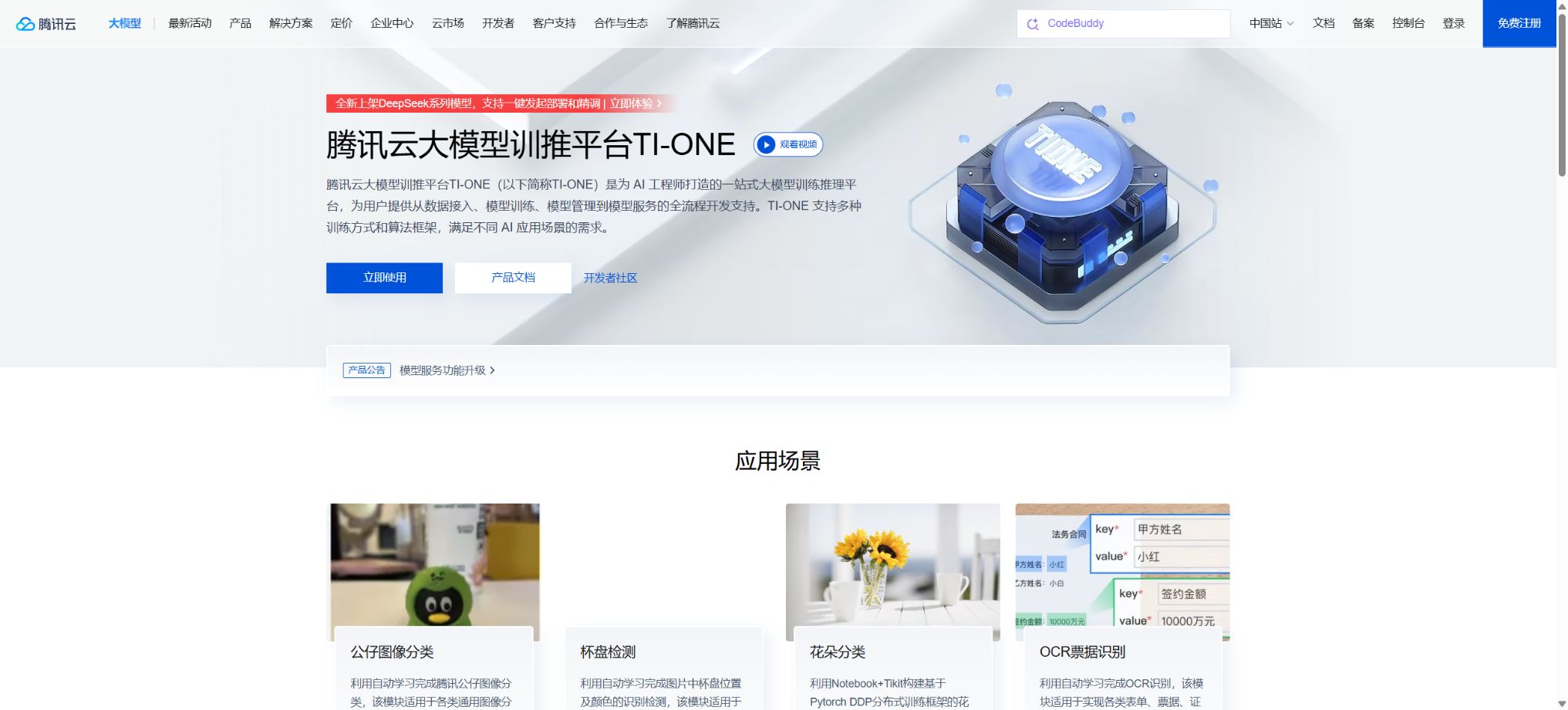
Tencent Cloud’s large-model training and deployment platform, TI-ONE, is a one-stop platform for machine learning and large-model development; it covers data preparation, cloud-based development, distributed training, fine-tuning, model management, evaluation, inference deployment, and service operation. It is designed for algorithm engineers, platform teams, and corporate AI centers, and it is not a regular chatbot.
TI-ONE leverages Tencent Cloud’s GPU resources, domestic computing power, as well as services such as CVM, COS, CFS, GooseFS, image management tools, monitoring, and logging services to bring model development and production deployment together in a unified workspace.
Six core modules
The current official website divides the platform into six modules: data center, training workshop, workflow, model management, model services, and large model plaza; it also utilizes enterprise management and platform management to oversee resources, quotas, and permissions.
Companies can create workspaces based on teams, thereby isolating data, models, and resources, while still being able to share computing resources and common images.
Data center
Data centers are used for creating datasets, linking object storage with file systems, managing versions, and performing annotation tasks. Training tasks should be associated with specific data versions to prevent the inability to reproduce them once the data is overwritten.
Before uploading, desensitization, authorization, and quality checks must be carried out. Sensitive personal information, customer data, and copyrighted content require a legitimate basis for their use.
Cloud development machine
The cloud-based development machine offers an interactive development environment equipped with a CPU or GPU, suitable for using notebooks, debugging code, exploring data, and conducting small-scale experiments. Users can choose the image to use, the resource specifications, and the storage options.
Running a development machine continuously incurs costs. Before leaving, it is necessary to save the code, stop the instance, and check the disk as well as the mounted data.
Training tasks
The training workshop supports task-based training and distributed training; it allows the use of platform images or custom images, as well as the configuration of nodes, environment variables, startup commands, and storage paths.
For large-scale tasks, breakpoints, checkpoints, and mechanisms for recovery in case of failure should be implemented, and the code, images, data, random seeds, and hyperparameters must be recorded.
One-click fine-tuning of large models
The platform includes pre-built templates for fine-tuning popular open-source large models, which reduces the need for configuring the environment and distributed frameworks. It is possible to use one’s own data for fine-tuning in scenarios such as industry-specific Q&A, classification, generation, and instruction following.
Before fine-tuning, it is necessary to assess whether prompt engineering, retrieval enhancement, or tool invocation can meet the requirements. Blind full-scale training will increase costs and pose a risk of overfitting.
Reinforcement learning training
TI-ONE natively supports the Ray distributed framework and includes veRL; it allows reinforcement learning tasks to be initiated with just one click, and is used for preference optimization, improving reasoning capabilities, and aligning behavior.
Reinforcement learning requires a reliable reward design, baseline evaluation, and safe samples. Bias in the reward model can lead to speculative behavior on the part of the model.
Large Model Plaza
The Large Model Plaza includes models such as Tencent Hunyuan, DeepSeek, Qwen, GLM, and Kimi; users can select a version and publish it as an inference service with just one click, while the platform recommends appropriate resource specifications.
“One-click deployment” does not mean that there is no need to evaluate licensing, context, video memory, concurrency, and security. Model cards and licenses still need to be considered separately.
Model management
The model repository stores all training outputs, versions, sources, and deployment records in one place, facilitating rollback and auditing. The team should keep track of the datasets, code submissions, evaluations, and responsible persons for each version.
Uploading only the weights without the Tokenizer, configuration, and inference code may make it impossible to reproduce the results later on.
Online reasoning service
Model services allow models to be deployed as online interfaces, with options to configure replicas, GPUs, images, environment variables, authentication methods, and networking settings. The platform provides support for service status, logs, metrics, and request records.
Before going live, it is necessary to conduct stress testing, plan for capacity needs, set timeout and throttling parameters, and design fallback solutions.
PD separate deployment
PD separation places the Prefill and Decode stages on different nodes, allowing for separate configuration of computing resources and replicas. According to the official website, this approach can significantly reduce latency for the first characters as well as between packets in suitable scenarios.
This architecture is more suitable for large models that require high concurrency and long contexts; however, it may increase network and scheduling complexity when the scale is small.
TACO reasoning acceleration
TACO is an inference engine developed by Tencent Cloud, supporting LLMs, VLMs, and DiTs. Benchmarks on the official website show that it can improve throughput and reduce latency for the first characters compared to the open-source vLLM; the actual performance depends on the model, hardware, quantization methods, and volume of traffic.
The benchmark figures cannot be directly equated to the user’s actual business operations. Load testing should be conducted using the actual prompt length, output length, and concurrency levels.
Inference parameters
TI-ONE provides environmental parameters such as context length, batch tokens, GPU memory utilization, quantization, prefix caching, thinking output, and speculative decoding for models like Hunyuan and DeepSeek.
Increasing the context size and concurrency raises the demand for video memory. Enabling speculation and quantization may affect the consistency of the output, so regression testing is necessary.
Automatic scaling
The model service supports manual, scheduled, and HPA-driven automatic scaling, allowing the number of replicas to be increased or decreased according to business demand. Scaling down during low-traffic periods helps save costs, while scaling up during peak times ensures adequate throughput.
The expansion speed is influenced by the image, weight loading, and available resources. Core services should maintain a minimum number of replicas and be pre-warmed.
Grayscale release and rollback
The platform supports multi-version grayscale deployment, smooth traffic switching, and rollback, making it suitable for testing new models with low traffic volumes. Complete request records facilitate auditing and issue identification.
Logs may contain user prompts and sensitive information, which require data masking, access control, and a defined retention period.
Evaluation of large models
TI-ONE includes open-source evaluation sets, custom evaluation sets, a scoring system based on judge models, and radar charts for comparing different models. These evaluations can be used for selecting the appropriate model, conducting fine-tuning checks, and determining the requirements for deployment.
Public lists cannot replace the actual tasks assigned to companies. The evaluation models also have biases, so manual verification through sampling is necessary.
Workflow orchestration
The drag-and-drop workflow connects data processing, training, evaluation, and deployment into a repeatable pipeline, supporting execution on a scheduled basis or in response to events. It helps reduce manual intervention and differences due to varying environments.
Workflow nodes require fixed inputs, outputs, and versions. In a production environment, testing for retry mechanisms, idempotency, and failure cleanup is necessary.
Heterogeneous computing power and domestic GPUs
The platform can manage NVIDIA-based computing resources as well as domestic alternatives such as Hygon, KunlunX, TianShu, and Zixiao, and it provides drivers, frameworks, scheduling tools, and platform-level adaptations.
Model compatibility and performance still depend on operators, precision, and the toolchain. Accuracy and throughput verification should be carried out before migration.
GPU virtualization
TI-ONE supports GPU virtualization and segmentation; the official website indicates that a minimum division of 0.01 card is possible, and the utilization rate can be increased by taking advantage of resource groups, quotas, and predefined specifications.
Fine-grained sharing is suitable for development and inference with light workloads, but it may not be appropriate for training tasks that are sensitive to bandwidth and GPU memory.
Tidal training scheduling
Tidal scheduling allows high-priority inference tasks to take precedence over low-priority training tasks, and it allocates available resources to other tasks, thereby enabling operations during the day and training at night.
The seized training environment must support checkpointing and restoration; otherwise, saving computing resources might result in the need to restart the task.
Embodied AI toolchain
The official website currently showcases capabilities in world model simulation, training of multimodal large models, and the development of embodied intelligence; these are suitable for tasks related to robot perception, control, and simulation data processing.
Such projects also involve sensors, simulation discrepancies, and physical safety; the training capabilities of a platform cannot replace on-site verification.
Enterprise permission governance
The two-level system of enterprise management and workspace allows for the configuration of members, roles, resource groups, quotas, and module permissions; it is suitable for multiple teams to share GPU clusters.
Administrators should adhere to the principle of least privilege, separate development, deployment, and auditing roles, and regularly rotate keys.
Price and version comparison
| Package or version | Prices, quotas, and core benefits |
|---|---|
| How is TI-ONE priced? | The costs of public clouds consist of the computing power required by the nodes and the fees associated with the TI-ONE software. Machines can be purchased directly from TI-ONE or linked to existing CVM instances; in the former case, both the computing power and software fees are charged, while in the latter case only the software fee is applied based on the time of use within TI-ONE, with the CVM itself being billed separately. Additionally, services such as COS, CFS, GooseFS, TCR, monitoring, logging, load balancing, and networking may all have their own separate pricing structures. |
| Examples of computing power prices | In June 2026, official figures listed a range of pricing details. For example, the cost per hour for a T4 quarter-card is around 3.72 yuan, while the cost per T4 card is approximately 9.55 yuan per hour. The cost per 4090d card is about 12.97 yuan per hour, and that for a 4090 card is around 16.51 yuan per hour; high-end multi-card systems can cost hundreds of yuan per hour. These are example prices only – factors such as region, promotions, availability, and software fees can affect the actual cost, so it’s necessary to check the prices in the control panel. |
How is TI-ONE priced?
The cost of public cloud services consists of the computing power of the nodes and the fees associated with TI-ONE software. Machines can be purchased directly from TI-ONE, or they can be linked to existing CVMs.
The former charges for computing power and software fees, while the latter only charges software fees based on the duration of use in TI-ONE; CVM is billed separately.
In addition, COS, CFS, GooseFS, TCR, monitoring, logging, load balancing, and networking may all be billed separately.
Pay-as-you-go and monthly subscription
When purchasing a machine from TI-ONE, you can opt for a pay-as-you-go option or a monthly subscription plan. Under the pay-as-you-go model, charges are calculated on a per-second basis for periods shorter than one hour, with settlement done on an hourly basis.
The subscription period is at least one month, making it suitable for stable workloads.
The official documentation states that when purchasing on a pay-as-you-go basis, the fee is frozen for 2 hours before it is released; it is necessary to ensure that there is sufficient balance before creation.
Examples of computing power prices
In June 2026, official figures listed a range of specifications. For example, the cost per hour for a T4 quarter-card is around 3.72 yuan, while the cost per hour for a single T4 card is about 9.55 yuan. The cost per hour for a single 4090d card is 12.97 yuan, and that for a single 4090 card is 16.51 yuan.
High-end multi-card nodes can cost hundreds of yuan per hour.
These are examples of listed prices; the actual amount will be affected by region, promotions, inventory levels, and software fees, so it is necessary to check the price in the console.
APIs and SDKs
Tencent Cloud offers the TI-ONE API, which enables the management of resources, training processes, model services, and billing settings; it can be accessed through Tencent Cloud SDKs, the command line, and API Explorer.
API keys should be stored in key management systems or environment variables; they must not be included in Notebooks or in publicly available code.
GitHub and the open-source status
The TI-ONE platform is a closed-source cloud service. Tencent Cloud has made available the tione-examples dataset, which is licensed under the Apache 2.0 license.
The Tencent-Ti organization also has a signature request tool.
The open-sourcing of the sample codes and signature SDKs does not mean that the platform’s server side, the TACO engine, or the scheduling system are all open-source.
Tencent Cloud TI-ONE Usage Guide
Complete a basic task.
- Install and configure Tencent Cloud TI-ONE, and create separate projects and run names for the experiments.
- Record the hyperparameters, data version, code version, and random seed in the training script;
- Initialize the task through the six core modules and connect to the appropriate cloud or on-premises service;
- Use the data center to continuously record losses, metrics, logs, and hardware status;
- Run a small-scale training session to check whether the number of steps, units, curves, and media samples are correct;
- After completion, save the model, configurations, results, and instructions for reproducing the experiment;
Create reusable professional workflows
- Standardize the naming conventions for projects, experiments, metrics, and labels;
- Include the six core modules, data centers, and cloud development machines in the training template;
- Establish version associations for datasets, code, environments, and models;
- Use the same evaluation set and comparison methodology to avoid focusing solely on the smooth curves;
- Restrict the scope of uploading sensitive samples, prompts, and model outputs;
- Set up exception alerts, retention policies, and conduct manual review before rolling them out to the team;
Which users is it suitable for?
- Enterprise algorithm teams that are responsible for training, fine-tuning, and deploying large models;
- There is a need for a platform department that can manage GPUs and domestic computing resources in a unified manner;
- Companies that develop high-concurrency online inference services;
- Teams that need model versions, evaluation, grayscale processing, and auditing;
- Organizations that are working on autonomous driving, education, robotics, and industry-specific AI.
Product advantages
- The entire pipeline encompassing data, training, models, and services;
- It includes popular large models and tailored templates;
- PD separation, TACO, and automatic scaling;
- Supports reinforcement learning and model evaluation;
- Unified management of NVIDIA hardware and domestic computing resources;
- Enterprise permissions, quotas, and auditing are fairly comprehensive.
Restrictions and Precautions
- TI-ONE is designed for professional development, and it requires an understanding of cloud resources, containers, as well as distributed training and inference.
- The costs include not only the GPU but also software, storage, logging, and networking;
- The deployment of large models involves licensing, data security, prompt logging, content safety, and cost management – it cannot be completed simply by pressing a button to go live.
Frequently Asked Questions
Is TI-ONE free?
It is not a product that is free on a long-term basis. There may be trials or promotions, but the use of development machines, for training purposes, and for related services is charged based on the computing power, software, and associated cloud resources used.
Can DeepSeek be deployed?
Yes, the Large Model Plaza and the official inference guidelines cover multiple versions of DeepSeek, and they provide optimized images as well as parameters.
Can existing CVMs be reused?
Yes. When reusing a CVM, TI-ONE charges a software usage fee, while the CVM resources are still billed according to the original order.
Is it compatible with domestic GPUs?
It supports various domestic computing solutions such as Hygon, KunlunX, TianRui, and Zixiao; the compatibility of specific models and regions must be verified through the console.
Is TI-ONE open source?
The platform is not open source; the official examples and some signing tools are open source, but the core cloud services and acceleration engines are not fully made available to the public.
Tools similar to Tencent Cloud TI platform



 Guigong Network Security Registration No. 45132202000164