






Scholarly Pu dialect
A large language model framework available for researchers and developers
Tags:AI training modelsWhat is the InternLM language model?
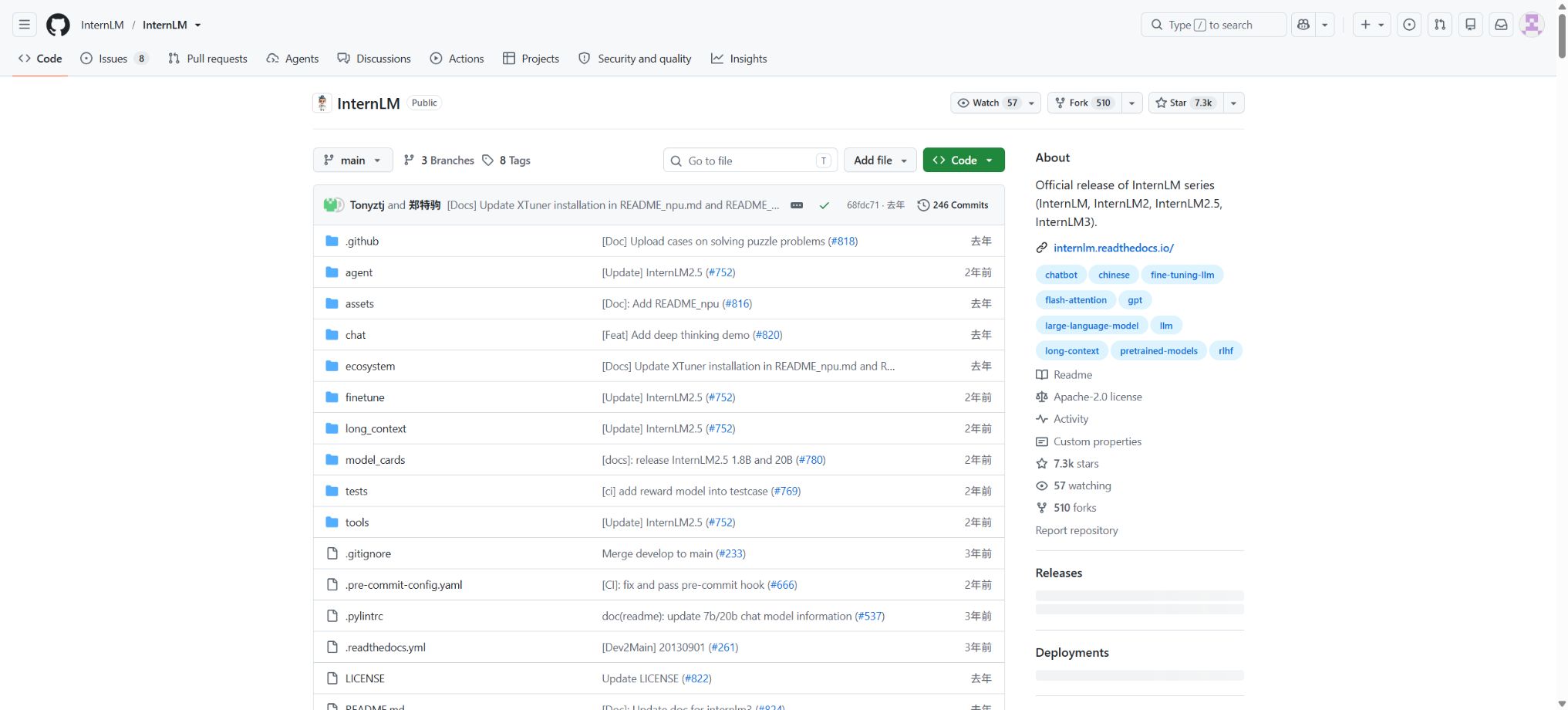
Shusheng·Puyu InternLM is an open-source large model and tool suite developed by the Shanghai Artificial Intelligence Laboratory; it is designed for tasks such as question-answering in Chinese and English, reasoning, coding, processing long texts, multi-modal understanding, scientific research, and Agent development. It offers not only an online chatting experience but also makes available the model weights, training and fine-tuning frameworks, deployment engines, agent frameworks, and evaluation tools.
The positioning of Shusheng Puyu is closer to that of an \"open model foundation and development ecosystem\"; it is not a commercial chat service based on individual membership subscriptions. Ordinary users can experience it through the official Chat Web, while developers usually download models from Hugging Face, ModelScope, or OpenXLab and deploy them on their own.
Main models
1. InternLM3
InternLM3 is the third-generation general language model developed by Shusheng Puyu; the version InternLM3-8B-Instruct is made available officially. It supports both normal conversation and deep thinking modes, and is suitable for tasks related to knowledge, mathematics, logic, coding, as well as complex instructions.
A scale of 8B is suitable for deployment on a single GPU; according to the official documentation, 4-bit quantization requires approximately 8 GB of video memory, but actual requirements are also influenced by factors such as the length of the context, the inference framework, the KV Cache, and concurrency. When working with limited video memory, it is necessary to measure the peak memory usage, rather than relying solely on the size of the weight files.
2. InternLM2.5
InternLM2.5 is available in sizes of 1.8B, 7B, and 20B, as well as in Chat, mathematics, reward model, and long-context versions. The 7B Chat 1M version supports a context length of up to one million tokens, making it suitable for working with very long documents; however, a longer context requires more memory, takes longer to preprocess, and incurs higher costs in terms of attention processing.
3. Intern-S Scientific Multimodal Model
The Intern-S series is designed for AI in scientific applications. Intern-S1 builds on general text and visual processing capabilities by adding data related to chemistry, materials science, life sciences, and earth sciences; it can understand molecular formulas, protein sequences, chemical structures, and scientific images.
Intern-S1-mini offers a lightweight version.
By 2026, Intern-S1-Pro will be expanded to support scientific reasoning using trillion-parameter MoE architectures, while Intern-S2 Preview will explore efficient scientific models with fewer parameters. These scientific models can assist with retrieval, interpretation, and the generation of candidate solutions, but they cannot replace experiments, peer review, clinical judgment, or professional safety procedures.
4. InternLM-XComposer
The XComposer series is designed for text and image understanding, free creation of text and images, as well as interactive handling of long-duration video and audio content; it can process high-resolution images, documents, web pages, and multi-modal inputs. The licensing terms for this series differ slightly from those of the general InternLM repository, and commercial use requires checking the specific requirements outlined for each model.
Online experience
The official Chat Web allows users to communicate directly with the models, making it suitable for testing their capabilities in answering questions in Chinese, performing reasoning tasks, and writing code. The version of the models offered through this online service, as well as the number of concurrent sessions, historical records, and free usage quotas, may change from time to time; the official website does not provide a fixed price list for individual subscriptions.
Therefore, the tool catalog should be labeled as “free online trial + open-source self-deployment”; it is not appropriate to invent monthly fees or claim permanent free access. Online API access as well as additional computing resources for specific activities may also require an application or can be obtained through platforms such as OpenXLab.
XTuner training and fine-tuning
XTuner is an open-source training engine part of the Shusheng ecosystem, which can be used for the pre-training of large models, instruction fine-tuning, multi-modal training, and reinforcement learning. The new version, XTuner V1, is designed for extremely large MoE models; it supports long sequences, FSDP, DeepSpeed Ulysses, as well as GPUs and Ascend NPU, and it can be integrated with LMDeploy, vLLM, and SGLang.
Individual developers can use LoRA or QLoRA to reduce the resources required for fine-tuning, but the quality, format, copyright, and privacy of the data used for fine-tuning are more important than the parameter settings. It is necessary to allocate a validation set before training, as well as to record the base model and its version numbers, in order to avoid focusing solely on the training loss.
LMDeploy inference deployment
LMDeploy is used for compression, quantization, inference, and API services; it supports InternLM, Intern-S, as well as various third-party models. It offers a high-performance inference engine, KV Cache management, quantization capabilities, and compatible interfaces, making it suitable for deploying models as local or server-based services.
Throughput depends on the GPU, precision, context, batching, and concurrency. For production deployments, it is necessary to implement authentication, rate limiting, content security, monitoring, log anonymization, and model rollback; demonstration services must not be exposed directly to the public internet.
Lagent intelligent agent framework
Lagent is a lightweight LLM Agent framework that supports tool invocation, code interpreters, search functions, memory management, as well as single-Agent and multi-Agent workflows. Developers can replace the local models or external APIs, and combine tools with agents using a unified message structure.
Code interpreters, web access, and external tools have real-world side effects. The execution environment should be isolated, network and file permissions should be restricted, and manual approval is required for operations such as deletion, payment, messaging, and database modifications.
OpenCompass evaluation
OpenCompass is an open-source platform for evaluating large models, developed by the Shanghai Artificial Intelligence Laboratory; it enables the comparison of models across domains such as knowledge, language, reasoning, comprehension, coding, and multi-modal datasets. The official performance benchmarks for InternLM are also generated using OpenCompass.
Public benchmarks are susceptible to the influence of prompt templates, sampling parameters, data contamination, and version differences. When selecting a model, it is necessary to take into account factors such as the actual documentation provided, language support, latency, cost, security aspects, as well as human evaluation scores, rather than relying solely on overall rankings.
Other ecological tools
- InternStudio:Offers courses in the Pusu language, as well as tutorials on computing power and practical applications.
- HuixiangDou:A domain-specific Q&A assistant for group chats and knowledge bases;
- MindSearch:Used for multi-step network searches and report-based responses;
- InternEvo:A training system designed for large-scale pre-training;
- OpenXLab:It provides services related to models, data, and open computing resources.
Different projects have varying maintenance statuses and adaptation models; therefore, the official current documentation should be used during installation, along with fixed versions of the dependencies.
Download and local deployment
The InternLM model is typically available in the Hugging Face Transformers format; it can also be obtained from ModelScope and OpenXLab. It can be run using tools such as Transformers, LMDeploy, and vLLM, and after quantization it can be used with consumer-grade GPUs.
Before downloading a model, it is necessary to evaluate the hard drive capacity, video memory, RAM, bandwidth, and licensing requirements. Enabling trust_remote_code will allow the execution of custom Python code from repositories; therefore, it is important to first check the source of such code, its version, and its content, and to run it in an isolated environment.
API and prices
The official InternLM repository provides access to Chat Web and APIs, but the official website does not currently offer a unified pricing schedule based on the number of tokens, as is the case with commercial MaaS platforms. The options for public testing, the computing resources available through OpenXLab, as well as the procedures for applying for APIs and the related billing mechanisms, may vary.
The model deployed on its own incurs no costs related to the token platform, but it does require investment in GPUs, cloud servers, electricity, storage, bandwidth, maintenance, and handling concurrent requests. Before adopting such a solution, enterprises should compare the costs of building it themselves with those of using third-party hosting services.
Open-source and commercial licenses
The main repository of InternLM3 specifies that the code and model weights are licensed under the Apache 2.0 license, which permits their use, modification, distribution, and commercial application; however, it is necessary to retain the license and copyright notices, as well as comply with applicable laws.
XTuner, Lagent, and several other tools also use Apache 2.0. The Intern-S1 project is currently labeled as Apache 2.0 as well.
Different multimodal projects may have additional requirements; for example, the XComposer code is licensed under Apache 2.0, but commercial use of the model weights still requires checking the relevant guidelines or submitting a commercial application.
Third-party foundation models, datasets, and the licenses associated with them are not covered by the InternLM project license. Commercial products require a thorough examination of their weights, code, training data, and external components, rather than relying solely on the license label displayed at the top of the GitHub page.
Data and Security
Open-source weights enable the processing of sensitive data locally, which helps to control data boundaries; however, the responsibility for security lies with the person who deploys them. Organizations need to fix any dependencies, manage model interfaces, keep track of access attempts, block attempts at prompt injection, and prevent the models from revealing system information.
The model may generate biased content, harmful material, error codes, and false facts. Authorities also emphasize that random generation cannot completely prevent unexpected outputs; therefore, publishers must conduct content review and manual verification.
Tutorial for the InternLM language model
Complete a basic task.
- Register the InternLM model and create an API Key intended solely for use in a testing environment;
- Select a model based on input type, context, quality, speed, and price;
- First, invoke the main model to process the minimal request and check the returned structure;
- Use the online testing tool to examine the streaming output, parameters, and response to exceptions;
- Record Tokens, number of calls, latency, error rate, and cost per call;
- Move the key to the server-side key manager before integrating it into the actual application;
Create reusable professional workflows
- Different keys and quotas are used for development, testing, and production environments;
- A representative evaluation set is established based on the main models, online experience, as well as XTuner training and tuning.
- Set timeout, concurrency, retry, throttling, and budget limits;
- Perform checks on the output regarding facts, security, format, and sensitive information;
- Monitor changes in model version, price, latency, and failure rate;
- Prepare plans for downgrading the model, implementing circuit breaking, and taking manual control;
Which users is it suitable for?
- Developers who need Chinese open-source language models for local deployment;
- Students learning fine-tuning, inference, quantization, and Agent development;
- Teams that use scientific multimodal models to study chemistry, materials science, and life sciences;
- Organizations that require millions of contexts and private documents for experimentation;
- Engineering teams that utilize XTuner, LMDeploy, and Lagent to build end-to-end applications;
- Companies that wish to use the weights from the Apache 2.0 generic model for their commercial products.
Restrictions and Precautions
- The 8B model has a lower cost, but it may not achieve the same performance as large closed-source models in dealing with complex facts, code repositories, long-term agents, and specialized domains.
- The outputs of scientific models are not either experimental results or professional certifications.
- A context of millions does not mean that the model will remember everything accurately; actual performance is affected by factors such as position, retrieval, and attention dilution.
- It should combine RAG, chunking, referencing, and manual review, rather than inserting all the data at once;
Frequently Asked Questions
Is Shusheng Puyu free?
The official provider offers a free online trial as well as open-source models that can be downloaded for free. The user is responsible for covering the costs related to hardware and maintenance once deployment takes place, and the amount of online service available may vary.
What is the latest universal model?
The current focus of the InternLM main repository is InternLM3-8B-Instruct; in the field of scientific multimodality, there are updates such as Intern-S1, S1-Pro, and S2 Preview.
Can it be used for commercial purposes?
The code and weights of InternLM3 are licensed under Apache 2.0, allowing their use in commercial applications. For projects such as XComposer, it is necessary to examine the model weights and the terms related to commercial use separately.
How much video memory is required?
According to the official examples, using InternLM3 8B with 4-bit precision requires approximately 8 GB of video memory; in addition, space must be reserved for the context, caching, and the framework itself.
Are APIs provided?
The authorities provide online interfaces related to APIs as well as examples for self-deployment, but there is no fixed, publicly available token price. Developers can also use LMDeploy or vLLM to deploy their own compatible APIs.
Is the Shusheng Pu language open source?
It is an open-source set of models and tools. There are official repositories for the main model, training processes, deployment, Agents, and evaluation tools; however, it is still necessary to check the licenses for each individual project and third-party component.
Tools similar to the scholar Pu language



 Guigong Network Security Registration No. 45132202000164