






AI Essay Writer with Academic Citations
AI Essay Writer with Academic Citations – makes AI-based content verification more efficient and simpler.
Tags:AI content detectionWhat is Samwell AI?
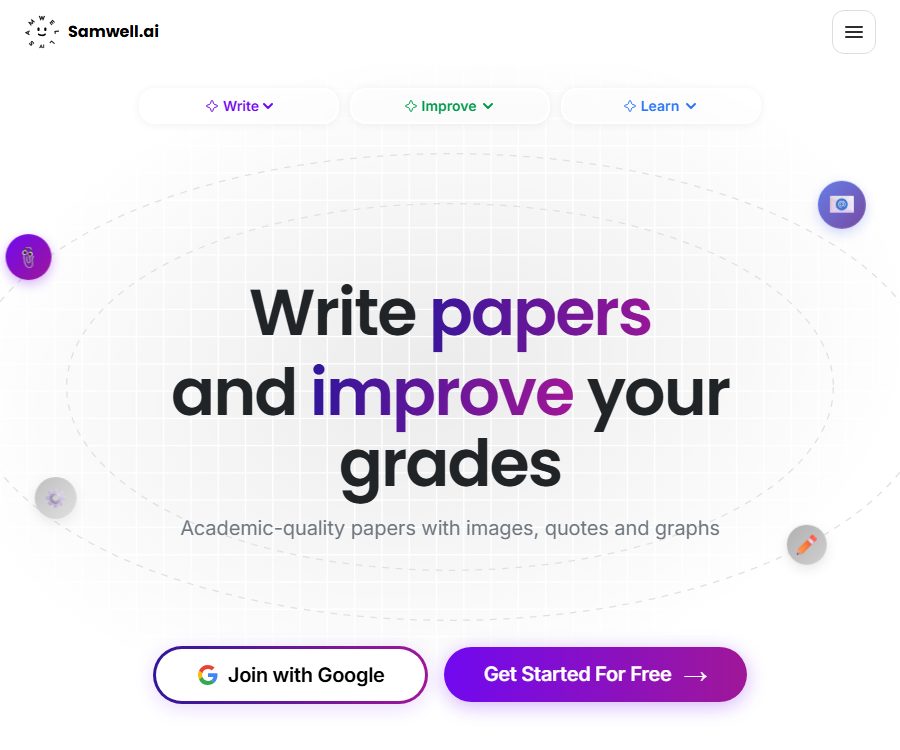
Samwell AI is an academic writing and learning assistant designed for students, researchers, and teachers. It can generate essays, research reports, literature reviews, and scientific papers, and it includes academic citations within the text.
The platform offers functions such as long-text editing, file uploading, collaborative commenting, AI Tutor, and content rewriting. The output provided by AI can only serve as a helper for research and writing; it cannot replace independent thinking, fact-checking, or the original work required by schools.
Main functions
1. Generation of various academic styles
Users can create essays, research papers, literature reviews, and scientific papers. The official website states that texts of up to about 50 pages can be supported; the actual maximum length is still determined by the account plan and the specific requirements of the task.
2. Academic citations and references
Samwell said that he would search more than 20 academic libraries and databases to find the genuine sources, and include the citations in the paper. Any automatically generated information such as author names, titles, years, page numbers, and arguments must be verified one by one in the original text.
3. Writing using existing materials
Users can upload PDFs, articles, or lecture notes; they can also provide specific materials so that the AI can write based on them. Before using documents that are protected by copyright or contain personal information, it is necessary to verify the rights to upload and process such documents.
4. Paper improvements and additional citations
Upload Essay allows you to import existing essays and add citations, references, charts, images, and tables. The system can also adjust the clarity, grammar, and paragraph structure, but it does not guarantee that all changes will comply with disciplinary standards.
5. Long-text editor
After it is generated, the paragraph can be expanded, sentences can be rewritten, additional explanations can be added, and further editing is possible. The auto-completion feature will suggest phrases in an academic tone for use during writing, and users can accept them by pressing Tab.
6. Custom writing instructions
Add Instructions allows for the inclusion of comparison objects, research perspectives, as well as requirements regarding structure and format. The more specific the instructions are, the closer the draft will be to the desired outcome; however, facts and citations still need to be checked manually.
7. Charts, images, and citations
The editor allows the inclusion of charts, images, tables, and direct quotations in papers. Data charts must be based on actual data, and direct quotations require verification of the original source, page numbers, and citation format.
8. Real-time collaboration
Users can invite classmates, teachers, or collaborators to edit the document together, leave comments, and discuss it. Before sharing, it is necessary to verify whether any unpublished research, grades, or personal data contained in the document are suitable for being made public.
9. AI Tutor
AI Tutor can answer questions, explain concepts, discuss topics, and create quizzes based on course materials. It is suitable for review and self-assessment, but it cannot replace textbooks, teacher feedback, or authoritative academic sources.
10. AI detection and text optimization
The platform offers AI-based checking and text normalization functions, but the developers admit that it is not possible to avoid all detection tools at all times. Using technology to conceal the fact that work was written by someone else, to circumvent school rules, or to pretend that the work is one’s own original creation can constitute academic misconduct.
Which users are it suitable for
- Students who need to organize the outline of their paper and identify the research questions.
- Researchers who need to quickly establish an initial framework for a literature review.
- I hope to add candidate materials and cited authors to existing papers.
- Study groups that require collaborative comments and the editing of long texts.
- Students who wish to engage in question-and-answer activities and self-assessments using the course materials.
- Teachers who need to guide students in verifying AI-generated content and citations.
Price and package comparison
As of August 24, 2026, the official website’s real-time pricing page displays the following options. The amounts shown on this page may vary depending on the billing cycle, region, promotions, or account status; fees, automatic renewal options, and final terms are subject to those indicated on the checkout page.
| Plan | Page price | Generate quota | Primary interests |
|---|---|---|---|
| Free Plan | $ | 1000 AI-generated words | Includes citations, authentic sources, and 1 AI Tutor learning course |
| Academic Plan | $ | 200,000 AI-generated words | Verified academic sources and in-text citations, charts and images, unlimited editing, Critical Thinking, unlimited Tutor courses |
| Custom Professional | Custom quote | As needed | Customized for publishers, professors, journalists, students, or institutions |
According to the website’s refund policy, subscriptions are automatically renewed on a recurring basis, and users can cancel these future renewals in their account’s billing section. Payments made for subscriptions or enterprise licenses are generally not refundable, unless otherwise provided by law or specified in a separate agreement.
It should be confirmed before purchasing.
- The settlement period and the total amount actually deducted for a price of 12 dollars.
- Rules regarding the renewal date, carryover, and excess for the 200,000-word quota.
- Check for quotas on citation search, AI verification, PDF uploading, and Tutor.
- The effective date of cancellation and the method for retaining account data.
- The scope of permission for generative AI granted by schools, journals, or clients.
Steps to write a paper using Samwell
- First, read the regulations regarding the use of AI in the course, school, or journal.
- Clarify the research question, paper type, target length, and citation style.
- Upload PDFs, course materials, or designated literature that you have permission to use.
- Fill in the core ideas, comparison objects, methods, and structural requirements.
- Let the system generate an outline; first check the order of the arguments and then expand the main text.
- Verify facts, data, definitions, and causal relationships section by section.
- Open the original document for each citation and verify the author, title, year, and page numbers.
- Rewrite the content based on your own understanding, and add original analysis and evidence.
- Check the format, repetitions, sources of charts, direct quotes, and references.
- Disclose the methods of AI use as required, and then submit it for manual finalization.
How to verify academic citations
- Verify that the document indeed exists, and that the author, title, journal, and year are correct.
- Read the summaries and relevant original texts, rather than relying solely on AI-generated summaries.
- Ensure that the cited content truly supports the argument of the current sentence.
- Check the text, page numbers, and context of the direct quote.
- Give priority to using officially published versions, DOIs, or records from authoritative databases.
- Delete references for which the original text cannot be found or whose content cannot be confirmed.
- Finally, format the text uniformly using the APA, MLA, Chicago, or another style required by the school.
Product advantages
- It is structured around papers, research reports, and literature reviews.
- It supports the search for candidate materials from over 20 academic libraries and databases.
- PDFs, articles, and course handouts can be uploaded as sources for writing.
- It integrates generation, editing, citation, charting, and collaboration.
- An AI Tutor is provided for question-and-answer in courses and self-assessment.
- The free version allows users to experience the core process with 1,000 AI-generated words.
Usage restrictions and risks
- AI may fabricate literature, page numbers, data, theories, and research findings.
- The so-called true source may still not align with the arguments in the main text.
- Automatic rewriting may alter the meaning of the original text or obscure necessary constraints.
- Charts and images may not have available data or copyright information.
- Generating long texts often results in repetition, contradictions, and vague statements.
- The results of AI detection are unstable and cannot be used as proof of originality or compliance.
- Paid subscriptions are automatically renewed and, in principle, no refunds are provided.
Academic integrity
The official privacy policy includes an Academic Integrity Policy that explicitly prohibits cheating, academic dishonesty, or any other form of improper behavior. Users are responsible for any consequences resulting from accusations of plagiarism, low grades, disciplinary actions, or issues related to course eligibility; accounts that violate these rules may be terminated.
- Use AI for brainstorming, outlining, language editing, and information retrieval.
- Do not submit the entire generated paper in its unverified form.
- Do not fabricate experiment, interview, survey, statistical results, or reading experiences.
- Do not use the naturalization feature to hide plagiarism or circumvent academic policies.
- Disclose the name of the tool and its scope of use as required by the school or journal.
- Retain prompt words, modification history, and document verification records.
Privacy and data security
Samwell’s privacy policy covers account management, payment subscriptions, communications, cookies, devices, IP addresses, usage metadata, and third-party login data. Payment account information is stored by third-party payment processors, while the platform may have access to subscribers’ information.
The policy also states that data may be transferred across countries, and that some information will be shared with service providers as well as partners involved in analysis and advertising. Before uploading unpublished papers, research data, student assignments, or sensitive materials, it is necessary to assess the confidentiality agreements, school policies, and requirements related to cross-border data transfer.
- Remove names, student IDs, interview identities, and other personal information.
- Do not upload research that has not yet been patented or is covered by a confidentiality agreement.
- Use features such as Community, which may make content public, with caution.
- Regularly check shared members, third-party accounts, and exported files.
- Apply to delete the account when it is no longer in use, and retain the request record.
API and open-source status
The privacy policy includes APIs as part of the services offered, but the official website does not provide any developer documentation that can be verified publicly, no entry point for making requests, no information regarding restrictions on the use of these interfaces, and no details on their pricing. Therefore, it should be indicated in the catalog that the APIs are not yet available to the public, rather than assuming that they can be integrated directly.
No official GitHub repository or open-source license for Samwell’s main product was found. The bioinformatics project with the same name on GitHub has nothing to do with this academic writing platform; therefore, Samwell should be considered a non-open-source online service.
Frequently Asked Questions
Can Samwell be used for free?
Yes. The free plan includes 1,000 AI-generated words, citations, sources, and 1 AI Tutor course.
How much is the Academic Plan?
As of August 24, 2026, the live page on the official website shows a cost of $12 per month for 200,000 AI-generated words; the final amount will be indicated on the checkout page.
Must the citation be accurate?
The platform claims to use more than 20 academic source databases, but users still have to open each document individually in order to verify the information about the source, the page numbers, and the arguments presented.
Can a subscription be refunded?
According to official policy, sales are considered final transactions and no refunds are provided. Users can cancel future renewals, but the amounts already paid are generally not refunded.
Can I use it to submit assignments directly?
Unverified generated content should not be submitted directly. Users must comply with the school’s rules, carry out original analysis, and disclose the use of AI as required.
Does Samwell offer an open source version or APIs?
The main product is not open source; although the privacy policy mentions APIs, there are currently no interface documents or pricing details that can be verified publicly, so it should be marked as not yet available to the public.
Summary
Samwell is well-suited for creating outlines for papers, identifying potential sources of literature, editing lengthy texts, and learning from course materials; its academic functions are more focused than those of general writing assistants. Its usefulness depends on accurate citation verification, original analysis, proper handling of privacy issues, and compliance with the university’s AI policies.
Tools similar to AI Essay Writer with Academic Citations





 Guigong Network Security Registration No. 45132202000164