






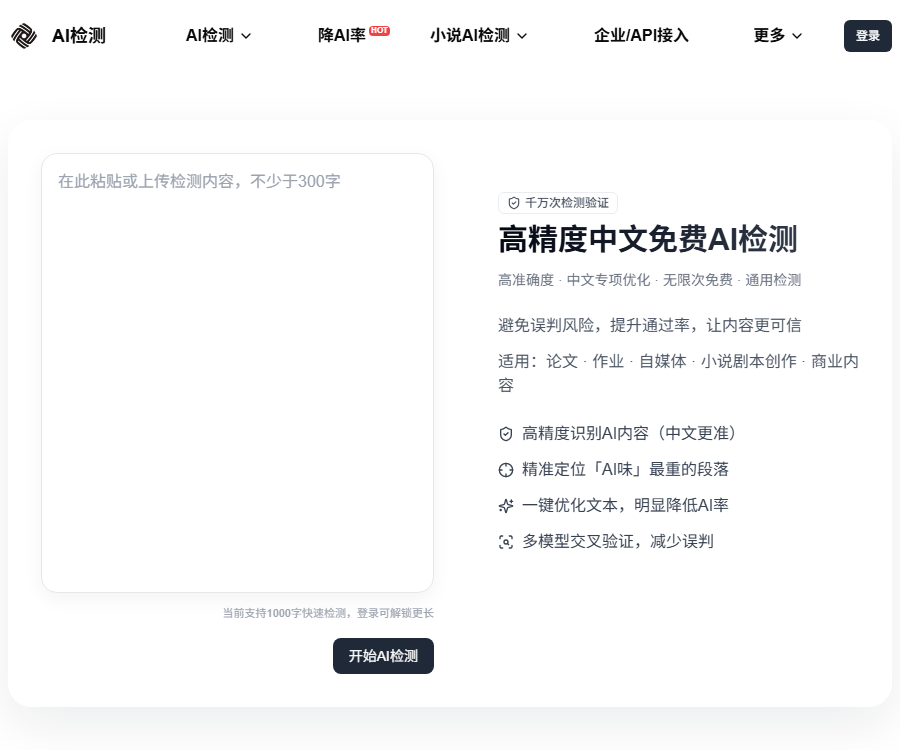
AI detection
It is a tool focused on detecting AI-generated content in Chinese, designed to help users determine with accuracy whether text was created by artificial intelligence. This platform has been specifically optimized for Chinese content, which helps reduce the rate of false detections; it also places a strong emphasis on user privacy by not storing any user data...
Tags:AI content detectionWhat is AI detection?
AI detection is an AI-powered tool for analyzing features of Chinese text, providing probabilities and risk trends.
It is suitable for self-checking of content and assisting in reviews, but it cannot verify the author’s identity nor replace human judgment.
Core functions
| Functions | Main function | Suitable scenarios |
|---|---|---|
| Basic AI rate detection | Estimate the similarity between a text and the features generated by AI. | Self-check of papers, assignments, and articles |
| Risk paragraph identification | Identify the paragraphs with distinct AI characteristics. | Targeted review and editing |
| AI heat map | Visualize the risks of different paragraphs | Checking of long texts and reports |
| Multi-platform verification | Compare multiple test results | Reduce bias from individual tools |
| Content credibility detection | Check for factual, citation, and logical risks | Quality control before release |
| Batch and API | Processing multiple files or integrating with business systems | Schools, platforms, and enterprises |
How does AI detection determine text?
The system does not read the “author’s identity”; instead, it analyzes the degree of similarity between the linguistic features and the outputs of common models.
- Confusion level: A measure of whether a text is too easy for a language model to predict.
- Suddenness: Observe whether the length of sentences, their rhythm, and the choice of words vary in a natural manner.
- Sentence pattern repetition: Identifying overly regular structures and excessive use of connecting words.
- Semantic smoothness: Assessing whether a paragraph is overly coherent and lacks natural transitions.
- Logical continuity: Check whether the expression exhibits the stable patterns typical of the model.
- Chinese fingerprint: A specialized assessment is conducted taking into account the syntax, context, and expression habits of the Chinese language.
Which model features are supported?
Officials state that the testing strategy monitors various major mainstream large models, but the results do not allow for an accurate identification of the specific source of each model.
- Common Chinese expression patterns used in content generated by DeepSeek.
- Features of domestic models such as DouBao, QianWen, and Kimi.
- Features of international models such as ChatGPT, Claude, and Gemini.
- Different model versions, temperatures, and manual modifications can alter the detectable features.
- \"Covering a certain model\" does not mean that it can be proven the text was definitely generated by that model.
Supported text and files
- Chinese text can be pasted directly for quick detection.
- Upload of DOCX and TXT files is supported.
- The public page currently offers a quick 1,000-word check.
- After logging in, you can unlock longer content; the maximum length per entry is 20,000 characters.
- Long texts can be divided into sections for testing, after which the overall trend can be analyzed.
- Code, tables, poetry, and highly formatted text are more prone to errors.
AI Detection Usage Tutorial
- Open the AI detection page and prepare the final version of the text that needs to be analyzed.
- Remove the cover, table of contents, references, and any fixed formatting that is not related to the main text.
- Paste text or upload supported DOCX and TXT files.
- Click to start the detection in order to view the overall AI rate and risk alerts.
- Focus on reading the paragraphs with high risk, rather than just looking at a percentage.
- Manual review is carried out by comparing with the writing outline, revision records, sources, and author’s notes.
- If necessary, use another testing method for cross-validation.
- Retain the testing time, text version, and review conclusions to prevent the results from being disconnected from their context.
How to understand the AI rate correctly
The AI score indicates the degree of similarity between the text and the features generated by the model; it is not the proportion of words written by AI.
- High scores may result from artificially generated text that is template-based, heavy on terminology, or overly structured.
- A low score does not prove that the text was entirely created by a human alone.
- The same text may yield different results in different tools due to thresholds and training data.
- Short text messages lack sufficient information, so fluctuations in detection are usually greater than those in longer texts.
- Manual modification, translation, and mixed use of multiple models further increase uncertainty.
- Important judgments should be based on process evidence, content quality, and face-to-face interviews.
Common misjudgment scenarios
| Scene | Reasons for misjudgment | Review suggestions |
|---|---|---|
| Academic abstract | Standard sentence structure and consistent terminology. | Examine the research process and the original data |
| Official notice | Fixed templates and consistent expression | Compare with the system template and drafting records |
| Technical documentation | Stable structure, precise wording | Verify version history and technical facts |
| Short text | Insufficient feature samples | Retest after adding more context. |
| Translate the text | Smooth tone and consistent syntax. | View the original text and the translation process |
| Weak language foundation | There are many repeated sentence patterns and conjunctions. | Avoid judging an author’s ability based on their style. |
Free testing and advanced homologous platforms
AI detection websites offer lightweight, free services; longer texts and advanced features are provided by the related AI platform.
- The basic testing option does not require a monthly subscription, and it is suitable for routine self-checks as well as repeated tests.
- There is no fixed daily limit on the number of free page views.
- The advanced platform offers paragraph heatmaps and downloadable reports.
- It supports cross-platform validation, as well as the detection of batch files and social media content.
- It also offers AI hallucination detection, content credibility assessment, as well as error and grammar checking.
- The function for reducing the AI ratio is part of expression optimization and should not be used for cheating or plagiarizing.
Price of the points package
As of August 30, 2026, Tongyuan AI has made available the following one-time credit packages on its platform.
| Points package | Price | Integration | Suitable uses |
|---|---|---|---|
| Trial Points Package | 9.9 yuan | 15 points | Single assignment or single publication |
| Standard integration package | 19.9 yuan | 40 points | Paper revision and repeated review |
| Professional points package | 39.9 yuan | 100 points | Frequent creation and batch optimization |
Prices, bonuses, and consumption rules may change; the terms applicable are those stated on the purchase page, the settlement page, and the current service terms.
Consumption of advanced feature points
| Functions | Public restrictions | Consumption |
|---|---|---|
| Advanced AI Detection | The length of a single piece shall not exceed 5,000 characters. | 2 points per attempt |
| Multi-platform detection | No more than 3,000 characters per instance. | 2 points per attempt |
| AI hallucination detection | No more than 3,000 characters per instance. | 2 points per attempt |
| Batch file detection | A maximum of 10 files at a time. | Follow the task page as the guide. |
| Reduce AI rate | If the page labeling is not reduced, points will be deducted. | Based on the number of words and the task. |
Before submission, verify the word count, estimated points, conditions for rejection in case of failure, and the method of saving the results.
AI heatmaps and multi-platform verification
Heatmaps are used to identify high-risk segments, while multi-platform validation is employed to observe the differences between various detectors.
- First, check whether multiple high-risk paragraphs share a common writing pattern.
- Give priority to verifying the evidence of the content, rather than mechanically replacing synonyms.
- When the results vary significantly across different platforms, the lowest score should not be used as the conclusion.
- The same text range and the same detection settings should be used before and after the modification.
- Reports can document trends, but they cannot be used as proof of cheating by the author.
AI hallucinations and content credibility detection
Homologous platforms can also identify risks such as fabricated facts, data, citations, sources, and logical errors.
- Hallucination detection is not suitable for novels, scripts, and works of artistic fiction.
- Results in specialized fields still require manual review by doctors, lawyers, researchers, and others.
- Testing can only indicate risks; it cannot replace verification from the original source.
- When citing, the author, title, year, page numbers, and the meaning of the original text must be verified.
- The data should be returned to the official databases, reports, or experimental records.
Privacy and data processing
According to the official statement, the text obtained from the testing is intended for use solely in the current analysis; it is not stored on a long-term basis nor used for model training.
- After refreshing the page, the complete test content and results may not be available again.
- Logged-in users can view a summary of the operation history, but this summary does not include the full details.
- The summary may include the title, word count, operation type, and result information.
- Papers, client submissions, and internal documents should still be anonymized before being uploaded.
- For private projects, it is necessary to confirm the enterprise agreement, data location, and deletion mechanism.
API and enterprise solutions
The homologous advanced platform offers standard APIs, batch asynchronous processing, and structured risk results.
- The results can include probability scores, risk levels, and paragraph locations.
- It supports high-concurrency scenarios as well as business operations involving millions of characters per day.
- The standard API is billed based on the number of calls made, and it offers a defined level of service along with technical integration capabilities.
- Companies can seek advice on industry strategies, as well as customized models and rules for enhancement.
- It supports private deployment, standalone environments, and integration with local processes.
- The public page does not display the unified API price; it is necessary to contact the platform for confirmation.
Open-source status
- No official public source code repository for the AI website detector was found.
- No weights for the detection model, training data, or open license were found.
- Providing a public explanation of the principles does not mean that the algorithm implementation has been made available under an open source license.
- Enterprise private deployment is a commercial service; it does not mean that users can download the source code.
- The ability to call the API openly does not imply ownership of the model or data.
Which users are it suitable for
- Students and teachers: assist in reviewing papers, assignments, and the writing process.
- Editing and social media: Identify template-based and mechanical expressions before publishing.
- Novel and script writers: Identify the paragraphs in the longer text that pose style-related risks.
- Corporate Marketing Team: Checks the quality of content before publishing external materials.
- Education and content platforms: Batch preliminary screening is carried out via APIs, followed by manual verification.
- AI writing tools: Provide users with warnings regarding the risks associated with the generated content.
Usage restrictions and precautions
- No AI detector can achieve 100% accuracy across all texts.
- The test results shall not be used as the sole evidence for imposing penalties, rejecting submissions, or dealing with academic misconduct.
- Reducing the use of AI cannot replace genuine research, original ideas, and the writing process.
- Attempting to avoid detection may violate the rules of schools, platforms, or organizations.
- When testing the same text multiple times, its version should be retained to avoid comparing different sections of content.
- When personal rights and interests are at stake, channels for filing complaints, seeking manual review, and obtaining evidence of the process should be available.
Frequently Asked Questions
What can AI detection mainly do?
It can estimate the degree of similarity between a Chinese text and the features generated by AI, and identify the paragraphs that require manual review.
Can an AI score prove that a text was written by AI?
No, the AI score represents probabilities and trends; it is not proof of the author’s identity, evidence of cheating, or the number of words generated.
Is AI detection free?
Basic tests are free of charge with no limit on the number of times they can be performed per day; advanced features such as heat maps and reports require the use of credits.
How long of a text can AI detection handle?
On the public page, a quick check can handle 1,000 characters; logging in allows access to a longer limit, with a maximum of 20,000 characters per submission.
How much is the points package?
The Homologous Premium Platform offers 15 points for 9.9 yuan, 40 points for 19.9 yuan, and 100 points for 39.9 yuan.
Will the test results be saved?
Officials state that the main text is used solely for the current analysis, and it is neither stored nor used for training; the account may retain an operation summary that does not include the main text.
Does AI detection provide APIs or open-source code?
The homogeneous platform offers commercial APIs and private deployment options, but no open-source code, model weights, or open-source licenses are available.
Tools similar to AI detection tools





 Guigong Network Security Registration No. 45132202000164