






Fast-descending duck
Professional AI plagiarism reduction tools that make it easier to reduce the plagiarism level in papers.
Tags:AI content detectionWhat is a fast-descending duck?
Kuaijiangya is an online AI tool for reducing text redundancy, designed for use in the process of revising papers; it identifies repetitive content through plagiarism reports and generates revised versions of the text.
It is not a plagiarism detection system, nor can it replace the author in carrying out fact-checking, ensuring proper citation practices, improving the academic style of writing, and conducting final quality checks.
Main functions
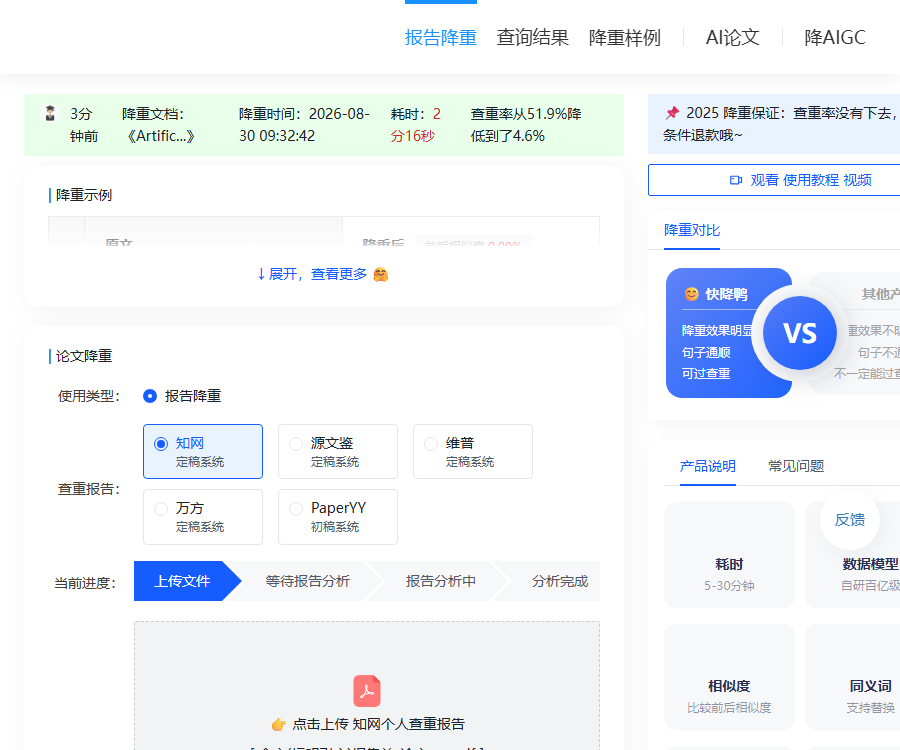
- Upload the PDF report generated by the plagiarism detection system.
- Automatically parse duplicate paragraphs in reports.
- Rewrite text that is marked in red or contains high repetition.
- It offers synonym replacement and sentence restructuring.
- Display the similarity comparison before and after rewriting.
- Keeping the original text and the rewritten version makes it easier to check.
- After completion, you can view the historical processing results.
Which plagiarism check reports are supported?
The official website currently offers five types of reports; before uploading, it is necessary to ensure that the selected type matches exactly the source of the report.
| Report type | Indicated on the official website | Usage suggestions |
|---|---|---|
| CNKI | Finalization system | Upload the personal plagiarism check PDF report |
| Source Text Inspection | Finalization system | Confirm that the report can be opened properly. |
| VIP | Finalization system | Select the corresponding report type. |
| Wanfang | Finalization system | Do not upload screenshots or scans. |
| PaperYY | Preliminary draft system | Suitable for reference during the initial draft stage |
Different plagiarism detection systems use distinct databases and algorithms; therefore, the duplication rates of the same paper obtained from different systems cannot be directly converted into one another.
File format and upload requirements
- The upload portal on the official website currently accepts PDF files.
- The size of the report file cannot exceed 30MB.
- An example from CNKI is “indicating the citation report for the entire text”.
- The report must come from the selected plagiarism detection system.
- Encrypted, corrupted, or scanned PDFs may not be able to be parsed.
- Names, student IDs, and contact information should be removed before uploading.
If the platform is unable to read the report, it is necessary to download the original report again; do not try to upload the text of the paper in the guise of a plagiarism check report.
Guide to using Quick Drop Duck
- First, complete a proper plagiarism check using the system recognized by the school.
- Download the PDF plagiarism report containing duplicate markers.
- Open Quick Drop Duck and select “Report Redundancy”.
- Choose CNKI, Yuanwenjian, VIP, Wanfang, or PaperYY.
- Upload a report that matches the specified type and is no larger than 30MB.
- Confirm the number of characters for billing and the amount due.
- Submit the task and wait for the report to be parsed and automatically rewritten.
- Compare the original text, the rewritten text sentence by sentence, and determine the similarity.
- Restore the terms, data, citations, and conclusions that were incorrectly altered.
- Complete the second round of manual revisions in your own words.
- Use the designated system to check for plagiarism again, as required by the school.
- Keep a record of the modifications and a backup of the final paper.
Understanding the principles of reducing redundancy and the resulting outcomes
Quick Drop Duck adjusts words, word order, and sentence structure based on the repetitive text identified in the report, and shows the differences between the text before and after the revision.
A decrease in similarity merely indicates that there have been changes in the expression; it does not mean that the argument is more rigorous, nor does it guarantee that the final plagiarism rate will meet the required standards.
| System output | It can be explained. | It cannot be explained. |
|---|---|---|
| Similarity before and after | Degree of textual variation in the current sentence | Overall final plagiarism rate |
| Synonym replacement | The wording has been adjusted. | The terminology remains accurate. |
| Syntax rewriting | The surface structure changes. | Logic and facts remain unchanged. |
| Official website success cases | The demonstration results displayed on the platform | Every user can reproduce it. |
Processing time
The reference time stated in the product description on the official website is 5–30 minutes; the actual speed may be affected by the length of the article, the task queue, and the status of the service.
- Short reports are usually faster than long reports.
- It may take longer during peak times.
- Do not make repeated payments when the upload is interrupted.
- If there are no results after a long time, check the historical tasks first.
- Time should be set aside for manual review before the official deadline.
Charging price
The prices listed below were verified as of August 31, 2026; the official website currently charges based on the number of characters used, rather than offering fixed monthly subscription plans.
| Billing items | Price | Billing rules |
|---|---|---|
| Report plagiarism reduction | 6.90 yuan per thousand characters | If the length is less than 1,000 characters, it will be charged as 1,000 characters. |
| 1–1000 characters | 6.90 yuan | By 1 kilogram of characters |
| 1001–2000 characters | 13.80 yuan | In units of 2 thousand characters |
| 5000 characters | About 34.50 yuan | Estimate in units of 5 thousand characters. |
| 10,000 characters | About 69.00 yuan | Estimated in units of 10 kilocharacters |
The example amounts are calculated based on the publicly listed unit prices; the actual number of characters, any discounts, and the payment amount shall be as indicated on the settlement page at the time the task is submitted.
How to read the refund instructions
The official website states that \"if the plagiarism rate does not decrease, a refund can be granted without any conditions,\" but it does not provide a complete list of the criteria used for assessment or the steps to apply for a refund.
- Confirm the specific definition of “not going down” before making the payment.
- Ask whether it is necessary to use the specified plagiarism-checking system for a recheck.
- Confirm the application deadline and the documents that need to be submitted.
- Ask whether manual modification affects the eligibility for a refund.
- Save the order, task number, and previous and subsequent reports.
- The actual order rules and the written responses from customer service shall prevail.
How to manually check the rewritten results
A common issue with AI-based text simplification is not that the text remains unchanged, but rather that after the changes, semantic distortions, term errors, or disruptions in logical relationships occur.
- Check against the original sentence to ensure that the core idea remains unchanged.
- Check names, times, numbers, units, and formulas.
- Restore specialized terms and proper nouns that cannot be replaced.
- Check for causal, contrastive, comparative, and negative relationships.
- Remove duplicates, vague, and unnatural expansions.
- Confirm that direct quotations still use quotes and indicate the source.
- Confirm that the conveyed views also retain the necessary quotations.
- Read the entire passage and improve the coherence between its parts.
Academic norms and proper usage
Plagiarism reduction tools are useful for identifying issues with wording and for coming up with ways to rewrite text; they should not be used to conceal plagiarism or to bypass a school’s requirements regarding academic integrity.
- Opinions, data, and conclusions should stem from genuine research.
- When citing others’ content, it is necessary to indicate the source properly.
- One cannot pretend to be original by simply replacing words with synonyms.
- It is forbidden to fabricate paper, experimental, or survey data.
- Comply with the school’s rules regarding the use of generative AI.
- Disclose the extent of AI assistance accurately when necessary.
- The final version must be reviewed and taken responsibility for by the author themselves.
Difference from AIGC detection
| Task | Primary target | Quick Drop Duck – Current entry point |
|---|---|---|
| Reducing plagiarism in papers | The text marked as repetitive in the plagiarism report | Support |
| Plagiarism check for papers | Duplication in papers and literature databases | It is not its main plagiarism detection service. |
| AIGC detection | The probability that the text was generated by AI | The current page redirects to other products. |
| Manual polishing | Logic, terminology, and overall expression | The author still needs to complete it themselves. |
Repetition rate and AIGC detection rate are two different metrics; reducing one of them does not guarantee that the other will also decrease.
Privacy and paper security
The plagiarism report may contain the full text of the paper, the author’s identity, school information, as well as unpublished research details; it is necessary to assess the risks associated with these data before uploading them.
- Remove the name, student ID, institution, and contact information.
- Do not upload confidential data, data that is still under patent application, or restricted data.
- Confirm that you have the authority to handle the materials related to the collaborative project.
- After use, delete the reports and results using the page functions.
- Important materials are stored only on reliable local devices.
- Do not save accounts and papers on public computers.
- If the retention period cannot be determined, it should be treated as sensitive data.
The official website claims to support the deletion of reports, but the available information is not sufficient to clarify the specific retention period, the process for deleting backups, and the mechanisms for internal access.
Which users are it suitable for
| User | Suitable uses | Not suitable for the intended use. |
|---|---|---|
| Graduates | Identify duplicate paragraphs based on official reports. | Automatic submission right before the deadline. |
| Graduate students | Compare different ways of expression | Changing academic views in order to avoid citations |
| Paper author | Assist in handling language repetition | Replacing fact-checking and citation verification |
| Non-native writers | Obtain ideas for restructuring sentences | Use a direct and forced rewrite. |
Product advantages
- The design is centered around the plagiarism report, and the operation path is straightforward.
- It supports various common Chinese plagiarism report formats.
- Charging is based on characters, so the cost of short texts is easy to estimate.
- You can compare the original text with the revised version.
- Processing records and examples are provided for reference.
Usage restrictions
- A compatible PDF plagiarism report must be obtained first.
- A single report cannot exceed 30MB.
- The repetition rate results for different systems can vary significantly.
- Rewriting may result in grammatical errors, redundancy, and semantic distortions.
- The examples on the official website do not represent the results of each individual paper.
- Processing time and the degree of reduction in redundancy should not be considered as guarantees.
- The conditions for a refund should be confirmed separately before payment.
- No official public API or open-source code has been confirmed.
API and open-source status
| Project | Current verification result |
|---|---|
| Online products | Hosting services are provided by the official website. |
| Public developer API | No official documentation has been found yet. |
| Official SDK | Not confirmed yet |
| Official GitHub repository | Not confirmed yet |
| Is the product open source? | It should not be marked as open source. |
Frequently Asked Questions
What is a quick-drop duck?
It is an online AI tool for reducing redundancy in papers, which identifies repeated paragraphs based on the plagiarism report and generates revised versions; it is not a plagiarism detection system.
Which plagiarism detection reports is QuickDrop Duck compatible with?
The official website currently lists CNKI, Yuanwenjian, VIP, Wanfang, and PaperYY; when uploading a file, it is necessary to select the format that corresponds to the source of the report.
How much does Fast Drop Duck cost?
The current price on the official website is 6.90 yuan per thousand characters; if the amount is less than 1,000 characters, it will still be charged as if it were 1,000 characters. The final amount will be indicated on the settlement page.
What are the requirements for the report on rapid duck descent?
The current entry point accepts PDF reports from the relevant plagiarism detection system; the file size must not exceed 30 MB. Encrypted, damaged, or scanned reports may not be able to be processed.
Can using QuickDrop Duck definitely help avoid plagiarism?
There is no guarantee; different plagiarism detection systems, the content of the paper, and manual edits can all affect the results. It is still necessary to conduct a recheck using the system designated by the school after completion.
Is it safe to upload papers and plagiarism reports?
The official website states that reports can be deleted, but it does not provide detailed guidelines for doing so; unpublished papers should first have their sensitive information removed, and it is necessary to avoid uploading any confidential or restricted materials.
Is QuickDrop a open-source tool or does it provide an API?
At present, there is no official open-source repository, SDK, or public API documentation for FastDrop Duck available; it should therefore be considered an online hosting service.
A tool similar to the quick-drop duck.





 Guigong Network Security Registration No. 45132202000164