






AI Detector & AI Checker for ChatGPT, Gemini, Claude, & More
AI Detector & AI Checker for ChatGPT, Gemini, Claude, & More – makes AI content detection faster and easier.
Tags:AI content detectionWhat is Detecting-AI?
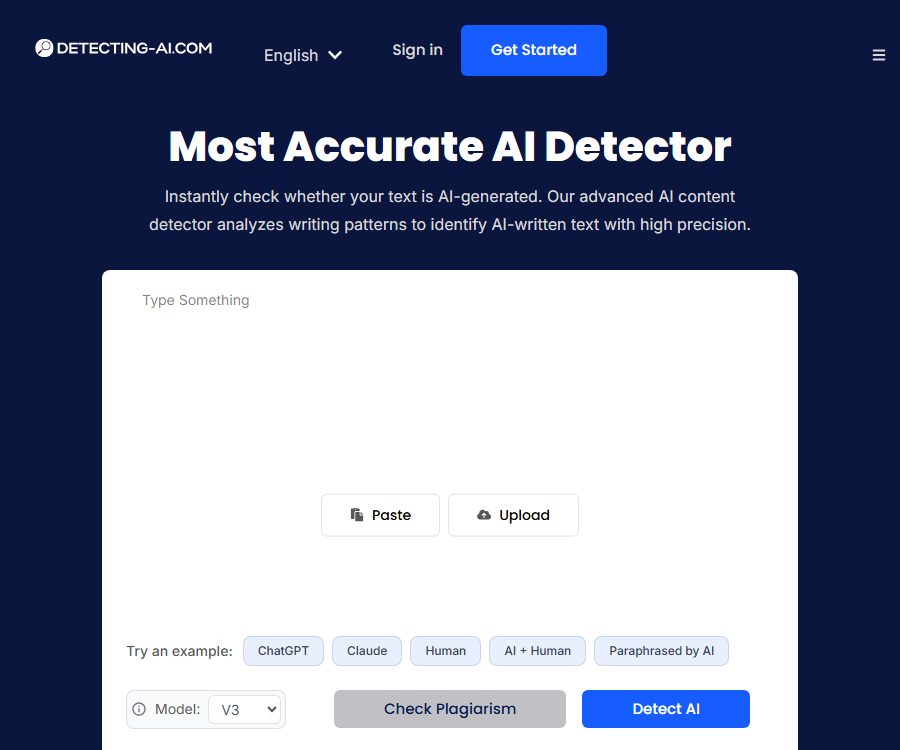
Detecting-AI is an online tool that analyzes whether text was likely generated by a large language model; it is operated by TEMURIYDEVS LTD. This tool provides an overall probability assessment based on AI, and it highlights suspicious sections using color coding at the sentence level.
The platform is intended for teachers, students, editors, recruitment staff, and content teams; it also provides tools for plagiarism detection, fact-checking, and text rewriting. The scores obtained from these tests can serve only as a supplementary indicator and cannot prove definitively whether the author used AI or not.
Main functions
1. AI text detection
After the user pastes text or uploads a file, the system analyzes language patterns, sentence probabilities, sudden changes, and structural features. The results are classified into categories such as human-generated content, AI-generated content, and mixed content.
2. Sentence-level highlighting
The platform indicates the AI probability for each sentence, helping users identify the sections that influence the overall judgment. The highlighting does not serve as evidence of plagiarism, nor does it indicate which specific model was used.
3. Multi-model coverage
The official website states that the system is continuously being adapted to work with models such as ChatGPT, Claude, Gemini, LLaMA, and DeepSeek. New models, manually edited text, and texts from specialized fields may still result in reduced recognition accuracy.
4. Multilingual detection
The official statement claims support for over 50 languages, with English being the most fully developed among them. For non-English texts, texts written in second languages, and short texts, more cautious interpretation standards should be applied.
5. File upload
The technical page lists the input formats such as PDF, DOCX, TXT, and images; the system first extracts the text before analyzing it. Errors in the recognition of scanned documents can directly affect the detection score.
6. Multi-file detection
The paid version allows the upload of multiple files at once, which is suitable for course assignments or batches of manuscripts to be reviewed. The results obtained in bulk still need to be checked one by one; it is not possible to automatically reject or penalize manuscripts based solely on certain thresholds.
7. Plagiarism check and fact verification
The paid plan includes features for detecting text similarity and verifying facts, which can be used to identify similarities between texts or statements that need to be checked. The results of the fact-checking process must be verified against reliable original sources.
8. AI Humanizer and Huma
The paid version offers AI Humanizer and the advanced Huma rewriting engine. These tools can be used to improve the naturalness and readability of text, but they should not be employed to circumvent the AI disclosure requirements imposed by schools, platforms, or clients.
Which users are it suitable for
- Teachers who need to conduct preliminary screening of a large number of assignments and carry out manual verification.
- Students and researchers who wish to check whether their papers trigger AI detectors.
- An editorial team is needed to review submissions, guest articles, and marketing content.
- Companies that need to identify spam or large amounts of low-quality text.
- Researchers who wish to analyze the textual characteristics of AI in different languages.
Price and version comparison
As of August 24, 2026, the official website offers three payment options: free, annual, and monthly. The price page indicates that an annual subscription is available at 50% discount for a limited time; the renewal price, taxes, and duration of the discount are subject to those specified on the checkout page.
| Plan | Price | Detection limits | Other equity interests |
|---|---|---|---|
| Free | $ | 5,000 characters per time, up to 100 times per day | Basic AI detection; no customer service and no early access to new features. |
| Yearly | $ | Unlimited times per day, 160,000 characters per session | 12,000 checks for plagiarism, fact verification, Humanizer, multiple files, Huma, advanced support and new features |
| Monthly | 14 dollars per month | Unlimited times per day, 160,000 characters per session | 1000 plagiarism checks, fact verification, Humanizer, multiple files, Huma, advanced support and new features |
The core testing functions for annual and monthly subscriptions are the same; the main differences lie in the payment cycle and the points allocated for plagiarism checking. Educational institutions can contact the platform to find out about the specific prices, while teams with high usage levels can request temporary adjustments or customized solutions.
It should be confirmed before purchasing.
- Does the character count include spaces, quotes, and text extracted from files?
- The method of calculating the duplication fee, its validity period, and the extra charge for exceeding it.
- Is the 50% discount for annual payment applicable only to the first period?
- There are no restrictions regarding whether fair use applies, nor any limits on speed or concurrency.
- The number of files that can be uploaded, their size and format, as well as the rules for handling failures.
- Eliminate the differences between the cancellation and refund policies, as well as those in the price FAQs and terms of service.
AI Detection Usage Tutorial
- Ensure the text is long enough, and keep the original file along with the writing notes.
- Remove irrelevant elements such as directories, references, and formatting errors.
- Paste text or upload supported files.
- Select the current detection model and run the analysis.
- View the overall score, categories, and sentence-level highlights.
- Pay special attention to checking the terms, templated expressions, and citations in the highlighted sentences.
- Cross-verify using the second testing method or manual review.
- Judgment is made by considering drafts, version history, classroom performance, and the author’s notes.
- Record the tool version, date, and input range.
- The results are used only as one of the pieces of evidence, and do not constitute an automated final decision.
Suggestions for use by teachers and institutions
- Before the course begins, disclose the permitted and prohibited uses of AI.
- Set up a manual review process so that students are not penalized based solely on a single score.
- Authors are allowed to explain the writing process and submit drafts, notes, or version history.
- Special attention is paid to non-native writers, template-based assignments, and misclassifications of short texts.
- The thresholds and group differences are regularly assessed using real samples from the school.
- Avoid uploading students’ full personal information along with their papers.
Technical principles
The official technical page states that its dual-model approach combines XGBoost for feature analysis with RoBERTa for semantic classification, and it extracts features such as perplexity, abruptness, readability, entropy, and syntactic proportion. The system also uses probability calibration methods to determine confidence levels.
The official website claims that an accuracy of around 99% and a false positive rate of less than 1% can be achieved in specific tests, but it does not provide on the same page complete information regarding reproducible experiments, all datasets, distribution across different domains, and results of independent audits. These figures should be regarded as statements made by the manufacturer, rather than guarantees for all texts.
Product advantages
- The free version allows for the analysis of 5,000 characters per session, and offers a higher number of sessions per day.
- Supports highlighting of the overall score as well as at the sentence level.
- Supports multiple languages and various file formats.
- The paid version allows for a higher character limit per submission and supports multiple files.
- It provides supplementary tools such as plagiarism checking, fact verification, and rewriting.
- Part of the technical architecture and a Portuguese detection model have been made public.
Usage restrictions and risks of misjudgment
- The AI detector relies on statistical features, rather than direct evidence of the author’s behavior.
- Short texts, formulas, code, lists, and highly templated writing are more difficult to classify reliably.
- Writing, editing, and translating in a language that is not one’s native language can alter the linguistic characteristics of the text.
- New models, mixed writing, manual rewriting, and domain-specific terminology can affect the results.
- The same text may yield opposite conclusions in different versions or different tools.
- A high confidence level does not mean zero errors, and a low confidence level requires even more careful interpretation.
- The detection and rewriting functions exist simultaneously, and should not be used to encourage circumvention of integrity rules.
Privacy and text processing
The FAQs on the official website state that the submitted text is not saved, shared, or used for training purposes; the technical page also claims that transmission and storage are encrypted. The general privacy policy specifies that the platform may collect account and usage information such as names, email addresses, contact details, IP addresses, visited pages, times, and cookies.
The public policy does not specify the exact retention periods for parsing temporary data, backups, logs, and data handled by third-party services. Before uploading unpublished papers, student assignments, resumes, or corporate materials, it is necessary to check the organization’s requirements regarding data handling.
- Delete the name, student ID, email address, and customer identifier before conducting the test again.
- Do not upload complete documents that are subject to confidentiality agreements.
- For institutional purchases, a data processing agreement and the scope of security certifications should be obtained.
- After the detection is complete, clear the account history and locally downloaded reports.
Refunds and subscription reminders
The price FAQ states that monthly subscriptions can be canceled at any time, and annual subscriptions allow for a refund of the unused portion; however, the terms of service indicate that services used during the payment period are generally not refundable, with requests to be considered on a case-by-case basis. There is a discrepancy between these two statements, so it is necessary to obtain written confirmation from customer service regarding the applicable rules before purchasing an annual subscription.
Subscriptions are automatically renewed; failing to cancel before the renewal date may result in charges for the next period. Payments are processed by Paddle, and the final billings and refund eligibility are subject to the settlement and order terms.
API and open-source status
The official website shows the ability to integrate with various everyday tools, but it does not provide complete developer API documentation, pricing information, or SDKs. Organizations that need to integrate this system should contact sales to obtain details regarding the interfaces, data processing rates, and service levels.
The authorities have made the Portuguese pt-ai-detector model available on Hugging Face under the CC BY-NC 4.0 license; it is permitted for use only for research and personal purposes, not for commercial applications. This model is not a complete multilingual detection engine for websites, and the main platform as well as the full service should still be considered non-open source.
Frequently Asked Questions
Is Detecting-AI free?
A free version is available, allowing up to 5,000 characters per query and a maximum of 100 checks per day.
Is it possible to detect ChatGPT and Claude?
The official website claims to support models such as ChatGPT, Claude, Gemini, LLaMA, and DeepSeek, but the actual performance is influenced by the type of text and the way it is edited.
Can the test scores prove that a student cheated?
No. It can only provide probabilistic assistance signals; it must be used in conjunction with the writing process, drafts, version history, and manual communication.
Is file uploading supported?
It supports formats such as PDF, DOCX, TXT, and images; the paid version also allows for the upload of multiple files.
Will the text be saved?
The official website states that the tested text is not saved, shared, or used for training, but institutional users should still check the terms regarding complete data processing and retention.
Is Detecting-AI open source?
The main platform is not open source; the developers have made available only a Portuguese detection model that is restricted for commercial use.
Summary
Detecting-AI is suitable for conducting AI-based probability assessments at the sentence level on text, and it offers a free version as well as a paid version based on the number of characters processed. The results obtained must be interpreted in conjunction with human expertise, especially in situations with significant consequences such as academic sanctions, hiring decisions, and publishing.
Tools similar to AI Detector & AI Checker for ChatGPT, Gemini, Claude, & More





 Guigong Network Security Registration No. 45132202000164