






InsightAI
InsightAI: an intelligent tool specialized in AI content detection.
Tags:AI content detectionWhat is InsightAI?
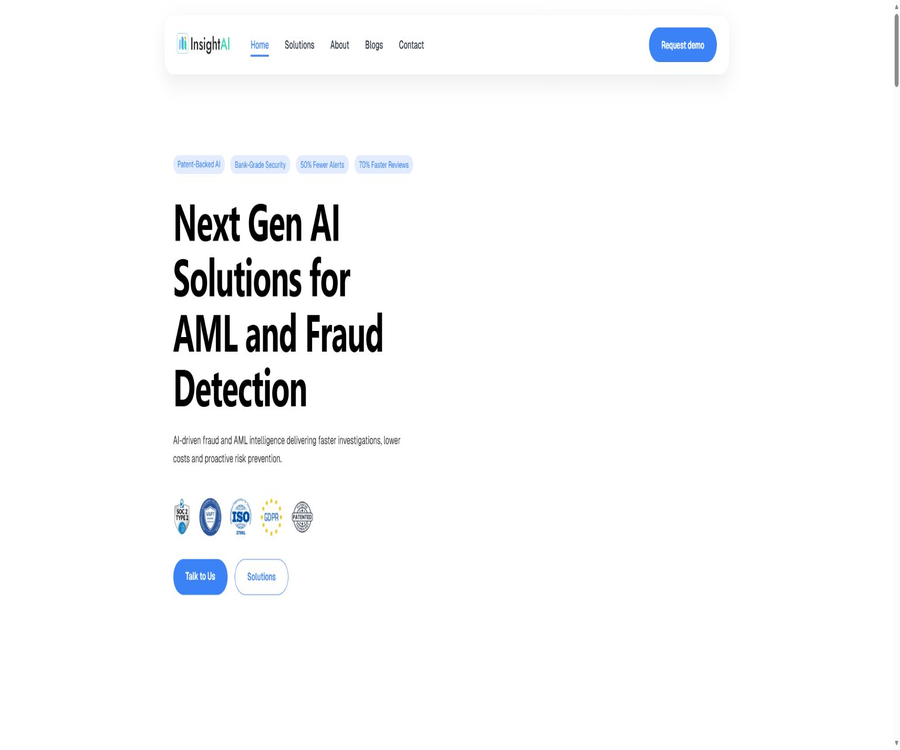
InsightAI is an AI-based platform for anti-money laundering, fraud detection, and risk analysis, designed for regulated financial institutions; it is operated by Pinnacle Technologies and Media Solutions. By integrating device signals, behavior analysis, relationship mapping, transaction context, and document forensics, it helps organizations identify risks before losses occur.
The product is designed to serve banks, payment platforms, fintech companies, insurance firms, and various business ecosystems; it is not a data analysis chat tool intended for ordinary users. It can be deployed as an independent module or integrated into existing AML and transaction monitoring systems.
A one-sentence summary
InsightAI utilizes multiple types of signals – related to devices, transactions, relationship networks, and documents – to provide financial institutions with real-time fraud scores, AML investigations, and actionable evidence regarding risks.
Four main solutions
| Solution | Core issue | Main inputs | Main output |
|---|---|---|---|
| Device Intelligence | Are the devices used for logging in, conducting transactions, or performing sensitive operations reliable? | Devices, networks, browsers, behaviors, and identity relationships | Device fingerprints, risk signals, and real-time events |
| AML Case Investigation | How to identify real money-laundering networks among a large number of alerts | Transactions, entities, documents, devices, and analyst feedback | Relationship diagrams, case summaries, risk descriptions, and evidence packages |
| Fraud Risk Management | Are there any abnormalities in payments, account openings, and account activities? | Speed, geography, behavior, transaction, and contextual signals | Millisecond-level scoring, alerts, and remediation suggestions |
| Document Forgery | Whether financial and identification documents have been altered or forged | PDF, images, metadata, text, and external validation data | Interpretable risk scores, anomaly flags, and reports |
Device information
Device intelligence is used to determine whether the current device and session are trustworthy during logging in, checking out, or other sensitive operations. It takes into account detections on the terminal, historical data from the backend, and real-time transmissions, rather than relying solely on IP addresses and cookies.
| Detection layer | Analysis content | Identifiable risks |
|---|---|---|
| RASP | Rooting or jailbreaking, emulators, debuggers, dynamic instrumentation, and application tampering | Controlled devices, repackaged applications, and automated attacks |
| Networks and Identity | Device binding, SIM cards, network connections, certificate fixation, and device-user relationships | Account takeover, device farms, and multi-account abuse |
| Behavioral signals | Touch, mouse, input speed, pasting, and form behavior | Script, robot, and card number testing |
| Relationship diagram | The connections between devices, users, accounts, and transactions | Gangs, Trojan accounts, and coordinated fraud |
| Real-time delivery | SDK, signed access interfaces, Webhooks, and real-time channels | Intercept in a timely manner at the business decision point |
Key attack types
- Account takeovers resulting from a combination of new devices, proxy networks, and credential stuffing;
- Rapid pasting of card numbers, as well as tests involving repeated failures when using such cards, and BIN attacks;
- Repackaged mobile applications with inconsistent signatures, or those that have been altered;
- Device farms that use the same device to control a large number of unrelated accounts;
- Automation of headless browsers, scripts, and dynamic instrumentation;
- Man-in-the-middle attacks and traffic interception;
- The device relationship between Trojan accounts and synthetic identities.
Investigation of AML cases
The AML module analyzes account behavior by placing it within relationship networks and timelines, rather than focusing solely on individual alerts. Transactions, entities, documents, devices, and behaviors are connected to a unified case view.
- Identify Trojan account patterns such as the aggregation, dispersion, and circular transfer of funds;
- Automatically connect transactions, entities, documents, and related devices;
- Generate case summaries, risk descriptions, and recommendations for further investigation;
- Prioritize based on the context, rather than using only static thresholds;
- Conduct the investigation in the relationship diagram, transaction timeline, and evidence section;
- Export evidence for use in STR, SAR, or similar regulatory submissions;
- Fraud confirmations and false positive reports are fed back into the continuous backtesting process.
Why are maps important?
When looking at each individual transaction in isolation, fund inflows and outflows may not seem abnormal; however, by representing the accounts, counterparties, devices, and timing aspects as a network, it becomes easier to identify organized groups and hierarchical structures. The resulting diagram still requires analysts to interpret it in context with the business background.
Real-time fraud risk management
The FRM module provides low-latency scoring for payments, account opening, and account activities, taking into account analysis speed, geography, user behavior, and transaction context. The model can adapt to new patterns, but institutions still need to maintain rules, carry out manual reviews, and have options for emergency fallbacks.
| Risk scenarios | Main signal | Possible actions | Precautions |
|---|---|---|---|
| Payment fraud | Amount, frequency, device, merchant, and behavior | Pass, challenge, delay, or reject | Set up business fault tolerance and appeal mechanisms. |
| Account takeover | New devices, network anomalies, credential attempts, and changes in behavior | Enhanced authentication or restriction of sensitive operations | Don’t refuse just because of a trip or a flight change. |
| Trojan account | Capital inflow/outflow, shared equipment, and relationship networks | Upgrade AML investigation | Taking into account the account age and business type |
| Abuse of automation | Script behavior, simulator, repeated input, and abnormal speed | Speed limits, verification codes, or blocking | Monitoring false alarms from accessibility tools |
| Synthetic identity | Contradictions in identity, devices, documents, and transactions | Additional verification or manual due diligence | Comply with fair lending and privacy requirements |
Document forgery detection
The document analysis module is used to detect pixel edits, metadata anomalies, inconsistent fonts, structural issues, and numerical inconsistencies in financial and identity documents. The results are provided in the form of a risk score, specific markers, and an explanatory report.
| Detection module | Analysis content | Represents an exception |
|---|---|---|
| Pixel forensics | Local images, overlay layers, and editing boundaries | Substitutions and syntheses that are not easily detectable to the naked eye |
| Metadata intelligence | Editing tools, timestamps, and file history | The generation date of the chain is inconsistent with the declaration date. |
| AI document verification | Structure, templates, and machine learning anomalies | Forged layouts and synthetic materials |
| Font and layout | Consistency in font, spacing, position, and formatting | Local digit or name replacement |
| Data verification | Date, amount, summary, and external records | Unbalanced balances, modified figures, and conflicts across different materials |
| Risk score | Aggregate multi-layer signals into interpretable levels | Allocate the workforce queues based on severity. |
Applicable documents
- For loans, pay stubs, bank statements, income tax documents, and employment verification;
- KYC and the PAN, Aadhaar, passport, and national identity card used in account opening;
- Repair invoices, medical reports, and claim documents in insurance settlements;
- In trade financing, invoices, letters of credit, bills of lading, and contracts;
- Financial statements, invoices, and registration documents in corporate audits.
The product demonstrates over 60 different document types, 12 levels of signaling, and examples with sub-second latency; however, these are indications of the platform’s capabilities and do not constitute a guarantee for all formats, languages, and deployment scenarios. Organizations should use actual local samples for verification.
Document processing workflow
- Submit files through the management interface, batch processing, or APIs, and associate them with the correct customers and cases.
- Complete OCR and document type identification to determine whether the file meets the basic processing requirements.
- Parallelly run checks for pixels, metadata, fonts, structure, AI, and data verification.
- Cross-verify document fields with transactions, identities, and other materials.
- Generate risk levels, locations of abnormalities, specific reasons, and analysis reports.
- Materials with low risk are automatically approved based on the organizational thresholds, while suspicious files are sent to the manual processing queue.
- Record the findings of the investigation, any required additional documents, as well as the decision regarding whether fraud has been detected or not.
- Use the reviewed feedback for backtesting, rule adjustments, and model monitoring.
AML investigation process
- Receive alerts from transaction monitoring or other systems, and create corresponding cases.
- Automatically link accounts, customers, transactions, devices, documents, and counterparties.
- View the relationship diagram and transaction timeline to identify fan-ins/fan-outs, cycles, and shared devices.
- Read the AI-generated summary, the description of risks, and the recommendations, but go back to the original evidence to verify them.
- Add KYC details, business background, negative information, and internal historical investigations.
- Analysts determine whether it is a false alarm, require further monitoring, necessitate escalation, or confirm that it is suspicious.
- Export the evidence and prepare declarations such as STR or SAR in accordance with local requirements.
- Feed the case outcomes back into the model and threshold evaluation, while retaining a complete audit trail.
Explainability and auditing
The platform emphasizes breaking down risks into specific elements such as devices, transactions, graphs, and documents, to help analysts understand the reasons behind them. In regulatory contexts, it is still necessary to keep track of the model version, inputs, rules, any manual adjustments made, and the final reasoning behind the decisions.
| Audited entity | What should be retained | Why is it important? |
|---|---|---|
| Risk determination | Scores, signals, thresholds, and time | Proof of the basis and consistency at that time |
| Models and rules | Version, parameters, and change approval | Reproduce historical results and manage drift |
| Manual operation | View, modify, upgrade, and dispose of records | Clarify responsibilities and prevent overstepping authority |
| Evidence in the case | Original transactions, documents, relationship diagrams, and explanations | Supports regulatory reporting and reinspection. |
| Feedback results | Confirm cases of fraud, misreporting, and losses | Assessing the actual performance of the model |
| Interface events | Requests, responses, errors, and retries | Identify missed reports, delays, and duplicate processing. |
Deployment method
| Deployment mode | Suitable situations | Advantages | Confirmation is needed. |
|---|---|---|---|
| Hosted SaaS | Hope for a quick launch and reduced infrastructure maintenance. | Unified maintenance and expansion of the platform | Data regions, networks, retention, and sub-processors |
| Private cloud | A dedicated environment and cloud governance are required. | Stronger isolation and enterprise control | Cloud accounts, keys, upgrades, and responsibility boundaries |
| Local deployment | There are strict requirements regarding data retention or isolation. | The data and operating environment are more controllable. | Hardware, model updates, monitoring, and support |
| Hybrid deployment | Real-time connection of device signals and internal operation of the case management system | Balancing real-time performance with data governance | Transmission across environments and failure recovery |
| Single module | First, resolve clear issues related to equipment or documents, etc. | The scope of implementation is limited. | How it connects with other signals and case workflows |
| Complete stack | Unified anti-fraud, AML, device, and document management | The context and schema are more complete. | Data integration, project timeline, and total cost |
APIs, SDKs, and real-time delivery
InsightAI offers interfaces with Bearer token authentication, Webhooks, and real-time channels. Device Intelligence also provides native plugins for Android, iOS, and Flutter; the documentation specifies support for Python, Node.js, and Java SDKs.
| Development capability | Current status | Primary uses | Apply attention. |
|---|---|---|---|
| REST API | Support | Upload customers, transactions, or documents to obtain risk assessments. | Key rotation, rate limiting, timeouts, and idempotency |
| Webhook | Support | Real-time delivery of processing status and risk results | Signature verification, retry, and event deduplication |
| Real-time channel | Support | Low-latency devices and session signals | Reconnection and fallback strategies |
| Android SDK | Support | Terminal RASP, device, and behavior signals | Application signing, permissions, and version compatibility |
| iOS SDK | Support | Device and session risk detection | System limitations, privacy policy, and updates |
| Flutter plugin | Support | Ability to package Android and iOS devices | Native dependencies and cross-platform testing |
| Python, Node.js, Java SDK | The document scheme is listed as supported. | Quick access to documents and backend processes | The method of acquisition, version, and production support need to be confirmed. |
Batch import of customer data
The FRM document allows CSV or JSON customer data to be uploaded via authorization tokens, and it returns information regarding success, failure, and any errors that occur. For production use, it is necessary to first validate the fields, encrypt the data during transmission, ensure batch idempotency, and retry attempts in case of partial failures.
Which institutions are suitable?
- Banks and payment platforms that require real-time payments as well as a rating of account activity;
- The compliance team, overburdened by a large number of AML alerts and L2 investigation tasks;
- Organizations that need to identify Trojan accounts, gang networks, and synthetic identities;
- Financial technology companies that aim to identify untrustworthy devices before logging in and carrying out transactions;
- Lending institutions that handle payrolls, bank statements, identification documents, and invoices;
- Insurance companies that need to verify the claims documentation;
- Regulated enterprises that require on-premises deployment, private cloud, and regulatory audit capabilities.
In what situations is it not very suitable?
- Only suitable for users who need basic OCR functions, PDF reading, or the organization of personal files;
- Businesses that process personal financial and device data without a legal basis;
- Small teams that wish to use permanent, free, self-service tools that require no implementation;
- Organizations that lack analyst feedback, case processing procedures, and capabilities for model governance;
- Organizations that intend to have a single risk assessment system take care of all rejection decisions automatically;
- Procurement projects that rely solely on promotional metrics without conducting local sample verification.
Product advantages
- Devices, behaviors, transactions, relationship graphs, and document signals can enhance each other;
- A relatively complete chain is established, ranging from device risks prior to the transaction to AML investigations after the transaction;
- Relationship diagrams help identify gang networks that are difficult to detect using individual rules;
- Document detection analyzes pixels, metadata, structure, and numerical consistency simultaneously;
- The risk outcomes are accompanied by explanations and evidence, facilitating supervision and manual review;
- The modular architecture allows deployment to begin with a specific problem;
- Supports SaaS, private clouds, and on-premises environments;
- APIs, Webhooks, real-time channels, and multi-platform SDKs support production integration.
Usage restrictions
- All figures related to the reduction of false alarms, improved efficiency, and accuracy must be verified using the organization’s own sample data.
- Device and behavior signals are affected by the system version, accessibility tools, and network environment.
- Graphical relationships indicate associations, and do not equate to acts of illegality or fraud;
- Missing document metadata, scanning compression, and language differences can affect detection;
- Continuous learning can amplify incorrect labels in the absence of high-quality feedback.
- Local deployment still requires model updates, vulnerability fixes, and operational monitoring;
- High-risk financial decisions require human oversight, explanation, and appeal mechanisms.
- Public information does not provide complete details on prices, throughput, or a list of regions covered.
Price and purchase methods
InsightAI does not disclose fixed pricing for its standard packages; pricing is usually determined through consultations, demonstrations, pilot projects, and corporate contracts. The cost is influenced by the modules selected, the volume of transactions or documents, the method of deployment, the region, interface capacity, as well as implementation and support services.
| Package or version | Price | Billing cycle | Core benefits or quota | Suitable for users |
|---|---|---|---|---|
| Device Intelligence | Custom quote | Contract or pay-as-you-go | The device SDK, signals, graphs, and real-time delivery scope are determined according to the plan. | Account and Payment Risk Control Team |
| AML Case Investigation | Custom quote | contract | Case, map, summary, narrative, feedback, and evidence functions | AML and Compliance Departments |
| FRM | Custom quote | By contract or based on volume of transactions | Real-time scoring, rules, alerts, and system integration | Banks, payment, and fintech companies |
| Document Forgery | Custom quote | Based on the contract or the volume of documents | Document evidence collection, risk assessment, batch processing, and reporting | Loans, KYC, insurance, and trade financing |
| Complete financial crime stack | Custom quote | Corporate contracts | Unified deployment of devices, transactions, AML, and documents | Large regulated agencies |
| Pilot or trial use | Decided by the platform. | Limited period | Customer samples can be used to verify specific capabilities. | The agency that is assessing the effectiveness |
The terms allow the platform to offer a free trial period on its own; charging may begin after the end of this trial. Subscriptions can be paid in advance on a periodic basis with automatic renewal. A refund can be requested within 10 days under specified conditions for the initial purchase of the contract, while the specific procedures for canceling and obtaining a refund for business orders are still governed by the terms of the contract signed.
Safety, reliability, and compliance
The solutions page lists SOC 2 Type II, ISO 27001, role-based access control, VAPT, and 99.9% platform availability, and describes the product as suitable for use in India’s financial regulatory environment. Purchasers should request the current certificates, reports, and information regarding the scope of SLA compliance as specified in the contract.
| Security projects | Public status | Key points of review |
|---|---|---|
| SOC 2 Type II | Marked as available. | Reporting period, scope, exceptions, and corresponding legal entities |
| ISO 27001 | Marked as certified | Certificate validity period, location, and scope of services |
| VAPT | Listed as a security measure | Recent test dates, scope, and proof of fixes |
| RBAC | Support | Minimum permissions, approval processes, off-boarding, and privileged accounts |
| Auditing capabilities | Support | Log fields, retention period, tamper prevention, and export |
| 99.9% availability | Platform objectives | Exclusions, calculation methods, service credibility, and support response times |
| Local and private deployments | Support | Keys, patches, backups, disaster recovery, and responsibility boundaries |
Privacy and data processing
The privacy policy was updated on August 7, 2026; the website collects names, email addresses, IP addresses, browser information, pages visited, time spent on those pages, and diagnostic data. The scope of processing of the company’s production data is determined by orders, data processing attachments, and the deployment architecture.
| Data matters | Processing instructions | Points for attention for users or businesses |
|---|---|---|
| Accounts and Contacts | Collect names, email addresses, and necessary account information. | Only provide the accurate data necessary for the service. |
| Website usage | Collect IP, browser, page, and diagnostic information | Managing Cookies and Marketing Choices |
| Risk data | Transaction, device, behavior, document, and relationship information | Establish legal basis, purpose limitations, and minimization |
| Retain | Retained due to legal obligations, disputes, and business needs | The specific deadline and deletion procedures are specified in the production contract. |
| Cross-border processing | It may be processed outside the user’s jurisdiction. | Verify data residency and transmission safeguards |
| Disclosure | It may be disclosed under transactions, law enforcement, or legal obligations. | Establish a process for reviewing notifications and requests |
| Delete | A request to delete can be made; legal obligations may require it to be retained. | Synchronously delete downstream replicas and backups. |
Model risk governance
- Define business objectives, inputs, thresholds, and prohibited uses for each model;
- Use an independent test set to evaluate accuracy, false positives, false negatives, and latency;
- Check for differences by customer group, region, device, and document type;
- Monitor concept drift, data drift, and the quality of feedback labels;
- Combine the model scores with rules, human, and external evidence;
- Record all significant rule and model changes and retain rollback versions;
- Establish processes for customer complaints, manual review, and error correction;
- Explanatory reasons can be retained for regulatory submissions and rejection decisions.
API, GitHub, and open-source status
InsightAI has made available the documentation for its devices, AML, and FRM interfaces, as well as a list of the SDKs supported across various platforms; however, no official GitHub organization or core code repository could be found. The open-source projects with similar names that were discovered are not related to this platform designed for combating financial crimes.
| Technical projects | Current status | Explanation |
|---|---|---|
| API documentation | Yes | Capabilities including device coverage, AML, FRM, and documentation. |
| Webhooks and real-time channels | Yes | Used for risk results and telemetry delivery |
| Mobile SDK | Yes | Integration with Android, iOS, and Flutter devices |
| Backend SDK | Product listing support | Python, Node.js, and Java; please consult for details regarding acquisition and versions. |
| Official GitHub | Not confirmed | Warehouses with the same name cannot be used as a basis for product codes. |
| Open-source core platform | No | Models, maps, consoles, and production services are trade secrets. |
| Local deployment | Support | Supporting local execution does not equate to being open source. |
Suggestions for pilot project evaluation
- Prepare retrospective samples to cover real frauds, normal users, and edge cases;
- Layer the samples by device, transaction, case, and document scenario;
- Compare existing rules, manual results, and the incremental value provided by InsightAI;
- Measure false positives, false negatives, case processing time, and actual losses;
- Verify peak throughput, end-to-end latency, retry on failure, and degradation;
- Test upgrades, backups, monitoring, and disaster recovery for locally deployed systems;
- Check whether the explanations are sufficient to support analyst and regulatory reviews;
- Verify data deletions, logs, keys, and role permissions;
- Include the final metrics, responsibilities, and exit clauses in the contract.
Basic information
| Project | Content |
|---|---|
| Tool name | InsightAI |
| Operating company | Pinnacle Technologies and Media Solutions company |
| Tool type | AML, fraud detection, device intelligence, and document forensics |
| Key customers | Banks, payment services, fintech, insurance, and business platforms |
| Deployment | SaaS, private cloud, on-premises, and hybrid models |
| Price | Custom quote |
| API | Yes |
| SDK | Yes, it covers mobile devices and some backend programming languages. |
| Official GitHub | Not confirmed |
| Core open source | No |
Frequently Asked Questions
What does InsightAI mainly detect?
It covers payment fraud, account takeover, botnet accounts, automated abuse, synthetic identities, document forgery, and AML compliance risks. The various modules can be deployed either individually or in combination.
Is it possible to identify risks before a transaction takes place?
Device intelligence analyzes device, network, and behavior signals during login, checkout, and sensitive operations to facilitate decision-making before transactions. The final blocking strategy should include options for challenge, manual intervention, and appeal.
What scenarios is document detection supported for?
It is suitable for loans, KYC processes, insurance, and trade financing; it can handle documents such as payrolls, bank statements, identification papers, invoices, and letters of credit. The specific templates and the countries covered will need to be determined as part of the pilot program.
Is local deployment available?
SaaS, private cloud, and on-premises deployment options are available; a hybrid model can also be adopted based on the architecture. The responsibilities regarding hardware, updates, and maintenance for on-premises deployment must be clearly specified in the contract.
What is the price?
There is no fixed, public pricing; quotes must be requested based on modules, volume of usage, method of deployment, region, and scope of implementation. Companies should also clarify the costs associated with overages, renewals, support, and termination.
Are APIs and SDKs available?
It offers interfaces, Webhooks, real-time channels, as well as device SDKs for Android, iOS, Flutter, etc.; the documentation also mentions support for Python, Node.js, and Java.
Is the platform open source?
It is not open source. The availability of public technical documentation and SDKs for integration does not mean that the core models, the data structures, and the code used in the console are made available to the public.
Can the official accuracy rates and the numbers related to reduced false positives be guaranteed?
No direct guarantee can be provided. Data, attack patterns, regions, and operational procedures all affect the results; therefore, independent verification using the organization’s own samples is necessary, and acceptance criteria should be established as a result of that verification.
Summary
InsightAI integrates device risks, real-time transaction scoring, AML relationship mapping, and document forensics into a modular platform for preventing financial crimes. It is suitable for regulated institutions that require low latency, explainability, auditability, and the ability to deploy solutions locally.
The key aspects of selection are verifying the actual incremental benefits, as well as the data and deployment boundaries, rather than focusing solely on the promotional figures. Only by incorporating model monitoring, manual investigations, complaints, access controls, and regulatory evidence can a platform’s capabilities be safely integrated into production processes.
Tools similar to InsightAI





 Guigong Network Security Registration No. 45132202000164