






AI Detector
AI Detector, an intelligent tool specialized in the detection of AI-generated content
Tags:AI content detectionWhat is AI Detector?
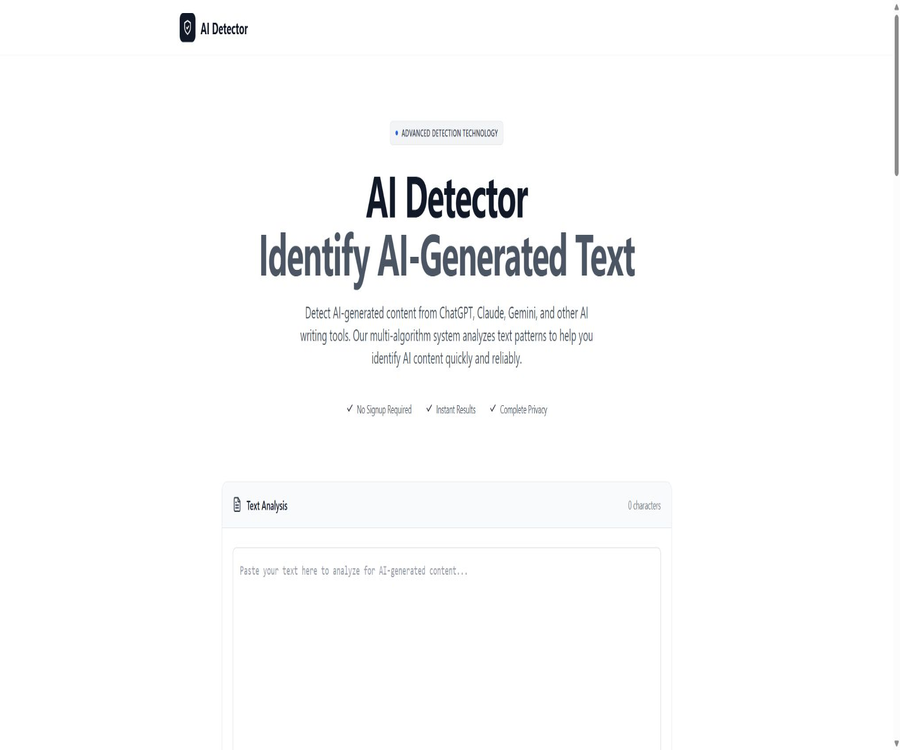
AI Detector is a free web tool for detecting AI-generated text, available at the learnprompting.pro domain. After the user pastes a piece of text, the system estimates the likelihood that it was generated by AI and lists the factors used for detection along with the sentences that have been identified as such.
No registration is required to use this website; the page in question describes the detector as a multi-algorithm system. It does not disclose any models, training data, independent accuracy reports, or information about the company behind it, so the results can only serve as supplementary indicators.
A one-sentence summary
AI Detector can determine the probability that a text was generated by AI as well as identify potential sentences of AI origin without requiring any login, but it cannot prove whether the author used AI or not.
Core functions
- Text paste detection: Submit content directly in the web form’s input field.
- AI probability score: Indicates the overall likelihood of the content having been generated by AI.
- Factors affecting the score: Indicates which linguistic or structural features influence the score.
- Sentence-level tagging: Lists the suspected AI sentences that have reached the threshold.
- Real-time word count: Displays the number of characters and words.
- No registration required: There is no need to create an account or provide payment details.
- Immediate results: They are displayed on the current page right after the request is completed.
- Privacy statement: The page claims that the user’s text is not saved after analysis.
Detection process
The page requires at least 50 words to be entered; the official FAQ recommends using more than 150 words to obtain a more reliable assessment. The system examines the language style, structural features, and various algorithmic scores, then combines them to determine an overall probability.
- Paste the entire paragraph to be checked into the text box.
- Ensure the content contains at least 50 English words.
- Click the analysis button and wait for the overall probability and the list of factors.
- View the marked sentences and their scores.
- It is judged together with other samples, manually edited records, and the writing process.
What does the result include?
| Result items | Meaning | Correct interpretation |
|---|---|---|
| Overall AI probability | The system’s comprehensive estimation of the characteristics of the entire text | It is not direct evidence of the author’s identity or of the tools used. |
| Detection factors | Language, structural, or stylistic cues that affect the score | It only indicates that the text is similar to certain patterns. |
| Sentence score | Degree of suspicion that a single sentence is AI-generated | Short sentences and common expressions may be misinterpreted. |
| List of sentences suspected to be AI-generated | Sentences whose score reaches the page threshold | Each sentence should be checked in context. |
| Word count and character count | Length of the input sample | The shorter the sample, the more unstable it is usually. |
Minimum text requirement
- The analysis button is not available when there are fewer than 50 words.
- It is recommended that pages contain more than 150 words.
- Complete paragraphs are generally more suitable for analysis than titles, lists, and fragmented sentences.
- The detector page is primarily described in English; information in other languages is not available.
- Mixed languages, codes, quotes, and template content may affect judgment.
It claims to be able to identify which models.
The page claims to be able to identify content generated by major AI writing tools such as ChatGPT, Claude, and Gemini, and it also says it can detect AI-generated sentences that have been mixed with human input or edited manually. Since no replicable experiments have been made public, these claims should not be considered as evidence of actual coverage.
Which users are it suitable for
- I hope for an editing of the content style in the preliminary review.
- It is necessary to identify the person in charge of the templated content.
- Authors who wish to compare the characteristics of different versions of a text.
- Teachers and students studying the limitations of AI text detection.
- Ordinary users who need a free option without the need for account verification.
- Teams that use the detector as one of the various audit signals.
Typical use cases
- Editing check: Identify sentences that are too uniform, repetitive, or formulaic.
- Version comparison: Compare the score changes between the original draft and the manually revised version.
- Class discussion: Demonstrate the false positives and false negatives that AI detectors may produce.
- Content quality inspection: Identifies issues through fact verification and originality checks.
- Model experiments: Compare the text generated by different models, prompts, and temperatures.
- Manual writing self-check: Verify whether formal writings have been misidentified by the detector.
Correct usage tutorial
- First, retain process evidence such as the author’s drafts, version history, and task requirements.
- Select a text that is long enough and of consistent type, without including a large number of citations or code.
- Test multiple paragraphs separately to check whether the results are stable.
- Cross-check using another detection method based on a different principle.
- Human reviewers examine the content, facts, and writing context of the marked sentences.
- The results are recorded as risk warnings; no violation is directly established nor any penalty imposed.
- When making important decisions, the author should be allowed to explain and appeal.
How to interpret high scores
A high score indicates that the characteristics of the text are more similar to the AI patterns recognized by the detector. Well-structured, concise texts with stable grammar, formal writings by non-native speakers, and highly template-based content can all achieve high scores.
- Check whether fixed templates, standard policies, or common definitions are being used.
- Check whether the author has kept drafts, materials, and revision history.
- Determine whether the marked sentence is merely a common professional expression.
- Compare past samples of the author’s natural writing.
- Do not interpret the probability figures as definite probabilities of cheating.
How to interpret low scores
A low score does not prove that the content was created entirely by humans. AI-generated text, after being rewritten, translated, having its spelling altered, or being manually restructured, can bypass detectors that rely solely on superficial linguistic features.
Why do AI detection systems make mistakes?
- Both humans and AI can use a common, fluent, and consistently structured language.
- Short texts provide insufficient statistical signals.
- Professional writing styles and standard answers are inherently highly template-based.
- The distribution varies across different models, languages, and writing fields.
- Translation, rewriting, and manual editing can change the characteristics of a text.
- Detection models will fall behind the new generation of generation models.
- Unpublished training data can lead to language and group biases.
Points to note in educational settings
Teachers should not conclude that a student has cheated based on the results of a single test. More reliable evidence includes the writing process, performance in class, citation records, draft versions, oral explanations, and an understanding of the content of the work.
- Explain in advance to students the permitted and prohibited ways of using AI.
- It is required to keep the selected topic, relevant materials, outline, and revision records.
- Use formative assessment rather than only evaluating the final product.
- Communications and reviews are arranged for high-score results.
- Avoid imposing unfair impacts on students due to linguistic background or writing style.
Notes for the content team
- Use the test results to identify paragraphs that need editing, rather than to assess employees’ integrity.
- At the same time, verify facts, citations, originality, and brand tone.
- Establish acceptable guidelines for AI assistance and disclosure rules.
- Record prompts, manual modifications, and responsibilities for final review.
- Use more reliable process evidence for customer or platform policies.
Price and entry barriers
The current page is completely free – no account is required, and there are no paid plans, restrictions on the number of uses, or pricing for bulk API calls. The structured data on this page also shows the price as $0.
| Project | Currently available public information | Precautions |
|---|---|---|
| Basic testing | Free | It can be used directly on the web page. |
| Account | It’s not necessary. | The page lacks a history section or instructions for team management. |
| Minimum length | 50 words | More than 150 is more in line with the recommendations for pages. |
| API | Not disclosed | It is not suitable for designing batch integration based on the existing data. |
| Enterprise Edition | Not disclosed | No SLAs, contracts, or information on administrator capabilities. |
Privacy Statement
The page claims that users’ text will not be stored, recorded, or shared, and will be deleted immediately after real-time analysis. The website does not provide a separate privacy policy, data processing agreement, or information regarding the entity in charge of its operation in a prominent location; therefore, sensitive content should still not be submitted.
- Do not paste confidential client information, unpublished papers, or personal sensitive data.
- Do not submit contracts, medical, financial, or identification documents.
- Before using it, a formal commitment regarding data processing and deletion should be obtained from the company.
- The browser request will still send the text to the website’s analysis function.
- Page declarations cannot replace independent security audits and contractual safeguards.
The relationship between domain names and brands
The canonical URL of the current page on learnprompting.pro points to aidetector.us.com, which indicates that both domain names refer to the same AI Detector service. This site is not the same domain as the Learn Prompting course platform at learnprompting.org; therefore, a formal relationship between them cannot be assumed just because their names are similar.
Product advantages
- No registration or payment is required; you can use it just by opening the page.
- The interface is simple, allowing one to view both the full text and results at the sentence level.
- It explicitly requires at least 50 words and recommends a longer sample.
- Provide the factors that influence the score, rather than just giving a single number.
- It is suitable for quickly demonstrating how an AI detector works and its limitations.
Usage restrictions and precautions
- The model, training data, and algorithm details are not made public.
- There are no accurately verified rates for precision, false positive rate, and false negative rate.
- The performance across different languages, fields, and author groups is not specified.
- Probability scores cannot prove that the author actually used AI.
- AI rewriting and manual editing may bypass detection.
- The page does not offer public APIs, batch uploading, or document detection.
- There are no team accounts, history records, auditing, or enterprise SLAs.
- The operating company, terms of service, and separate privacy policy are not publicly available in a significant manner.
- The domain name is likely to be confused with the Learn Prompting education platform.
- It should not be used solely for educational punishment, employment rejection, or legal decisions.
GitHub and open source
The AI Detector page does not contain a link to the official GitHub repository, nor does it make available any detection functions, model weights, training data, or licenses beyond those related to the front-end interface. The open-source course on Learn Prompting that was found cannot be considered the same project as the detector associated with this domain name.
Therefore, this testing service should be labeled as non-open source. The fact that browsers can download the front-end JavaScript does not mean that the server-side algorithms are licensed under an open source license.
Basic information
| field | Content |
|---|---|
| Tool name | AI Detector |
| Visit domain name | learnprompting.pro; the canonical address points to another domain of AI Detector. |
| Product type | AI-generated text detector |
| Key capabilities | Overall probability, detection factors, and sentence-level markers |
| Minimum input | 50 words; it is recommended to have more than 150 words per page. |
| Price | Free |
| Is registration required? | No |
| Is it open source? | No; no official GitHub repository, model, or license is provided. |
Recommendation score
3.2 / 5. This AI Detector is free, does not require registration, and provides clear results, making it suitable for quick self-checks and educational demonstrations; however, it lacks information regarding its operation, the algorithms used, verification reports, and privacy-related documents, so it cannot be relied upon for making accurate judgments regarding authorship.
Frequently Asked Questions
Is AI Detector free?
It is completely free at the moment; no registration is required, and there are no paid plans available.
How much text is required at a minimum?
At least 50 words are required; it is recommended to use over 150 words on the page to obtain more stable results.
Is it possible to detect ChatGPT?
The page claims to support models such as ChatGPT, Claude, and Gemini, but it does not provide any independently verified data.
Can a high score prove that AI was used?
No, a high score merely indicates that the characteristics of the text are similar to the AI patterns defined by the detector.
Can a low score prove that the writing is entirely done by hand?
No, AI-generated content that has been rewritten, translated, or manually edited may receive a low score.
Is the submitted text saved?
The page claims zero retention, but it does not provide any significant independent privacy documents or audit evidence.
Is it possible to upload PDF files?
The current interface only supports pasting text; it does not allow the uploading of PDF files or multiple files at once.
Is learnprompting.pro the official website for Learn Prompting?
It cannot be concluded in this way; the well-known Learn Prompting education platform uses another domain name.
Is AI Detector open source?
It is not open source; the official GitHub repository, the detection models, the training data, and the open-source license are not made public.
Tools similar to AI Detector





 Guigong Network Security Registration No. 45132202000164