






Originality.ai
A content quality platform that integrates AI-based detection, plagiarism checking, fact verification, and website scanning.
Tags:AI content detectionWhat is Originality.ai?
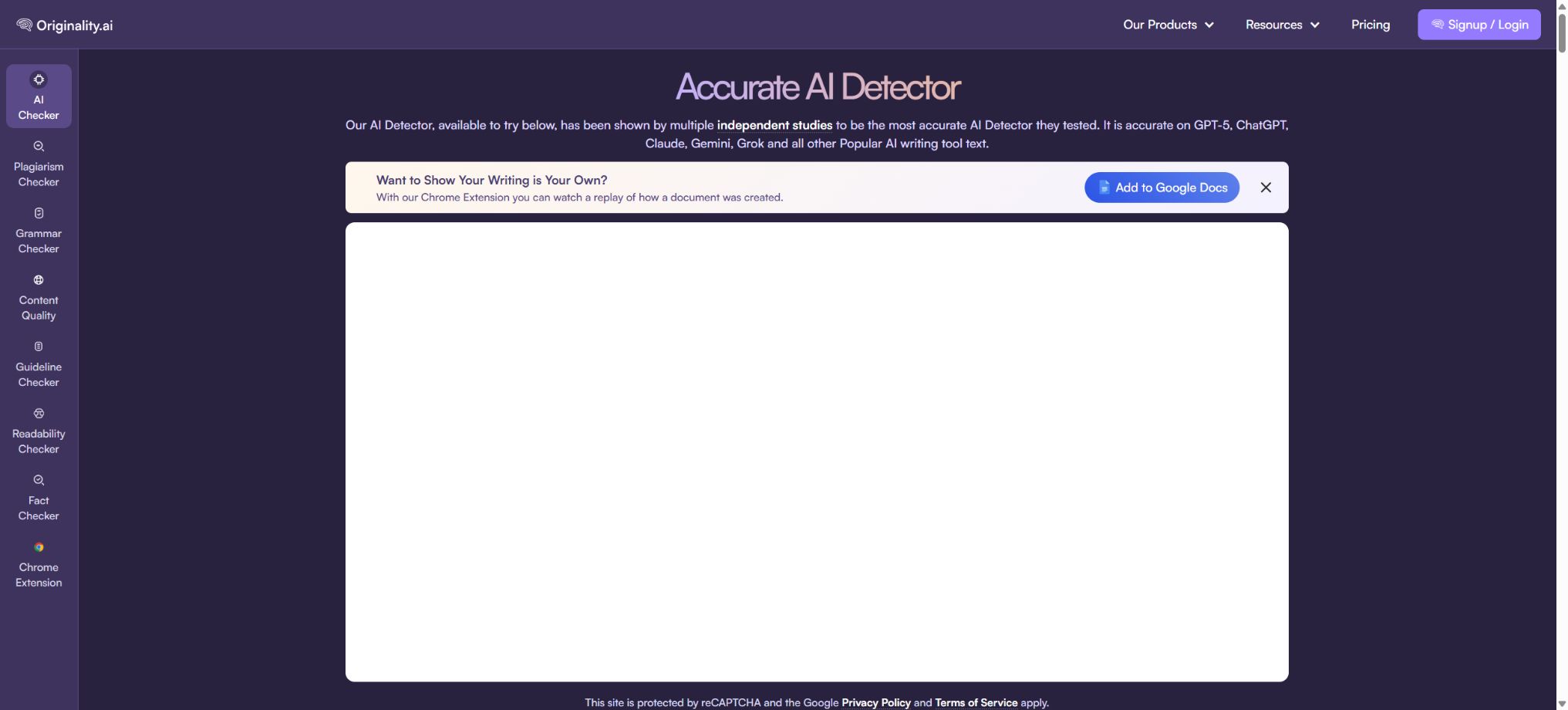
Originality.ai is a platform for verifying the authenticity of content, designed for website owners, content marketing teams, editors, publishing houses, educational users, and developers. It integrates functions such as AI-generated text detection, plagiarism checking, fact verification, readability and grammar analysis, full-site scanning, team collaboration, and API integration into a single workflow, making it useful for conducting additional reviews before publishing, accepting, or approving content created by others.
The product is operated by Originality.ai Inc.; its core detection models and cloud platform constitute proprietary commercial services. The AI scores it provides are based on probabilistic assessments of language patterns, and they do not constitute direct proof of the author’s identity or of any violations.
Core functions
1. Multi-model AI text detection
Users can paste text, upload DOC, DOCX, or PDF files, or enter a web address for scanning. The platform offers various detection models such as Lite, Turbo, Academic, and Multilingual: the Lite model focuses on minimizing false positives and allows for slight AI-driven edits.
Turbo is more sensitive and suitable for screening AI-generated text that has been altered or processed in various ways; Academic is designed for academic and STEM tasks, including code and formulas.
Multilingual is used for content that is not in English.
Different models have varying risk preferences, and the same text can yield different results when processed by different models. Short texts, formatted paragraphs, references, translations, formulaic writing, grammar correction tools, and collaborative editing can all affect the score; for formal reviews, a complete document should be used along with a fixed version of the model.
2. Paragraph highlighting and reporting
The scan results show the overall AI probability and highlight those sentences that are more likely to have been generated by AI, thereby helping reviewers identify the areas that need verification. The report can be saved, labeled, or a read-only sharing link can be created, making it easy for editors, clients, and team members to review it together.
The score indicates the model’s ability to recognize language patterns; it does not represent the exact number of words written by AI. A high score does not prove that AI was used, while a low score does not mean the text was created entirely by humans.
3. Plagiarism detection and citation export
The Plagiarism Checker compares the submitted content with materials available on the Internet, and provides information on the degree of similarity, the matching paragraphs, and possible sources. It is suitable for checking articles, marketing texts, student assignments, and outsourced work; it also allows the generation of citations in common academic formats based on the matching results.
Similar content may arise from proper citation, fixed terms, text in the public domain, or requirements set by the assignment; therefore, similarity alone cannot be considered as plagiarism. To determine whether it constitutes plagiarism or copyright infringement, it is necessary to consider the context, citation rules, permissions, and the degree of substantive similarity.
4. Fact-checking
Fact Checker is used to identify verifiable claims in text and to help determine which statements may lack evidence. It is useful for editors to create a checklist before publishing, but it cannot replace the need to examine the original sources, verify the date of publication, the author, the statistical methods used, and the context in which the information appears.
Fact-checking may still overlook implicit claims, use outdated information, or misinterpret sources. Content related to medicine, law, finance, policy, and security must be reviewed by qualified professionals.
5. Readability, grammar, and SEO support
The platform can analyze the readability, grammar, and spelling of articles, and it offers tools such as the SEO Content Optimizer for content optimization. Readability metrics help identify long sentences, complex vocabulary, and structural issues, but they do not guarantee the quality of the content or its ranking in search results.
In an attempt to meet these metrics, repeated revisions can lead to a loss of professional accuracy, as well as of the brand’s tone and natural way of expression.
6. URL and full-site scanning
Users can enter a single web address to check the content that has been published. Plans Pro and above also offer Full Site Scan, which allows for the bulk review of pages on a whole website. This feature is useful for inventorying content, conducting reviews prior to acquisitions, ensuring editing quality, and identifying duplicate pages.
Dynamic loading, login restrictions, script rendering, and crawling rules can result in pages being missing. It is necessary to check the actual scope of data retrieval for the entire site; the indication of “not detected” should not be interpreted as meaning that there are no issues with the website.
7. Chrome extensions and Writer Replay
The official Chrome extension allows for scanning web pages, selecting text, and working with Google Docs files in both Chrome and Edge. Writer Replay utilizes Google Docs’ revision history to create a character-by-character replay of the writing process, showing information such as pastes, modifications, contributors, typing rhythm, and automatic typing signals.
The writing replay provides contextual information about the process behind an AI’s score, but it is not a final judgment. The replay will be incomplete if the document is imported from Word, pasted in after being created in another tool, entered via voice input, or lacks a complete history of its versions.
The Human Typing Score is also merely a supplementary indicator.
8. Team management
For Pro and Enterprise plans, it is possible to purchase team memberships, assign user roles, set a monthly credit limit for each member, and share tags and reports. Additional Pro memberships cost $9.95 per month, or $103.44 per membership on an annual basis;
The additional seat for Enterprise costs $24.95 per month, or $228.44 per seat when paid annually.
The seat is renewed on the same day as the main subscription; if it is removed midway, the fee for that period is generally not refunded.
9. Integration of APIs with education
Enterprise offers APIs that enable the integration of AI-based detection and plagiarism checking into CMS platforms, submission systems, educational platforms, or batch review processes. The company also provides integrations for educational tools such as Moodle.
API requests consume Credits, and are subject to restrictions regarding character count, rate, permissions, and plan options.
Automation systems should not reject submissions, suspend users, punish students, or make hiring decisions based solely on a score. For production use, it is necessary to retain records of the model version, input ranges, manual reviews, appeals, and audits.
How to choose a detection model?
- Lite:It places more emphasis on reducing false positives, making it suitable for publishing and educational contexts where tools such as Grammarly are allowed to make minor edits.
- Turbo:It is more sensitive to AI and rewritten content, making it suitable for content moderation where an improved recall rate is needed;
- Academic:It is used for academic writing and STEM assignments, and can handle elements such as code and formulas;
- Multilingual:It is used for multilingual texts; the official statement is that it supports 30 languages.
The accuracy rates of 98%, 99% or higher stated on the official website are based on specific official test sets, models, languages, and thresholds. The actual results vary depending on the length of the text, its topic, the model used, and the degree of editing; therefore, the figures advertised cannot be applied to every article.
Price and Credits
Originality.ai offers one-time Credits, as well as individual and enterprise subscriptions. The prices listed below are in US dollars as shown on the official price page as of August 2026; taxes and settlement fees may apply additionally.
| Package or version | Prices, quotas, and core benefits |
|---|---|
| Pro | $ |
| Enterprise | 179 dollars per month, or 1638.96 dollars if paid annually, which is equivalent to 136.58 dollars per month; 15,000 Credits per month, including API access, priority support, and 365 days of scanning history. |
The subscription Credits for Pro and Enterprise expire at the end of each billing period and are not carried over; separately purchased additional Credits have a validity period of 2 years. When there are both types of credits in an account, the subscription Credits for that month are used first.
Subscriptions are automatically renewed; once canceled, they usually remain valid until the end of the current period.
How are credits converted?
When only AI detection or only plagiarism detection is enabled, up to 100 words can be scanned per Credit; when both AI detection and plagiarism detection are used, 2 Credits are required for every 100 words, which means that each Credit covers up to 50 words.
If more than one billing interval is involved, the value is rounded up; for example, checking two items with 1001 words will cost 21 Credits.
Under the current official restrictions, AI detection can handle up to 10,000 words per instance, while the plagiarism detection tool for web pages allows up to 50,000 words; Chrome extensions and public APIs have a limit of 10,000 words for plagiarism scanning.
SEO content scanning costs 1 Credit per 100 words.
Functions and limitations may change; for batch tasks, it is advisable to estimate the costs first using a small sample.
Misjudgment and proper use
Originality.ai officially acknowledges that all AI detectors produce false positives. Human-written text that is short, has a highly fixed structure, has been translated, contains numerous statistical or scientific expressions, or has been processed using grammar and rewriting tools may be labeled as AI-generated.
AI-generated content that has been manually revised can also fail to be detected.
- Try to scan the entire text and ensure it is long enough; avoid drawing conclusions based on a single sentence.
- Ensure that the same model, the same text, and the same settings are used;
- Examine the references, formulas, and the author’s text separately to analyze the sources of influence;
- Compare 3 to 5 historical texts of similar length by the same author;
- View drafts, revision history, writing playback, citations, and creation notes;
- The author is allowed to explain and appeal, with a final decision made by a person.
Especially in educational settings, AI-generated scores represent probabilities rather than indications of guilt; they cannot be used as the sole evidence for determining cheating, deducting points, or imposing disciplinary action.
Data and Privacy
The official help center states that the data submitted may be used in an anonymous and secure manner for training or improving AI models, and users can choose to opt out of data collection in their account settings. The terms of service also grant the platform the right to store, process, and analyze content to the extent necessary for providing, protecting, maintaining, troubleshooting, and improving the services.
Unpublished manuscripts, student assignments, customer data, and trade secrets must have the organization’s authorization, data retention policies, sub-processors, and relevant contracts verified before being uploaded. Chrome extensions that need to access the content of web pages and Google Docs require that users be informed about this, and that the minimum necessary permissions be used.
GitHub and the open-source status
During this verification, no official GitHub open-source projects were found on the Originality.ai website that provided direct links to the complete detection models, training data, or the platform’s backend. The core AI detection tools, plagiarism detection databases, fact-checking functions, site-wide scanning capabilities, and APIs are all proprietary cloud services that cannot be hosted locally.
The detectors, bypass tools, and third-party clients with the same name available on GitHub do not represent the official implementation provided by Originality.ai; such tools should be labeled as non-open source, and a commercial API should be offered.
Originality.ai Usage Guide
Create reusable professional workflows
- Different keys and quotas are used for development, testing, and production environments;
- A representative evaluation set is created based on multi-model AI text detection, paragraph highlighting and reporting, as well as plagiarism detection and citation export.
- Set timeout, concurrency, retry, throttling, and budget limits;
- Perform checks on the output regarding facts, security, format, and sensitive information;
- Monitor changes in model version, price, latency, and failure rate;
- Prepare plans for downgrading the model, implementing circuit breaking, and taking manual control;
Which users is it suitable for?
- Reviewing external authors, freelance writers, and website owners who create marketing content;
- An editorial team that requires a combined review using AI, plagiarism detection, fact-checking, and readability assessment;
- Publishing houses and agencies that conduct content audits of a large number of existing pages;
- Teachers who use AI scores as a supplementary clue while retaining manual review;
- Companies that need team quotas, shared reports, and audit history;
- Developers who integrate content validation into CMS or submission systems via API.
Frequently Asked Questions
Is Originality.ai free?
The official website offers a limited free trial for some of its functions, but full scanning is available only through one-time credits or by subscribing, and it is not a tool with unlimited free usage.
How much is Pro?
The monthly cost is 14.95 dollars, while the annual cost is 155.40 dollars, which amounts to 12.95 dollars per month; this plan includes 2000 Credits per month.
How many Credits are needed for 1000 words?
10 Credits for checking only AI or only plagiarism; 20 Credits for checking both.
If the count exceeds 100 words, it will be rounded up.
Can AI scores prove cheating?
No. The authorities have made it clear that such tests are based on probability and can lead to false positives; therefore, it is necessary to take into account the full text, historical examples, the writing process, and human interaction.
Is Chinese supported?
The Multilingual model supports multiple languages and can handle Chinese, but the official accuracy figures are based on specific tests; therefore, the results for Chinese and short texts should be interpreted with caution.
Are APIs provided?
Available; the current column represents an Enterprise feature that allows integration with AI and plagiarism detection workflows. The quotas and usage limits are specified in the console.
Is Originality.ai open source?
It is not open source; there is no official, complete open-source repository or self-hosted version available for the core models, training data, and platform.
Tools similar to Originality.ai





 Guigong Network Security Registration No. 45132202000164