






GPTZero
AI text detection and writing process verification platform for education and content moderation
Tags:AI content detectionWhat is GPTZero?
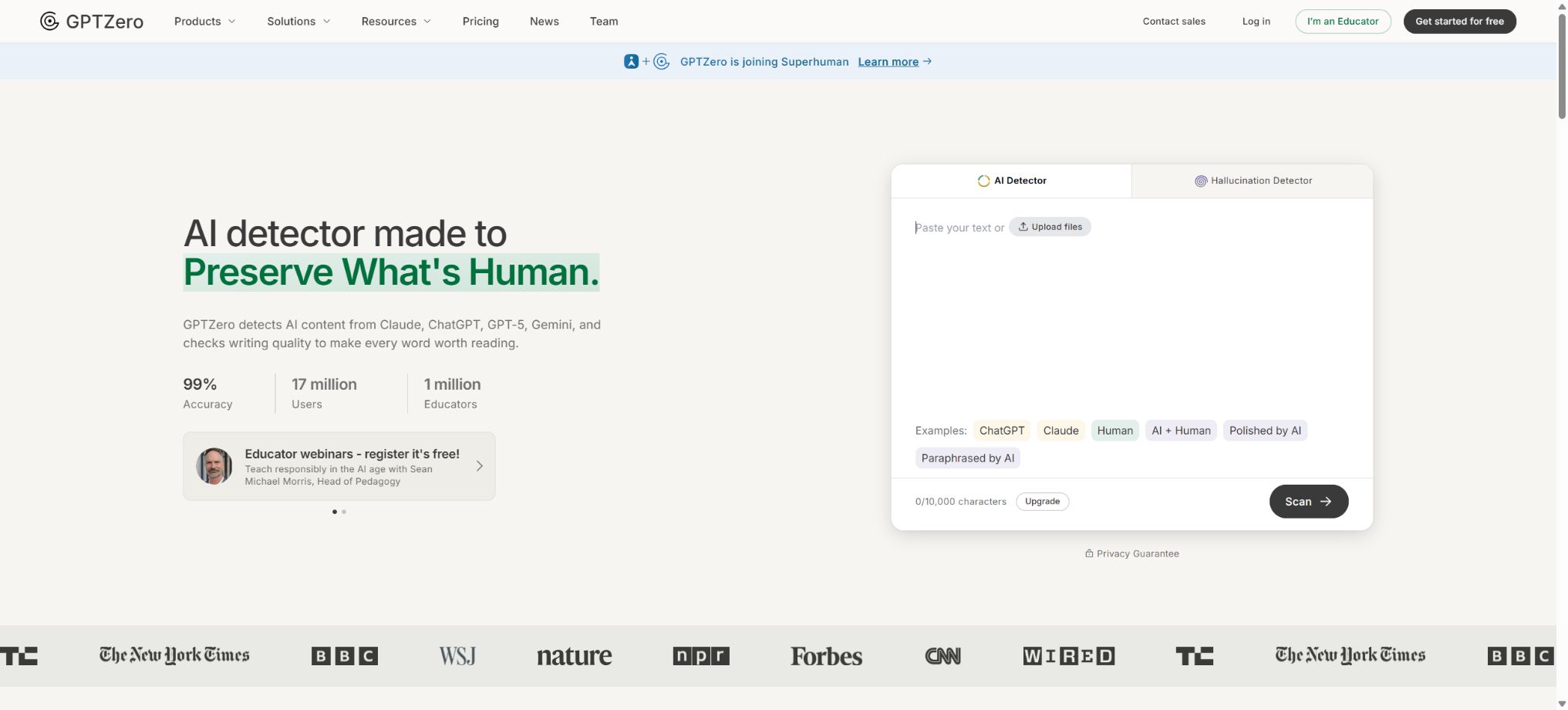
GPTZero is a platform for detecting AI-generated text and verifying the authenticity of written content. It was founded in 2023 by Edward Tian, and it serves teachers, students, editors, publishers, recruiters, and content teams. By analyzing the linguistic patterns in a text, it determines whether the entire text, individual sentences or words were more likely to be written by a human, by AI, or by a combination of both, providing color-coded highlights and explanations.
As of this verification, GPTZero has become a product under Superhuman.
In addition to AI Detector, there are also Advanced Scan, plagiarism checking, verification of citations and sources, Hallucination Detector, Writing Feedback, Authorship and Writing Replay, the Origin Chrome extension, Google Docs, Canvas, Google Classroom, Zapier, and a developer API.
How does AI detection work?
AI text detection is not about finding hidden watermarks; rather, it involves learning, based on training data, the differences between human-written text and model-generated text in terms of predictability, sentence structure variations, repetition, style, and many other characteristics. According to GPTZero, its detection model consists of seven processing components, and the training data is updated to take into account new models such as ChatGPT, GPT-5, GPT-4, Gemini, Claude, Llama, and DeepSeek.
The results usually include document-level classification, AI probabilities or percentages, sentence highlighting, and explanations. The probability does not indicate \"how much of the text was actually written by AI,\" nor is it direct evidence of the author’s identity.
Mixed writing, extensive manual editing, template-based human writing, translated text, and very short inputs all reduce reliability.
Core functions
1. Basic Scan and Advanced Scan
Users can paste text or upload documents for quick scanning. The free version allows for the direct entry of up to 10,000 characters; once a free account is created, it becomes possible to process longer texts.
Basic Scan provides an overall assessment and highlights the key paragraphs, while Advanced Scan employs more sophisticated models and explanations, making it suitable for paid users who need to review each sentence in detail.
Officials emphasize that document-level results are generally more reliable than those based on individual sentences or short passages, with English prose performing best in this regard. For formal evaluations, it is advisable to submit the complete context rather than testing by using just one sentence at a time.
2. AI sentence highlighting and mixed text
GPTZero identifies areas that resemble AI-generated text, text refined by AI, or mixed writing styles, thereby helping reviewers determine where further discussion or verification is needed. It can distinguish between different types of text such as purely AI-generated content, human-written content, AI + human collaboration output, content polished by AI, and content paraphrased by AI; however, differences in models and degrees of revision may still lead to misjudgments.
3. Plagiarism check
The Plagiarism Checker compares the text submitted with various online sources, academic papers, websites, books, and other materials, and provides information on the degree of similarity, as well as the specific paragraphs and sources that match. According to the developers, it covers more than 100 million academic and online sources; the free version allows for up to 10,000 words to be checked per month.
AI detection and plagiarism detection are two different things: humans can commit plagiarism, and AI can also generate content that does not contain exact textual overlaps. Similarity can also arise from proper citation, fixed terms, or requirements set by the assignment, so any similarity found cannot be assumed to indicate plagiarism.
4. Citation Check and Source Finder
Citation checking allows one to examine the references and the arguments presented in a text, identifying missing sources, unmentioned citations, and sources that may not support the given arguments; it also suggests materials that can support or contrast a particular claim. Source Finder searches through over 220 million academic papers, preprints, and current news articles to find relevant evidence, and it supports formats such as APA, MLA, Chicago, IEEE, and BibTeX.
The authorities make it clear that Source Finder is not a source of factual judgment; it merely indicates which online resources might support, refute, or discuss a particular claim. It is still necessary to examine the sources recommended, taking into account the author, methodology, quality, date, and actual conclusions.
5. Authorship and Writing Replay
The Origin extension allows for the recording of all edits made to a document in Google Docs, from its initial creation to completion; it generates a Writing Report as well as video replays. Teachers or authors can view information such as the pace of typing, text pastes, major edits made, collaborators involved, and the time spent writing, which serves as an additional tool beyond simply checking the final outcome of the document.
Process evidence is usually more suitable than AI probabilities for assessing authenticity, but it does not constitute absolute proof. Auxiliary technologies, voice input, pasting content that has been written offline, language barriers, and multi-person collaboration can all lead to abnormal editing patterns; it is necessary to inform the writer about the scope of data collection before using such methods.
6. Writing Feedback and AI Tutor
The platform can generate comments in Google Docs based on the rubrics provided by teachers or custom guidelines, analyzing aspects such as clarity, tone, redundancy, structure, and expression, and offering writing suggestions similar to those from an AI tutor. The feedback must be verified by teachers or editors; the platform cannot assume responsibilities for grading, fact-checking, or making academic judgments.
7. Chrome Origin extension
The Chrome extension can scan web pages, carry out checks and provide writing feedback in Google Docs, generate Writing Replays, and export or share PDF reports. It reads the content of pages and documents; when deployed in schools, it is necessary to address issues related to notification, minimal permissions, data retention, and the privacy of minors.
8. Integration of teaching platforms
GPTZero can be connected to Canvas, Google Classroom, Google Docs, and Zapier; the institutional version is designed for batch scanning, sharing team Credits, as well as unified billing and management. The detection results can serve as a starting point for communication between teachers and students, and they should be taken into account along with drafts, citations, verbal explanations, and classroom performance, rather than leading to automatic penalties.
9. API
The developer API allows for the integration of document classification, sentence-level results, and related detection functions into LMS platforms, publishing systems, recruitment sites, or content workflows. Examples are provided in 17 different programming languages, including Node.js, Python, C#, Java, and PHP.
API subscriptions and individual products are billed separately; please check the developer pricing or contact sales for details.
The document_classification value returned by the API represents the most likely classification provided by the model; it should not be used as a basis for rejecting submissions, suspending accounts, refusing employment offers, or imposing any penalties. Production systems must include mechanisms for manual review, appeal processes, logging, version tracking, and threshold verification.
Supported languages and models
GPTZero fully supports English, German, Portuguese, French, and Spanish; other languages may also be supported, but its performance is best when dealing with English prose. Chinese is not among the languages officially supported, so the results generated in this language should be regarded as estimates with low reliability, and the accuracy levels associated with English cannot be applied to Chinese text.
The detection scope covers the main common models and their related services, including ChatGPT, GPT-5, GPT-4, Gemini, Claude, Llama, DeepSeek, and Copilot, among others. New models, sampling methods, as well as translation and rewriting tools continuously change the landscape, which means that any detector needs to be updated and cannot remain ahead forever.
Price and quantity used
| Package or version | Prices, quotas, and core benefits |
|---|---|
| Professional | GPTZero offers free accounts, individual paid plans, Professional plans, team plans, enterprise plans, and API solutions. |
| Pro | On the Internet, there are various products that use similar domain names such as gptzero.app and gptzero.cc; their Pro version costing 19.9 dollars, the lifetime version priced at 299 dollars, or the option at 4.99 dollars are not the official prices from gptzero.me, and these prices should not be used interchangeably. |
| Free version | The official student page confirms that the free version allows for scanning 10,000 words per month and the use of a Chrome extension. |
GPTZero offers free accounts, as well as paid individual plans, Professional plans, team plans, enterprise plans, and API solutions. The price page on its official website features dynamic account configuration, showing that annual payment options can save 45% compared to monthly payments.
The team plan includes Professional features, shared team Credits, and a unified billing system; the specific prices for each seat need to be checked by selecting the number of people on the page or after logging in.
The official student page confirms that the free version allows for scanning 10,000 words per month as well as the use of a Chrome extension. The help documentation from July 2026 states that any additional words beyond this limit will be charged at$Charging excessive fees.
The name of the personal profile, the character count, the amount allowed for plagiarism, and the limit for Advanced Scan will be updated; the information displayed there is the one that applies at the time on the account subscription page.
On the Internet, there are various products that use similar domain names such as gptzero.app and gptzero.cc; their Pro version priced at 19.9 dollars, the lifetime version at 299 dollars, or the option at 4.99 dollars are not the official prices from gptzero.me, and these prices should not be used interchangeably. When making a purchase, it is necessary to verify the domain name as well as the entity to which the payment will be made.
How should one interpret the accuracy rate?
The official website cites its own tests, those conducted by partner laboratories, as well as RAID benchmarks, claiming to achieve a detection rate of over 95% for modern models or specific datasets, with a false positive rate for human-written text of around 1%, and it states an accuracy rate of 99%. These figures apply to specific models, languages, text lengths, thresholds, and samples; therefore, it cannot be concluded that 99% accuracy is guaranteed for every piece of text processed.
The official website also states clearly that no AI detector can achieve 100% accuracy, and the results should not be used for punishment or as a final decision; it is more difficult to assess short texts and highly edited content.
In scenarios with a low baseline rate, even if the false positive rate is low, a considerable number of genuine authors may still be incorrectly labeled.
Correct usage method
- First, scan the entire text to avoid drawing conclusions based on a single sentence.
- View highlights and explanations, rather than just the total score;
- Check drafts, version history, citations, and the writing process;
- Engage in an open communication with the author, allowing for explanations of the tools and methods of assistance;
- Determine whether there is a violation based on the course or institution’s policies, rather than automatically equating the use of AI with cheating;
- Manual review and appeal channels will be retained; they are not used for fully automated decision-making in high-risk situations.
Privacy and security
The official education page lists security, privacy, and accessibility practices such as SOC 2, FERPA, CCPA, GDPR, HECVAT, and VPAT, and explains the use of encryption, limited data retention, and access controls. The specific scope of certification, data locations, sub-processors, and retention periods must be specified in the Trust Center agreements and institutional contracts.
Student assignments may contain names, educational records, and data related to minors. Teachers should not upload sensitive materials in bulk to unauthorized personal accounts, and they should also indicate whether processes such as Writing Replay are enabled for monitoring.
GitHub and the open-source status
During this verification, no official open-source repository was found that contained links to the GPTZero website, as well as the complete detection models, training data, and the backend infrastructure of the product. GPTZero has published research on detection methods and provided examples of API code, but the core models, Advanced Scan, the plagiarism database, and the platform itself are proprietary cloud services.
Projects on GitHub such as “GPTZero alternative”, “bypass GPTZero”, or those with similar names are all third-party tools; they cannot be used to assess the implementation or security of the official models. Such projects should be labeled as non-open source and as offering commercial APIs.
GPTZero Usage Guide
Create reusable professional workflows
- Create a brand term list, prohibited expressions, and approved sample texts;
- Organize Basic Scan and Advanced Scan, AI sentence highlighting and mixed text processing, as well as plagiarism detection into a fixed workflow;
- Designate responsible persons for research, the first draft, editing, and fact-checking respectively;
- Randomly check whether the model fabricates numbers, sources, or examples;
- Compare readability, conversion rates, search performance, and rework time;
- The templates and rules are continuously updated based on actual outcomes;
Which users is it suitable for?
- Teachers and schools that use AI detection as a means of communication in the classroom;
- Students and authors who wish to demonstrate the actual writing process using Writing Replay;
- A publishing and content team that checks for AI use, plagiarism, and the quality of citations;
- Educational institutions that require batch scanning and integration with LMS;
- Organizations that provide supplementary review in recruitment, media, and legal processes;
- Developers can integrate the detection functionality into existing platforms through APIs.
Restrictions and Precautions
- False positives and false negatives cannot be eliminated, especially in the case of short texts, non-English content, template-based writing, translations, AI-driven editing, and new models.
- Chinese students, English language learners, and users of assistive technologies may exhibit different writing characteristics, so discriminatory thresholds should be avoided.
- A high AI probability does not prove that the rules have been violated, and a low AI probability does not prove that no AI was used.
- Detectors can be altered, manually edited, or influenced by mixed writing, and therefore cannot serve as the sole evidence in legal matters, employment decisions, academic admissions, or disciplinary actions.
Frequently Asked Questions
Is GPTZero free?
There is a free account; the student page indicates that 10,000 words can be scanned per month and that a Chrome extension is available. Advanced scanning functions, detection of plagiarism, team features, and higher quotas require payment.
Which models can GPTZero detect?
It supports major models such as ChatGPT, GPT-5, GPT-4, Claude, Gemini, Llama, DeepSeek, Copilot, as well as related services.
Does it support Chinese language detection?
Chinese is not an officially fully supported language. The languages that are fully supported are English, German, Portuguese, French, and Spanish, with English offering the best performance.
Can the test results be used to determine cheating?
No. The authorities explicitly recommend using the results as a starting point for conversations, combining them with writing reviews, drafts, citations, and human interaction; they should not be used for automatic penalties or final decisions.
Are APIs provided?
Independent developers are provided with APIs and code examples in multiple languages; the pricing is separate from that of individual subscriptions. Please visit the API page or contact sales for more details.
Is GPTZero open source?
It is not open source. Research papers and API examples do not equate to the core detection models, training data, or the backend of the product being made available under an open source license.
Tools similar to GPTZero





 Guigong Network Security Registration No. 45132202000164