






Yizhen AI+
Since its establishment, YiZhen AI+ has been dedicated to the independent research and development as well as the application of core technologies underlying medical big data in various fields such as medical imaging, ultrasound, endoscopy, nuclear medicine, and pathology. It focuses on medical technology services, the use of medical big data, collaboration, research, operations, patient experience, and artificial intelligence...
Tags:AI improves efficiencyWhat is YiZhen AI+?
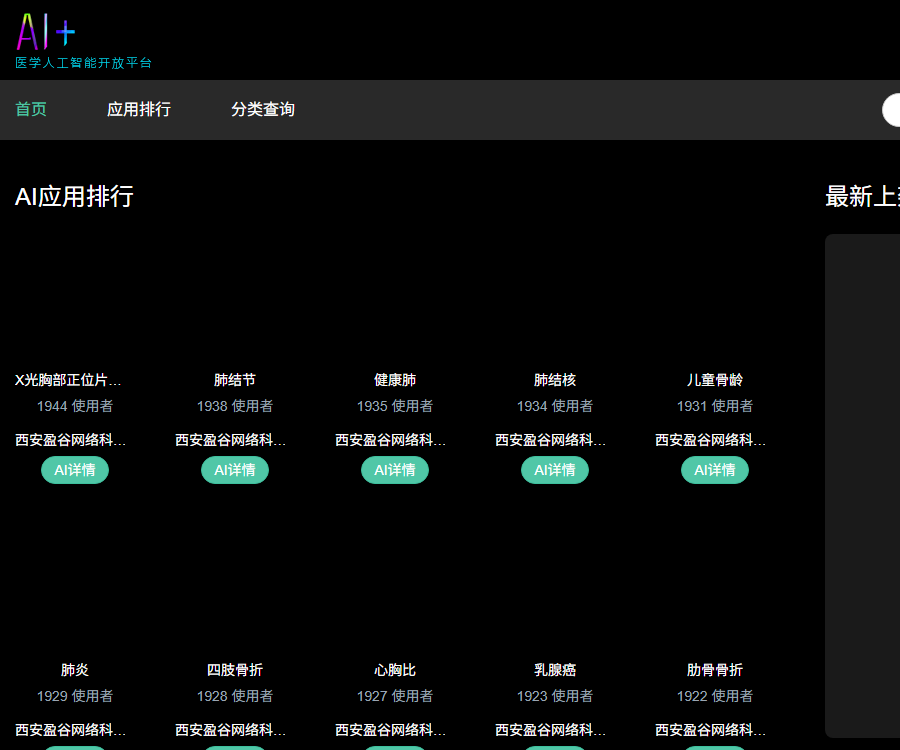
Yizhen AI+ is an open platform for medical artificial intelligence within the Yizhen cloud ecosystem; it is operated by Xi’an Yinggu Network Technology Co., Ltd. This platform uses AI Store to link medical institutions, doctors, and providers of medical AI services, integrating algorithmic solutions into processes related to image examination, analysis, reporting, and collaboration.
This is not a chat tool designed for ordinary users to enter their symptoms and receive a diagnosis. The public entry point of this platform offers functions such as browsing applications, logging in, and registering as a user; however, actual use requires institutional verification, affiliation with a doctor, proper configuration, as well as appropriate medical privileges.
Current operating status
- The entry point to the medical artificial intelligence open platform is still accessible; it offers application rankings, categorized searches, a search function, login options, and the possibility to join the platform immediately.
- Yizhenyun continues to release updates on its products, and it integrates AI Store with specialized alliances in medical imaging, as well as with various cloud-based medical services and mobile workflows.
- The public application cards include both products developed by Yinggu itself and those from third-party manufacturers; however, the operation of this platform does not mean that every application can be activated directly by any account.
- The “free premium” option mentioned in the old records cannot be used as a basis for current billing; the public pages do not provide information regarding a unified free version, membership plans, or pay-as-you-go packages.
AI Store app market
Currently available application categories
| Application areas | Current public examples | Possible business processes involved | It must be checked before use. |
|---|---|---|---|
| Image quality control | Quality control of chest X-ray anteroposterior views | Assist in evaluating image quality | Equipment, position, quality control rules, and version |
| Chest imaging | Lung nodules, healthy lungs, pulmonary tuberculosis, pneumonia | Image analysis and suggestions | Indications, sensitivity, specificity, and registration qualifications |
| Bone imaging | Childhood bone age, fractures of the limbs, rib fractures | Bone age or additional analytical methods for detecting abnormalities | Age range, type of examination, and contraindications |
| Quantitative analysis | Heart capacity ratio | Image measurement and structured results | Measurement methods, image quality, and thresholds |
| Mammary gland imaging | Breast cancer | Assisted identification of lesions or risk indication | Image modalities, suitable patient populations, and medical device approvals |
| Third-party apps | Shukun MR analysis, as well as the applications of Shukun and Keyado in various medical conditions | Analysis of multiple diseases or specific topics | Manufacturer contracts, current listing status, and available institutions |
The application name and the number of “users” only indicate the information displayed on the public page; they do not reflect the diagnostic performance, the registration status of the medical device, or its current availability for purchase. Each algorithm should be verified separately in the application details, registration documents, contracts, and hospital validation materials.
In-house and third-party AI management
- The platform enables unified management of both in-house and third-party AI solutions, and it matches the appropriate applications to the relevant business processes based on the type of inspection, thereby reducing the need for doctors to switch between multiple separate systems.
- AI service providers can release applications through the onboarding process, and medical institutions can then order them, configure them, and grant doctors access to use them based on specific needs.
- Specialty alliances can also integrate their own algorithms into AI Store, but the aspects related to data, models, deployment, validation, and responsibility allocation need to be agreed upon separately by the participating parties.
- The automated calculations performed in the cloud yield auxiliary results; ultimate diagnosis, report review, and clinical decision-making are still carried out by qualified professionals.
Medical imaging and overall medical technology workflows
- Yizhenyun covers various processes such as appointment registration, queue numbering, sample collection, imaging diagnosis, report review, clinical result dissemination, and remote consultations.
- The platform is designed for medical imaging applications such as radiology, ultrasound, endoscopy, nuclear medicine, interventional procedures, pathology, and electrocardiography; the specific modules available depend on what the institution decides to purchase and configure.
- Image processing capabilities include the retrieval of DICOM data, as well as advanced processing in the cloud for 2D, 3D, CTA, and fMRI images; AI-generated results can be integrated with the original images and reports.
- Multi-institutional collaboration enables remote diagnosis, joint review of images, audio and video communication, as well as asynchronous consultations; it is suitable for medical networks, regional platforms, and imaging specialty alliances.
- Management functions such as quality control, statistics, management of critical values, and handling of significant positive test results are used for the governance of an institution’s operations; they are not self-diagnosis services provided directly to patients.
Large models and “small but capable” applications
In 2025, Yi Zhenyun released the pilot application “Xiao Zhen”, which is based on the DeepSeek technology platform. Five types of capabilities were listed in the official description, but whether these capabilities are made available to a particular organization depends on the version, deployment method, and permissions in place.
| Ability | Main inputs | Auxiliary output | Primary users | Risk control |
|---|---|---|---|---|
| Real-time error correction in reporting | The report text written by the doctor | Error or inconsistency messages | Reporting doctor and reviewing doctor | To be confirmed and modified by a doctor. |
| Yizhen Intelligent Assistant | Business issues or work instructions | Auxiliary answers or operation suggestions | Medical technical staff | Restrict permissions and log actions. |
| Speech generation report | Doctor’s voice | Draft report text | Reporting doctor | Verify terms, values, and patient identity. |
| Patient AI consultation | Questions raised by the patient | General explanations and guidance | Patient service scenarios | It cannot replace emergency care or medical treatment by a doctor. |
| Interpretation of medical test reports | Check the content of the report | Auxiliary explanations for patients | Patients and staff | Combine clinical information and advise seeking medical attention. |
Large models may generate errors, overlook certain constraints, or apply general knowledge to individual patients inappropriately. Organizations should implement mechanisms for defining the scope of knowledge, conducting manual reviews, managing permissions, keeping logs, protecting sensitive information, and handling abnormal situations.
Development of medical AI and deployment of models
Yizhenyun released WattML 2.0 aimed at medical AI developers, researchers, and universities; its capabilities include data preprocessing, image classification, detection, segmentation, automatic training parameter tuning, and model deployment. This information relates to a product release from 2019, and it does not necessarily mean that the same process can still be used to activate the service today.
- The service provider or research team first determines the purpose of the algorithm, the image modalities it can be applied to, the target population, and the regulatory aspects involved.
- Prepare training, validation, and testing data that comes with proper authorization and anonymization measures, while documenting the quality and representativeness of such data.
- Submit the relevant documents regarding the entity, products, qualifications, and technologies through the platform or via business channels, and wait for approval.
- Interface, computing resources, input/output handling, exception handling, and logging integration are carried out in an isolated environment.
- Local validation is carried out by medical institutions to assess performance, the impact on workflows, manual review processes, and failover solutions.
- Complete the procurement, authorization, and deployment configurations as per the contract, and then gradually make them available to the departments and doctors.
- After going live, continuous monitoring is carried out for versions, data drift, error cases, response time, and medical safety incidents.
How institutions and doctors can become part of the system
| Characters | Main steps | Audit relationship | Conditions for starting use |
|---|---|---|---|
| Medical institutions | Register an account, submit verification documents, configure features | Information for platform review agencies | Authentication has been successful and the procurement configuration is complete. |
| Doctor | Register an account and select a hospital to be affiliated with. | Verify doctor information at the affiliated hospital | Approval has been granted and business permissions have been assigned. |
| AI service providers | Submitting entity, algorithms, and product materials | Review by the platform and purchasing organization | Complete technical integration, verification, and contract signing |
The public process does not list all the required documents, the duration of the review process, or the rules for dealing with failures. Hospitals, doctors, and manufacturers should consult the platform in advance to determine the latest list of required materials, their responsibilities regarding the data, and the associated costs.
Supported platforms and clients
| Platform or component | Current public use | Suitable for users | Precautions |
|---|---|---|---|
| Web platform | Institution and doctor services, AI Store browsing and logging in | Hospitals, doctors, and service providers | The functions depend on the account permissions. |
| iPhone and Android | View patient information, images, and department updates | Authorized medical personnel | Mobile diagnosis must comply with institutional regulations. |
| iPad and Android tablets | Diagnosis, review, querying, and dynamic monitoring | Radiologists and medical imaging specialists | The store version may have different features. |
| iMAGES | Image preview and retrieval | Professional desktop users | The recommended version must be installed. |
| Research version and editor | Scientific labeling or image editing | Researchers and professionals | Project permissions and data compliance will be confirmed separately. |
| Collection plugins and device drivers | Connection of ultrasound, endoscopy, high-resolution scanners, barcodes, etc. | Medical institution workstations | Check the system version and the specified hardware. |
Yizhenyun HD available in the app store is currently designed for iPad and supports Simplified Chinese. The store may allow it to run on certain Macs equipped with Apple chips, but this is not equivalent to a native macOS client that has been developed specifically for those devices.
Prices, Purchases, and Refunds
| Package or version | Price | Billing cycle | Core benefits or quota | Suitable for users |
|---|---|---|---|---|
| AI Store app | Contact sales | Confirm by application or contract | Algorithm licensing, computing resources, and business access options have not yet been made publicly available in a unified manner. | Organizations that purchase medical AI |
| Yizhenyun Institutional Platform | Custom quote | According to the project contract | Modules, organizational scale, as well as storage and service scope can be configured as needed. | Hospitals, medical networks, and regional platforms |
| AI service providers are joining. | Not yet made public | In accordance with the cooperation agreement | Application release, technical integration, and operational rules are pending confirmation. | Medical AI manufacturers |
| Interface or privatization | Custom quote | According to the project contract | Deployment, interfaces, operation and maintenance, as well as service levels, will be agreed upon separately. | Organizations with integration and compliance requirements |
Currently, no unified and publicly available information is available regarding free quotas, subscription prices, per-use fees, trial periods, or refund policies. The budget should include separate items for software licenses, AI applications, image storage, computing resources, interfaces, implementation services, training, maintenance, and hardware adaptation in the procurement list.
Medical projects should not be decided solely on the price per page; the contract must also specify the acceptance criteria, service levels, version upgrades, response times in case of failures, data migration procedures, mechanisms for exiting the agreement, as well as rules regarding refunds or handling of breaches.
API, SDK, and open-source status
- The historical documentation of AI Store covers open interfaces and vendor integration, but currently no API documentation available to the public, no information on call costs, and no page for applying for developer keys can be found.
- The iMAGES, collection plugins, and device drivers that are available for public download are components of the business client; they are not SDKs intended for use by third-party developers.
- Currently, no official source code repository that demonstrates the open-source nature of YiZhen AI+, YiZhen Cloud, AI Store, or their models as a whole exists; therefore, they should be considered proprietary platforms.
- The availability of third-party AI models on the market does not mean that their model weights, training code, or datasets are open source; licenses and commercial usage rights must be checked for each individual product.
- When HIS, EMR, PACS, as well as device or algorithm interfaces are required, the current specifications, testing environments, and security requirements must be obtained through project coordination.
Privacy, Data, and Security
- The certification of institutions and doctors may involve handling names, identification documents, professional qualifications, contact information, and work-related details; medical practices also involve health information, images, reports, and treatment records.
- Device identifiers, network logs, transaction or account information can be used for logging in, delivering notifications, assessing risks, conducting audits, and preventing security incidents.
- The privacy policy distinguishes between personal information and the user’s business data; the user owns their business data, which is processed by the platform in accordance with the user’s instructions and agreements.
- Business data is stored in a data center selected in consultation with the user; the specific location, backup procedures, retention period, deletion policies, and disaster recovery measures must be specified in the project contract.
- The public security guidelines include encryption, access control, data masking, electronic signatures, operation logging, indigenous technology development, and level-based protection; however, the applicable scope of specific certificates must be determined based on the specific project under consideration.
- Medical institutions still need to fulfill their own responsibilities, including providing informed consent, applying the principle of minimum privilege, conducting access audits, ensuring data quality, providing staff training, and responding to incidents.
Boundaries for medical use
- AI applications can only serve as auxiliary tools for doctors and medical institutions; they cannot replace licensed professionals in making diagnoses, conducting evaluations, or deciding on treatments.
- Patients must not stop taking medications, change their medication regimen, or delay seeking medical care based on AI suggestions; in cases of emergencies or dangerous symptoms, it is necessary to contact professional medical services immediately.
- The performance of the algorithm may vary across different devices, regions, user groups, and inspection qualities; therefore, local testing and continuous monitoring are required before it is put into use.
- The name of the application card cannot replace the medical device registration certificate; it is necessary to verify the registrant, model version, scope of use, contraindications, and expiration date.
- Errors can occur in voice reports, error corrections, and the interpretation of those reports; it is therefore necessary to retain the original images, the original reports, and records of any manual verification.
Suitable for users and typical use cases
- Medical institutions: Integrate multiple medical AI applications into the existing workflows for image examination and reporting, and standardize permission settings and computing resources.
- Medical consortia and regional platforms: enable routine tests at the local level to benefit from the expertise of senior specialists, as well as from cloud-based processing and remote collaborative support.
- Radiologists and medical imaging specialists: they can access images within their authorized scope, carry out supplementary analyses, prepare review reports, and participate in consultations.
- Medical AI service providers: They submit their algorithm applications; once the technical integration with the platform is completed, these applications are made available for purchase and use by various institutions.
- Research team: Labeling, analysis, and model validation are carried out on the basis of compliant data and ethical approvals; the research findings cannot be used directly as clinical tools.
Advantages and limitations
Main advantages
- By integrating AI applications with cloud-based medical technology processes, a continuous business workflow can be established, covering everything from test matching and calculations to the generation of reports and consultations.
- By managing both in-house and third-party applications simultaneously, medical institutions do not need to create a separate entry point for each algorithm.
- Web pages, mobile devices, video components, and data collection plugins cover a wide range of clinical terminal and device scenarios.
Current restrictions
- Limited details are available regarding the applications; without logging in, it is not possible to determine the performance of each algorithm, its regulatory compliance status, input constraints, or its procurement status.
- The unified pricing, trial periods, usage rules, and refund policies have not been made public yet; procurement evaluations must go through the business and contract processes.
- There are no API and SDK documentation available for the general public, so the cost of third-party integration cannot be estimated merely based on the public pages.
- The platform handles highly sensitive medical data, and its requirements regarding deployment, permissions, and compliance are significantly higher than those of ordinary office AI tools.
Frequently Asked Questions
Can Yizhen AI+ provide medical consultations for ordinary users directly?
It should not be used in this way. It is primarily an AI application platform designed for use within medical institutions and doctors’ workflows; the AI-generated results cannot replace a doctor’s diagnosis, prescriptions, or decisions in emergency situations.
What are the current AI applications?
The public catalog lists applications such as chest X-ray quality control, detection of pulmonary nodules, tuberculosis, pneumonia, assessment of bone age, identification of fractures, calculation of the cardiothoracic ratio, and breast imaging; it also shows third-party products for various diseases. Actual usability can only be determined after logging in and with confirmation by the relevant institution.
How can organizations start using it?
Organizations need to register, submit certification documents, wait for approval, and carry out personalized configurations. AI applications require procurement, verification, authorization, and integration into existing workflows.
Can individuals register as doctors?
Doctors can register and choose a hospital to be affiliated with, and it is the hospital that reviews their information. Even after approval, they can only use the functions and data permissions granted by their respective institution.
What is the public price of the platform?
At present, there are no publicly available unified prices, free usage quotas, or subscription plans. For institutional platforms, AI applications, APIs, and deployment services, custom quotes must be obtained by contacting sales.
Are APIs or SDKs provided?
The historical product documentation mentions open interfaces, but no public development documents, SDKs, or self-service key pages are available at present. Actual integration requires coordination with the supplier through the relevant project.
Is YiZhen AI+ an open-source project?
Currently, there is no evidence indicating that the platform or the models as a whole are open source. The availability of third-party applications and the possibility to download client plugins does not mean that the code or the model weights are made available.
How to protect medical data?
The platform’s public specifications include encryption, access control, data masking, electronic signing, and log auditing. The specific rules regarding data centers, data retention, backups, and deletion must still be outlined in the organizational contract and subject to ongoing audit.
Summary
Yizhen AI+ should be understood as a platform for the application and integration of medical AI within Yizhen Cloud’s comprehensive medical technology ecosystem, rather than a tool for individual diagnosis. When evaluating such systems, medical institutions need to check the qualifications and performance of the algorithms involved, carry out local testing, ensure data compliance, conduct access audits, and negotiate contracts before integrating AI into their clinical workflows.
Tools similar to YiZhen AI+.


 Guigong Network Security Registration No. 45132202000164