






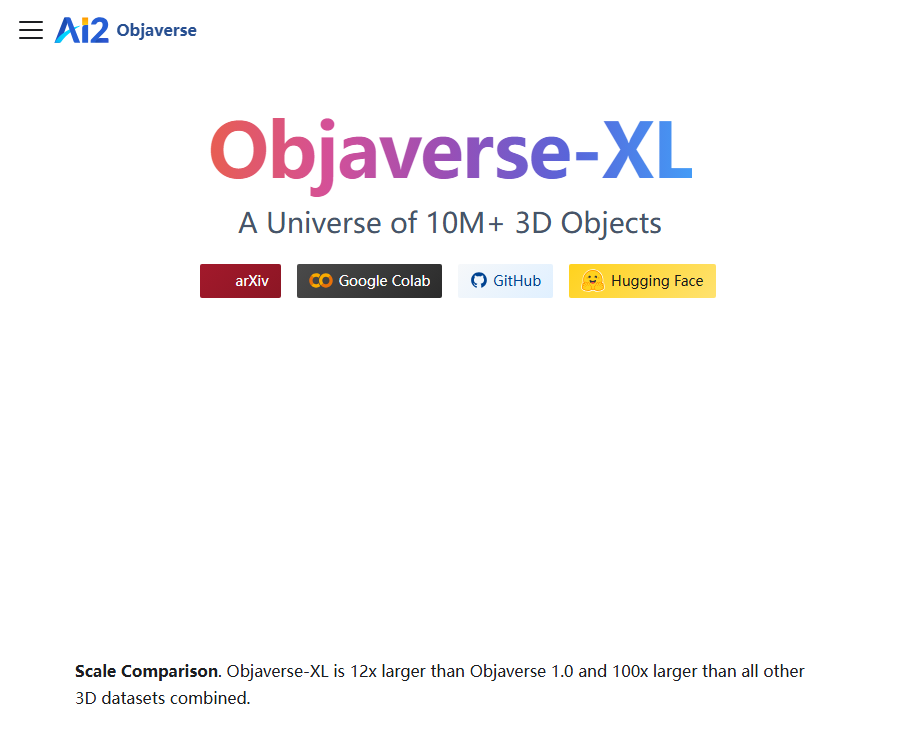
Objaverse-3D object dataset
Objaverse is a database that offers a vast array of resources for the 3D field; it not only supports the training of AI models and the creation of 3D content, but it is also compatible with the popular 3D editing software Blender.
Tags:AI improves efficiencyWhat is Objaverse?
Objaverse is a large-scale 3D object dataset designed to support research in 3D computer vision, generative AI, and embodied intelligence.
The project was created by the PRIOR team at the Allen Institute for Artificial Intelligence along with researchers from the University of Washington, and a Python download tool is provided.
It does not generate 3D models on behalf of the user; instead, it provides materials for model training, evaluation, rendering, and data analysis.
Comparison of dataset versions
| Version | Scale | Main features | Recommended uses |
|---|---|---|---|
| Objaverse 1.0 | 798,759 objects, which can generally be considered as over 800,000. | Includes annotations such as name, description, tags, license, and geometry. | Research that requires stable identifiers and extensive annotations |
| Objaverse-XL | Over 10 million 3D objects | It has a larger source of data and a bigger scale, making it suitable for large-scale training. | 3D basic models, expansion rules, and web scale experiments |
| Polycam subset | Provided within the approved scope. | Available for academic researchers; non-commercial use only. | Eligible non-commercial academic programs |
The Objaverse 1.0 interface is currently used primarily for backward compatibility and to read additional annotations; new projects should give priority to considering the XL interface.
Data content and characteristics
Multi-source 3D objects
Objaverse-XL combines manually created models, photogrammetric scans of everyday objects and landmarks, as well as specialized scans of historical artifacts.
Diversity facilitates model generalization, which also means that file structure, quality, proportions, and licensing are not entirely uniform.
Rich variety of object forms
Objaverse 1.0 includes static models, animated objects, bound characters, detachable components, indoor and outdoor environments, as well as various visual styles.
According to official information, there are over 44,000 animated objects, but their actual usability still needs to be checked one by one.
Object annotation
1.0 Comments can include name, description, tags, category, license, number of animations, number of vertices, number of faces, and texture information.
Researchers can filter samples using annotations, thereby reducing storage and network waste that would result from downloading all files first and then removing those that are not needed.
Unique identifier and local cache
Objaverse 1.0 assigns a unique identifier to each object; the download function returns the correspondence between these identifiers and the local GLB files.
The downloaded objects are stored in the local cache, so they generally do not need to be transmitted again when requests are made subsequently.
Objaverse-XL multi-source interface
The XL interface allows for the reading of annotations, aligning them, and downloading them based on selected objects; it is suitable for creating subsets from large collections.
The original source may delete or modify objects; the code provides a callback mechanism to help keep track of files that are found, changed, missing, or newly added.
Batch rendering in Blender
The official repository includes Blender scripts that allow importing various common 3D formats and rendering images from multiple perspectives.
The script can also save the camera matrix and object metadata, making it suitable for creating new perspective synthesis and visual training samples.
Research on 3D basic models
The research team trained Zero123-XL using Objaverse-XL, and examined the scale effect by analyzing over 100 million multi-view renderings.
The paper demonstrates generalization to new perspectives of inputs such as sketches, cartoons, and characters, but the dataset itself is not the inference model.
Objaverse Download and Usage Guide
- Clarify the research objectives and the permissible licenses for subjects.
- Estimate sample size, network traffic, disk, and rendering costs
- Create a list to keep track of object identifiers, sources, and licenses.
- Prepare the Python environment and install the official objaverse package.
- Choose the Objaverse 1.0 or Objaverse-XL interface.
- First, read the object annotations rather than downloading the entire set directly.
- Filter by source, license, label, or geometric properties
- Use a fixed random seed to select a small number of representative samples.
- Call the download interface to save it in a separate data directory.
- Logs the status of objects that have been found, modified, are missing, or have been added.
- Check whether the file can be parsed and whether the textures are complete.
- Perform scanning and screening of malicious files, abnormal content, and individuals.
- Use Blender scripts to generate test views.
- Check the consistency of scale, coordinates, camera, and lighting.
- Complete duplicate removal and division of the training set and validation set.
- Save the license and ownership information for each object.
- First run small-scale training, then increase the amount of data.
- When publishing the results, cite the datasets and follow the requirements for citing papers.
Prices and packages
Objaverse does not charge a fee for dataset subscriptions, but it is not cost-free; in particular, it is not suitable for downloading all XL objects indiscriminately.
| Project | Official fees | Possible costs involved | Key points of licensing |
|---|---|---|---|
| Objaverse 1.0 | Get it for free | Network, disk, cleaning, and rendering computing power | Verify the overall license and object-specific licenses separately. |
| Objaverse-XL | Get it for free | Large-scale storage, bandwidth, rendering, and training computing power | Overall ODC-By 1.0; object permissions vary. |
| Polycam data | Provided after application | Approval, data management, and research computing | Only for approved non-commercial academic research. |
| Official Python code | Free | Environmental maintenance and secondary development | Apache-2.0 |
| Cloud-based training or rendering | Charged by the cloud service provider | GPU, CPU, storage, and outbound traffic | Comply with both cloud platform and object licensing requirements. |
The actual budget is usually determined by the number of selected objects, the average file size, the number of rendering views, and the number of training iterations.
Licenses must be understood at different levels.
| Hierarchy | Licenses or rules | What does it mean? |
|---|---|---|
| The entire Objaverse-XL dataset | ODC-By 1.0 | When using the entire database, it is necessary to comply with terms such as attribution. |
| Single 3D object | Determined by the respective original sources. | May allow commercial use, require attribution, restrict adaptation, or prohibit commercial use |
| Polycam subset | For non-commercial academic use after approval | It cannot be used in commercial products just because it is part of the XL ecosystem. |
| Download and process code | Apache-2.0 | The code can be used and modified in accordance with its terms. |
| Content and citations of the paper | In accordance with paper and publication rules | Research findings should cite the Objaverse or Objaverse-XL papers correctly. |
Open-source code, open databases, and the ability to use materials commercially are three distinct issues; none of them can replace the other two.
For commercial projects, an object-level permission allowlist should be established before starting the training process; authorization checks cannot be carried out after the model has been released.
Data quality and security risks
Web page scale data inevitably contains corrupted, duplicate, missing textures, abnormal geometry, incorrect labels, and inappropriate content.
- Parsing complex 3D files of unknown origin in an isolated environment
- Check the compressed packages, scripts, and external texture references.
- Filter out character scans, personal information, and sensitive content.
- Detecting extreme vertex counts and extremely large textures
- Remove duplicates for hashes, near-duplicates, and semantic duplicates separately.
- Retain the processing logs for objects that have been removed or whose sources are no longer valid.
The official documentation states that some of the suspected scan targets were removed and rechecked, and users still need to establish their own content governance processes.
Supported platforms
- Web version or official online portal
The client, region, language, and entry point may change with different versions; it is necessary to refer to the current product page before installation or payment.
APIs, SDKs, and open-source status
The official interface is based on Python; it allows for filtering annotations using data frames, followed by downloading the selected items via multiple processes.
Batch rendering relies on Blender as well as sufficient CPU, GPU, and memory; for large-scale tasks, it is also necessary to manage retries in case of failures and to use checkpoints.
- Create reproducible experimental configurations for data versions and filtering criteria.
- Do not store the complete data on the system drive.
- Manage the original files, cleaning results, and rendered images in separate directories.
- Create association tables for object identifiers, licenses, and sources.
- Statistical analysis of categories, sources, and license distributions before training
- Regularly check for changes and withdrawals in upstream objects.
Which projects are suitable?
- Research on converting images into 3D models and text into 3D models
- New Perspective Synthesis and Multi-View Representation Learning
- 3D object classification, retrieval, and segmentation
- Object perception in robots and embodied intelligent systems
- Evaluation of visual model robustness and long-tail categories
- Create domain sub-datasets that have undergone permission filtering.
Advantages and disadvantages
Main advantages
- The size of these objects is much larger than that of traditional 3D datasets.
- The sources and visual styles are diverse.
- Provides annotation, download, and rendering tools
- Supports downloading by object rather than in its entirety.
- It can be used in various areas of 3D vision research.
- Papers and official code are made public.
Deficiencies that need attention
- The quality and format of the objects are not consistent.
- The licensing terms vary greatly depending on the individual asset.
- Full download and rendering incur high costs.
- May contain inappropriate or sensitive content.
- The upstream files will be deleted or modified.
- Strong data engineering skills are required.
Basic information
| Project | Verify information |
|---|---|
| Tool name | Objaverse-3D object dataset |
| English name | No unified English name has been made public yet. |
| Development company or operating entity | The PRIOR team from the Allen Institute for Artificial Intelligence and researchers from the University of Washington |
| Tool type | Objaverse, Objaverse-XL, 3D datasets |
| Price pattern | Free and paid options are available both. |
| Chinese support | Based on the current product interface and model. |
| Registration requirements | It shall be in accordance with the current requirements for function entry points. |
| API | The public API has not been confirmed yet. |
| SDK | The official SDK has not been confirmed yet. |
| Open-source status | There are open-source components or SDKs available; the specific boundaries are detailed in the main text. |
| Main platforms | Web version or official online portal |
Recommendation score
Recommendation score: 4.3/5.
Objaverse is suitable for research teams that need large volumes of diverse 3D data; it represents a data infrastructure rather than a ready-to-use generation tool.
Its value lies in its scale, annotations, and toolchain, while the barriers to using it relate to license management, quality processing, and computational costs.
The safest approach is to start with a small sample for which the licensing is clear, verify the process, and then scale it up to the Objaverse-XL size.
Frequently Asked Questions
What is Objaverse?
Objaverse is a large-scale open dataset designed for research in 3D vision; it was created by the PRIOR team at the Allen Institute for Artificial Intelligence in collaboration with researchers from the University of Washington, and it provides model files as well as annotation information.
What is the difference between Objaverse and Objaverse-XL?
Objaverse 1.0 includes around 800,000 annotated 3D objects, while Objaverse-XL offers more than 10 million objects from a wider range of sources, along with more flexible interfaces for downloading and processing them.
Can Objaverse be used for free?
Datasets and download codes are available for free, but downloading, storing, rendering, and training incur computing costs, either locally or in the cloud; moreover, some sources require applications or impose restrictions on usage.
Can Objaverse be used in commercial projects?
It cannot be generalized. The entire dataset uses ODC-By 1.0, but each individual object retains its own licensing agreement; before using it for commercial purposes, it is necessary to filter the objects accordingly and keep proof of authorization.
How to download some models from Objaverse?
After installing the official Python packages, read the annotations, filter them by source, license, or object identifier, and then call the download function. It is recommended to first download a small number of samples to verify the format, size, and licensing terms.
Are the models in Objaverse all subject to quality review?
No. It is a dataset of web-scale data; the models may contain defects, lack textures, have abnormal geometry, include duplicate entries, or hold inappropriate content. It is necessary to examine such datasets, remove duplicates, and filter out unwanted elements before training.
Is Objaverse an open-source project?
The code for downloading and processing is licensed under the Apache-2.0 license, while the datasets as a whole are licensed under ODC-By 1.0; neither of these licenses applies to the original license of each individual 3D object.
Tools similar to the Objaverse-3D object dataset


 Guigong Network Security Registration No. 45132202000164