






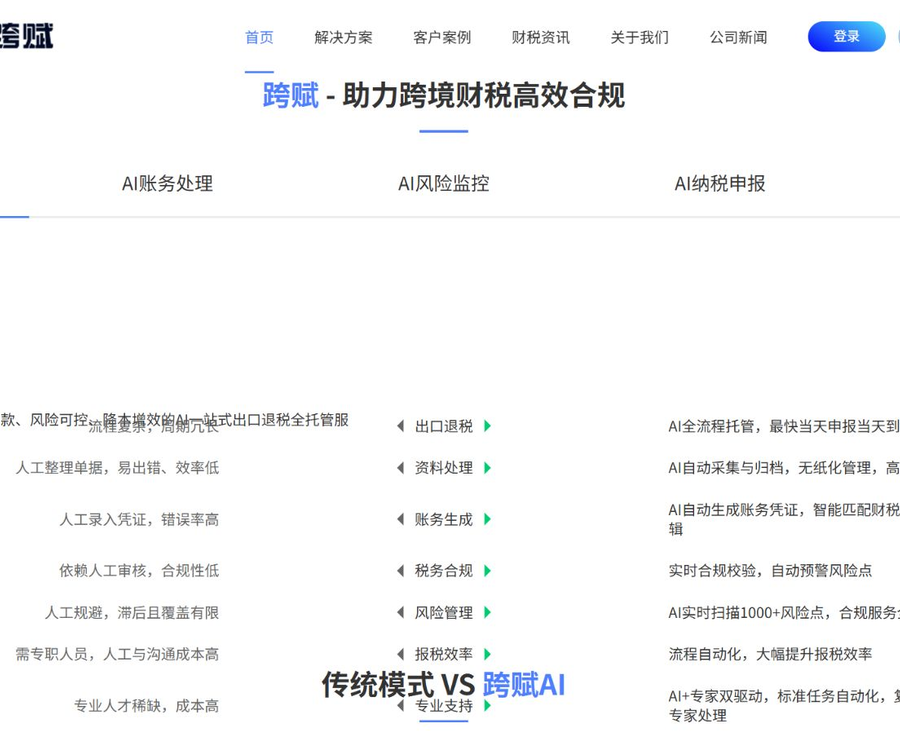
Cross-assignment – Cross-border AI tax refund
AI application service products specifically designed for cross-border scenarios
Tags:AI improves efficiencyWhat is Cross-assignment AI?
Cross-Endow AI is a platform for financial compliance and export tax rebates, offered by Mingxin Digital to e-commerce companies operating across borders.
It combines system automation with the services of financial and tax experts, covering accounting, tax filings, documentation, and risk management.
Core functions
| Functions | Main function | Human liability |
|---|---|---|
| Tax refunds for AI exports | Collect data and assist with tax refund filings | Verify the authenticity of the business operations and the results of the declarations. |
| AI-based accounting processing | Generate credentials and align them with fiscal and accounting principles. | Accounting review items and amounts |
| AI Risk Monitoring | Detect anomalies and provide warnings. | Assessing risks and implementing corrective measures |
| AI tax filing | Automatically fill in the relevant declaration information. | The authorized person confirms and submits it. |
| AI document management | Collecting, archiving, and tracking materials | Ensure that the documents are accurate and complete. |
Tax refunds for AI exports
The system aggregates data related to export operations, such as orders, customs declarations, logistics, fund receipt, and invoices, to assist in establishing the declaration process.
- Analyze the company’s export business model.
- Match the customs declaration with the business order.
- Check the incoming invoices and product information.
- Track the status of submissions and any missing information.
- Indicates anomalies that require manual processing.
- The actual tax refund is subject to the approval of the tax authorities.
AI-based accounting processing
AI-based accounting processes generate suggestions for accounting entries based on business data, thereby reducing the need for repetitive data entry and table formatting.
- Automatically collects business data from multiple channels.
- Match financial accounts according to rules.
- Generate vouchers and accounting treatment suggestions.
- Identify anomalies in amounts, tax rates, and periods.
- Accountants need to conduct random checks and reviews for each individual transaction.
- System outputs cannot replace the legal obligation to keep accounts.
AI Risk Monitoring
The risk module continuously scans business and tax data, identifying issues that may lead to audits, inquiries, or reporting errors.
- Check whether the data chains are consistent with each other.
- Identify missing documents and abnormal transactions.
- Monitor discrepancies in invoices, customs declarations, and foreign currency receipts.
- Provides risk points and handling suggestions.
- Establish records for the correction of issues and their verification.
- A warning does not equate to an official conclusion from the tax authorities.
AI tax filing
The system can assist in filling out forms based on the verified data, thereby reducing the complexity associated with formatting and following rules.
- Select the correct tax type and filing period.
- Check the corporate entity and the identity declared.
- Check income, costs, and taxes.
- Verify the applicable conditions for the preferential policies.
- It must be reviewed by an authorized person before being submitted officially.
- In the event of policy changes, the statements of the relevant authorities shall prevail.
AI document management
The document management module automatically aggregates scattered materials and creates paperless archives, facilitating submission and subsequent inspections.
- Create files based on orders and customs declarations.
- Associated contracts, logistics, and payment collection documents.
- It indicates missing, duplicate, or abnormal documents.
- Record supplementary information and modification history.
- Keep the original documents for the statutory period.
- Electronic archiving does not exempt the obligation to keep the original documents.
Applicable export model
| Pattern code | Common names | Key points of focus |
|---|---|---|
| 0110 | General trade | The customs declarations, invoices, foreign currency receipts are in line with the accounting records. |
| 9610 | Cross-border e-retail exports | Matching of orders, payments, and logistics details |
| 9710 | B2B direct export in cross-border e-commerce | The corporate transaction and filing documents are complete. |
| 9810 | Overseas warehouses for cross-border e-commerce exports | Overseas warehouses, sales, and tax refund processes |
To determine whether a particular model is applicable to a company, it is necessary to take into account the actual transaction processes, regulatory requirements, and the guidelines set by the relevant authorities.
Cross-assignment AI Usage Tutorial
- Clarify the corporate structure and export business models.
- Contact CrossEnd to carry out requirement and compliance diagnostics.
- Choose either the direct customer system or agency services.
- Confirm the scope of services, responsibilities, and pricing.
- Register the system and set user permissions.
- Connect to or import order, customs, and logistics data.
- Provide additional invoices, contracts, and information related to fund receipt.
- Run accounting, document, and risk checks.
- Financial staff handle exceptions and missing items.
- Review the tax return forms and refund documents.
- The formal submission is carried out by authorized personnel.
- Save the receipts, vouchers, and complete records of all operations.
Scope of services
- Diagnosis of financial, tax, and refund processes.
- Analysis of corporate structures and equity frameworks for domestic and foreign companies.
- Guidance on the first tax refund and regular filings.
- Assistance with accounting processing and audit inquiries.
- Training in cross-border finance and taxation, customs clearance, and foreign exchange.
- Logistics, freight forwarding, and financing-related consulting services.
Cooperation and pricing methods
Cross-assignment relies on two main forms of collaboration: enterprise systems and professional agents; the official website does not disclose a unified price for these packages.
| Cooperation methods | Public price | Suitable for businesses |
|---|---|---|
| Direct customer system | Consultation and quotation | Operating the system with an in-house financial team |
| Proxy services | Consultation and quotation | Tax refunds are handled by the Cross-Assignment team. |
| Fiscal and tax diagnosis | Confirm by project | Companies that need to address their existing issues |
| Architecture and planning | Confirm by range | Involves domestic and foreign entities as well as related-party transactions |
| Training and supporting services | Confirm separately | Teams that require knowledge or supply chain support |
The price information listed above was verified on August 30, 2026; costs, timelines, and deliverables are subject to the official quote and contract.
What needs to be prepared before requesting a quote?
- Business registration location and taxpayer status.
- Main sales platforms and target markets.
- Export modes such as 0110 and 9610.
- Average monthly order volume, as well as the scale of customs clearance and tax rebates.
- Existing financial software and data interfaces.
- Historical reports, anomalies, and correspondence inquiries.
- I hope to use a system or fully managed service.
Direct customer model and agency model
| Comparison items | Direct customer model | Proxy pattern |
|---|---|---|
| System operation | Corporate finance team | Cross-functional fiscal and tax team |
| Internal capability requirements | It is necessary to be familiar with business operations and fiscal matters. | The company is responsible for providing and verifying the information. |
| Process control | Self-management by the enterprise | Coordinated management in accordance with service agreements |
| Suitable scenarios | The team is mature and aims to operate independently. | Insufficient staff or need for professional support |
Data and information security
The tax refund system handles highly sensitive corporate data such as transactions, invoices, customs declarations, logistics, and banking information.
- Assign the minimum access rights based on the role.
- Encrypt APIs and file transfers.
- Limit exports, downloads, and batch operations.
- Log the user logins and submission actions.
- Agree with the service provider on the data retention period.
- After the collaboration ends, confirm the transfer and deletion of data.
Boundaries of fiscal and tax compliance
- AI cannot prove the authenticity of transactions and documents.
- Automatic data submission cannot replace the company’s responsibility for verification.
- Risk warnings are not determined by the tax authorities.
- There may be differences in the implementation criteria across different regions.
- Tax policies and forms continue to change.
- For significant issues, it is advisable to consult professional financial, tax, and legal experts.
How should one understand the speed of tax refunds?
The quick application and payment processes shown on the official website are descriptions of the service capabilities, and they do not constitute firm commitments for each individual transaction.
- The completeness of the information affects the progress of processing.
- When a company files for approval for the first time, more verification is usually required.
- Correspondence and risk assessments may prolong the timeline.
- The tax authority determines the final processing date after reviewing the case.
- The contract should specify the controllable aspects and responsibilities.
API and open-source status
As of the time of verification, no developer APIs intended for the public, official SDKs, or product source code repositories were found.
- Connecting to interfaces such as those of customs does not equate to making public APIs available.
- The integration of enterprise data must be carried out in accordance with project-specific authorizations.
- The use of large models does not mean that the system’s source code is open-source.
- Third-party warehouses with the same name cannot be considered official projects.
Which companies are suitable?
- Domestic enterprises that engage in cross-border e-commerce exports.
- A team responsible for handling orders across multiple platforms and refund-related documents.
- Financial departments that need to improve document management.
- Cross-border sellers who lack a complete tax refund team.
- Companies that involve overseas warehouses and B2B exports.
- Companies that need financial and tax diagnosis as well as risk mitigation.
Product advantages
- It covers accounting, declaration, documentation, and risk management processes.
- Integration of system automation with expert services.
- It supports various cross-border export business models.
- Connecting multiple data sources reduces the need for repeated data organization.
- Two types of cooperation are available: direct customer relationships and agency partnerships.
- It allows tracking of progress and generates visual reports.
Usage restrictions and precautions
- The official website does not disclose a unified standard price.
- The effectiveness of the system depends on the accuracy and completeness of the data.
- AI-generated results must be reviewed by professionals.
- Changes in tax policies can affect the rules for handling matters.
- The time it takes for the tax refund to arrive cannot be guaranteed unilaterally by the platform.
- Before making a purchase, it is necessary to clarify the boundaries regarding data and responsibilities.
Frequently Asked Questions
What services does Cross-Assignment AI mainly provide?
It offers financial and tax services such as export tax rebates, accounting handling, risk monitoring, tax filing, and document management.
Which export modes does Cross-Assign AI support?
The examples on the official website cover models such as 0110, 9610, 9710, and 9810; the suitability of these models must be determined based on the specific business requirements.
How is Cross-Assignment AI priced?
The official website does not list any standard packages; the costs are determined on a case-by-case basis, depending on the partnership model, the scale of operations, and the scope of services provided.
Can companies operate the cross-assignment system on their own?
It is possible to opt for a direct customer model handled by the company’s finance team, or to use an external team to provide agency services.
Can using AI ensure a successful tax refund or its quick arrival?
No, the outcome of the application and the time required to process it are influenced by factors such as the documents submitted, risk assessments, and the examination carried out by the tax authorities.
Do AI-generated certificates and forms need to be reviewed?
It is necessary for corporate accountants and authorized personnel to verify the transactions, amounts, tax rates, documents, and the details of the declarations.
Does CrossAssign AI provide public APIs or source code?
As of the time of verification, no public API, official SDK, or source code repository that can be attributed to the product owner was found.
Similar to tools for cross-assignment and cross-border AI tax refunds



 Guigong Network Security Registration No. 45132202000164