






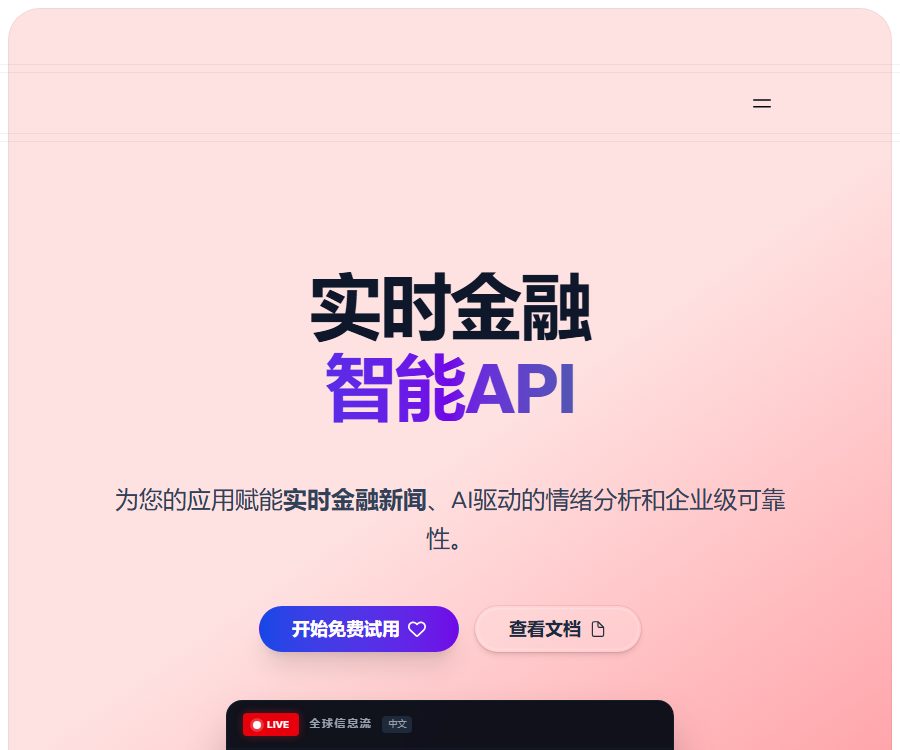
finlight
Finlight – boosts AI efficiency, making tasks more efficient and simpler.
Tags:AI improves efficiencyWhat is Finlight?
Finlight is a platform for financial and geopolitical news data, developed by the Callbk team; its operating entity is Bartsch und Büyükkakac GbR based in Germany. It is intended for developers, fintech teams, and corporate data projects, offering searchable and filterable news data through program interfaces.
The product is not a tool for providing investment advice, nor does it make trading decisions on behalf of users. Its value lies in organizing disparate news articles into structured results, and enabling integration with applications and smart assistants through REST API, WebSocket, Webhook, or MCP.
Main functions
Structured financial news retrieval
The REST API accepts parameters such as keywords, time ranges, language, country, categories, company or security identifiers, and returns the article titles, publication dates, media sources, summaries, and related metadata. It is suitable for searching through historical news, creating research pages, generating batch reports, or providing event context for applications.
Language filtering is carried out using two-character language codes with exact matching; if no code is specified, English is used by default. If Chinese, Japanese, or another language is required, it must be specified explicitly – multiple languages cannot be handled by assuming that all of them will be returned automatically in a single request.
Emotion and corporate entity labeling
The enhanced results may include fields such as emotional direction, confidence level, company name, stock code, exchange, ISIN, industry, category, and country. Users can use these details to filter for specific companies, sectors, or negative events; however, the emotional labels are outputs of the model and do not represent predictions regarding market fluctuations.
Some enhanced fields are subject to package restrictions. When a request is made for a capability for which no permission exists, REST may return an error indicating lack of permissions, and real-time updates may omit those corresponding fields; therefore, the receiving end needs to be able to handle the absence of such fields.
WebSocket real-time streaming
WebSocket is suitable for market dashboards, real-time alerts, and low-latency event processing; once connected, clients can subscribe to news via queries, media, excluded media, or language filters. The raw stream is optimized for reducing latency, and it does not provide full sentiment and entity enhancement features.
This feature is available only with paid plans, and there is an infrastructure limitation that limits the connection duration to about two hours. The official SDK will reconnect automatically, while custom clients need to implement functions for retrying after disconnection, processing repeated messages, and resuming subscriptions.
Webhook event push
Webhooks deliver matching news directly to the user’s public security endpoint, making them suitable for backend tasks, workflow platforms, and systems that do not require maintaining persistent connections. Enhanced subscriptions allow filtering by company, country, category, entity, and update status, while basic subscriptions focus on speed.
The receiving end must verify the HMAC-SHA256 signature, and it must handle cases of duplicate deliveries, out-of-order deliveries, timeouts, and failed retries appropriately. The number of webhooks and the amount of data that can be delivered per batch vary depending on the package chosen; if these limits are exceeded, one must wait for the cycle to reset or upgrade to a higher package.
MCP Financial News Tool
The remote MCP service enables the retrieval of financial news to be integrated with AI clients and Agent frameworks that support OAuth 2.0. When users ask questions in natural language regarding corporate developments, market sentiment, or geopolitical events, the client can utilize structured news tools to formulate responses.
MCP achieves authorization through dynamic client registration and PKCE; the API key is entered on the managed authorization page, without the need to include it in the client configuration. MCP can be used with all plans, but each invocation consumes the account’s regular API request quota.
Custom information streams and enterprise deployment
Enterprise clients can discuss customized media collections, dedicated data processing, private cloud or on-premises deployment, custom natural language processing, translation services, and service level agreements. The actual coverage area, latency, fields, licensing terms, and delivery methods are determined through the enterprise contract.
Input and output
| Method | Main inputs | Main output | Suitable for tasks |
|---|---|---|---|
| REST API | Search terms, date, language, company, country, and category | Paginated articles and enhanced metadata | Search, research, batch processing, and application pages |
| WebSocket | Real-time subscription filtering criteria | Low-latency original news events | Dashboards, alerts, and stream processing |
| Webhook | Subscription rules and receiving endpoints | Originally pushed raw or enhanced events | Automation, message notifications, and backend tasks |
| MCP | Natural language questions and tool parameters | Structured articles for processing by AI clients | Dialogue Research and Agent Workflows |
Process of using REST API
- Register an account, create and copy the API key in the console.
- Choose the official SDK based on the task, or call the REST endpoints directly.
- Store the key in the server-side key management system and send it via a specified request header.
- First, verify the returned fields and pagination using a small range of dates, languages, and keywords.
- Add company, security, country, category, or sentiment criteria to narrow down the results.
- Handles permission errors, quota limits, empty results, missing fields, and network retries.
- Monitor usage in the console, and arrange the frequency of caching and tasks based on the credit period.
API keys should not be stored in the browser frontend, mobile application packages, or public code repositories. To provide data to end users, a custom backend proxy should be used to make the requests and to implement access controls.
Real-time push for the onboarding process
- Confirm that the package includes WebSocket or Webhook along with the required quota.
- Choose WebSocket if a continuous connection with low latency is required, and choose Webhook for triggering backend tasks in response to events.
- Design sufficiently precise filtering rules for queries, languages, and media categories.
- It enables automatic reconnection and deduplication for WebSocket connections, as well as signature verification for Webhooks to ensure quick confirmation of receipt.
- Model the original event and the subsequent enhanced results separately, to avoid assuming that their fields are exactly identical.
- Monitor the number of connections, the amount of data pushed, the failure rate, and the credit limit; take proactive measures to reduce load before these thresholds are reached.
MCP access process
- Obtain the Finlight API key and verify that the account can be used to make calls successfully.
- Add the finlight service to clients that support remote MCP and OAuth 2.0.
- The client opens the authorization page, enters the key on that page, and completes the PKCE authorization process.
- Use a simple company news question testing tool to check the connection and return format.
- Gradually add filtering criteria such as date, media, language, emotion, or securities.
- Check the amount of quota consumed with each invocation, and request that the AI retain the article’s timing and the publisher’s context.
Price and quota
| Package or version | Price | Billing cycle | Core benefits or quota | Suitable for users |
|---|---|---|---|---|
| Launchpad | 0 dollars | Monthly | 5,000 requests; news delivery is delayed by about 12 hours; REST and MCP interfaces are available, but there is no real-time updates nor emotion enhancement. | Prototype verification and low-frequency testing |
| Pro Light | $ | Monthly | 10,000 requests, real-time data, 1 webhook, 5,000 webhook deliveries, 5,000 WebSocket deliveries | Individual developers and small applications |
| Pro Standard | $ | Monthly | 50,000 requests, emotions and entities; 2 Webhooks, with 25,000 pushes per webhook, plus access to more extensive historical data | Production-grade financial applications |
| Pro Scale | $ | Monthly | 150,000 requests, 5 Webhooks; unlimited number of push deliveries; historical data and account managers available | High-usage teams |
| Enterprise | Custom quote | In accordance with the contract | Requests, streams, and Webhooks are customizable; there is also dedicated support for media, deployment, models, translation, and SLAs. | Large enterprises and regulated environments |
The price listed does not include value-added tax or local taxes; the final amount may vary depending on the region and the payment page. The free version and Pro Light cover approximately the past month, while the higher-tier plans provide access to a longer historical period. The specific dates available depend on the account permissions.
Limits and error handling
- Each REST request consumes one unit of the monthly request quota, and this count is reset at the start of each billing period.
- Short-term burst limits are controlled using a ten-second window, and they apply only to the plans for which such a limit has been set.
- The number of simultaneous WebSocket connections as well as the volume of data distributed, and the number of Webhook deliveries are each subject to separate billing or quota restrictions.
- If the request exceeds the limits or there is a sudden surge in traffic, an error regarding the quota will be returned; the client should wait before attempting the request again rather than repeating it frequently.
- The current response does not provide standard header information indicating the automatic waiting time or remaining quota.
- The console usage chart is summarized on a daily basis; the actual restrictions are applied in real time, which may result in a delay in the data displayed on the chart.
SDK, GitHub, and open-source status
| Language | Official client | Real-time stream | License |
|---|---|---|---|
| TypeScript and JavaScript | Yes | Support | MIT |
| Python | Yes | Support | MIT |
| Go | Yes | Support | MIT |
| .NET and C# | Yes | Support | MIT |
| Java and Kotlin | Yes | Support | MIT |
| PHP | Yes | WebSocket is not supported. | MIT |
| Ruby | Yes | Support | MIT |
| Rust | Yes | Support | MIT |
All eight client codes are made public and distributed under the MIT license, which facilitates review, modification, and commercial integration. This license applies only to the SDK code; it does not imply that news platforms, data sets, enhanced models, or third-party articles are open source.
Suitable for users and scenarios
- Fintech developers: Provide real-time news to enhance end devices, research products, or customer portals.
- Quantitative and trading team: Integrate news events into internal monitoring and feature engineering, but do not rely on the sentiment expressed in articles as the only indicator.
- Corporate intelligence team: Continuously monitors developments within the company, the industry, competitors, and regulatory environments.
- Risk team: Monitors geopolitics, policies, supply chains, and negative corporate events.
- AI Application Team: Uses MCP to provide intelligent assistants with filterable, up-to-date financial news.
- Content and Data Team: Creates authorized thematic information streams based on language, country, and category.
Advantages
- REST, streaming connections, event push, and MCP cover different application architectures.
- The results include emotions, company identifiers, and categories, which reduces some of the work involved in organizing entities.
- The free tier allows for the verification of interfaces and data formats, making it convenient to conduct technical tests before upgrading.
- All eight official SDKs come with a clear MIT license, offering a fairly comprehensive range of programming languages.
- The main quotas for public requests, Webhooks, and WebSocket in the paid tier.
Capabilities boundaries and limitations
- News updates on the free tier are delayed by about 12 hours, making it unsuitable for real-time alerts or immediate trading scenarios.
- The original real-time stream gives priority to latency and does not include complete emotion and company entity enhancement.
- The model’s emotions and the confidence levels associated with entities may be inaccurate; it is necessary to verify them using the original text and other data.
- News coverage varies depending on the media, language, region, and permissions; therefore, it is not possible to ensure that data is available for every event or publisher.
- The platform does not guarantee the continuous availability of specific media or fixed delivery times.
- In the absence of a standard remaining quota response header, the caller must keep track of the count themselves and monitor it through the console.
- The historical range, the full text of the article, and the additional fields may all be subject to restrictions imposed by the package and content licensing.
Copyright, Commercial Use, and Refunds
API access permits are intended for personal use or internal business purposes only; they cannot be transferred, relicensed, or resold. It is not allowed to bypass usage limits by using multiple accounts, to reverse-engineer the interface, to republish copyrighted content without permission, or to use this API to create competitive news distribution services.
Third-party articles remain the property of their original publishers; when displaying or distributing them, it is necessary to indicate the publisher clearly and provide a link to the original article where applicable. As for whether it is possible to save the full text, use it to train models, redistribute it to customers, or incorporate it into paid products, one must check both the publisher’s permissions and any corporate contracts in force.
Paid subscriptions and automatic renewals are, in principle, non-refundable; cancellation only prevents further charges, while the benefits associated with the current subscription period remain valid until its end. Repeated charges, incorrect payments, or legal mandates may constitute exceptions. It is advisable to first test the data, fields, and performance using the free version before upgrading.
Privacy and security
Finlight handles account names, email addresses, usage levels, IP addresses, browser and device information, communication records, as well as data related to product usage. The service makes use of cloud infrastructure located in Europe, and it relies on suppliers for payment processing, email services, analysis, behavior monitoring, and error tracking; standard contract clauses are used to ensure secure cross-border data transfer.
- API keys should be stored only on the server, and managed in accordance with the principles of minimum permissions, regular rotation, and anonymization of logs.
- Webhooks require signature verification, and public endpoints need to implement access control, replay protection, and monitoring as well.
- The account can be requested to be deleted, but tax, dispute resolution, or other legal obligations may require that certain records be retained.
- The product is not intended for users under 16 years of age, and projects that involve data related to minors should not be used.
- The privacy policy does not replace the data processing agreements, security addendums, and supplier assessments required by corporate clients.
Frequently Asked Questions
Is Finlight an investment advice service or an automated trading tool?
No. It provides financial news and structured metadata; investment decisions, risk management, and transaction execution are still handled by the user’s own systems and professionals.
Is the free version truly real-time news?
No. The free tier of Launchpad allows 5,000 requests per month; however, there is a delay of about 12 hours for news updates, and paid plans are required for real-time data.
Is MCP needs to be purchased separately?
MCP is available for all plans at no additional cost; however, its use counts toward the regular API request quota of the account. The latency and field limitations applicable to the free tier also apply to MCP.
What is the difference between WebSocket and Webhook?
WebSocket is suitable for continuous connections with low latency, while Webhook is used to push matching events to backend endpoints. The quotas, connection management, and failure handling methods for the two differ.
Is emotion analysis available in all packages?
No. The free tier and Pro Light do not include emotion enhancement; this feature is available only in Pro Standard, Pro Scale, and the corresponding enterprise plans.
Is Finlight an open-source product?
The hosting platform’s source code has not been made available under an open-source license. The eight official client SDKs are licensed under the MIT license, but this does not apply to the platform’s code, news data, or advanced models.
Can I get a refund after making the payment?
Generally, this is not possible. Paid subscriptions and renewals are not refundable in principle; the payment remains valid until the end of the billing period. Exceptions may apply in cases of repeated charges or under legal provisions regarding refunds.
Can the articles returned by the API be republished?
Reposting rights cannot be obtained merely through an API subscription. The copyright of third-party articles belongs to their original authors; when displaying such content publicly, it is necessary to give credit to the authors, and redistributing the entire text requires obtaining the appropriate permission.
Summary
Finlight is suitable for developers and corporate teams that need to obtain financial news through APIs, real-time streams, event notifications, or MCP. Structured entity and sentiment data help to reduce integration time, but the level of real-time performance, the range of historical data available, and the additional fields that can be used are all constrained by the chosen package.
Before going live officially, it is necessary to first verify data coverage using the free tier, and then confirm the payment limits, copyright permissions, key security, as well as the design for retries and monitoring. Projects intended for use in transactions or for distribution to customers require additional data quality control and legal review.
Tools similar to Finlight



 Guigong Network Security Registration No. 45132202000164