






Experimental API for AI services
An experimental API for AI services that makes it more efficient and simpler to enhance the productivity of AI-driven tasks.
Tags:AI improves efficiencyWhat is UseAPI.net?
UseAPI.net is an experimental third-party AI automation interface service. It connects users’ own generative AI website accounts to REST APIs, enabling developers to call functions that are typically used via web pages or Discord through code on a batch basis.
It is not the official API provided by the manufacturers of the underlying models, nor does it offer sales of accounts for these platforms or generate credits. Users must bear the costs associated with UseAPI subscriptions, the fees for the underlying services, as well as the risks related to compliance with the requirements of third-party accounts.
Core working principle
After purchasing a UseAPI subscription, the user receives an API token via email, which is then used to connect their accounts on platforms such as Google Flow, Runway, Kling, and MiniMax. UseAPI enables the user to access third-party platforms, providing unified interfaces for tasks like creation, querying, and downloading.
- UseAPI layer: Provides Bearer tokens, REST endpoints, task queues, polling, Webhooks, SSE, and multi-account scheduling.
- Third-party account layer: Provides the actual models, generates credits, offers concurrency capabilities, and enforces content policies.
- Developer application layer: Submit prompts and materials, and receive task status and generated results.
- Cost layer: UseAPI charges a subscription fee for accessing the interface, while third-party platforms deduct amounts according to their own pricing plans.
Difference from the official developer API
| Comparison items | UseAPI.net | Official API from the model manufacturer |
|---|---|---|
| Identity | Independent third-party automation services | Provided by the operator of the corresponding model or platform. |
| Account basics | Connect to the user’s own consumer-grade website account | Use the official developer account or cloud project. |
| Costs | Monthly fee for UseAPI, plus subscription to the underlying website or credits | It is usually billed based on calls, outputs, or developer packages. |
| Authentication | Use an API token together with third-party account credentials, cookies, or session information | Official API key, OAuth, or cloud identity |
| Stability | It relies on third-party web pages and internal interfaces, and is explicitly marked as experimental. | There is usually a formal version, along with quotas and support policies. |
| Compliance risks | Automation may violate third-party terms and lead to account suspension. | When used in accordance with the official developer terms, the risks are relatively clear. |
Currently supported services
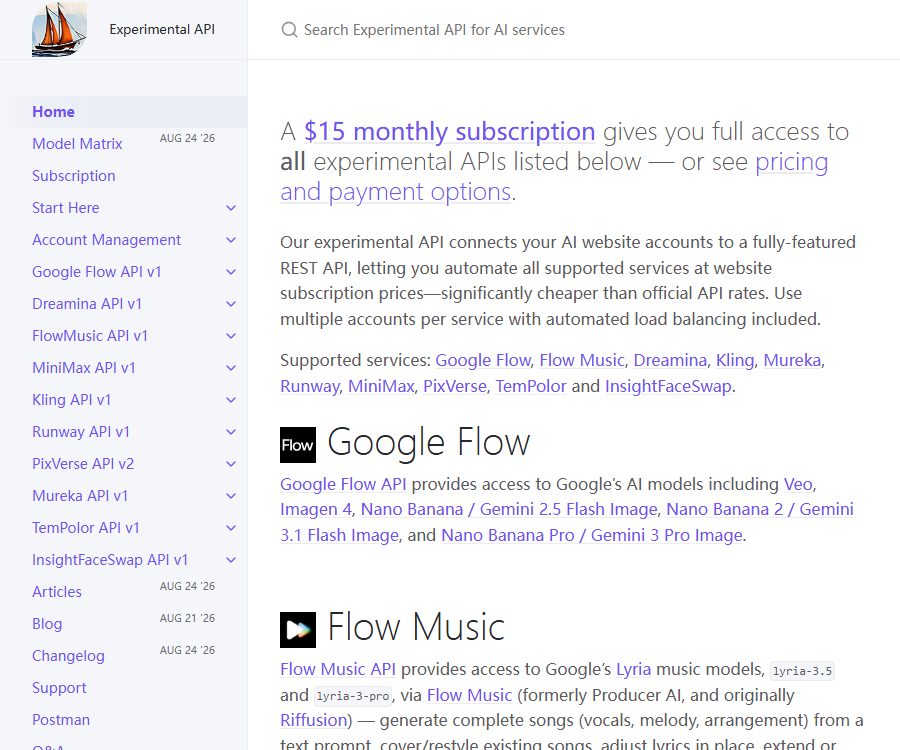
The current subscription page lists ten categories of services, covering video, images, music, voice, and face swapping. The specific models, features, regions, and account requirements change rapidly; it is not possible to determine whether a particular plan is available based solely on the name of the model.
| Services | Key capabilities | Typical input | Typical output |
|---|---|---|---|
| Google Flow | Videos, images, zooming, expansion, character and voice references | Text, images, videos, and reference materials | Images, short videos, and task results |
| Dreamina | Image generation and enlargement such as Seedance videos and Seedream. | Text, images, and asset references | Image, video, and task status |
| FlowMusic | Music generation, editing, lyrics, and file processing | Prompt words, lyrics, and audio files | Music files and task records |
| MiniMax | Videos, images, voice, music, sound cloning, and Agents | Text, images, audio samples, and reference tracks | Multimedia files, voice, and task data |
| Kling | Videos, images, special effects, lip synchronization, avatars and voice | Text, images, videos, audio, and character elements | Videos, pictures, profile videos, and audio |
| Runway | Videos, images, Act-Two, lip-sync, zooming and transcription | Prompt, first frame, reference image, or driving video | Videos, images, transcripts, and asset records |
| PixVerse | Videos, images, special effects, music, voice, and editing | Text, images, videos, and audio | Videos, pictures, music, and voice |
| Mureka | Songs, lyrics, instrumental music, extensions, voice, and sound cloning | Prompt words, lyrics, reference audio, and sound samples | Songs, accompaniment, voice, and cover art |
| TemPolor | Songs, instrumental music, tracks, MIDI, and cloned sounds | Text, lyrics, MIDI, and sound samples | MP3, WAV, stereo tracks, and MIDI |
| InsightFaceSwap | Face swapping, avatar, and background processing | Source face and target image | Face-swapped images and task records |
The status of Midjourney needs to be checked separately.
The current document still provides a quick start guide for Midjourney v3, and the official GitHub page offers relevant examples as well as a Python client; however, Midjourney is not listed in the list of services supported on the subscription page. If you plan to acquire this functionality, you should first check with the support team to determine whether it is available for purchase, what version is required, and what account requirements apply.
Main functions
Unified REST API
Different services use their own account configurations and endpoints, but all of them employ UseAPI tokens for Bearer authentication. Developers can submit tasks using regular network requests via client or server code, without having to manually interact with each platform’s website.
- The account endpoint is used to add, view, and delete connected third-party accounts.
- The generation endpoint accepts prompts, models, material references, duration, aspect ratio, and other service parameters.
- The task endpoint returns statuses such as queued, processing, successful, failed, or canceled.
- The file and asset endpoints are used to upload reference materials, retrieve generated outputs, and delete data that is no longer in use.
Asynchronous tasks, polling, and Webhooks
For time-consuming tasks such as video and music processing, the task identifier is returned first, after which the client polls to check the status. The supported endpoints also allow receiving Webhooks via replyUrl, and some Midjourney workflows offer real-time events via SSE.
- Polling is suitable for scripts and small-scale batch processing; it has a simple logic but requires control over the frequency.
- Webhooks are suitable for production services, as the platform initiates a callback once the task is completed.
- SSE is suitable for interactive interfaces that require real-time display of generation progress or events.
- The callback endpoint should validate requests, remove duplicate tasks, and be able to handle duplicate and out-of-order notifications.
Multiple accounts and automatic load balancing
The basic subscription allows up to 3 proprietary accounts per supported service to be connected. Multiple accounts increase the available concurrency and quota capacity; UseAPI provides scheduling and load balancing, but the actual capacity is still limited by each third-party plan.
- When an account is busy, its credit limit is exhausted, or it is restricted, the application needs to identify the corresponding error.
- Increasing the UseAPI subscription only expands the number of accounts that can be connected; it does not automatically purchase credits from third parties.
- Different accounts for the same service may have different models, regional benefits, or subscription tiers.
- The production system should record which account is used for each task, to facilitate cost and fault tracking.
Model matrix and cross-media capabilities
The model matrix organizes the available models by video, image, music, voice, and other tasks, indicating which consumer services can be used to access them. A single model may appear in multiple services, but its resolution, duration, audio quality, reference materials, and credit rules vary.
Complete integration process
- First, select the target model and the underlying service, and read that service’s own terms regarding accounts, automation, content, and commercial use.
- Prepare a third-party account dedicated to automation, in order to avoid direct connections to the main account that contains personal data or critical assets.
- Purchase a UseAPI subscription, receive the API token via email, and store it securely in the server’s key management system.
- Connect to third-party accounts according to the relevant setup documents; this may require an email password, a Discord token, cookies, or a session token.
- Call the account inquiry endpoint to verify that the connection is valid, as well as to check the planned benefits and remaining quota, and then run the minimal generation test.
- Use the generation endpoint to submit a low-cost task, save the task identifier, and retrieve the results via polling, Webhook, or SSE.
- Implement timeout, retry, idempotency, rate limiting, content filtering, a failure queue, and product downloading; do not treat temporary result addresses as permanent storage.
- Before going live, tests were conducted for scenarios such as third-party account failure, exhaustion of credits, session expiration, rejection of tasks during review, and service disruption.
Authentication and credential security
The UseAPI token should be stored only on the server side; it must not be saved in the browser, mobile application packages, public repositories, or logs. Third-party passwords, cookies, and session tokens that are used for connections should also be treated as highly confidential information.
- Create a separate account for automation, and use a distinct email address along with a strong password.
- Connect only to accounts that you own or for which you have written permission from the account owner.
- Regularly rotate UseAPI tokens, third-party passwords, and session tokens.
- Authorization, cookies, passwords, email addresses, and temporary media addresses are masked in the logs.
- Upon the leakage of credentials, immediately revoke the relevant tokens, exit any third-party sessions, and check for any abnormal activities.
Price packages
UseAPI is available on a monthly subscription basis, with the cost increasing depending on the number of accounts that can be connected. The table below shows only the costs related to the interface layer; all fees associated with the underlying platform subscriptions, credits, verification services, and other third-party services are additional.
| Package or version | Price | Billing cycle | Core benefits or quota | Suitable for users |
|---|---|---|---|---|
| First subscription | 15 dollars | Monthly | It covers all the APIs that are currently supported; each service can be connected to a maximum of 3 proprietary accounts. | Individual developers and small-scale testing |
| 2nd subscription | An additional $10 is added, for a total of $25. | Monthly | Add 3 more accounts per service, for a maximum of 6 in total. | Teams that need more concurrency or quota pools |
| 3rd subscription | An additional $10 is added, for a total of $35. | Monthly | A maximum of 9 accounts per service in total. | Medium-volume workflow |
| 4th subscription | An additional $10 is added, for a total of $45. | Monthly | A maximum of 12 accounts per service in total. | Multi-account scheduling scenario |
How to calculate the true total cost
UseAPI claims that no additional fee is charged for each generation, but each task consumes the credits or plan benefits associated with the third-party account. The actual monthly cost should take into account UseAPI’s monthly fee, all underlying subscriptions, any additional credits, verification services, storage, and outbound data transfer.
- The basic monthly fee does not apply to unlimited subscription plans.
- The same UseAPI subscription covers multiple interfaces, but it does not include members of the ten underlying platforms.
- The free basic account only unlocks the limited functions permitted by the platform; it does not mean that videos or advanced models are available for free.
- Third-party prices, regional packages, and credit rules may change at any time.
Payments and Refunds
- It can be purchased through payment processors using bank cards or cryptocurrencies.
- Cryptocurrencies allow only a single subscription per account, and refunds are not permitted.
- Within 14 days of the initial purchase, if fewer than 50 generations are successfully carried out, a full refund can be requested in accordance with the refund policy.
- The approved refund is supposed to be processed within 1 working day, and the time it takes to arrive in the account may also be affected by the payment method used.
- No refund will be given after 14 days; no refund is available in case of change of mind, insufficient use, or if the third-party account is suspended due to violations.
- Multiple subscriptions require different email addresses, as the email address serves as the unique account identifier for UseAPI.
Which users are it suitable for
- Independent developers who need to use code to perform batch operations on the functions of consumer-oriented AI websites.
- Teams that wish to use unified authentication and a task-based approach to connect with various video, image, and music platforms.
- Prototypes or internal automation projects that are willing to take on the risks associated with experimental interfaces and account terms.
- Having multiple accounts on the same platform requires automatic scheduling of concurrency and the creation of quota pools for teams.
- Engineers who need runnable Node.js and Python examples to quickly verify the media pipeline.
Typical scenarios
- Submit prompts in batches to the video model, and the MP4 file will be downloaded automatically once the task is completed.
- First, generate the material using an image model, and then pass the first frame to a video model to create the animation.
- The generated results are written into content management, review, or delivery systems via Webhook.
- Connect to music services to generate songs, instrumental music, lyrics, track separation, or voice content in bulk.
- Allocate tasks among multiple accounts to reduce waiting times caused by high workload on a single account.
Product advantages
- A single UseAPI token can cover multiple types of generation services, thereby reducing the effort required to adapt separate authentication and task logic for each service.
- The documents are categorized by services and endpoints, and include request parameters, error responses, tutorials, and runnable examples.
- It supports polling, Webhooks, and certain SSE workflows, and is compatible with scripts and online products.
- Multi-account connection and scheduling are suitable for batch processing, but they do not change the quota of the third-party plan itself.
- GitHub’s official repository provides examples for Node.js, Python, and various clients, which helps to shorten the time required for concept validation.
Key constraints and risks
- The service is explicitly labeled as experimental; it can be changed, suspended, or terminated without prior notice, and no guarantees are provided regarding continuity, error-free operation, or security.
- It automates third-party services through consumer-level accounts; they are not official APIs recognized or endorsed by these model manufacturers.
- Providing passwords, cookies, or session tokens is equivalent to granting third parties permission to operate the account on your behalf, which poses risks of credential leakage and account takeover.
- Automation may violate the terms of service of third-party services, and users risk having their accounts suspended, losing their balance, or facing legal disputes.
- Changes to the underlying web pages, login verification, verification codes, regional policies, and the deactivation of certain models can all cause endpoints to stop functioning suddenly.
- The monthly fee for UseAPI is separate from third-party subscriptions, and no refund is automatically granted even if a underlying account becomes unavailable.
- For critical production services, an official API or other suppliers should be available as a fallback solution.
Privacy and data security
- Account information: Collects email address and optional name.
- Request logs: API requests are recorded, and the logs may contain the prompts submitted by users.
- Payment data: The full card details are processed by the payment service provider, but UseAPI may obtain the billing address, the last four digits of the card number, and transaction records.
- Credentials: The service stores and processes third-party login credentials, cookies, or session tokens in order to handle user requests.
- Sharing: The policy states that personal information shall not be sold or rented out, but it can be shared with service providers such as those dealing with payments, legal authorities, or for the purpose of enforcing the policy.
- Transmission security: Public API endpoints use TLS for encrypted transmission, but no details regarding full static encryption, key management, or independent auditing are available.
- Cookies: The policy states that the website does not use cookies.
- Unrevealed details: The exact retention period for credentials, prompts, request logs, and the assets generated, as well as the mechanism for self-deletion, have not been specified yet.
Suggestions for handling sensitive content
Do not use this interface to process access keys, personally identifiable data that is subject to regulatory constraints, confidential business information, or portraits and audio files that are not authorized for uploading. When dealing with customer-related content, it is necessary to first carry out evaluations regarding data processing, retention, deletion, cross-border transfers, and incident notification.
Content copyright and commercial use
Users retain the right to the content they enter, but the rights regarding the output depend entirely on the terms of service of the third-party service that generates that content. UseAPI does not claim ownership over the generated results, nor does it grant users any additional copyright or commercial rights.
- Verify one by one the pricing plans, models, regions, and output licenses of the underlying platform.
- Face replacement, voice cloning, and video of individuals require authorization from the relevant persons.
- Referencing images, videos, songs, lyrics, and audio samples must not violate third-party rights.
- The output of the model may be similar to existing works, and content and copyright verification are required before it is made public.
GitHub, SDKs, and open-source status
| Project | Current status | Explanation |
|---|---|---|
| Official GitHub organization | Confirmed | Multiple examples, tutorials, and dedicated repositories for services are available. |
| Node.js example | Confirmed | It covers processes such as batch generation, polling, Webhooks, and result downloading. |
| Python example | Confirmed | The examples repository provides corresponding Python implementations for some workflows. |
| Python client | Some items have been confirmed. | There is a Midjourney API client available, but the applicable version and the current status of the service need to be verified. |
| Open source on the product server side | Not confirmed | Public examples and clients are not equivalent to the open-source backend hosted by UseAPI. |
| License | Verify by warehouse | The license of a particular sample repository cannot be applied to the entire platform. |
The GitHub field in the database originally pointed to Just the Docs; that is merely a Jekyll theme used by the documentation site, and it is not the source code of the UseAPI product nor its official SDK.
Pre-launch checklist
- Verify that the target third-party service explicitly permits your method of automation, and save the current version of the terms.
- Use separate accounts and non-sensitive test data to verify the connection, without directly linking to the core production accounts.
- Calculate the total cost of UseAPI, underlying subscriptions, additional credits, verification codes, storage, and traffic.
- Achieve token isolation, log masking, key rotation, webhook verification, and least privilege.
- Covers 401, 412, 422, 429, task timeouts, session expiration, account bans, and disruptions to third-party services.
- Verify copyright, portrait rights, audio licensing, content approval, and regional compliance.
- Prepare official APIs or alternative solutions from other suppliers for critical functions.
Frequently Asked Questions
Is UseAPI.net the official API of the model manufacturers?
No, it is an independent third-party automation service; it has no official affiliation or endorsement with platforms such as Google Flow, Runway, Kling, etc. to which it is connected.
Does the monthly fee of $15 include the generation cost?
This fee does not include the UseAPI interface layer; it allows each service to be connected to a maximum of 3 accounts. The subscription for the underlying platform as well as the generation of credits still have to be paid separately by the user.
How many services can one subscription be used for?
The current documentation states that a subscription covers all the APIs listed in the supported list, but for each service the user must have their own valid account; the actual capabilities depend on the rights associated with that account.
Why is there a risk associated with connecting accounts?
Some services require passwords, cookies, Discord tokens, or session tokens, and automating account usage may violate third-party terms, leading to the exposure of credentials or account suspension.
Does UseAPI.net support Webhooks?
Multiple asynchronous generation endpoints support the replyUrl callback, and developers can also poll for tasks; some Midjourney workflows also offer SSE events.
What are the conditions for a refund?
A full refund can be requested within 14 days of the first purchase, as long as fewer than 50 transactions have been made. Refunds are not available for payments made in cryptocurrency, nor are they granted if the deadline has passed or if the third-party account is disabled.
Is UseAPI.net an open-source project?
The official GitHub page provides sample code, tutorials, and some clients, but there is no evidence that the server-side components are fully open source; it is necessary to check each repository’s license.
Can it be used directly in the production of critical business processes?
It is not recommended to rely on it in the absence of a fallback plan; it is explicitly labeled as experimental, and it is subject to changes in third-party websites, accounts, verification codes, and terms.
Summary
The value of UseAPI.net lies in its ability to automate various consumer-grade generation platforms through a unified interface; it offers asynchronous tasks, multi-account scheduling, and numerous examples, making it suitable for rapid prototyping and bulk media workflows.
A low monthly fee for the interface does not mean low overall risk or unlimited generation of content; before making a purchase, it is necessary to take into account the underlying costs, security of credentials, terms imposed by third parties, authorization for output, and plans for dealing with service interruptions.
Tools similar to the Experimental API for AI services



 Guigong Network Security Registration No. 45132202000164