






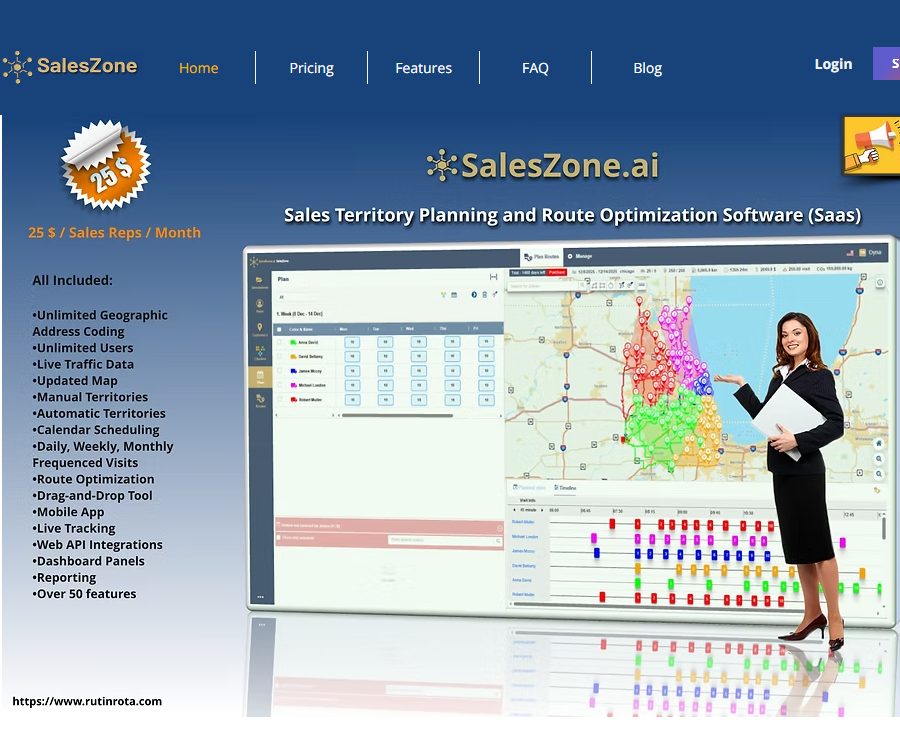
Dynaroute
Dynaroute: leverages AI to make work more efficient and simpler.
Tags:AI improves efficiencyWhat is Dynaroute?
Dynaroute.ai is an AI-based route optimization and operational planning tool operated by Rutin Route Optimization & Software Solutions Ltd. Co. It is designed for drivers, couriers, delivery companies, sales representatives, and field service personnel who need to visit multiple locations on a regular basis.
The current product information covers both mobile applications for multiple users and multiple locations, as well as web-based fleet management solutions. The packages, trial periods, and usage restrictions for these options vary; before making a choice, it is necessary to determine whether to use the Mobile Basic or Pro version, or a fleet system based on vehicle counts.
Do not confuse it with products of the same name.
On the market, there is also DynaRoute, which is used for routing requests related to large models, as well as a logistics product with a similar name called DynoRoute. This entry focuses solely on Dynaroute.ai, which is operated by Rutin Route Optimization and is used for navigating actual vehicles to various locations.
- The core entities are addresses, pick-up/drop-off points, vehicles, drivers, and delivery and pickup tasks.
- The main outputs are the sorted route, ETA, navigation, and operational reports.
- The company responsible for the operation of this product is located in Turkey, with liaison offices in Europe.
- It is not an API gateway for developers to choose different large language models.
Main functions
| Functions | Enter | Output | Suitable for tasks |
|---|---|---|---|
| AI multi-site optimization | Address, stops, priority, and vehicle conditions | Efficient access route after sorting | Delivery, pickup, visits, and on-site service |
| Traffic perception planning | Real-time road and route conditions | Consider the route and dynamic ETA for transportation. | Urban delivery and temporary route changes |
| Excel import | Address, order, and custom columns | Batch docking points and planable tasks | Migrate daily orders from the table |
| OCR address recognition | Photos, screenshots, or documents | Addresses extracted and geocoded | Paper lists and unstructured orders |
| Capacity and 3D loading | Quantity of goods, size, and vehicle capacity | Feasible routes and loading arrangements based on capacity | Delivery/pickup mixing and space planning |
| Route recalculation | New orders, priority changes, or on-site adjustments | Updated stop order and ETA | Insertions, delays, and adjustments on the same day |
| Revenue perception pathway | Projected revenue, costs, and task priorities | A approach that takes into account both efficiency and profitability | Selectively arrange high-value stops. |
| POD and reports | Completion status, signature, photo, and time | Delivery certificates, KPI and ROI reports | Customer confirmation and operational review |
How does route optimization work?
After a user imports or enters multiple addresses, he can set service times, priorities, delivery or pickup types, as well as capacity constraints for each stop. The system determines the order of visits based on distance, traffic conditions, and operational rules, and updates the estimated arrival times whenever there are changes in the route.
- It supports various modes of transportation such as cars, vans, motorcycles, bicycles, and walking.
- The Pro plan will add a truck mode to take into account routes that are more suitable for commercial vehicles.
- It is possible to avoid toll roads, highways, or ferries; the specific options depend on the application.
- It is possible to reverse the route, edit stop points, and insert new tasks into the existing route or add them at the end.
- It can handle delivery, pickup, and reverse logistics simultaneously.
- The route suggestions still need to be determined by the driver based on traffic signs, road conditions, and vehicle limitations.
The optimization results do not guarantee navigation safety; temporary road closures, weather conditions, low bridges, weight restrictions, and map errors can all affect the feasibility of the plan. The transport of hazardous materials, heavy vehicles, and items subject to regulatory controls must be reviewed by qualified personnel.
Excel, OCR, and address quality
Dynaroute allows for the bulk import of stops from Excel, and it can also extract addresses from images and documents using OCR. AI geocoding converts incomplete or improperly formatted text into map coordinates, and provides a status indication of the quality of the addresses for the user to review.
- Prepare a table containing the address, customer name, quantity, time window, and priority, or take a clear photo of the order.
- Import an Excel file or select OCR recognition to allow the system to extract the address and task fields.
- Map the source file columns to the application’s fields for address, quantity, remarks, and task type.
- Check the geocoding status such as Exact, Good, or Review.
- Manually correct the Review address using auto-completion or map location.
- Add vehicle capacity, departure point, arrival point, and route preferences.
- Run optimizations and check the stop sequence on the map, as well as any abnormal detours and unreachable locations.
- Save the route and start navigating station by station; recalculate it whenever there are changes on site.
The fact that OCR recognition is accurate does not necessarily mean that the geographical coordinates are correct; errors are particularly likely to occur regarding floors, entrance points to complexes, roads with the same name, and missing postal codes. All addresses that require verification should be processed before carrying out bulk planning.
Delivery, pickup, and capacity planning
Products can be scheduled for delivery and pickup on the same route, and the remaining capacity of the vehicles can be adjusted according to the amount of cargo at each stop. 3D loading planning takes into account the space available for the goods as well as their placement order, thereby reducing the need to search around or face situations where goods cannot be loaded after arriving at a stop.
- Delivery reduces the inventory on the vehicle, while picking up items increases the load.
- Capacity can be expressed in terms of quantity, weight, volume, or custom business units.
- The priority feature allows urgent tasks to be placed at a higher position.
- Temporary orders can be inserted after the current position or added at the end of the route.
- On the same day, the route can be recalculated and the ETA updated.
- For actual loading, it is also necessary to take into account the center of gravity, securing methods, isolation of hazardous materials, and regulatory requirements.
Proof of Delivery and operational analysis
Proof of Delivery is used to record information regarding the completion of each delivery stop, including electronic signatures, photos, or status details, thereby helping delivery staff to have evidence of the deliveries that have been made. KPI reports provide a summary of the sites that were delivered to, any delays, time spent, costs incurred, and efficiency levels, while the ROI calculator is used to estimate the savings resulting from route optimization.
- The driver can update the status to completed, failed, or abnormal upon arrival at the station.
- Signatures and photos may contain personal information, so access to them and their retention period should be controlled.
- Managers can compare the planned route with the actual execution.
- The report can be used to identify recurring delays, inefficient sections, and service issues.
- The results regarding earnings and savings depend on the assumptions regarding oil prices, time costs, and income.
- The estimates contained in the report are not equivalent to financial audits or guarantees of achieved returns.
Mobile version and web fleet version
| Version | Primary users | Working method | The platform has been confirmed. | Main boundaries |
|---|---|---|---|---|
| Mobile Single Version | Independent drivers, couriers, and on-site staff | Import, optimize, navigate, and record PODs on mobile devices | Android; officially claims to support iOS. | Daily and monthly stop limit applied |
| Web Fleet Version | Dispatchers, logistics, and multi-vehicle teams | Create orders in the browser, import orders, and plan as well as assign drivers. | Mainstream web browsers and driver mobile apps | Depending on the vehicle subscription plan, the criteria for the trial period vary. |
| Web Service API | Companies with internal systems | Connect the customer database or ERP to the routing system | The web-based fleet management solution is listed as a feature. | No public development documentation or SDKs were found. |
Dynaroute Route Optimization in the app store currently focuses on individual route planning as well as the Basic and Pro packages. The older or alternative web-based fleet management solutions, on the other hand, include functions such as simulation, zone management, driver assignment, real-time tracking, management reports, and enterprise integration.
Mobile plan options and data limits
| Package or version | Price | Billing cycle | Core benefits or quota | Suitable for users |
|---|---|---|---|---|
| Mobile trial | $ | 15 days | Try out the mobile route feature; eligibility and scope are specified on the in-app page. | First test |
| Basic | Subject to in-app purchases. | As displayed in the app store | Up to 200 unique stops per day, and 4,500 stops per month; core optimization, OCR, ETA, POD, and reports | Single-person delivery for medium and low frequencies |
| Pro | Subject to in-app purchases. | As displayed in the app store | Up to 200 unique stops per day, 6,000 per month; includes Basic functions and truck mode | Users with higher frequencies or truck users |
Using the same stop point on the same day for recalculation, updating of ETA, or another calculation does not consume the quota associated with the limited number of stops allowed per day. New addresses can still be taken into account within this quota; the specific prices vary depending on the region, taxes, the store, and the settlement period.
Website Fleet Version Price
| Package or version | Price | Billing cycle | Core benefits or quota | Suitable for users |
|---|---|---|---|---|
| Web fleet trial | $ | 10 days or 15 days | Different official pages state that a maximum of 150 points can be earned for 5 vehicles, or 100 points for 3 vehicles; no credit card is required. | Enterprise process verification |
| Monthly Fleet Version | $ | On a monthly basis | Complete fleet functionality, driver interface, tracking, reporting, and Web Service API | Teams with significant changes in the number of vehicles |
| Annual Fleet Edition | $ | Prepayment on an annual basis | Similar to the monthly payment option, there is a 10% discount for annual payment. | Teams with a stable number of vehicles |
| Customization and private deployment | Contact sales | Project or contract | Workflow customization, database integration, or server deployment | Complex enterprises and controlled environments |
The price details on the website indicate that taxes and fees may be charged separately; the number of vehicles can be adjusted. Upgrades generally require a proportional payment difference, while downgrades take effect in subsequent billing cycles. The trial period and limits vary across different official pages, and the information provided on the actual registration page, the account dashboard, and the sales confirmation should be taken as the authoritative source.
API, GitHub, and open-source status
| Project | Current status | Precautions |
|---|---|---|
| Web Service API | The website’s fleet version is listed as a feature. | No public API documentation, authentication methods, or versioning strategy were found. |
| Public SDK | Not confirmed yet | No official Python, JavaScript, or mobile SDKs were found. |
| Official GitHub | Not confirmed yet | No official warehouse for route products that can be uniquely assigned was found. |
| Core product source code | Not open | As a hosting service, the terms prohibit unauthorized reverse engineering and copying. |
| Enterprise integration | You can contact the team. | It can be customly connected to customer databases or business systems. |
Python packages, MCP services, or large-model routing projects with the same name that appear in search results are not part of the products covered by this entry; they cannot be considered official SDKs from Dynaroute.ai. Companies that wish to integrate such solutions should first obtain the current API documentation, information regarding rate limits, testing environments, and the scope of support available.
Privacy and data security
Dynaroute needs to manage accounts, devices, locations, addresses, files, images, signatures, photos, as well as information related to delivery and usage in the context of route management. According to the detailed privacy policy, this data can be used for route optimization, calculating estimated arrival times, geocoding, OCR processing, subscription management, providing support, conducting analyses, and ensuring security and compliance.
- The location function may handle current positioning, the starting point of a route, and navigation-related location data.
- Excel files, images, and signatures may contain personal information of customers or recipients.
- Payments can be processed by Apple, Google, RevenueCat, or other payment processors; the product does not store the full card number.
- The product claims that it does not sell personal information nor is it used for targeted advertising across different contexts.
- Personal data is retained for service, operational, legal, dispute resolution, and security purposes, with no unified fixed deadline specified.
- Users can submit requests to access, correct, or delete information; the specific rights depend on their location.
The data security summary on Google Play indicates that developers claim not to share or collect data, that data transmission is encrypted, and that deletion can be requested; however, the detailed privacy policy outlines a broader range of data processing practices. These two perspectives should be considered in conjunction with the specific functions of an app, its permissions, and the latest policies – companies cannot rely solely on the summary provided by the store.
Terms, responsibilities, and practical boundaries
Users must have the right to upload customer addresses, stops, files, photos, signatures, and delivery data. The terms prohibit the reverse engineering, scraping, copying, resale, re-licensing, or commercial use of the platform without authorization.
- The routes, ETA, traffic assumptions, address coding, and map results may be incomplete or inaccurate.
- Drivers must always give priority to obeying road signs, laws, and on-site safety requirements.
- The system cannot guarantee that all temporary traffic, weather, and road restrictions are reflected in a timely manner.
- Failures in third-party mapping, OCR, hosting, and notification services can affect functionality.
- When a subscription is purchased through an app store, renewal, cancellation, and refunds are subject to the rules of that respective store.
- For critical deliveries, backup processes for address verification, exception handling, and manual scheduling should be maintained.
Suitable for users and scenarios
- Independent delivery drivers: Plan multiple delivery and pickup locations within a single day.
- Express delivery and e-commerce shipping: Batch import orders and continuously update ETA.
- On-site service team: Arranges repairs, installations, maintenance tasks, or sales visits.
- Fleet scheduling: Take into account vehicle capacity, time windows, drivers, and route areas.
- Reverse logistics: Coordinating return shipments and recycling tasks during the delivery process.
- Services that require proof of delivery: recording signatures, photos, status, and time.
- Enterprise Systems Team: Evaluate the API for the Web Fleet version or custom integrations.
Advantages and main limitations
Main advantages
- It provides a complete closed loop, from address import and optimization to navigation, as well as POD and report generation.
- Excel and OCR reduce the workload associated with bulk data entry and the transcription of paper orders.
- It is possible to add new stops on the same day, recalculate the route, and update the estimated arrival time.
- Consider traffic, capacity, priority, cost, and expected revenue at the same time.
- It covers single-vehicle movement scenarios, while also retaining the web solution designed for fleets.
Main limitations
- The amount for the mobile version is not displayed uniformly on public websites; it is necessary to check the in-app purchases within the app specific to that region.
- There are discrepancies regarding the duration of the web trial, as well as the limits on the number of vehicles and orders, across the various official pages.
- Address recognition and map data can still be inaccurate; they cannot replace the driver’s judgment.
- The details in the privacy policy and the summary of data security in the app store do not exactly match.
- The Web Service API lacks public development documentation, and the SDK as well as version information have not yet been determined.
- The core product is closed-source, making it unsuitable for teams that need to deploy the source code on their own.
Frequently Asked Questions
What problem does Dynaroute mainly solve?
It sorts multiple stops based on criteria such as distance, traffic conditions, priority, capacity, and profitability, thereby helping drivers to avoid the need for manual route planning. The ETA can be recalculated and updated whenever the route changes.
What is the difference between Dynaroute and regular map navigation?
While ordinary navigation systems handle a single destination, Dynaroute focuses on handling multiple stops in sequence, combining pick-up and delivery tasks, managing capacity, as well as generating POD and operational reports. Ultimately, segment-by-segment navigation still relies on maps and the actual road conditions.
Can addresses be imported from Excel or images?
Yes, batch import from Excel is supported, and OCR can be used to extract addresses from images or documents. Addresses marked as Review in terms of geocoding need to be corrected manually.
How long is the free trial?
The current instruction for mobile apps is 15 days. On the official websites related to the fleet version, different amounts are specified – 10 days and 15 days respectively – and the quotas also vary; it is necessary to follow the details provided on the actual registration page.
What is the difference between Basic and Pro?
The maximum number of unique stops for both versions is 200 per day; Basic allows up to 4,500 stops per month, while Pro allows up to 6,000 stops per month and includes truck mode. The specific prices are displayed within the app, depending on the region.
Will recalculating the same route result in the stop points being deducted again?
On the same day, reusing the same stops to recalculate routes, update ETAs, or perform further calculations does not result in the duplicate counting of the daily quota points; new stops can still be included within that quota.
How is the website’s fleet version priced?
The current pricing page indicates a cost of $40 per vehicle per month for monthly payments, with an annual payment rate of $36 per vehicle per month; taxes may also apply. The Basic and Pro versions for mobile devices do not follow this vehicle-based pricing structure.
Are there Android and iOS apps?
It has been confirmed that Android apps are available, and the official FAQ also states that support is provided for both iOS and Android. No specific details regarding iOS apps that could correspond to this one were found; therefore, it is necessary to check the developer’s name before downloading.
Does Dynaroute offer an API?
The website’s fleet solution lists the Web Service API, but no public documentation or SDKs are available. The terms for the Basic and Pro versions of the mobile service do not include this API as part of the standard features; companies need to contact the team to get confirmation.
Is Dynaroute open source?
It is not a product with publicly available source code, nor was any official GitHub repository found. The routing code for large models and MCP packages with the same name that were discovered belong to other projects.
Tools similar to Dynaroute



 Guigong Network Security Registration No. 45132202000164