






Dashworks
Dashworks: leverages AI to make work more efficient and simpler.
Tags:AI improves efficiencyCurrent status of Dashworks
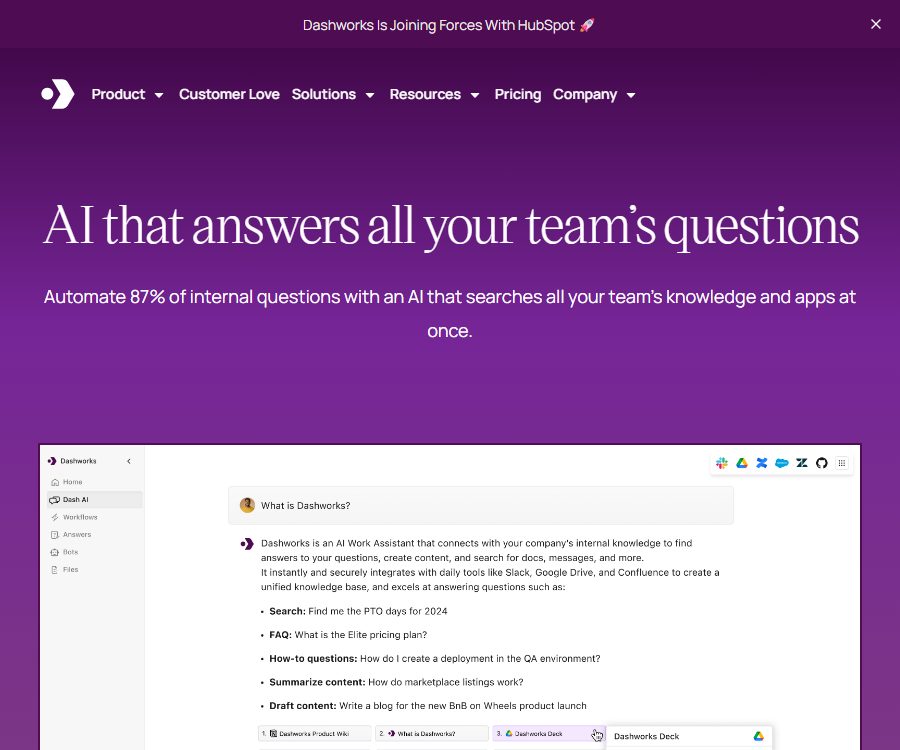
Dashworks was once an enterprise AI search and Q&A assistant that connected a team’s cloud applications, files, messages, and business systems to answer internal questions and generate work tasks.
In 2025, HubSpot acquired Dashworks, and the standalone service was discontinued. It is no longer possible to register for a new account, log in to the web application, or use the original Dashworks API; the remaining official website pages are only useful for learning about the product’s history.
Acquisition and shutdown timeline
| Date | Event | Impact on users |
|---|---|---|
| April 16, 2025 | Announce joining HubSpot, and provide instructions for migration and export. | Web applications and Slackbots no longer accept new registrations; existing customers are in a transition period. |
| April 23, 2025 | The Dashworks API is no longer available. | The existing programmed integration is no longer available. |
| July 16, 2025 | Login is disabled for web applications and Slackbots. | Once access to all individual products is completed, the window for exporting historical data closes as well. |
| Within 30 days after shutdown | Delete customer data | The migration guide promises to securely remove customer data from the Dashworks system. |
The official transition arrangements also guarantee that customers will receive a proportional refund for the periods for which they have prepaid but can no longer use the service. At this stage, it is not necessary to make any payments to old accounts or rely on previously exported data.
What problems has Dashworks solved in the past?
Corporate knowledge is often scattered across chats, cloud storage, project management tools, CRM systems, code hosting platforms, and help desks; employees are thus forced to search through multiple systems repeatedly. Dashworks was designed to allow users to find information across these systems using a natural language interface.
- Internal Q&A: Answers employee questions based on the company’s internal knowledge base, and includes relevant internal documents in those answers to facilitate verification by users.
- Unified search: Retrieve documents or conversations across files, messages, emails, calendars, tasks, tickets, CRM data, and code collaboration platforms.
- Real-time reading: For applications that support it, real-time search interfaces are used instead of creating long-term indexes for all content, in order to reduce the number of outdated copies.
- Permission inheritance: Synchronizes the access permissions of various connected applications, showing users only the results to which they are authorized to have access.
- Content generation: Drafting emails, preparing summary documents, creating content, or providing assistance in dealing with various issues, all based on the company’s knowledge.
- Custom Bots: Administrators can select models, commands, and available applications to create dedicated Q&A bots for different departments.
- Workflow templates: Use reusable prompts to handle code reviews, support tickets, social media content, and other repetitive tasks.
- Management Insights: Helps administrators identify knowledge gaps, permission issues, and documents that need to be updated.
Historical input and output
| Task | Enter | Historical output | Precautions |
|---|---|---|---|
| Corporate Q&A | Employees’ natural language questions | Integrated answers and relevant materials based on internal knowledge | The generated answer may not be accurate; it is necessary to check the original text. |
| Cross-application search | Keywords, people, projects, or customer leads | Files, messages, emails, events, tickets, and records | The results are limited by the connection scope and the permissions of the original system. |
| Content generation | Task instructions, templates, and company knowledge | Emails, summaries, drafts, and code assistance content | Manual review is required when customer commitments or code changes are involved. |
| Custom Bot | Models, instructions, scope of application, and confidence thresholds | Robots dedicated to specific departments or scenarios | Different bots may have varying levels of access to data. |
| Data export | Export request by administrator or individual | Bookmarks, connections, files, answers, bots, workflows, and conversations, etc. | The official export window has closed. |
Historical usage process
- The workspace administrator creates organizations and connects the cloud applications used by teams.
- The system inherits the user identities and access permissions from various applications, thereby restricting the search scope for different members.
- Employees can raise questions, search for information on the web page or in Slack, or generate content using workflows.
- Dashworks performs real-time queries of authorized systems, aggregates the responses, and provides verifiable internal materials.
- Users examine the original document, the time frame, and the permissions before taking any action, and provide feedback on incorrect answers.
- Administrators examine the level of adoption, existing knowledge gaps, as well as Bot and permission settings, and continuously adjust data connections and commands accordingly.
The above process is intended solely to illustrate the design of previous products; the original web interface, Slackbot, and API are no longer in use.
Historical prices and current purchase status
The official website still shows the prices from before the service was discontinued, but these plans can no longer be purchased. The 14-day trial, as well as the Team, Business, and Enterprise plans, are all part of the past package offerings.
| Package or version | Historical prices | Historical billing cycle | Original core rights and interests | Current status |
|---|---|---|---|---|
| 14-day trial | 0 dollars | One-time, 14 days | Product trials that do not require a credit card | New registrations are closed. |
| Team | $ | Monthly or annual payment | No minimum number of seats required; includes search, Slackbot, and workflows. | No longer in operation; not available for purchase. |
| Business | $ | Monthly or annual payment | At least 10 seats, with additional enterprise features such as custom bots. | No longer in operation; not available for purchase. |
| Enterprise | It was originally a custom quote. | Contract-based billing | Advanced management, security, training, and support | No longer in operation; not available for purchase. |
| HubSpot-related capabilities | The old prices from Dashworks cannot be used. | In accordance with HubSpot’s current product rules | The acquired technology is used to enhance Breeze’s search and contextual capabilities. | It’s not the standalone package of the original Dashworks. |
Historical integration scope
- Collaboration and messaging: Slack, Microsoft Teams, Google Chat, etc.
- Files and knowledge: Google Drive, Dropbox, Notion, Confluence, OneDrive, SharePoint, and internal websites.
- Research and development and project management: GitHub, Jira, Linear, Asana, Trello, ClickUp, and other project management systems.
- Customers and sales: Salesforce, HubSpot, Zendesk, Intercom, Pipedrive, etc.
- Email and meetings: Gmail, Google Calendar, Outlook, call transcription and recording systems.
These connectors cease to function along with the standalone services, and it cannot be assumed that they are still capable of authorization or synchronization based on the static integration page.
API, application, and open-source status
- The original Dashworks API was discontinued on April 23, 2025; older applications can no longer rely on this interface.
- Access to the web application and Slackbot was discontinued on July 16, 2025.
- No independent iOS or Android clients have been identified, nor are any browser extensions currently available.
- There is no confirmation regarding an officially available product repository, SDKs, or open-source licenses; the previous version of Dashworks was a proprietary cloud service.
- HubSpot has acquired the teams and technologies, but the existing APIs, pricing models, bots, and workflows cannot be considered part of HubSpot Breeze’s current features.
The historical perspective on security and privacy
- The security page listed SOC 2 Type 2, GDPR, HIPAA Type 1, static AES-256, and transport TLS 1.2, and it supported permission synchronization as well as SCIM.
- For the supported applications, the no-indexing approach allows information to be retrieved via real-time interfaces, thereby reducing the need to store additional corporate content; other functions may still save accounts, configurations, conversations, and uploaded files.
- The safety guidelines state that third-party AI processors are not allowed to use customer data to train their own models, but the old terms of service permitted the use of input data, output results, or content to improve the performance of the Dashworks services and models, without the user needing to log out first; these two provisions cannot be considered as the same commitment.
- The Google Workspace API data is subject to specific restrictions; it cannot be used for developing, improving, or training general-purpose, non-personalized AI or machine learning models.
- The privacy policy stated that personal data from the EU could be transferred to the United States via standard contract clauses, and provided options for requesting access, correction, and deletion of such data.
- The shutdown and migration guide guarantees that all customer data will be securely deleted from the Dashworks system within 30 days after July 16, 2025.
Advice for existing users and new visitors
- Stop trying to purchase old plans, create new workspaces, or restore the original API – the official date on which these services were discontinued has already passed.
- If internal documents still contain Dashworks Tokens, Webhooks, or connection credentials, those credentials should be revoked in the respective third-party applications and replaced.
- Check the Slack workflows, bots, bookmarks, and automations that rely on Dashworks to ensure that they have been switched to another valid system.
- When evaluating alternative enterprise search solutions, it is important to compare aspects such as permission inheritance, real-time searching, traceability of references, data retention, model training, and the ability to export data in bulk.
- If you need AI search within HubSpot, you should follow HubSpot’s current documentation and account settings; do not rely on the old interface or plans from Dashworks.
Frequently Asked Questions
Is it still possible to register for or use Dashworks?
It’s not possible. New registrations will cease on April 16, 2025, while logging in to the web version and the Slackbot will be disabled on July 16.
Can the Dashworks API still be used?
No. The standalone API was discontinued on April 23, 2025.
Can the packages listed on the old price page still be purchased?
No. Team, Business, Enterprise, and the 14-day trial are all historical information from before the service was discontinued.
Did the original customer receive a refund?
The migration plan guarantees a proportional refund of the prepaid amount once the workspace is no longer in use.
What happened to Dashworks’ customer data later on?
The official migration guide promises that all customer data will be securely deleted within 30 days after the service is discontinued on July 16, 2025.
Has Dashworks become HubSpot Breeze?
It’s not possible to equate the two in this manner. Teams and technologies were added to HubSpot to enhance Breeze, but the original product, APIs, interface, and plans have been discontinued.
Tools similar to Dashworks



 Guigong Network Security Registration No. 45132202000164