






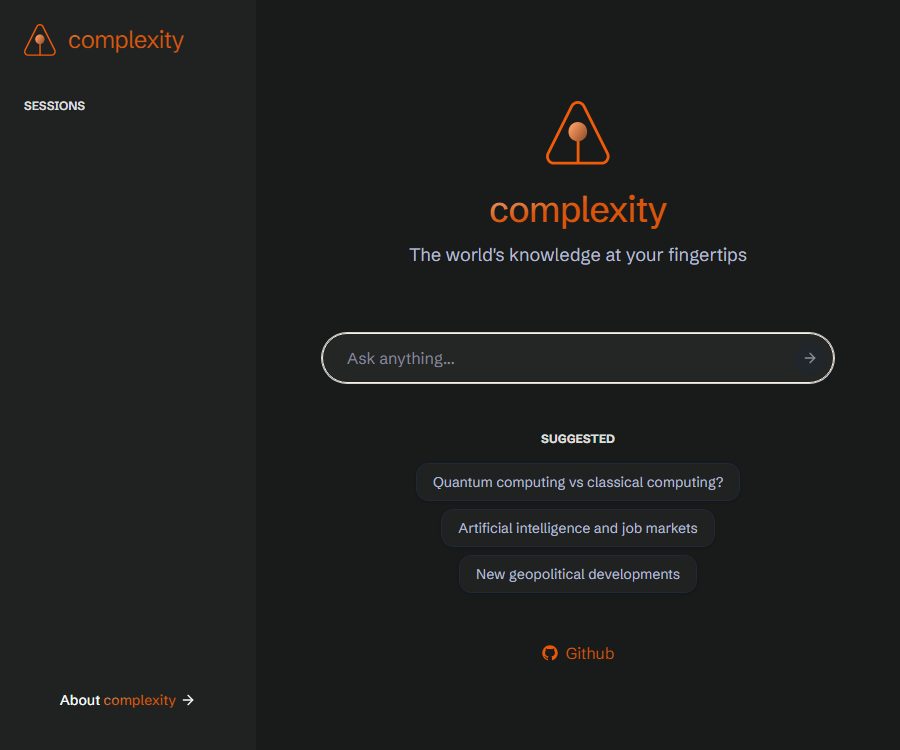
Complexity AI
Complexity AI enhances the efficiency of AI, making tasks more efficient and simpler to handle.
Tags:AI improves efficiencyWhat is Complexity AI?
Complexity AI is a web-based AI search engine created by Emil Ahlbäck and Hamed Mohammadpour; its purpose is to answer questions in natural language and to display relevant web content. It is built on Cohere’s conversational capabilities together with a web search engine, and it functions as a simplified version of an online Q&A tool.
This entry refers to the Complexity AI search website and its FOLLGAD team’s code repository; it is not the Perplexity browser extension with the same name. The developers, web addresses, functions, and license statuses of these two are all different.
Main functions
Online Q&A
- When a user enters a text-based question on the website, the system first performs a search on the site, and then the model generates a concise answer in natural language.
- Answers are displayed step by step in a streaming manner, making it suitable for quickly understanding concepts, comparing topics, or tracking general information.
- By default, the open-source code uses the Cohere Command R series of models, but the models that are actually used in deployment can be adjusted through server environment variables.
Searching for document and paragraph citations
- The search connector returns relevant documents; the results page displays the titles of these documents in the form of cards, and the ranges of references are indicated within the text of the answers.
- Users can view the document corresponding to a certain piece of text, which helps determine whether the answer is supported by the retrieved materials.
- The fact that a citation is present does not necessarily mean that the conclusion is correct; it is still necessary to check the date, context, and credibility of the original source.
Continuous questioning and asking for suggestions
- Questions can be entered further within the same session, and the server will provide the existing questions and answers as part of the chat history to the model.
- After each round, the system can automatically generate up to three short follow-up questions based on the current session.
- Long sessions may lose early details due to truncation of the model’s context, so key conditions should be restated through follow-up questions.
Session recording and sharing
- The browser saves a list of sessions locally, making it easy to return to previous questions and answers.
- The server-side code also writes the questions, answers, user identifiers, references, and document information into the database, to enable historical retrieval and read-only sharing.
- The sharing feature creates a read-only session page; before sending, it is necessary to check whether the conversation contains personal, customer, or internal information.
Feedback and usage analysis
- The results page provides options for approval, rejection, and textual feedback, helping developers assess the quality of responses and understand functional requirements.
- It integrates the open-source tool PostHog to log events such as page visits, questions, answers, clicks, feedback, and anonymously generated user identifiers.
- The site does not disclose the complete procedures for data retention and deletion; for sensitive queries, it is not sufficient to rely solely on anonymous identifiers to ensure privacy.
Input and output
| Project | Supported content | Result format | Restrictions |
|---|---|---|---|
| Enter | Natural language text problems and sequential questioning | Submit to the web page Q&A process | No functionality for uploading documents, images, or audio files is available. |
| Search | The model invokes the web search connector to obtain documents. | Search for document cards and reference mappings | The coverage area and update time are not publicly available. |
| Answer | Generate content by combining issues, history, and search materials. | Stream-based Markdown text | Omissions, outdated information, or incorrect conclusions may occur. |
| Subsequent operations | Follow-up questions, copying and sharing, quality feedback | Continuous sessions and read-only pages | Session data may be stored locally as well as on the server side. |
Usage method
- Open the product page and enter the specific issue in the input field, making sure to include the topic, time frame, and the desired format of the output.
- Wait for the system to complete the web search and generate the streaming response; first view the document cards resulting from the search, then check the citations corresponding to the key statements.
- Use suggested questions or ask additional questions to provide more details; if necessary, request comparisons between different viewpoints or a narrowing of the time frame.
- Review the original materials regarding important facts; do not consider the generated results as medical, legal, financial, or other professional conclusions.
- When collaboration is needed, a read-only session can be shared, but sensitive content should be removed first, and it should be taken into account that the person who receives the link might see the entire conversation.
Suitable for users and scenarios
- General information lookup: Quickly obtain an overview of a topic in natural language, and then proceed to reading the cited materials.
- Starting point for learning and research: Continuously ask questions around a certain concept, and organize relevant terms, differences, as well as potential directions for further investigation.
- Preparation of content topics: Search for clues on public websites and common opinions, but independent fact-checking is still necessary before publishing.
- Developer learning: Study how Next.js, Cohere, web search, streaming responses, and reference display are implemented.
Managed services vs. self-deployment
The product page does not provide information regarding subscription options, points, usage limits, or enterprise solutions; nor is there any guarantee of permanent free access. The website offers a direct inquiry option at the moment, but the number of times inquiries can be made, the constraints on simultaneous requests, and potential future charging methods are not yet disclosed.
| Package or version | Price | Billing cycle | Core benefits or quota | Suitable for users |
|---|---|---|---|---|
| Official hosting page | Not yet made public | Not yet made public | Asking questions on web pages, retrieving answers, citing content, and maintaining continuous sessions; the quota is not disclosed. | Users who wish to experience it firsthand |
| Self-deploy the source code | The price of the software has not been made public yet. | Bear the service costs yourself. | It is necessary to set up Cohere, a database, analysis services, and the deployment environment. | A team with capabilities in development and operation. |
Self-deployment may also incur costs related to model invocation, web searches, databases, as well as hosting and analysis services. Since the repository lacks a license, it is necessary to obtain appropriate authorization from the copyright holders before deploying, modifying, or using it for commercial purposes.
Platform, API, and open-source status
- The product is available in the form of a responsive web page; no official mobile app, desktop client, or browser extension has been found.
- The warehouse makes available internal interfaces such as Q&A and suggestions, but it does not provide stable APIs, SDKs, authentication solutions, or service level guarantees for third parties.
- A code repository allows one to view and replicate the technical structure, but no license files are provided; the fact that the source code is made public does not entail permission to copy, modify, distribute it, or use it for commercial purposes.
- The repository is not archived, but the last code push dates back to December 2024; the current pace of maintenance and the future roadmap are not yet clear.
Notes on privacy, security, and copyright
- In a public implementation, the user identifier is stored locally in the browser, along with a copy of the session.
- Questions, answers, citations, and related documents are stored in the server-side database; the analysis component may also receive events related to page visits, inquiries, answers, and feedback.
- The product does not have a public, independent privacy policy, information regarding retention periods, procedures for requesting data deletion, terms of service, or security guidelines; therefore it is not suitable for storing confidential, regulated, or personally identifiable data.
- Web search results and model responses may contain content protected by third-party copyrights; citing such content does not automatically grant the right to reproduce or use it for commercial purposes.
- There are no public rules regarding refunds or payment contracts; if a payment interface becomes available in the future, it is necessary to check the prices, as well as the conditions for renewal, cancellation, and refunds, before making any payments.
Capacity boundaries
- This is a lightweight online Q&A tool; it is not a vetted professional database, nor does it offer public access to a comprehensive search range.
- The model may misinterpret web pages, confuse times, or generate statements without proper basis; its citations may also support only a part of a sentence.
- It is not possible to determine whether the current deployment is exactly identical to that in the public repository; the stability of the models, data processing, and services may change depending on the environment settings.
- The interface is primarily in English, and there is no guaranteed quality for inputs and responses in other languages.
Frequently Asked Questions
What can Complexity AI do?
It accepts text-based questions, searches the web, and generates responses in real time that include cards with the searched documents as well as paragraph citations; it also allows for further questions to be asked within the same session.
Is it an official product of Perplexity?
No. This entry refers to the separate Complexity AI search project; it should not be confused with Perplexity or the browser extension of the same name.
Is Complexity AI free?
The current website provides a direct option for submitting questions, but it does not offer any guarantees of free access on a long-term basis, nor does it specify any limits on the number of queries or any pricing plans; therefore, it cannot be considered a service that is available indefinitely at no cost.
Is Complexity AI open-source software?
The official repository has made the source code available, but no license has been specified. Users can read the code, yet they cannot assume that they have been granted permission to modify it, distribute it, or use it for commercial purposes.
Are APIs or SDKs available?
The project code includes internal Q&A interfaces and makes use of the Cohere SDK, but no stable API or official SDK that can be used by third parties has been released.
Can sensitive information be entered?
It is not recommended. A public implementation would handle sessions locally and on the server, as well as enable usage analysis; however, the site has not yet made its data retention, deletion, and security policies fully public.
Tools similar to Complexity AI



 Guigong Network Security Registration No. 45132202000164