






Connecterra
Connecterra: boosts AI efficiency, making work more efficient and simpler.
Tags:AI improves efficiencyWhat is Connecterra?
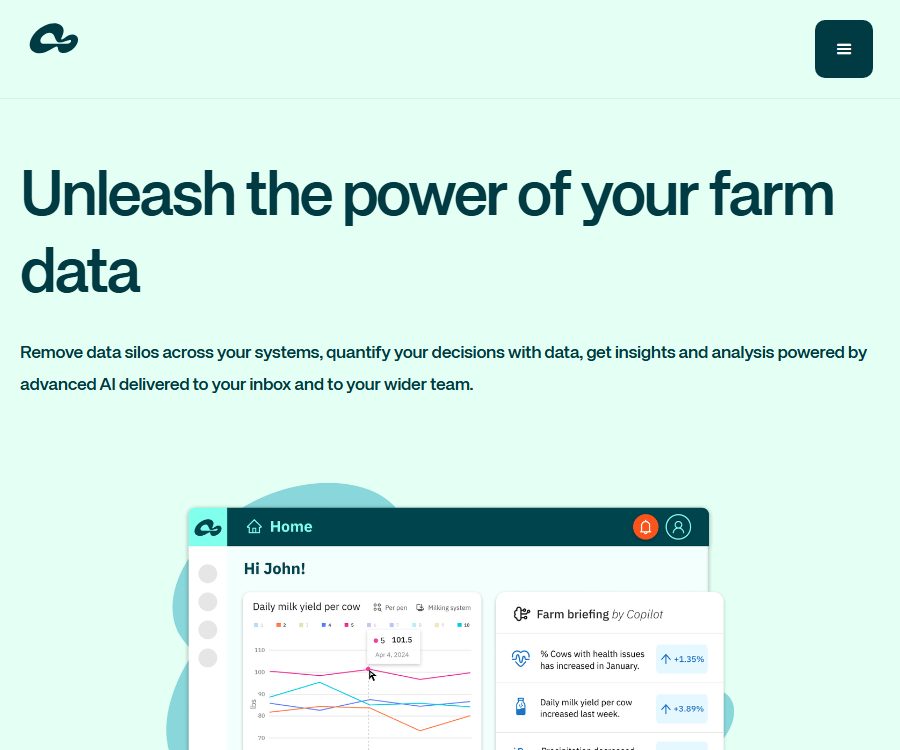
Connecterra is a data and AI-based decision-making platform designed for dairy farms, ranch consultants, and dairy industry organizations; it is currently part of the Datamars brand portfolio. Its main function is to aggregate the data scattered across cattle management, milking, feeding, sensors, and business systems, turning it into insights and alerts that can be used for daily management.
The service provider specified in the platform’s privacy policy is Connecterra B.V. in the Netherlands, while the developer of the mobile app store is listed as Datamars SA. The Ida sensor business was integrated into Datamars in the past; currently, Connecterra focuses on cross-system data platforms, so the two should not be considered identical products.
Main functions
Multi-source data connection and quality inspection
- It can integrate data from cattle herd management, milking, feeding, behavior sensors, health, reproduction, finance, weather, as well as offline files.
- The system synchronizes, cleans, and enriches the data, and uses anomaly detection to identify missing, duplicate, or suspicious records, thereby reducing the need for manual processing.
- Different pages utilize over 30 and more than 50 systems respectively; the specific connectors, synchronization frequency, and available fields need to be confirmed at the time of activation.
Analytics analysis
- Users can view indicators such as milk production, reproduction, feeding, behavior, health, and weather on the dashboard, and filter by number of days in lactation, herd, or parity.
- Events can be overlaid on trend charts, allowing adjustments to the diet, management actions, or abnormal dates to be viewed alongside changes in the indicators on the same timeline.
- The output includes charts, key metrics, and clues to anomalies, making it suitable for post-meeting reviews, comparisons across different sites, and issue diagnosis.
Copilot weekly reports and reminders
- Copilot continuously monitors the connected data and sends, on a weekly basis, an email summarizing the key changes, risk signals, and matters that require attention.
- Users can also generate ranch reports for custom date ranges, and receive alerts via email or mobile push notifications when thresholds are reached.
- The report combines information on pasture-related incidents with relevant context, but it serves only as an auxiliary analysis tool and should not replace veterinary diagnosis, nutritional plans, or on-site inspections.
Decision Support Decision-making support
- Impact trackers are used to observe changes in yield, milk fat and protein content, income, behavior, or feeding practices before and after a management adjustment.
- A/B testing analysis allows for the comparison of different herds or approaches, while the event timeline records management events that are identified automatically or added manually.
- The results are used to formulate hypotheses and to monitor outcomes; synchronous changes in the data do not automatically prove a causal relationship between management actions and the results.
Team collaboration and multi-farm management
- Farm owners can invite employees, consultants, or organization members, and control which farms and data they are able to view.
- Consultants can view metrics and alerts in a multi-farm view, which is suitable for nutrition, veterinary, and operations teams serving multiple clients.
- Authorization is revocable; companies or consultants need the consent of the farm owner in order to access data related to a specific farm.
Data API
- The Connecterra Data API provides REST-based data access, with requests being made using bearer tokens issued by authentication services.
- The interface enables the extraction of data on animal status, behavior, feeding, and production; it also allows for the customization of datasets and two-way integration based on the needs of the enterprise.
- The public documentation follows the OpenAPI standards, but this does not mean that an official SDK is provided; the interfaces are offered as they are, with a warning that version changes may lead to incompatibilities.
Input and output
| Type | Common content | Processing results | Primary uses |
|---|---|---|---|
| Cattle herds and production data | Animal records, lactation stage, milk production volume, milk composition | Generate dashboards, trends, and grouped comparisons | Tracking production and herd performance |
| Feeding and behavior data | Diet, feeding, rumination, activity data | Abnormality alerts, change correlations, and weekly reports | Feeding or behavioral abnormalities detected |
| Health and reproduction data | Records of diseases, treatments, breeding, pregnancy, and events | Health and reproduction indicators, timeline | Supports review of veterinary and breeding management practices. |
| Operational and environmental data | Milk prices, income, finances, and weather | Impact estimation and background comparison | Assess the business impact of management changes |
Usage process
- Register or apply for a trial, select the usage option for farms, consultants, or businesses, and specify the size of the herd as well as the data sources that need to be connected.
- Authorize connections to existing systems, or import configuration files and API data from implementation teams; check for missing, duplicate, and abnormal records marked in the system.
- In the Farm Timeline, add events such as feed adjustments, treatments, or equipment changes to create an understandable background for the farm.
- Use Analytics to select metrics, time ranges, and herd filtering criteria, view trends, and overlay events on the chart.
- Configure Copilot’s weekly reports, threshold alerts, and mobile notifications, and regularly check the alerts against the actual conditions on site.
- Validate management measures using impact tracking or grouped comparisons, and invite employees, consultants, or company members to collaborate based on their roles.
Suitable for users and scenarios
- Dairy farm operator: Monitor production, health, reproduction, and feeding metrics in one place, thereby reducing the need to switch back and forth between different systems.
- Dietitians, veterinarians, and ranch consultants: Manage multiple clients’ ranches, and determine the priority of services based on weekly reports and alerts for any abnormalities.
- Dairy companies and partner organizations: After obtaining authorization from the farms, they conduct comprehensive analyses, incorporate internal data or models, and develop customized workflows.
- Data and technology team: Retrieves standardized ranch data via REST APIs, and develops reports, data pipelines, or enterprise system integrations.
Plans and prices
The public pricing page shows the usage options for trials, consulting services, farms, and enterprises, but it does not specify the payment amounts. The actual prices, taxes, currency used for settlement, as well as the conditions for cancellation and refunds are determined based on the account settlement page, the contract, or the sales confirmation.
| Package or version | Price | Billing cycle | Core benefits or quota | Suitable for users |
|---|---|---|---|---|
| The consultant recommends a free solution. | Free | Not yet made public | Up to 3 farms can be connected; functionality is limited. | Consultant trying the multi-farm view for the first time |
| Farm Advisor | Contact sales | Not yet made public | Multi-farm management, analysis, and support features | Professional consultants and service organizations |
| Farmer | Contact sales | Calculations are to be done on a monthly basis; the details need to be confirmed. | 60-day trial period; the license baseline is determined based on the average herd size per year | Independent dairy farms and ranching teams |
| Enterprise | Custom quote | In accordance with the contract | Custom integration, Data API, organization-level workflows | Dairy companies and large organizations |
If there are more than 3 farms connected, if the herd size exceeds 5,000 heads, or if an enterprise-level configuration is required, it is necessary to contact sales. When the scale of the farms changes by more than 15% relative to the licensed baseline, it is also necessary to consult the service provider regarding any adjustments to the licenses.
Supported platforms
| Platform | Provided format | Precautions |
|---|---|---|
| Web version | The complete data platform within the browser | Suitable for desktop-based analysis, configuration, and multi-farm management. |
| iOS and iPadOS | App Store apps | The system requirements and update dates listed by the store may change. |
| Android | Google Play apps | It can be used for mobile viewing, reminders, and on-site collaboration. |
| Enterprise systems | REST Data API | Tokens, permissions, and corresponding contract configurations are required. |
API and open-source status
The Data API documentation is available for public viewing, but calling it requires an authentication token and the appropriate access rights. No official SDK, product source code repository, or open-source license at the product level has been found; therefore, the public interface specifications cannot be considered equivalent to open-source products.
Privacy and data security
- The ranch owner retains control over its own data, can grant access to specific individuals and can also revoke such access; it is stated publicly that the ranch’s data will not be sold.
- The service handles account information, contact details, device and usage data, and may store such data for the purposes of fulfilling obligations, providing support, conducting analyses for improvement, or meeting legal requirements.
- Data may be processed across borders, and the retention period depends on service requirements, legal obligations, and security needs; users can request access to, correction of, or deletion of their personal information through the channels specified in the policy.
- The platform’s documentation states that it is hosted on Microsoft Azure, but Google Play’s data security labels indicate that the data is not encrypted; for sensitive deployments, it is necessary to verify with the service provider what measures are in place for protecting the data during transmission, storage, and transfer.
- Public information does not provide complete details on the refund rules; it is necessary to clarify the procedures for switching from a trial version to a paid version, renewing the subscription, canceling it, exporting data, and terminating the contract before making a purchase.
Capacity boundaries
- Quality analysis relies on the integrity of source system data, its temporal consistency, and field mapping; anomaly detection cannot correct all errors that occur during data collection.
- The number of connectors is indicated differently on various pages; older devices, regional systems, or custom-developed software may require customized integration.
- AI summaries and threshold alerts are used to identify key issues, but they do not guarantee the detection of all diseases, equipment failures, or operational risks.
- The information available in mobile app stores may not be synchronized with that on web platforms; it is necessary to verify the current version, language, device, and account permissions before deployment.
Frequently Asked Questions
What problem does Connecterra mainly address?
It aggregates the data from various systems in the dairy farm onto a single platform, and uses dashboards, alerts for anomalies, weekly reports, and impact analyses to help the team identify issues more quickly and assess management changes.
Are the Connecterra and Ida sensors the same product?
It is not exactly the same as the current product positioning. The Ida sensor business has been integrated into Datamars, while Connecterra now functions primarily as a platform for managing data across different systems and for making decisions using AI.
Is Connecterra free?
The plan recommended by the consultant allows for free connection to up to 3 farms, with limited functions; the price of the paid version is not disclosed. The pricing page states that a 60-day trial period is available, and the final cost must be confirmed by contacting sales.
Which ranch data can be connected?
Common categories include herd management, milk production, feeding, behavior, health, reproduction, financial data, and weather data. The specific equipment, systems, fields, and synchronization frequency need to be verified before implementation.
Does Connecterra provide APIs or SDKs?
The platform offers REST Data APIs and OpenAPI documentation that require authentication for data extraction and enterprise integration; no official SDKs are available at present.
Who controls the ranch data?
The official policy states that the ranch owners retain control over their own data and can grant or revoke access to specific individuals. In cases involving sensitive data, it is still necessary to define security measures, retention periods, and the way in which such data will be handled after access is withdrawn, through contractual agreements.
Tools similar to Connecterra



 Guigong Network Security Registration No. 45132202000164