






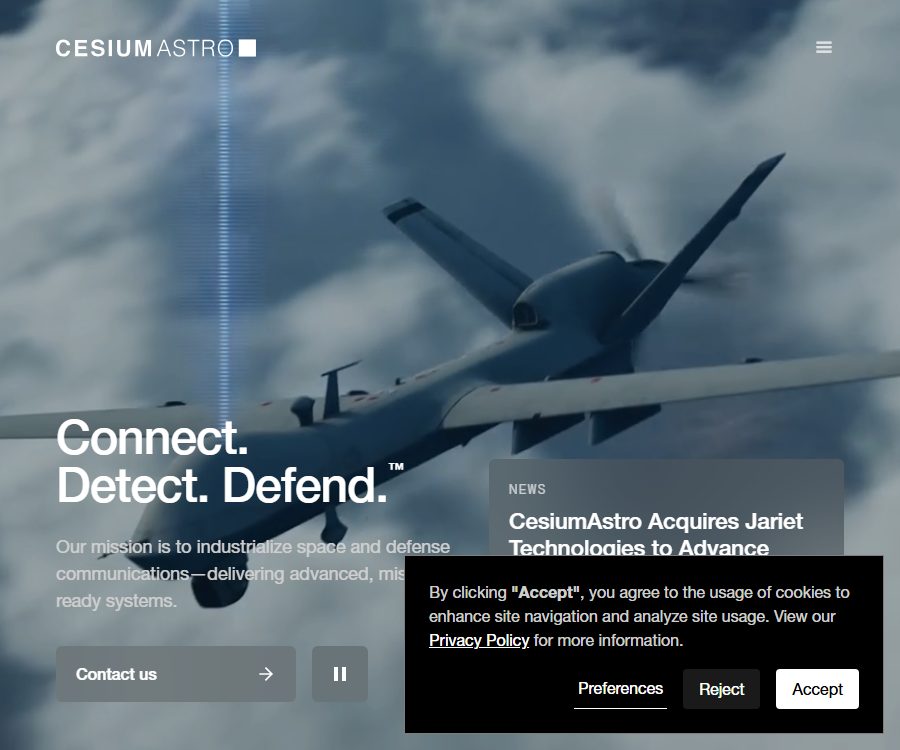
CesiumAstro
CesiumAstro: enables AI to make work more efficient and simpler.
Tags:AI improves efficiencyWhat is CesiumAstro?
CesiumAstro Inc. is a manufacturer of communication systems for aerospace, defense, and commercial applications; it designs, manufactures, and tests satellites, phased-array payloads, SATCOM terminals, software-defined radios, and onboard processing equipment. Its products integrate radio frequency hardware, beamforming technologies, processors, firmware, waveforms, and software to create mission-specific systems.
It is not an online AI tool that requires personal registration followed by the entry of prompts; nor does it offer a free public version or self-service subscription. AI represents the capability embedded in satellites, payloads, terminals, and ground systems, and it is used for signal analysis, RF optimization, mission planning, payload scheduling, and edge-based decision-making.
Product portfolio
| Product or series | Form | Primary uses | The role of AI and software | Procurement method |
|---|---|---|---|---|
| Element | Integrated low-earth orbit satellite platform | Communication, intelligence, surveillance, and reconnaissance as well as constellation missions | On-board AI, ground-based AI interfaces, autonomous signal processing, and dynamic task scheduling | Contact sales |
| Vireo | Multi-beam active phased array payload | High-throughput satellite communication and multi-user coverage | Digital beamforming, dynamic capacity allocation, and reconfigurable processing | Contact sales |
| Nightingale | Single-beam communication payload | Satellite missions that require comprehensive coverage and simplified integration | Software-defined radio and task configuration | Contact sales |
| Skylark | Flat-panel phased array SATCOM terminal | Aviation, land, maritime, unmanned systems, and emergency communications | Software-defined, cross-track connection, and beam control | Contact sales |
| RPU and RDP | Reconfigurable airborne processing platform | Signal processing, channeling, task applications, and data pipelines | It handles AI and machine learning workloads, with acceleration provided by FPGA. | Contact sales |
| SDR series | Software-defined radio module | Low Earth orbit, geosynchronous orbit, the Moon, deep space, and onboard communication | Configurable waveforms, frequency bands, and data processing | Contact sales |
| SBC and power supply module | Single-board computer and power supply module | Command and control, data processing, and power supply for the SpaceVPX system | Provides a platform for upper-level task software and processing architectures | Contact sales |
AI capabilities and current limitations
Already established capabilities
- Element incorporates onboard AI and native ground-based AI interfaces into its architecture, which are used for autonomous signal processing, task planning, and dynamic payload scheduling.
- General-purpose computing and reconfigurable hardware can support AI, machine learning, sensor processing, DSP, and custom data pipelines.
- Multi-beam systems can dynamically allocate capacity based on users, gateways, or areas with high demand, and update beam plans, waveforms, and routing in orbit.
- AI enhancement does not mean that the system operates outside its designated rules; the boundaries of operations, permissions, failure modes, and the need for human intervention must still be defined by the customer.
Capabilities being expanded following the acquisition
In 2026, CesiumAstro acquired Vidrovr, a company specializing in real-time multi-modal signal analysis, and began to extend its machine learning capabilities to communication payloads, Element satellites, and ground networks. The goals include adaptive radio frequency optimization, autonomous operation of payloads, edge computing, data prioritization, and inter-satellite and ground-based routing.
- Multimodal signal analysis can integrate data from sensors such as visual, radio frequency, and electromagnetic sensors, rather than processing only data from a single source.
- Edge inference aims to determine in advance, before data is sent down, which data should be processed on board and which should be transmitted to ground-based systems.
- The machine learning team has proposed approaches such as countering RF interference, automated operation, and distributed intelligent networks; however, the maturity level of delivery for each of these products needs to be assessed individually.
- Fully autonomous satellites and real-time self-optimizing networks, which are part of the vision for development over several years, cannot be considered standard features of all currently available models.
Primary communication value
- Inter-stellar links: Enable real-time data transmission within a constellation, reducing reliance on the visibility window of any single ground station.
- High-speed downlink: Transfers orbital mission data to ground stations with high throughput.
- Lunar communication: Supports lunar mission architectures such as Earth-Moon links, relays, and short-range networks.
- Multi-beam connection: Uses independent, controllable beams to serve multiple users, gateways, or areas simultaneously.
- 5G terrestrial networks: The next-generation networks that connect the terrestrial, aerial, and space domains.
- Mobile SATCOM: Provides beyond-line-of-sight connectivity for aircraft, unmanned platforms, ships, emergency response teams, and fixed sites.
Typical project workflow
- Define task orbit, coverage, frequency band, throughput, latency, platform size, power consumption, thermal design, and reliability objectives.
- Determine whether to purchase a complete satellite, communication payloads, terminals, processing modules, or a fully integrated system.
- Describe the requirements for AI or software, including input signals, reasoning locations, decision-making authority, model updates, and methods for manual intervention.
- Work with the sales and engineering teams on confidentiality, export controls, data classification, and end-user verification.
- Request a formal quote, specifications, interface control documents, verification plan, delivery milestones, and a list of software licenses.
- Submit a purchase offer and wait for written acceptance; a display on the website or oral communication does not constitute a final contract.
- Functionality and fault tolerance are verified through environmental, radio frequency, hardware-in-the-loop, and system-level testing, before deciding on flight or field deployment.
- After delivery, the firmware, waveforms, models, keys, spare parts, defect fixes, and configuration changes are managed in accordance with the contract.
Input, processing, and output
| Stage | Typical input | Main processing | Typical output |
|---|---|---|---|
| Communication link | RF signals, link status, user and gateway requirements | Beamforming, modulation and demodulation, channeling, and routing | Multi-beam coverage, data links, and capacity allocation |
| On-board AI | Vision, radio frequency, electromagnetic, and task context | Multimodal analysis, reasoning, prioritization, and task planning | Load commands, alerts, summaries, and download decisions |
| Constellation Network | Inter-stellar topology, link quality, and traffic volume | Path selection, resource allocation, and in-orbit reconfiguration | Interstellar routing and terrestrial exit arrangements |
| Ground and terminal | Satellite orbit, network, platform attitude, and operational data | Electronic beam control, cross-track connection, and network management | Aerial, terrestrial, maritime, or emergency connections |
The actual interfaces, data formats, frequency bands, models, inference hardware, and output permissions vary depending on the task and the applicable specifications. A public product overview cannot replace interface control documents, export classification rules, test reports, or written acceptance criteria.
Suitable for customers and scenarios
- Government and defense agencies: flexible communications, intelligence, surveillance, and reconnaissance, as well as mission-level constellations.
- Satellite operators: high-throughput payloads, inter-satellite links, dynamic beam steering, and in-orbit reconfiguration.
- Aviation and Unmanned Systems Team: beyond-visual-range command and control, mission data, and multi-track connectivity.
- Maritime and emergency organizations: Continuous communication in offshore environments, during disasters, and in cases of network disruptions on land.
- Moon and Deep Space Projects: Dedicated radio systems, processing modules, and relay network architectures.
- It is not suitable for individual creators, ordinary corporate chatbots, teams that lack aerospace integration capabilities, or those looking to acquire a ready-to-use SaaS solution.
Prices and Purchases
CesiumAstro does not disclose any retail prices, free usage limits, trial versions, or subscription plans; the cost of all its main products is determined based on the requirements of the task, the quantity needed, the level of work involved, and the delivery conditions. A fixed price is established only after the customer’s purchase offer is accepted in writing, at which point a contract is formed.
| Package or version | Price | Billing cycle | Core benefits or quota | Suitable for users |
|---|---|---|---|---|
| Element task system | Custom quote | By project and milestone | Satellites, payloads, AI interfaces, integration, testing, and delivery scope | Governments, operators, and constellation projects |
| Vireo or Nightingale payload | Custom quote | According to the purchase order | Phased array, RF, processing, firmware, waveforms, and support | Satellite Manufacturing and Payload Team |
| Skylark terminal | Custom quote | By configuration and quantity | Different sizes, tracks, platforms, and network integrations | Aviation, maritime, land, and unmanned platforms |
| Processors, radios, and modules | Custom quote | By model and quantity | Hardware, embedded software, documentation, and agreed-upon services | Aerospace system integrator |
| Custom AI and systems engineering | Contact sales | By range and milestone | Models, signal analysis, edge deployment, and task integration | Organizations with clear, defined requirements for controlled tasks |
Notes on payment and delivery
- Unless otherwise specified in the quote, payments shall be made in US dollars, via bank transfer or check.
- The full payment is usually made within four weeks after the customer’s offer is accepted, and delivery is arranged only upon receipt of the full amount.
- The down payment is usually due within 14 days after accepting the offer, while the remaining amount is to be paid before delivery.
- The scheduled delivery date is a non-binding estimate; the actual milestones, responsibilities in case of delays, and acceptance criteria must be specified in the order.
- If an order cannot be fulfilled due to the unavailability of the product, the amount paid for it will be refunded in accordance with the relevant terms.
- This is not a consumer subscription; there is no universal 7-day trial period or policy for unconditional refunds.
Warranty, software licensing, and liability
- The standard warranty for non-flight products is usually one year from the time of customer acceptance.
- Flight products are typically covered by a warranty for one year after acceptance or until the date of launch, whichever comes first.
- The hardware warranty covers defects in materials and manufacturing; the software operates in accordance with the applicable specifications, while other components are provided as they are.
- Unauthorized modifications, incorrect use, or failure to follow the instructions in the documentation may render the warranty invalid.
- Important tasks should specify in the contract the procedures for repair, replacement, post-launch support, spare parts, software defects, and the limits of liability.
- The customer shall keep their own backups of the documents, models, code, or samples provided, as the general terms do not imply any obligation to store them.
API, SDK, GitHub, and open-source status
| Project | Current status | Open source and licensing boundaries |
|---|---|---|
| Product-level software and firmware | Provided with the hardware or project | CesiumAstro retains the intellectual property rights; customers obtain limited rights to use it under the contract. |
| Public API and developer portal | Not confirmed yet | Internal interfaces or on-ground AI interfaces are not equivalent to public APIs. |
| Public SDK | Not confirmed yet | It is not possible to infer the existence of an SDK based on a software-defined architecture. |
| Official GitHub organization | It exists, but there is no public warehouse. | Private packages or organization homepages cannot be considered open-source products. |
| The overall product | Proprietary business systems | There is no public, general open-source license. |
| Embedded open-source components | May contain | They are subject to the licenses of various actual components such as AGPL, GPL, LGPL, MPL, Apache, BSD, etc. |
The terms allow customers to contact CesiumAstro to obtain details regarding the open-source components that come with the product. The presence of such open-source components only affects the corresponding code; it does not make the satellite, its payloads, firmware, models, or the entire product become open source automatically.
Privacy, Security, and Compliance
- Websites may collect names, companies, roles, email addresses, phone numbers, communication content, IP addresses, devices, access data, and Cookie data.
- Personal data can be used to respond to inquiries, provide customer support, handle recruitment, conduct marketing, analyze website traffic, ensure compliance with legal requirements, and safeguard security.
- CesiumAstro does not sell personal data, but may disclose necessary information to hosting, analysis, recruitment, business partnership, and legal entities.
- The retention period is determined based on the purpose of collection, user preferences, legal obligations, disputes, and contractual requirements; there is no fixed uniform duration specified.
- When accessing from outside the United States, personal data may be transmitted and processed in the U.S.
- Before providing identifiable personal information, the project client must first sign an addendum regarding data processing that outlines the terms agreed upon by both parties.
- AS9100D and ISO 9001:2015 are certifications for quality management in the aerospace industry; they are not equivalent to certifications related to AI security, privacy, or network security.
- Products and technologies may be subject to ITAR, EAR, sanctions, end-user, and reexport restrictions; the purchaser must obtain the necessary permits prior to cross-border delivery.
Capacity boundaries
- AI capabilities depend on task data, sensors, computing power, the RF environment, model validation, and controlled software versions.
- Adaptability and autonomy in competitive environments do not mean that one cannot be deceived, make mistakes, or require human intervention.
- The updating of on-board models is constrained by bandwidth, power consumption, thermal design, radiation, certification, and mission risks.
- A public product description is not sufficient to demonstrate the performance for specific tasks; test conditions, acceptance data, and written specifications must be taken as the basis.
- Different frequency bands, orbits, countries, and end-users may give rise to additional licensing, spectrum, export, and security requirements.
- The integration of AI is still evolving, and purchasers should ask for clarity on which functions have been delivered, which are still in the process of integration, and which are part of future plans.
Summary
CesiumAstro positions itself as a supplier of AI-enhanced hardware for aerospace communications and embedded systems; its core strength lies in the ability to deliver satellites, phased arrays, processors, terminals, and mission software as a complete package. When evaluating this company, it is necessary to focus on factors such as mission requirements, the maturity of AI technologies, export regulations, testing and validation processes, software rights, and lifetime support, rather than comparing registration requirements or monthly fees with those of ordinary online AI tools.
Tools similar to CesiumAstro


 Guigong Network Security Registration No. 45132202000164