






BellmanLoop
BellmanLoop – makes AI more efficient, turning tasks into simpler and more efficient processes
Tags:AI improves efficiencyWhat is BellmanLoop?
BellmanLoop is an AI solution designed for debt collection and accounts receivable processes in corporate environments. It aims to implement consistent communication strategies through automated agents, and to assess the effectiveness of recovery efforts using real-time data.
This product is not a tool for personal to-do lists or general office productivity; it is designed primarily for financial institutions, debt collection companies, and large teams responsible for managing accounts receivable. The official website offers versions in Chinese, Spanish, and English, but there is limited public documentation and legal information available.
Main functions of BellmanLoop
AI debt collection agents
The system is designed as an AI agent capable of handling various collection scenarios, intended to assist with or automate repetitive communications. Companies still need to determine when to switch to manual intervention, when to pause contact, and the rules for resolving disputes.
Consistent communication and quality
The platform emphasizes maintaining a consistent tone, procedures, and quality standards across various interactions. Standardization can reduce variations among individuals, but it cannot guarantee that each communication will be lawful or appropriate.
Multi-channel communication
The official website states that it is possible to interact with the debtor through various communication channels, and that strategies can be adjusted to match the brand’s tone. The specific channels available, such as text messages, emails, phone calls, or instant messaging, are not listed in detail on the public page.
Multilingual support
The system provides communication capabilities for multilingual communities; examples on the official website include Chinese, English, Spanish, and Portuguese. Before it is put into formal use, terms, cultural expressions, and legal notices should be checked by native speakers.
Self-learning strategy
The platform states that it will use reinforcement learning, taking into account past interactions and outcomes, in order to continuously improve its collection strategies. Companies need to prevent the system from regarding short-term repayment rates as the only goal, and they must monitor any behavior that is unfair or involves excessive pressure.
Real-time analysis
The dashboard is used to monitor performance, results, and collection strategies, providing the operations team with insights for improvement. Key metrics should include the amount recovered, complaints, disputes, cancellations, cases that require manual intervention, and compliance-related incidents.
Elastic scaling
The official website adopts a pay-as-you-go model, allowing companies to adjust their processing capacity as the volume of tasks increases or decreases. The public pages do not specify the unit of pricing, the minimum consumption amount, or the number of concurrent tasks allowed.
BellmanLoop usage process
- Contact the authorities to provide information on the country, the type of debt, the scale of the case, and the channels for communication.
- A demonstration of the product’s backend, actual interfaces, audit logs, and the process for manual intervention is required.
- Clarify the applicable rules regarding collection practices, privacy, consumer protection, and recording.
- Prepare de-identified test data and establish a legitimate basis for data processing.
- Define contact periods, frequency, language, prohibited words, and policies for difficult customers.
- Configure exception processes for disputes, payments already made, incorrect identities, and cessation of communication.
- Test the accuracy rate, complaint rate, and performance of manual escalation using small batches of cases.
- The scope of use will be expanded gradually after approval by the Legal and Compliance team.
- Continuous audit model strategies, communication content, and differences in outcomes across different groups.
Issues to confirm before purchasing
- Which countries, regions, and debt types are supported?
- It specifies which communication channels are involved and what the third-party fees are.
- Are official APIs, SDKs, Webhooks, and sandboxes available?
- How does the model handle authentication, disputes, and requests to stop communication?
- Location of data storage, retention period, and deletion process.
- Billing unit, minimum consumption, excess charges, and service level.
- Whether manual review, audit export, and compliance reports are provided.
- What sample and calculation methodology are used for the performance figures displayed on the official website?
Which users are it suitable for
- Banks, credit unions, and lending institutions that deal with overdue loans.
- Professional debt collection companies that need to increase the volume of cases they handle.
- Telecommunications, utility, and medical institutions that have to deal with a large number of overdue bills.
- Large enterprises with complex accounts receivable processes.
- I hope for fintech and payment platforms that incorporate automated debt collection functions.
- Inter-regional teams that require multilingual communication and centralized analysis.
Potential advantages of BellmanLoop
- It enables consistent processes and a uniform brand tone across a large number of cases.
- Scaling based on usage is more flexible than expanding a fixed team of staff.
- Multilingual skills help serve different communities.
- Real-time analysis facilitates the timely detection of changes in strategies and performance.
- The self-learning mechanism can adjust strategies by referring to historical results.
- Automation and manual collection can be combined into a hierarchical process.
Usage restrictions and risks
- Debt collection is a highly regulated activity, and AI cannot replace legal and compliance reviews.
- Automatically generated content may contain incorrect amounts, wrong identities, or inappropriate wording.
- Excessive contact, contacting at the wrong time, or ignoring requests to stop can pose serious risks.
- Training data and optimization objectives may have an unfair impact on certain groups.
- A recovery rate 2.5 times that of the official website, a 60% reduction in costs, and 95% customer satisfaction are marketing claims.
- The public page does not provide example cases, evaluation methods, or information on independent audits.
- The product interfaces, distribution channels, deployment methods, and security certifications have not yet been made public.
- There are no public terms of service or privacy policies available for thorough verification.
BellmanLoop price
As of August 26, 2026, the official website only states that a pay-as-you-go model is used and invites companies to contact the team; it does not disclose the unit price, billing units, free trial options, minimum spending requirements, or comparisons between different packages. Therefore, this article does not include a price table that lacks a basis in factual information.
When making a purchase, a written quote should be obtained to determine whether the number of cases, messages, calls, the amount of model usage, the level of concurrency, or the amount recovered constitute the units for billing. Third-party services related to communication, deployment, integration, training, compliance support, and taxes may also incur additional costs.
API and code example explanations
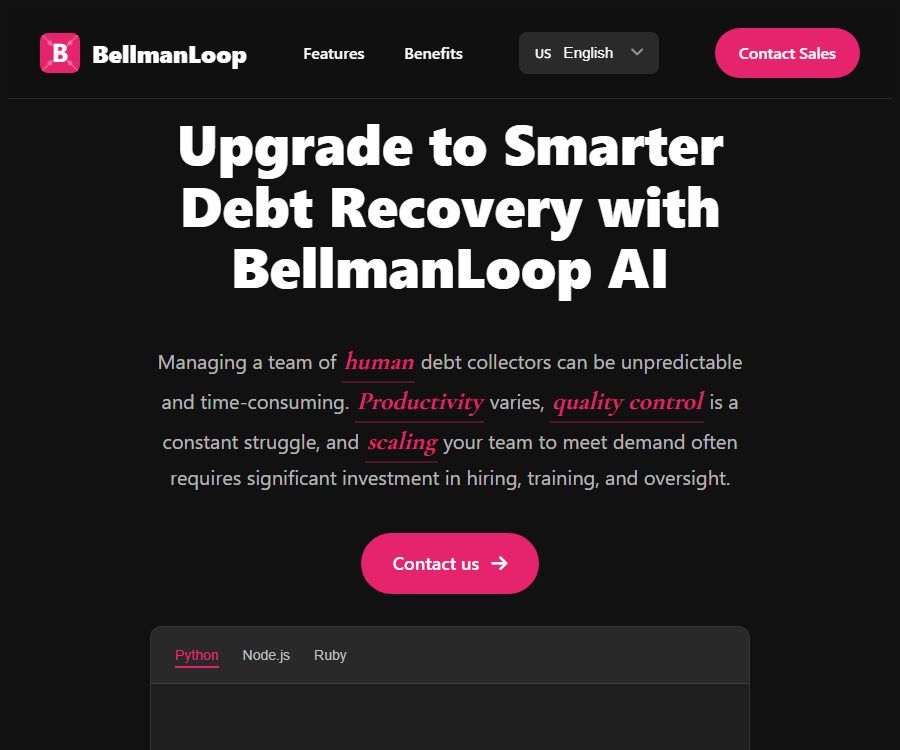
The home page displays tags for Python, Node.js, and Ruby, as well as code snippets for initializing collection agents; the examples include parameters for batch processing and concurrency. However, no public API documentation, package addresses, authentication methods, or a functional developer console were found.
Therefore, these snippets should be viewed as demonstrations of the product’s capabilities; it cannot be concluded that the SDKs in these three languages have been officially released. The development team needs to obtain the actual interface documentation, a sandbox environment, and information regarding error codes before making any purchases.
Is BellmanLoop open source?
Since there is no official GitHub repository for BellmanLoop, no open-source license, and no source code that can be deployed independently, it should be considered a closed-source enterprise solution. The presence of code examples, API calls, or language tags does not equate to being open source.
Frequently Asked Questions
Is BellmanLoop suitable for individual use?
It is not suitable. It is intended for corporate teams that are involved in debt collection or have large volumes of accounts receivable to manage.
Which languages are supported by BellmanLoop?
The example on the official website lists Chinese, English, Spanish, and Portuguese; for a complete list of languages, it is necessary to consult the authorities.
How much is BellmanLoop?
The official website only states that payment is based on usage; it does not disclose the unit price or any standard packages, so it is necessary to contact the team to obtain a quote.
Can BellmanLoop automatically ensure compliance?
It’s not possible. The platform emphasizes compliant configuration, but companies still need to carry out manual reviews and ongoing monitoring in accordance with the laws of their respective locations.
Does BellmanLoop offer a public API?
The official website provides code-based demonstrations, but there is no publicly available API documentation, SDK for download, or developer console.
Is BellmanLoop an open-source tool?
No. Currently, no official source code repository, open-source license, or self-hosted version has been identified.
Tools similar to BellmanLoop


 Guigong Network Security Registration No. 45132202000164