






ArcaNotes
ArcaNotes: leverages AI to make work more efficient and simpler.
Tags:AI improves efficiencyWhat is ArcaNotes?
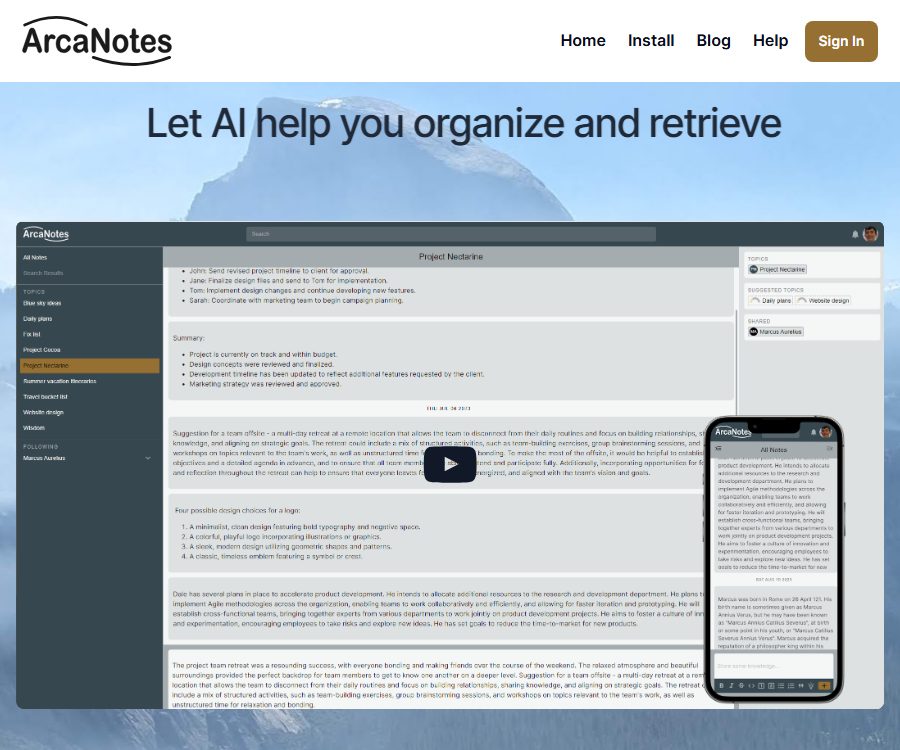
ArcaNotes is an AI-powered note-taking and knowledge management application that focuses on \"micro-notes.\" It encourages users to break down an idea into short entries, save them quickly, and then use topics along with AI to organize them.
The interface and browsing experience are more similar to those of messaging apps, rather than those of traditional document editors. Users can review their notes in a manner similar to scrolling through messages, and they can also ask questions about their note collection to receive brief answers.
The main functions of ArcaNotes
Quickly take micro-notes
The input area is designed to capture brief messages with a single topic at any time. Compared to creating folders, documents, and titles first, the micro-note process reduces the number of steps required for organization before recording.
Thematic organization
Each note can be assigned one or more topics, such as projects, people, or areas of knowledge. The multi-topic approach is more suitable for dealing with information that is related to multiple contexts at once, compared to using single-folder structures.
AI-themed recommendations
When a user enters a note, the local AI analyzes its content and suggests appropriate topics. As the user continues to write notes and confirms these topics, the suggestions become more in line with the user’s personal organization habits.
Notes Q&A
In addition to keyword searches, users can also pose questions to their notes in natural language. ArcaNotes generates brief responses based on the individual notes and provides clues to those notes, making it easy to go back and check the original records.
Information-flow style review
Notes can be displayed as a continuous stream of information, showing either the entire content or a specific topic. This approach is useful for quickly reviewing recent ideas, project updates, and scattered pieces of knowledge, without the need to open folders one by one.
Share and Follow
Users can share individual notes or notes on specific topics and invite others to view them. Recipients can follow the public topic streams of those users, thus receiving ongoing updates just as they would with a subscribed channel.
Suggestions for sharing recipients
AI will recommend possible recipients based on past sharing actions, thereby reducing the need for repeated selection steps. It is still necessary to verify each item and the recipient before sharing, to avoid sending private notes to the wrong people.
ArcaNotes isn’t anything.
- It is not a tool for automatically recording, transcribing, and summarizing meetings.
- It is not an AI writing tool designed for creating long articles or generating text based on prompts.
- It is not an AI search engine that searches public Internet materials.
- It is not a team knowledge base centered around complex databases and corporate approval processes.
The official focus is clearly on storing, organizing, retrieving, and sharing personal knowledge. The questions and answers come from the users’ own notes, rather than being automatically included in web search results.
Who is ArcaNotes suitable for?
- Individual users who are accustomed to jotting down ideas, facts, to-do items, and notes from readings whenever they have the chance.
- Students and researchers who need to organize fragmented research findings across multiple themes.
- Knowledge workers who wish to create a lightweight “second brain”.
- Small teams that need to continuously share brief updates on a project basis.
- Users who do not like complex folder structures and lengthy document-based note-taking methods.
ArcaNotes Usage Guide
- Register for a free account, and choose the web version or an app suitable for your device.
- First, establish a small number of broad topics, such as work, study, people, and projects.
- Record only one clear idea at a time, to avoid cramming multiple topics into a single long note.
- View the AI-recommended topics, select the appropriate projects, or manually add multiple topics.
- Regularly review recent notes through topic streams, merge duplicate information, and adjust categorizations.
- When looking for facts, start by using search, and then try to ask questions in natural language to the notes.
- Check the original notes from which the answers are taken; do not consider AI-generated summaries as the only source of truth.
- Before sharing, confirm the topic scope and recipients to prevent newly added notes from being accidentally made public.
How to write good micro-notes
- One that expresses only one fact, opinion, task, or question.
- Include the necessary names of people, project titles, and dates to facilitate understanding of the context in the future.
- Record the conclusions in complete sentences, rather than just keeping unreadable keywords.
- Separate action items from background information to reduce noise in subsequent searches.
- Regularly remove invalid topics to keep the categories simple and stable.
The advantages of ArcaNotes
- The entry process is simple, making it suitable for quickly capturing scattered knowledge.
- The same note can be associated with multiple topics, allowing for more flexible search paths.
- AI recommends topics, reducing interruptions caused by manual sorting.
- Q&A is based solely on personal notes, so its scope is clearer than that of open web searches.
- The theme stream takes into account both personal reflections and asynchronous knowledge sharing.
- Officials emphasize that AI runs locally on the device, reducing the need to send notes to third-party models.
Usage restrictions and precautions
- Micro-notes are not suitable for containing complex long texts, tables, or complete project documents.
- AI-based topic recommendations and Q&A systems may still misinterpret the content, so users need to verify it.
- The quality of answers depends on the extent of the notes available; reliable answers cannot be generated when the original records are missing.
- After sharing a topic, future content added to that topic may be seen by the followers.
- The help center on the official website is rather simple; details regarding complex migrations, import/export processes, and team permissions have not yet been fully made available.
- Local AI does not mean that all data is stored only on the device; notes are still saved in the encrypted ArcaNotes database.
ArcaNotes price
As of August 26, 2026, the official website allows users to register for a free account, and the Apple App Store indicates that the application can be downloaded for free. The company does not disclose any information regarding paid subscription plans, storage limits, AI usage quotas, or the price of the team version.
The amounts for the Standard or Premium versions listed in third-party directories have no basis in the official website, and therefore they are not used in this text. Should a subscription service be introduced in the future, the scope of features, the trial period, taxes, and refund rules will be those displayed in the application itself or on the payment page.
Supported platforms
- Web browser.
- iPhone and iPad.
- Android devices.
- Windows devices.
The official installation page lists the aforementioned platforms. The Apple App Store currently labels it as a free app and states that it is designed for iPad; the specific system versions and device compatibility details can be found on the download page.
Data and Privacy
The official website states that notes are stored in the ArcaNotes database, which uses 256-bit AES encryption; the AI engine runs on the user’s own machine or device, and neither the notes nor the metadata related to AI processing are shared with any third-party services.
This means that both “local AI” and “cloud-based encrypted storage” need to be understood simultaneously; they cannot be simply equated with traditional offline notes. Users can delete their account on the profile page within the settings, and once this is done, the account along with its associated data will be removed.
Is ArcaNotes open source?
No official open-source repository or source code license for the ArcaNotes application has been identified; therefore, it should be classified as a proprietary commercial product. The information provided on its official website regarding local AI and encryption measures does not indicate that the code is open source, nor can it replace an independent security audit.
Frequently Asked Questions
Is ArcaNotes free?
The official website offers free accounts, and the Apple App Store also indicates that it can be downloaded for free. The official site has not yet disclosed the prices of paid plans or advanced features.
What are the micro-notes in ArcaNotes?
Micro-notes are brief entries written around a single idea, focusing on quick capture, which are later organized around one or more themes.
Can ArcaNotes ask questions about notes?
Yes. Users can ask questions in natural language; the system generates brief answers based on their personal notes and provides the original notes for reference.
Does ArcaNotes write articles automatically?
No. The official statement clearly says that it is not an AI writing tool; its purpose is to help users store, organize, retrieve, and share existing knowledge.
Does ArcaNotes’ AI run in the cloud?
The official website states that the AI engine runs on the user’s machine or device, but the notes themselves are stored in ArcaNotes’ encrypted database.
Which platforms does ArcaNotes support?
The official list includes Web, iPhone, iPad, Android, and Windows; the specific installation methods and system requirements can be found on the download pages for each platform.
Tools similar to ArcaNotes



 Guigong Network Security Registration No. 45132202000164