






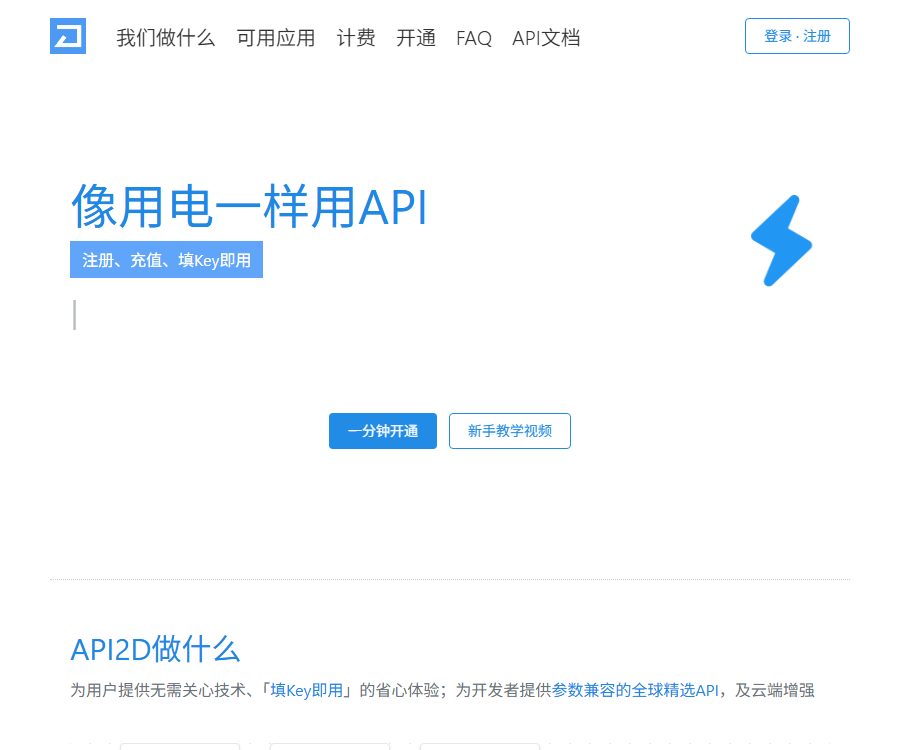
API2D
API2D enhances AI efficiency, making tasks more efficient and simpler.
Tags:AI improves efficiencyWhat is API2D?
API2D is a unified model interface and value-added service platform designed for developers and users of AI applications. After registering and making a payment, users obtain a ForwardKey; they then enter this key along with the interface address into clients, SDKs, or custom-built applications that support custom configuration.
Its purpose is to lower the barriers associated with submitting separate requests, making payments, and integrating with the interfaces of multiple model providers. API2D is a third-party commercial gateway; it is not the official website of OpenAI, Anthropic, or Google.
The main functions of API2D
Compatible chat interface
The platform offers interfaces similar to those of the mainstream chat completion formats, enabling existing applications to migrate by modifying the keys and base addresses. The specific models, parameters, and available regions are subject to the console and interface documentation.
Multiple models and multiple types of services
The official website describes features such as OpenAI, Claude, Stability, Gemini, Azure Voice, and vector databases. In addition to text-based conversations, it can also handle tasks related to images, voice, embeddings, knowledge bases, and business plugins.
- Chat and text generation interface.
- Vector embedding and knowledge base enhancement.
- Image generation and processing capabilities.
- Text-to-speech and speech-to-text.
- Search for enhanced features and custom business plugins.
ForwardKey management
API2D refers to the access key used for applications as ForwardKey. Users can create multiple keys and manage them separately by project or purpose, thereby preventing all applications from sharing the same credentials.
Request caching
The platform calculates the cache identifier based on the request body; when the same request is encountered again within the cache validity period, it can be returned directly without any charge. The official website states that the cache is typically retained for 24 hours, but it is also possible to force it to be ignored by using request headers.
Amount and points
The call costs are calculated in units of points P, and the console is used to check the balance and usage details. Different models, input/output tokens, streaming responses, and multimedia traffic all affect the actual consumption.
Agent and grouping capabilities
Accounts that meet the balance requirements can apply for the agent functionality, which allows them to create keys in bulk and set models, capabilities, and sales prices by group. Before engaging in resale, it is necessary to understand the platform’s rules, tax obligations, and the requirements regarding the compliance of end-user data.
SDK and compatible apps
API2D provides tutorials for creating compatible applications, as well as a JavaScript SDK that can be used in browser and Node environments. The SDK supports stream-based chat output, embedding, handling of images, and certain voice-related functions; however, it is necessary to verify separately the version of the software package and the capabilities of its interfaces.
Who is API2D suitable for?
- Individual users who need to configure models must use a chat client that supports custom interface addresses.
- Developers who wish to test multiple models using a single method of access.
- Teams that add AI capabilities to websites, robots, plugins, or automated processes.
- Application operators who need enhancements such as a knowledge base, search functions, or custom business interfaces.
- Service providers that are ready to create and manage downstream keys in a centralized manner.
API2D Usage Guide
- Register an account and complete the necessary account verification.
- Test the arrival of funds for small top-ups as well as the actual charging process; do not deposit an excessive amount of money from the start.
- Create ForwardKeys in the console, and name them separately for development, testing, and production purposes.
- Check the latest interface documentation for the target model to confirm the path, model name, parameters, and billing rules.
- Configure the API base address and ForwardKey on the client or server side.
- First, send a low-cost test request to check the return format, latency, and point deductions.
- Decide whether to enable caching, a knowledge base, search, or content moderation based on business needs.
- After going live, continuously monitor the balance, error rate, and model changes, while preparing a plan for supplier replacement.
Client access requirements
Clients that can use API2D usually need to support both custom API keys and the base address. Software that only allows access to official accounts and does not permit changes to the interface address generally cannot be connected directly.
Suggestions for integrating code
- Keys should be stored only in server-side environment variables or dedicated key management services.
- Set backoff retries for network timeouts, rate limiting, and upstream errors.
- Perform format validation and security filtering on the content returned by the model.
- It records the request identifier, model, Token, and points to facilitate cost reconciliation.
- Do not expose the ForwardKey in browser code, public repositories, or logs.
Advantages of API2D
- Lower the barriers to integrating multiple models by using unified keys and compatible interfaces.
- It supports common domestic payment methods, as well as credit card payments.
- Deductions are applied based on actual usage; there is no requirement to purchase a fixed monthly membership.
- A cache hit eliminates the deduction of points, making it suitable for fixed Q&A pairs with a high repetition rate.
- In addition to basic model calls, it also offers value-added features such as a knowledge base, search, and grouping.
- There are compatibility guide tutorials, API documentation, and a JavaScript SDK available.
Usage restrictions and precautions
- API2D is a third-party intermediary platform; its stability, the availability of its models, and its data connections differ from those of a direct connection to the manufacturer.
- The available models may change depending on the supplier’s strategies, and the model names listed in older tutorials might no longer be valid.
- Each request requires a minimum of 1P; the unit cost for a large number of very short requests may be high.
- Streaming requests, multimedia tasks, and platform traffic affect the costs; it is not possible to estimate them simply based on tokens alone.
- The default caching may result in identical requests returning the same output; when new results are required, the cache should be explicitly bypassed.
- Points have an expiration date; therefore, it is not advisable to top up a large amount at once if you won’t use them for a long time.
Risks associated with third-party interfaces
The request content passes through API2D and may be further sent to the actual model provider. Before processing contractual, medical, identity, trade secret, and personally sensitive information, it is necessary to verify the data storage methods, cross-border transmission procedures, deletion mechanisms, and the terms set by the provider.
Critical operations should retain the ability to use the original manufacturer’s interfaces or switch to other services, and budget limits as well as failover mechanisms should be established. A single intermediary service should not be regarded as an irreplaceable infrastructure.
API2D prices and billing
As of August 26, 2026, API2D charges fees based on the actual number of calls made, using a system of recharging credits; there is no fixed monthly membership plan. The official website states that the overall price is usually around 1.5 times the price listed by the interface providers, but factors such as the 3.5 yuan recharging amount, minimum spending requirements, caching, streaming output, and multimedia data usage can result in variations in prices.
- A minimum of 1P is consumed with each call.
- No fee is charged when the same request hits the cache.
- The prices of input and output tokens vary across different models.
- Image, audio, and video interfaces may incur additional data charges.
- Flow-based calls may use different pricing methods for input tokens.
- The final cost should be verified using the point calculator and actual small-value transactions.
The platform accepts payments via WeChat, Alipay, Chinese bank cards, and credit cards. The amount required for top-ups, the free points offered, the model scaling factor, and the payment methods may change; the information displayed on the settlement page shall prevail.
Validity period of points
According to the FAQ on the official website, the validity period of points is 180 days from the date of the last top-up; a subsequent top-up will extend this validity period. Expired points may be removed during system upgrades or maintenance, so it is advisable to set reminders for both the balance and its expiration date.
Cache rules
API2D caches requests with exactly the same content, typically for 24 hours. Caching can be determined for non-stream responses by examining the fields returned, while for stream responses it is possible to check the corresponding response headers.
Caching can reduce the cost of repeated queries, but it is not suitable for tasks that require real-time responses, randomness, or entirely independent generation of results. Similar answers may still be obtained even when caching is disabled; this could also be due to the model’s temperature settings and the prompts used.
Is API2D open source?
The API2D platform is itself a commercially hosted service, and there is no evidence indicating that its backend and control panel are open source. The publicly available api2d-js is merely a client SDK that enables compatibility with API2D and OpenAI; it is licensed under the MIT license, and this alone does not allow the entire platform to be considered open source.
Frequently Asked Questions
Is API2D the official website of OpenAI?
No. API2D is a third-party unified interface and value-added service platform; when using it, it is necessary to comply both with the rules of API2D and those set by the actual model provider.
How is API2D priced?
The platform charges based on a points system; the overall price is usually around 1.5 times the official price set by the upstream provider, but minimum spending requirements, caching, streaming output, and multimedia data usage can affect the actual amount charged.
Which clients can use API2D?
Generally, the client is required to enter both a custom API key and the base address simultaneously. Applications that can only use fixed official interfaces cannot be configured directly.
Why does API2D return the same content multiple times?
An identically formatted request body may be served from the 24-hour cache. To regenerate it, you can use the request headers specified in the official documentation to bypass the cache.
Do API2D points expire?
Yes. The official website states that the validity period of the points is 180 days from the date of the last top-up, and this period can be extended by making another top-up.
Is API2D an open-source project?
The platform itself is not a fully open-source project. The public JavaScript SDK is licensed under the MIT license, but it merely serves as a client-side integration component.
Tools similar to API2D



 Guigong Network Security Registration No. 45132202000164