






AIProxy
AIProxy – boosts AI efficiency, making work more efficient and simpler.
Tags:AI improves efficiencyWhat is AIProxy?
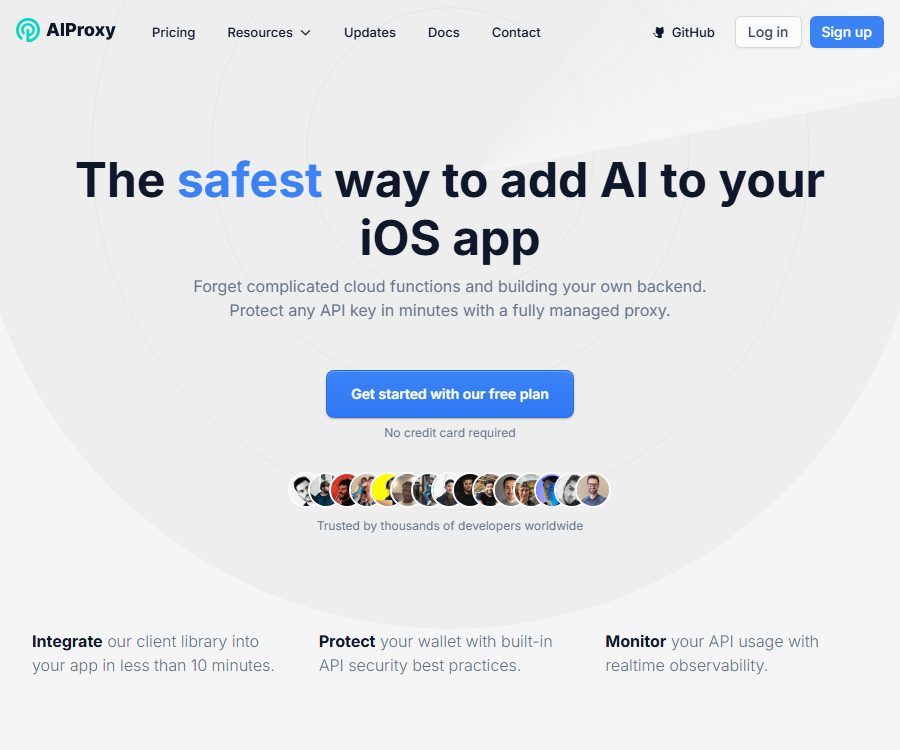
AIProxy is a managed proxy service that helps iOS and macOS applications make secure calls to AI services as well as other third-party APIs. It enables developers to avoid the need to create their own cloud functions or backends, while also preventing the supplier’s private keys from being included in the client software.
The platform offers a developer console, AWS-hosted proxies, and the AIProxySwift client library. The commercial proxies are responsible for key protection, abuse prevention, and monitoring, while the Swift library is used to construct and send requests within Apple applications.
Why can’t the client save the API key directly?
Keys that are written to application packages, configuration files, or runtime memory can be obtained through reverse engineering, packet capture, or debugging tools. Once a vendor’s keys are leaked, attackers can generate a large number of requests and incur high costs.
Submitting requests to a remote proxy does not eliminate all risks, but it allows for the limitation of the callable endpoints, the identification of devices, the setting of rates, and the rapid deactivation or replacement of vendor keys in case of anomalies.
Main functions
Sharded key protection
AIProxy does not store the complete supplier keys that can be used directly in the backend. The platform encrypts the keys and stores only a part of the encrypted data; the other part is sent along with the requests by the application. It is only by combining these two parts that the data can be temporarily decrypted and forwarded.
Apple DeviceCheck
The service uses Apple DeviceCheck to verify that requests originate from applications running on legitimate Apple hardware, and it ensures that device tokens can be used only once. This mechanism helps reduce the risk of proxy endpoints being abused directly by scripts.
Certificate is fixed.
The client supports fixed certificates, which helps to reduce man-in-the-middle attacks and traffic interception. Certificate updates and compatibility with different application versions require ongoing maintenance; incorrect configurations can cause legitimate requests to fail.
Endpoint rules and rate limiting
Developers can expose only the API paths that the application actually needs, while blocking other endpoints. Requests can also be restricted based on thresholds, in order to prevent a single device or user from continuously consuming the provider’s quota.
Use monitoring and anomaly alerts
The console displays information on request usage, status, and client identifiers, and provides notifications for any abnormal activities. The Live Console allows for testing of calls, identification of errors, and analysis of performance.
Remote model coverage
Model Overrides enables changing the model used by specific endpoints in the console, without the need to redeploy the application. It is suitable for model migration, cost testing, and emergency deactivation, but it is necessary to verify the parameter compatibility of the new model.
Self-key mode
The platform allows end-users to provide their own supplier keys, enabling requests to be sent directly to the supported services. Nevertheless, the application must still collect, store, and delete user keys in a secure manner.
Multi-vendor Swift client
AIProxySwift supports more than 15 services, including OpenAI, Anthropic, Gemini, Replicate, Stability AI, ElevenLabs, OpenRouter, Perplexity, and DeepSeek. Each provider only makes available the endpoints listed in its documentation.
Which users are it suitable for
- Independent developers who use AI models within iPhone, iPad, or Mac applications
- There is no desire to create a separate Swift team for handling the backend of early-stage products.
- Applications that require limiting the frequency of model endpoints and user requests
- Teams that wish to monitor AI calls and abnormal states from the console
- Products that require remote model switching without having to resubmit them to the App Store
- Applications that offer the option of using custom API keys for advanced users
AIProxy Integration Tutorial
- Register in the developer console and create a project.
- Add the AI services that need to be protected and configure the supplier’s API key.
- Create a DeviceCheck key and related identifiers in the Apple Developer account.
- Configure the P8 file, Key ID, and Apple Team ID in the project.
- Install AIProxySwift in an Xcode project using the Swift Package Manager.
- Configure the service client using the initialization code generated by the console.
- Only the endpoints required by the application are allowed, with reasonable rate limits in place.
- Run real requests on the testing device to check certificate fixation and DeviceCheck.
- Go live after configuring usage alerts, supplier budgets, and key rotation procedures.
Supported service types
The official documentation covers various interfaces such as chatting, streaming chat, multi-modal input, image generation, voice, structured output, and weather information. Supporting one particular supplier does not mean supporting all of its APIs and all its new models.
- OpenAI: Chat, streaming, multimodal, text-to-speech, and image-to-speech, etc.
- Anthropic and Gemini: chatting and the interfaces listed in their respective documentation
- Replicate and Stability AI: Image generation models
- ElevenLabs: Voice-related capabilities
- OpenRouter, Together AI, Groq, and DeepSeek: Calling large models
- Perplexity and Brave Search: Search and Q&A interfaces
Prices and packages
The prices listed below were verified on August 25, 2026, based on the official price page; they are expressed in US dollars, and the amount is calculated according to the number of requests made by the agent each month. The subscription fee for AIProxy does not include the costs associated with the models provided by upstream suppliers such as OpenAI and Anthropic.
| Plan | Monthly fee | Monthly requests | Support level | Primary interests |
|---|---|---|---|---|
| Free | Free | 1000 times | Standard | No credit card is required; basic proxy capabilities can be tested. |
| Starter | 10 dollars | 10,000 times | Standard | Security, monitoring, throttling, coverage, and real-time console |
| Pro | 50 dollars | 100,000 times | Standard | Same functions as Starter, but for higher request volumes |
| Premium | 200 dollars | 1 million times | Priority support | Complete security and control features |
| Business | 2000 dollars | 10 million times | Support as needed | Custom integration with 99.99% availability guarantee |
For plans starting at Starter and above, Key Security, DeviceCheck, Certificate Fixation, Usage Monitoring, Rate Limiting, Model Coverage, Activity Alerts, and Live Console are all included. Procedures for handling excess usage, upgrades, and any additional costs should be confirmed with the authorities prior to going live.
How to estimate actual costs
The total cost consists of the monthly fee for AIProxy and the fees associated with the usage by the upstream AI suppliers. A single application operation can generate multiple proxy requests; therefore, the number of requests cannot be simply equated to the number of active users.
- Calculate the average number of proxy requests generated per core process.
- Estimate the monthly active users, daily usage frequency, and peak concurrent users.
- Calculate streaming requests, retries, tool calls, and image tasks separately.
- Set budget and usage alerts for upstream suppliers as well.
- Reserve buffers for abnormal retry attempts, version releases, and marketing growth.
Privacy and logs
According to the official privacy policy, the proxy saves the IP address from which the request was sent as well as the HTTP response status code. When registering an account, the name and email address are collected, while payment information is stored by Stripe.
The actual prompts, images, audio, and outputs are still forwarded to the selected supplier through AIProxy; therefore, developers must evaluate both the privacy policies of AIProxy and those of the upstream services. Do not assume that the proxy layer will handle sensitive data locally.
- Avoid sending unnecessary personal and device information.
- Reveal proxy and model providers in the application’s privacy policy
- Medical, financial, and child-related data should undergo specialized compliance assessments.
- Debug logs for the request body and response body related to shutting down the production environment
- Establish processing procedures for deletion, access, and requests from data subjects
Security configuration recommendations
- Only the API endpoints that are actually used by the application are made accessible.
- Set hierarchical rate limits based on functionality and user scenarios.
- Do not submit the full upstream key to the code repository.
- Regularly rotate supplier keys and test the revocation process.
- Set multiple alerts for abnormal request volumes, error rates, and costs.
- For high-risk operations, it is still advisable to consider building one’s own backend and implementing more detailed identity control measures.
Product advantages
- Designed specifically for Swift and Apple apps, with a clear integration path.
- Sharded keys reduce the risk associated with the static storage of the full supplier key.
- Combining DeviceCheck, certificate fixation, and one-time tokens
- Supports more than 15 AI and third-party services
- It is possible to remotely apply models and set constraints on endpoints.
- The free plan provides 1,000 requests per month for verification purposes.
Usage restrictions and precautions
- The product focuses on the Apple platform, rather than a generic cross-language backend gateway.
- Proxy security cannot replace application identity, permissions, and business risk control.
- DeviceCheck requires Apple developer configuration, and there are limitations related to devices and platforms.
- The costs of upstream suppliers are not included in the AIProxy subscription.
- Model coverage may lead to changes in parameters or output behavior.
- Any remote agent increases network dependency and introduces a delay in calls.
Open-source status
AIProxy’s managed proxies, developer console, and commercial security services are not officially classified as complete open-source platforms; users cannot replicate their backend services solely based on the publicly available Swift code.
The official AIProxySwift client library is available on GitHub and is licensed under the MIT license. This open-source library allows direct connections to suppliers or requests through the AIProxy backend, but its license does not apply automatically to commercial proxies.
Frequently Asked Questions
Does AIProxy store the full API key?
Officials state that they will not store the complete key that can be used directly; instead, only a part of the encrypted result is stored, with the other part being provided by the application upon request. It is only when these two parts are combined that the data can be forwarded.
Why can the AIProxy client key be stored within the application?
This portion of the key alone cannot be used to recover the supplier’s key; it must be combined with server-side components and security checks. It should still be used alongside DeviceCheck, certificate fixation, and endpoint rules.
How many requests are there in the free version?
The free plan includes 1,000 proxy requests per month and does not require a credit card; the costs and usage limits associated with the supplier’s API still have to be covered separately.
Which platforms are supported?
The products are primarily designed for Swift applications on iOS and macOS, and the documentation and SDKs are also tailored for the Apple ecosystem. It is necessary to check with the official sources to determine whether other technology stacks are supported.
Is it possible to switch models without updating the application?
Model Overrides can be used on supported endpoints, but it is necessary to test the request parameters, response structure, and any changes in costs. Do not switch to them in a production environment without conducting such tests.
Is AIProxy an open-source tool?
The Swift client library is licensed under the MIT license, but the hosting proxy and console are commercial services; their open-source status must be indicated separately.
Summary
AIProxy is suitable for Swift developers who wish to quickly protect the AI provider keys used in Apple applications. Its advantages include segmented keys, DeviceCheck, fixed certificates, rate limiting, and remote model control. Before going live, it is necessary to calculate both the costs associated with proxy requests and those related to the models, while also ensuring that configurations for endpoints, logging, privacy disclosures, and key rotation are in place.
Tools similar to AIProxy



 Guigong Network Security Registration No. 45132202000164