






Databrain
Databrain: boosts AI efficiency, making tasks more efficient and simpler.
Tags:AI improves efficiencyWhat is DataBrain?
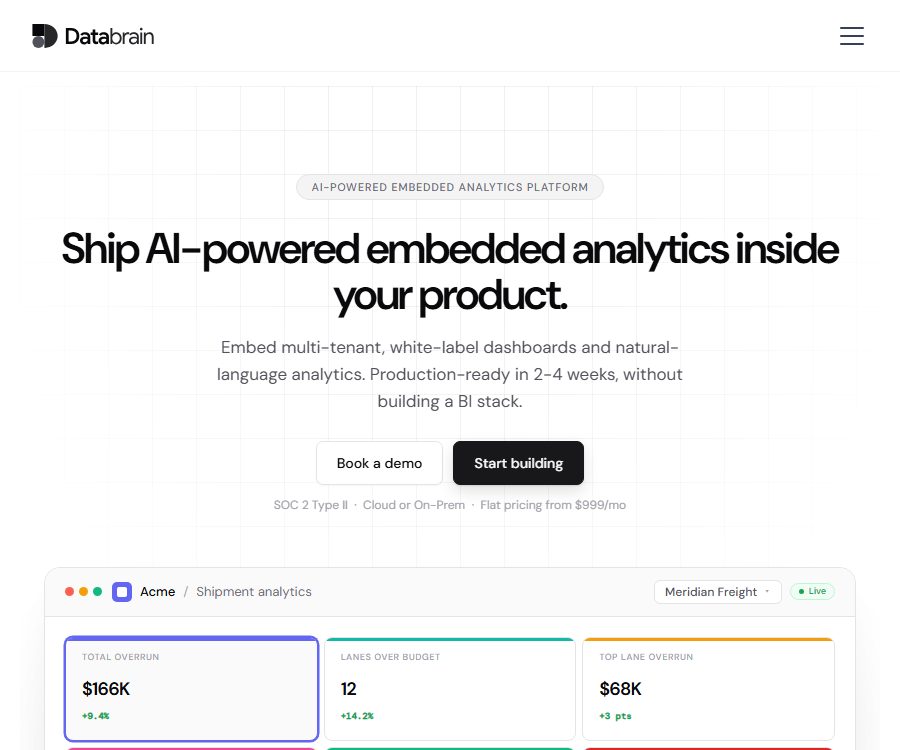
DataBrain is an AI-powered embedded analytics platform developed by DataBrain Labs; it helps B2B SaaS companies integrate data dashboards, metrics, reports, and the ability to pose questions in natural language into their products. It is designed for product, engineering, and data teams, rather than being a traditional BI tool intended solely for internal analysts.
The platform offers code-free dashboard creation, brand customization, multi-tenant isolation, developer SDKs, REST APIs, and MCP servers. Companies can either use cloud services or opt for self-hosted or private cloud deployment as part of their own solutions.
A one-sentence summary
DataBrain is a multi-tenant analysis platform that enables the integration of branded data dashboards, self-service analytics, and AI-driven query tools into SaaS products.
Core functions
Embedded data dashboard
Developers can embed complete dashboards, individual metrics, or data applications within existing interfaces, allowing end-users to analyze data without leaving the product. Official support is available for integration via React, Vue, Angular, Next.js, Web Components, iFrame, and REST APIs.
AI natural language question answering
Users can ask questions about business data using natural language; the system then displays the reasoning process, the data structure chosen, as well as the SQL code generated, before providing the analysis results. The AI’s responses are based on a structured semantic framework, but it is still necessary to verify the definitions of metrics, the SQL code used, the time range, and permission settings.
Semantic layer and indicator management
The team can define datasets, Datamarts, metrics, field descriptions, and business logic in a centralized manner, thereby reducing the likelihood of different people interpreting the same metric in different ways. The governance semantic layer also serves as the basis for consistent definitions to be used by AI queries, dashboards, and agents.
Interactive visualization
The platform offers dozens of chart types and supports features such as drill-down, cross-filtering, real-time connectivity, automatic refreshing, and responsive display on mobile devices. The exact number of chart types varies – some official pages mention over 40 types while others cite over 50; it is necessary to follow the information provided in the current editor when making a choice.
White-labeling and theme customization
Companies can adjust colors, fonts, logos, CSS settings, domain names, and the behavior of various components, as well as remove the DataBrain brand. The Pro version and higher tiers offer more comprehensive options for customizing themes, emails, and customer interfaces.
Multi-tenant and data isolation
DataBrain supports both single-tenant and multi-tenant architectures, and allows for the application of row-level, column-level, and role-based permissions when performing queries. Embedded tokens need to be linked to specific tenants and users, in order to prevent unauthorized access even when data is hidden on the frontend while queries can still be executed in the backend.
Self-service reports
End users can use the drag-and-drop builder to combine fields, filtering criteria, charts, and reports, and then export them. This reduces the workload for the product team, which otherwise has to create temporary reports for each customer repeatedly.
Predictions and anomaly insights
The official features include prediction, anomaly detection, trend identification, recommendations, and AI-generated summaries. The accuracy of predictive results depends on data quality, the range of samples considered, and the time periods analyzed; therefore, they should not be regarded as definitive conclusions for business decisions.
MCP server
The official MCP server enables compatible clients to set up data embedding, queries, and customized dashboards using natural language. It is suitable for configuring analyses in AI development tools, but it is necessary to use tokens with minimal permissions and to restrict the data applications that can be accessed.
Which users are it suitable for
- B2B SaaS product team: Incorporates customer dashboards and AI-driven queries as core product features.
- Engineering team: Fast integration through SDK, Web Component, or API.
- Data team: Unified metrics, semantic layer, datasets, and customer reports.
- Operations team: Develops internal BI tools and real-time business monitoring systems.
- Enterprise software vendors: offer fully white-labeled customer self-analysis tools.
- Medical, financial, and supply chain teams: Present analyses under strict tenant and field permission controls.
- AI Agent Developer: Uses MCP to enable agents to access governed data models.
Packages and prices
As of August 24, 2026, DataBrain’s main publicly available plans are Growth, Pro, and Enterprise. The Growth and Pro plans charge a fixed monthly fee; there is no increase in the cost based on the number of end users or instances embedded.
| Plan | Public price | Trial | Data sources and tenants | Key capabilities |
|---|---|---|---|---|
| Growth | $ | 14 days | 1 data source, single data source for multiple tenants | Unlimited seats and embedding, basic chat, and email support |
| Pro | $ | 14 days, POC can be carried out using own data. | No restrictions on data sources; multiple tenants and multiple data sources supported. | SSO, role-based permissions, more comprehensive customization, and collaboration support |
| Enterprise | Custom quote | 14 days, POC can be carried out using own data. | Single tenant or multiple data sources | Self-hosted, multi-region, VPC, dedicated account manager, and advanced support |
The public pricing page indicates that all three options offer no limits on the number of seats, workspaces, teams, data rows, or embedded elements. The final contract may include costs related to taxes, deployment, support, data volume, service level, and customization; it is necessary to refer to the quotation or billing page before making a purchase.
Comparison of features across versions
| Ability | Growth | Pro | Enterprise |
|---|---|---|---|
| Seats and Embedding | No restrictions | No restrictions | No restrictions |
| Data source | 1 | No restrictions | Configure according to the enterprise architecture |
| Multi-tenant | Single source, multiple tenants | Multi-source multi-tenant | Single-tenant or multi-tenant |
| White label and theme | Supports basic white labeling | Supports customer-specific themes and email branding. | Supports deep customization |
| SSO and permissions | Limited capabilities | OAuth, roles, and permissions | SAML, SCIM, MFA, and advanced controls |
| Row-column level security | Support | Support | Support |
| Natural language analysis | Support | Support | Support |
| Prediction and anomalies | Confirmation is required. | Supports advanced analytics | Supported and customizable |
| Self-hosting | Not included | Not included | Support |
| Dedicated account manager | Not included | Not included | Support |
Precautions for trials and purchases
- The public pricing page currently states a 14-day free trial.
- After the trial period of Growth, billing is done on a monthly basis; Pro and Enterprise versions allow for POCs using one’s own data.
- The official website does not disclose on its pricing page the details regarding refunds, early termination of contracts, and renewal notifications.
- Enterprise needs to define the boundaries for self-hosted, VPC, multi-region, SLA, and advanced support.
- Before proceeding with the official purchase, it is necessary to keep the order, quotes, data processing agreements, and service level terms.
Supported data sources
The connection options listed in the official documentation include Snowflake, BigQuery, Redshift, PostgreSQL, MySQL, ClickHouse, MongoDB, Elasticsearch, and MSSQL, among others. Data can also be prepared in CSV format, using spreadsheets, or through APIs; the permissions associated with each connector depend on the specific solution and deployment method.
When connecting to a production database, it is necessary to create read-only accounts, restrict the IP addresses that are allowed to access it, limit the databases and tables available for use, and set query timeouts. In scenarios involving high concurrency, it is also important to consider factors such as caching, database replicas, resource queues, and costs.
Quick Start Tutorial
- First, define the users, tenants, metrics to be displayed, the frequency of data refresh, and the response targets.
- Register for a trial account and add a read-only test data source to the workspace.
- Create Datamarts and semantic layers to add business descriptions to tables, fields, and metrics.
- Create the first dashboard in the drag-and-drop editor, and test filtering, drilling down, and exporting.
- Row-level, column-level, and role-based permissions are set for tenant testing.
- Choose among React, Vue, Angular, Web Component, or iFrame as the integration method.
- The server generates short-term, tenant-specific embedding tokens; management tokens are not stored in the browser.
- Test the theme, responsive layout, error states, and login renewal in the pre-release environment.
- Perform privilege escalation tests using different tenant accounts, and then observe the query performance and database load.
- After going live, monitor tokens, audit logs, slow queries, AI accuracy, and end-user feedback.
Process for launching AI question-answering services
- Standardize the definitions and time zones for key metrics such as revenue, customers, activity, and retention.
- Only the approved tables, fields, and relationships are exposed at the semantic layer.
- Add synonyms, business descriptions, units, and allowed aggregation methods for fields.
- Prepare a set of real questions, and save the correct SQL queries along with the expected results for each question.
- Check whether the AI-generated SQL includes tenant, date, status, and permission criteria.
- Set limits on query costs, timeout periods, the number of rows, and concurrency for large tables.
- Display to the user the data date, metric definition, the generated SQL, and any uncertainty notes.
- Continuously collect error issues to update the semantic layer and the evaluation set.
Developer capabilities
| Method | Uses | Precautions |
|---|---|---|
| NPM plugins | Dashboard for embedding React, Vue, Angular, and JavaScript applications | Check version compatibility, themes, and token renewal. |
| Web Component | Embed the same analysis component across frameworks | Control the isolation of properties, events, and styles. |
| iFrame | Quick access to a complete dashboard | Verify domain names, cookies, and content security policies. |
| REST API | Manage data applications, dashboards, metrics, and integrations | The key is stored only on the server side. |
| Webhooks | Receiving analysis processes and data events | Verify signatures and handle duplicate events |
| MCP Server | Enable the AI client to analyze and access governed data. | Use the minimum required permissions and a testing environment. |
Safety and compliance
The official security pages and documentation state that AES-256 static encryption, TLS for data transmission, SSO, MFA, fine-grained access controls, and audit logs are employed; they also mention compliance with standards such as SOC 2 Type II, ISO 27001, GDPR, and CCPA. HIPAA is described on various official pages as either “supported” or “ready,” while on earlier pricing pages it was indicated as “coming soon.” For medical procurement, it is necessary to obtain current certifications and information regarding the scope of compliance.
The Privacy Policy was last updated on February 27, 2025; it specifies that information such as account details, customer data, payment processing information, application details, communication records, logs, and cookies is collected. Credit card data is received by the payment processing service providers, and DataBrain states that it does not access, store, or collect the full details of credit cards.
Enterprise security inspection
- Request the current SOC 2 report, ISO certificates, a summary of penetration tests, and the scope of the systems in question.
- Confirm the cloud region, backup location, sub-processors, and cross-border transfer arrangements.
- Check data retention, deletion, export, event notification, and handling after contract termination.
- Test row-level, column-level, role-based, and embedded token isolation using multiple tenants.
- When managing it in-house, it is essential to clarify the responsibilities related to upgrades, bug fixes, logging, backups, and disaster recovery.
- In the context of medical data, it is necessary to determine whether a business partner agreement has been signed and what exactly the scope of HIPAA applies to.
Product advantages
- Designed for client-side analysis, with full support for multi-tenant setups, white-labeling, and embedding capabilities.
- Regardless of the number of end users or instances embedded, the costs are easier to predict under a per-seat pricing model.
- Code-free development along with SDKs for multiple frameworks cater to both product managers and engineering teams.
- The semantic layer enables dashboards, AI-based queries, and agents to share business definitions.
- It supports self-service reporting, natural language queries, as well as forecasting and anomaly detection.
- Cloud, self-hosted, and private network options meet various data control requirements.
- It provides REST APIs, Webhooks, and MCP servers to facilitate automated integration.
Usage restrictions and precautions
- The entry price is $999 per month, which is not suitable for small needs that require only a personal dashboard.
- Growth includes only one data source; multiple data sources require the Pro or Enterprise version.
- Advanced SSO, permissions, self-hosting, multi-region capabilities, and dedicated support are all part of the premium plans.
- Natural language-generated SQL may still use incorrect fields, associations, filtering, and aggregation criteria.
- The fact that there is no limit on the number of operations does not mean that database queries, caching, and concurrency come without performance costs.
- The official website provides different information regarding the number of charts and the HIPAA compliance status; written confirmation is required before making a purchase.
- The pricing page does not disclose the complete rules regarding refunds and cancellations.
- White-labeling and embedding cannot replace server-side token control and tenant isolation testing.
Open source and GitHub status
DataBrain has an official GitHub organization that provides demonstrations, sample plugins, organizational guidelines, and some historical projects. Official NPM plugins and MCP servers are also available for developers to install, but the software packages distributed publicly do not mean that the entire source code of the platform is made available.
The official team once made the DataNeuron text-to-SQL framework available publicly; that repository has now been archived. There is also a DuckDB branch under the MIT license within the organization. These are independent components or examples, while the DataBrain commercial platform, cloud services, dashboard editor, and enterprise control panel should be labeled as not being open source.
Basic information
| Project | Content |
|---|---|
| Tool name | DataBrain |
| Development company | DataBrain Labs, Inc. |
| Tool type | AI-based embedded analytics and white-label BI platforms |
| Primary users | B2B SaaS products, engineering, and data teams |
| Deployment method | Cloud; Enterprise supports both self-hosted and private clouds. |
| Develop interfaces | SDK, Web Component, iFrame, REST API, Webhooks, and MCP |
| Price pattern | 14-day trial, monthly subscription, and enterprise pricing |
| Whether API is provided | Yes |
| Is there an official GitHub? | Yes |
| Is the main platform open source? | No |
| Recommendation score | 4.5 points |
Frequently Asked Questions
Is DataBrain free?
It is not a permanently free tool; a 14-day free trial is available at the moment. The regular price starts at $999 per month on Growth.
Will there be a charge based on the end user?
The public pricing follows a fair-price model; for the Growth, Pro, and Enterprise versions, no limits are specified regarding the number of seats or the amount that can be integrated. The scope of services and resources covered under corporate contracts remains subject to the pricing details provided.
Is natural language query support available?
Yes, users can submit questions and view the generated SQL statements as well as the results. The accuracy depends on the semantic aspects, permissions, data model, and the way the questions are phrased; therefore, continuous evaluation is necessary.
Can it be integrated with React or Vue?
Yes, the official platform provides NPM plugins suitable for React, Vue, Angular, and JavaScript; it also supports Web Components, iFrame, and REST APIs.
Is private deployment supported?
Supported. Features such as self-hosting, private clouds, multi-regions, and VPCs are available in the Enterprise version. Responsibilities related to hardware, upgrades, and maintenance must be specified in the contract.
Is DataBrain open source?
The main platform is not an open-source product. The examples, archived projects, and separate open-source branches available on the official GitHub do not reflect the open-source nature of the entire commercial platform.
Summary
DataBrain is suitable for SaaS teams that wish to deliver client-side analytics, AI-driven queries, and branded dashboards quickly. Its advantages include a cost-effective model that does not limit the number of end users, multi-tenant security, and comprehensive development interfaces. When making a choice, it is important to evaluate the number of data sources, SSO and permission settings, query performance, AI accuracy, compliance with HIPAA standards, and the responsibilities associated with self-hosting.
Tools similar to Databrain



 Guigong Network Security Registration No. 45132202000164